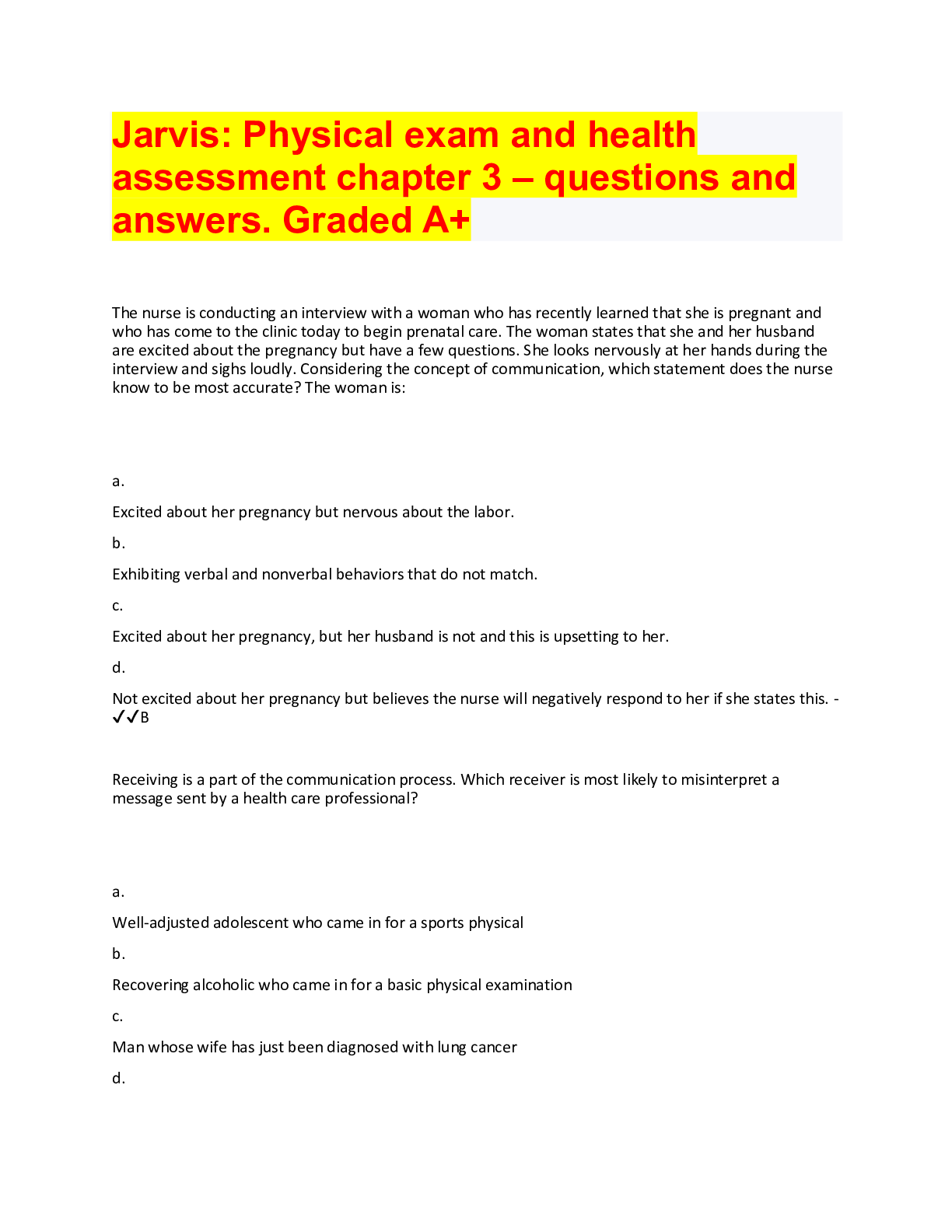
Jarvis Chapters 1, 2, 3 Practice Questions. 2022. 100% Graded A+
When assessing a patient's health status, which data do you classify as subjective?
A Anything you cannot quantify
B Anything the patient tells yo
...
Jarvis Chapters 1, 2, 3 Practice Questions. 2022. 100% Graded A+
When assessing a patient's health status, which data do you classify as subjective?
A Anything you cannot quantify
B Anything the patient tells you about self as part of the health history
C Anything you can feel but not see
D Anything communicated about the patient by another health-care provider - B
When assessing a patient's health status, subjective information is anything that the patient says about himself or herself as part of the health history. What you as the health professional "observe" through inspection, percussion, palpation, or auscultations during the physical examination are objective data.
What is the starting point of diagnostic reasoning?
A important from unimportant data
B Performing an organized assessment
C Developing a hypothesis about health problems
D Making a preliminary list of signs and symptoms - B
An organized assessment is the starting point of diagnostic reasoning. Diagnostic reasoning is the process of analyzing the health assessment data and drawing conclusions to identify diagnoses. For the novice this involves forming hypotheses and using deductive reasoning.
Which is the best defining characteristic of intuition as it relates to clinical judgment?
A Bypassing the rules
B Perceiving a current need as part of a long-term goal
C Recognizing patterns immediately
D Not needing validation for clinical judgment - C
Using intuition is a part of functioning at the level of expert in clinical judgment. Using intuition is using knowledge received as a whole and is characterized by the immediate recognition of patterns. Expert practitioners attend to a pattern of assessment data and act without consciously labeling it.
Which constitutes a first-level priority problem?
A Acute pain
B Elevated cholesterol levels
C Mental status change
D Anaphylaxis - D
First-level priority problems are those that are emergent, life threatening, and immediate, such as establishing an airway or supporting breathing. Thus anaphylaxis constitutes a first-level priority problem. Second-level priority problems are those that require prompt intervention to prevent further deterioration. Examples of these are acute pain, mental status change, and acute urinary elimination problems. Third-level priority problems are those that are important to the patient's health but can be addressed after more urgent problems. Elevated serum cholesterol levels would fall in this category.
Which is the best description of a complete health database?
A Collection of subjective and objective health data.
B Collection of information related to the current health status obtained by physical examination and laboratory analysis.
C Information obtained by history taking and physical exam.
D Baseline description of present and past health against which future changes will be measured. - D
A complete or total health database describes current and past health states and forms a baseline against which all future changes can be measured. It includes a complete health history and a full physical examination. It screens for pathology, yields the first diagnosis, and determines the ways patients respond to health problems.
What type of database is established when a nurse is mainly concerned with one problem?
A Focused
B Follow-up
C Emergency
D Complete - A
A focused (or mini) database concerns mainly one limited or short-term problem and is used in all care settings. It is smaller in scope and more targeted than a complete database. The follow-up database is also used in all care settings; however, it focuses on the evaluation of identified short-term or chronic health problems at regular and appropriate intervals. The emergency database requires a more rapid collection of data than the focused database, and is often combined with lifesaving measures. The complete database is a total health assessment. This includes a complete health history plus a full physical examination and can be performed in both primary and acute care settings.
Mr. Fitzgerald is a 62-year-old new patient who presents to the clinic for a routine health assessment. Which type of health database would be established?
A Focused
B Emergency
C Follow-up
D Complete - D
The complete health database is an assessment of an individual's total health. This includes a complete health history plus a full physical examination and can be performed in both primary and acute care settings. The focused (or mini) database is utilized mainly for one limited or short-term problem and is used in all care settings. It is smaller in scope and more targeted than a complete database. The emergency database requires a rapid collection of data and is often combined with lifesaving measures. The follow-up database is used in all care settings and focuses on the evaluation of identified short-term or chronic health problems at regular and appropriate intervals.
What type of database is most appropriate to establish when a patient's chronic illness problems are being evaluated at regular intervals?
A Focused
B Follow-up
C Emergency
D Complete - B
The follow-up database is used in all care settings. It is concerned with the evaluation of identified short-term or chronic health problems at regular and appropriate intervals. A focused (or mini) database concerns mainly one limited or short-term problem and is used in all care settings. It is smaller in scope and more targeted than a complete database. The emergency database requires a rapid collection of data and is often combined with lifesaving measures. The complete database is a total health assessment. This includes a complete health history plus a full physical examination and can be performed in both primary and acute care settings.
What type of database is often compiled concurrently with lifesaving measures?
A Focused
B Follow-up
C Emergency
D Complete - C
The emergency database requires a rapid collection of data and is often combined with lifesaving measures. A focused (or mini) database concerns mainly one limited or short-term problem and is used in all care settings. It is smaller in scope and more targeted than a complete database. The follow-up database is used in all care settings and is concerned with the evaluation of identified short-term or chronic health problems at regular and appropriate intervals. The complete database is a total health assessment. This includes a complete health history plus a full physical examination and can be performed in both primary and acute care settings
Which type of database is most appropriate to establish when an overall healthy person seeks care for a rash at an ambulatory care center?
A Focused
B Follow-up
C Emergency
D Complete - A
In this case, a focused (or mini) database is most appropriate since it concerns mainly one limited or short-term problem (the rash). This database is smaller in scope and more targeted than a complete database; it can be used in all care settings. The follow-up database is also used in all care settings; however, it is concerned with the evaluation of identified short-term or chronic health problems at regular and appropriate intervals. Once this rash is identified and treatment has begun, the patient may return to the clinic to complete a follow-up database. The emergency database requires a more rapid collection of data than the focused database, and is often combined with lifesaving measures. The complete database is a total health assessment. This includes a complete health history plus a full physical examination and can be performed in both primary and acute care settings.
What type of database is most appropriate to establish for an individual who is admitted to a long-term care facility?
A Focused
B Follow-up
C Emergency
D Complete - D
The complete database is an assessment of an individual s total health, which serves as a basis for measuring future changes in health status. It includes a complete health history plus a full physical examination. The complete database is necessary in this case because many individuals who are admitted to long-term care have complex medical histories and complex medication regimens. This database can also provide support for the practitioner to get the patient necessary resources, such as ambulatory aids
Ms. Benson is a 24-year-old patient who presents to the clinic for a health assessment. Which assessment findings are classified as objective? (Select all that apply.)
A Alert and oriented
B Dizziness
C Earache
D Abdominal tenderness
E Ankle edema
F Heart murmur - A, E, F
A patient's level of consciousness (alert) and orientation (oriented to person, place, and time) status is determined by inspection. Ankle edema is determined by inspection and palpation. A heart murmur is identified by auscultation. All are objective data findings because objective data are what the health care professional observes by inspecting, percussing, palpating, and auscultating during the physical examination. Subjective data are what the patient reports about himself or herself, so dizziness, ear pain, and abdominal tenderness are all examples of subjective data.
When is a complete database obtained?
A In life-threatening situations requiring a rapid response.
B For problems involving one cue complex or one body system.
C In cases requiring determination of the cause of illness.
D When a baseline measure of overall health status is needed. - D
The complete database is obtained when a baseline measure of overall health status is needed. It includes a complete history and a full physical examination. The complete database is often collected in primary care settings and is an opportunity to build and strengthen your relationship with the patient.
A follow-up database is used to:
A Monitor progress of short-term or chronic health concerns.
B Manage a limited or short-term problem usually consisting of one problem, one cue complex, or one body system.
C Evaluate the cause of disease.
D Perform a thorough or comprehensive health history and physical examination. - A
A follow-up database is used to monitor progress of short-term or chronic health concerns. A focused database is used to manage a limited or short-term problem usually consisting of one problem, one cue complex, or one body system. A medical diagnosis is concerned with the cause of disease. A thorough or comprehensive health history and physical examination is part of a complete database.
When performing health assessments, both objective and subjective data are gathered. Which are examples of objective data? (Select all that apply.)
A Left tympanic membrane is pearly gray with visible light reflex.
B "My ear has been bothering me."
C "The baby wakes up crying in the middle of the night."
D Left knee has been swollen and stiff for the past 3 days.
E Crepitation is present in the left knee joint. - A,E
Objective data are those collected by the examiner through observing, percussing, palpating, or auscultating. Thus examples of objective data are left tympanic membrane pearly gray with visible light reflex and crepitation in the left knee joint. The condition of the tympanic membrane is determined through inspection with an otoscope, and crepitation is an audible and palpable crunching or grating that accompanies movement.
What is the purpose of assessment?
A Make a judgment
B Gather data
C Update records
D Disprove a hypothesis - A
The result of an assessment is the establishment of a database. From the database, a clinical judgment or diagnosis is made about the individual s health state, response to actual or potential health problems, and life processes. Thus, the purpose of assessment is to make a judgment or diagnosis.
One step in the diagnostic reasoning process is clustering of data. What is meant by clustering data in this context?
A Grouping together signs and symptoms that occur in the same time period
B Grouping together signs and symptoms that appear to be causal or associated
C Grouping together signs and symptoms that relate to the same body system or function
D Grouping together signs and symptoms that seem to develop in a coordinated and progressive manner - B
Assessment data are organized into meaningful clusters; that is, data that appear to be causal or related are grouped together.
When performing health assessments both objective and subjective data is gathered. Which are examples of subjective data? (Select all that apply.)
A Burning on urination
B Uneven gait
C Left ear canal impacted with dry, dark wax
D Spots floating in front of the eyes
E Pedal edema - A, D
Subjective data are what the patient says about himself or herself. Objective data are those collected by the examiner through observing, percussing, palpating, or auscultating. Thus examples of subjective data are burning on urination and spots floating before the eyes. Uneven gait, left ear canal impacted with dry, dark wax, and pedal edema are examples of objective data.
Which phrase refers to the concept that the mind, body, and spirit are interdependent and function as a whole within the environment?
A Individualized practice
B Nursing model
C Holistic health
D Wellness focus - C
The view that the mind, body, and spirit are interdependent and function as a whole within the environment is considered holistic health. Consideration of the whole person is the essence of holistic health. In this view, the basis of disease is multifaceted, originating both from within the person and from the external environment.
What is an integral factor in responding adequately to the health care needs
[Show More]