*NURSING > QUESTIONS & ANSWERS > Ortho - practice questions and answers, 2022/2023 update, Graded A+ (All)
Ortho - practice questions and answers, 2022/2023 update, Graded A+
Document Content and Description Below
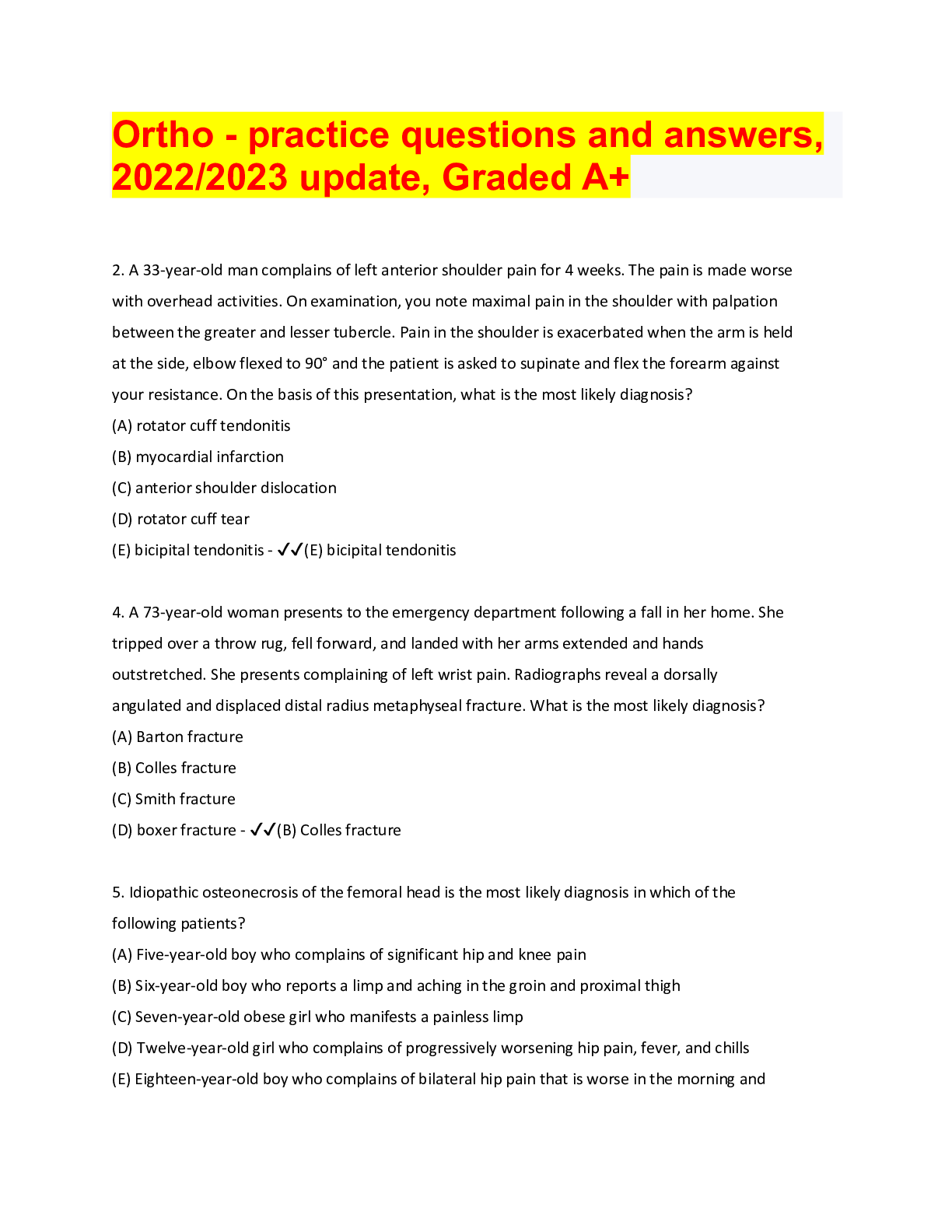
Ortho - practice questions and answers, 2022/2023 update, Graded A+ 2. A 33-year-old man complains of left anterior shoulder pain for 4 weeks. The pain is made worse with overhead activities. On ... examination, you note maximal pain in the shoulder with palpation between the greater and lesser tubercle. Pain in the shoulder is exacerbated when the arm is held at the side, elbow flexed to 90° and the patient is asked to supinate and flex the forearm against your resistance. On the basis of this presentation, what is the most likely diagnosis? (A) rotator cuff tendonitis (B) myocardial infarction (C) anterior shoulder dislocation (D) rotator cuff tear (E) bicipital tendonitis - ✔✔(E) bicipital tendonitis 4. A 73-year-old woman presents to the emergency department following a fall in her home. She tripped over a throw rug, fell forward, and landed with her arms extended and hands outstretched. She presents complaining of left wrist pain. Radiographs reveal a dorsally angulated and displaced distal radius metaphyseal fracture. What is the most likely diagnosis? (A) Barton fracture (B) Colles fracture (C) Smith fracture (D) boxer fracture - ✔✔(B) Colles fracture 5. Idiopathic osteonecrosis of the femoral head is the most likely diagnosis in which of the following patients? (A) Five-year-old boy who complains of significant hip and knee pain (B) Six-year-old boy who reports a limp and aching in the groin and proximal thigh (C) Seven-year-old obese girl who manifests a painless limp (D) Twelve-year-old girl who complains of progressively worsening hip pain, fever, and chills (E) Eighteen-year-old boy who complains of bilateral hip pain that is worse in the morning and is relieved with activity - ✔✔(B) Six-year-old boy who reports a limp and aching in the groin and proximal thigh 6. A 22-year-old female person was playing basketball when she tripped and landed on the pavement with her hands outstretched. She presents complaining of abrasions on the right thenar eminence and "wrist pain." Physical examination reveals tenderness to palpation between the extensor pollicis longus and the extensor pollicis brevis. Assessment of the median, ulnar, and radial nerves reveals no sensor or motor changes when compared with the left hand. Radial and ulnar pulses are 2+ bilaterally with capillary refill less than 2 seconds on all five fingers of the right hand. Posterior-anterior view radiographs of the wrist and posterior-anterior wrist radiographs with the wrist in ulnar deviation reveal no fractures or dislocations. What is the appropriate management for this patient at this time? (A) immediate orthopedic referral (B) cock-up splint until symptoms resolve (C) physical therapy referral for assessment and treatment (D) thumb spica splint and repeat radiographs in 3 weeks (E) No further treatment is necessary because the radiographs were negative and no vascular or neurological abnormalities were noted on examination. - ✔✔(D) thumb spica splint and repeat radiographs in 3 weeks 7. A 53-year-old patient of Scandinavian descent presents with pain in the ring finger of the right hand. The patient states that he/she has pain when he/she extends his/her finger after making a fist. The finger will not extend on its own, requiring the patient to manually extend the finger, a maneuver that produces both an audible snap and considerable pain. What is the most likely diagnosis? (A) jersey finger (B) trigger finger (C) Dupuytren contracture (D) gamekeeper finger (E) ganglion cyst - ✔✔(B) trigger finger 9. A 27-year-old woman with no significant medical history presents complaining of left elbow pain for 3 days. The patient states that over the last 3 days, her left elbow has become increasingly red, swollen, and painful. The patient is left-hand-dominant. The patient is employed as a chiropractor, she is sexually active but denies a history of sexually transmitted infections. The patient is currently having her menses, denies any recent foreign travel, and acknowledges that while she regularly plays tennis, she does not recall any history of elbow trauma. On physical examination, you discover an elbow joint that is markedly erythematous, warm to touch, and tender to palpation. Range of motion is decreased secondary to edema and pain. Radiograph of the elbow reveals only soft tissue swelling but no fracture or dislocation. Joint aspiration is performed and a gram-negative diplococcus is identified on cytological examination. What is the most likely cause of this patient's septic arthritis? (A) Staphylococcus aureus (B) Escherichia coli (C) Neisseria gonorrhoeae (D) Pseudomonas aeruginosa (E) Methicillin-resistant Staphylococcus aureus - ✔✔(C) Neisseria gonorrhoeae 10. A 53-year-old woman presents with pain in her right wrist. The pain is aggravated by movement of the thumb and when she makes a fist. She also notes that when she moves her thumb, there is an occasional locking sensation in the radial aspect of her wrist. Physical examination of the wrist reveals swelling and tenderness over the distal radius, and full flexion of the thumb into the palm, with ulnar deviation of the wrist, produces pain. Radiographic evaluation of the wrist shows no bone abnormalities. Which of the following would be the treatment of choice in this patient presentation? (A) immobilization of the wrist with a thumb spica splint (B) tendon sheath corticosteroid injection (C) operative treatment to restore functionality (D) prompt neurological evaluation (E) proceed to bone scan to evaluate the area of pain - ✔✔(A) immobilization of the wrist with a thumb spica splint 11. Which of the following most accurately describes the physical examination findings suggestive of a boutonniere deformity? (A) hyperextension of the proximal interphalangeal joint with fixed flexion of the distal interphalangeal joint (B) persistent extension of the proximal interphalangeal joint with hyperflexion of the distal interphalangeal joint (C) hyperextension of the distal interphalangeal joint with flexion of the proximal interphalangeal joint (D) persistent flexion of the proximal interphalangeal joint with hyperextension of the distal interphalangeal joint (E) hyperextension of the distal interphalangeal joint with extension of the proximal interphalangeal joint - ✔✔(D) persistent flexion of the proximal interphalangeal joint with hyperextension of the distal interphalangeal joint 13. You have been following a 52-year-old man with a complaint of back pain over the past 7 weeks. During the first 5 weeks of his condition, Abraham's back pain was steadily declining and his neurological findings on physical examination were decreasing. Over the past 2 weeks, Abraham has complained of worsening pain that is currently unrelenting, especially at night. On physical examination, Abraham demonstrates findings on both the straight leg raise and crossed straight leg raise tests. His muscle weakness has likewise accelerated over the past 2 weeks, and he is no longer able to heel walk using his left ankle. What is the most appropriate management strategy at this time? (A) conservative therapy including application of ice and physical therapy referral for muscle stretching and strengthening (B) plain radiographs of the spine (C) computed tomography (CT) of the spine (D) MRI of the spine - ✔✔(D) MRI of the spine 16. A 10-year-old boy is brought to the emergency department after falling during the recess at school. The patient states that he was running with a football when two of his classmates tackled him. He complains of pain in his right wrist. Radiographs reveal a fracture to the right radius. The fracture line runs diagonally from the epiphysis through the metaphyseal bone. By definition, how would you classify this patient's fracture? (A) Salter-Harris type I (B) Salter-Harris type II (C) Salter-Harris type III (D) Salter-Harris type IV (E) Salter-Harris type V - ✔✔(B) Salter-Harris type II 17. A 25-year-old man was involved in a motor vehicle accident (MVA) and complains of right leg pain. The car was traveling approximately 50 miles per hour when the driver lost control of the vehicle, causing it to leave the road and run head-on into a tree. At the time of the accident, he was sitting in the passenger side of the front seat. The force of the collision caused the dashboard to be driven violently back against the patient's knees. On the basis of this mechanism of injury, what would you expect to find when you inspect the right leg? (A) flexed, abducted, and externally rotated (B) shortened, abducted, and externally rotated (C) shortened, abducted, and internally rotated (D) shortened and externally rotated (E) shortened, adducted, and internally rotated - ✔✔(E) shortened, adducted, and internally rotated 18. A 42-year-old automobile mechanic presents complaining of neck pain that radiates down the lateral aspect of his arm and into his left hand. The patient states that the pain has become progressively more constant over the past 3 weeks. He feels that he is "loosing strength" in his left hand and that parts of his left hand are feeling numb. He states that his symptoms seem to lessen when he places his hand on top of his head. Physical examination reveals vital signs that are within normal limits; no muscle atrophy or spasm are noted in the neck or upper extremities bilaterally. Sensory ability is diminished in the long finger on the left hand. Triceps muscle strength is 5/5 on the right and 4/5 on the left. Bicep strength is 5/5 bilaterally. Biceps and brachioradialis reflexes are +2 bilaterally, right-sided triceps reflex is 2+, and left-sided triceps reflex is 1+. On the basis of this presentation, what spinal root is most likely involved? (A) C5 (B) C6 (C) C7 (D) C8 (E) T1 - ✔✔(C) C7 20. A 7-year-old boy is brought to the emergency department after sustaining a fall onto his outstretched hand. He complains of pain involving the entire arm and refuses to move his arm, which is held in anatomical position with the elbow flexed at 90°. On physical examination, there is notable tenderness over the elbow with associated swelling and pain on attempted rotation. There is no apparent tenderness to palpation involving the wrist or shoulder. The child refuses to participate with range of motion evaluation. Radiographic evaluation of the elbow shows the presence of a positive posterior fat pad sign. What is the most likely diagnosis with this patient's presentation? (A) nursemaid elbow (B) lateral epicondylitis (C) medial epicondylitis (D) radial head dislocation (E) occult fracture of the radial head - ✔✔(E) occult fracture of the radial head 21. A 35-year-old man presents with complaints of swelling and pain in left knee. The patient states that he sustained a twisting injury in a basketball game 3 days ago. The injury did not take him out of the game; he was able to participate with minimal difficulty. Over the last 2 days, the pain has progressed. He notes a *catching* sensation and pain that is more medially located. On physical examination, the patient is found to have tenderness over the medial joint line and limited range of motion. Forced flexion and circumduction of the joint causes a *painful click*. What is the most likely diagnosis in this patient presentation? (A) anterior cruciate ligament tear (B) medial meniscus tear (C) pes anserine bursitis (D) tibial plateau fracture (E) medial collateral ligament tear - ✔✔(B) medial meniscus tear 22. Which of the following motor, sensory, and reflex finding are most likely to be found in a patient with lumbar radiculopathy of the L4-L5 disc? (A) weakness of the anterior tibialis, numbness of the shin, and an asymmetric knee reflex (B) weakness of the great toe flexor and gastrocsoleus, inability to sustain tiptoe walking, and an asymmetrical ankle reflex (C) weakness of the great toe extensor, numbness on the top of the foot and first web space, no reflex findings (D) perianal numbness, urinary and bowel incontinence (E) ankle clonus - ✔✔(C) weakness of the great toe extensor, numbness on the top of the foot and first web space, no reflex findings 24. A 15-year-old boy was playing football and was hit during a play, causing an abduction injury of his left lower leg. He locates the pain along the medial aspect of the knee, and there is a minimal level of joint effusion. Which of the following tests would assess for stability of the medial collateral ligament? (A) valgus stress test (B) varus stress test (C) apprehension sign (D) Lachman test (E) anterior drawer sign - ✔✔(A) valgus stress test 25. A 12-year-old obese boy presents with pain in the right thigh and medial knee. The pain has been over a 6-week period. The pain is described as aching in nature. Over the last month, the patient has had a limp present. On physical examination, the right knee is found to be unremarkable, but there is a slight limp noted with gait. Radiographs of the right knee are normal. Which of the following is the most appropriate step in the evaluation of this patient? (A) examine and x-ray the right hip (B) x-ray the left knee for comparison (C) obtain a CT scan of the right knee (D) obtain a magnetic resonance image of the right knee (E) reassure the parents and observe the patient for progression - ✔✔(A) examine and x-ray the right hip 29. An 8-year-old boy presents with complaint of a painful right wrist of 2 days' duration. The mother of the child reports that the child jumped off of a swing landing on his outstretched arms. He immediately complained of pain in the right wrist and now has some mild swelling on the radial aspect of the wrist. Radiographic evaluation of the wrist presents an area of impaction on the distal radius, with a slight bend in the opposing cortex. Which of the following best describes this type of pediatric fracture? (A) greenstick fracture (B) torus fracture (C) plastic deformation (D) radial neck fracture (E) Monteggia fracture - ✔✔(B) torus fracture 30. A 39-year-old woman presents with complaints of pain in her left foot of 4 weeks' duration. The patient works as a cashier in a department store, which requires her to be on her feet for long periods. She notes that the pain is most severe on the bottom of her foot and is worse upon arising in the morning and then it subsides with ambulation. The patient has a benign medical history and no other complaints. Which of the following is the most likely diagnosis of this patient? (A) heel spur (B) Achilles tendonitis (C) tarsal tunnel syndrome (D) plantar fascitis (E) posterior tibial nerve entrapment - ✔✔(D) plantar fascitis 31. A 17-year-old boy presents with complaints of pain located in his fifth digit. He was involved in an altercation and states that his hand was injured from punching someone. On physical examination of the patient's hand, there is tenderness, swelling, and pain with extension. The patient is diagnosed with a "boxer fracture." What radiographic finding would be present to diagnose this patient? (A) spiral fracture of the third metacarpal (B) fracture of the fourth metacarpal (C) fracture of the fifth metacarpal (D) comminuted fracture of the distal phalanx of the fifth digit (E) comminuted fracture of the distal phalanx of the fourth digit - ✔✔(C) fracture of the fifth metacarpal 32. Which of the following best defines the deformity that causes a "mallet finger"? (A) rupture or avulsion of the insertion of the extensor tendon at the base of the distal phalanx (B) rupture or avulsion of the insertion of the flexor tendon at the base of the distal phalanx (C) fracture of the distal phalanx (D) dislocation of the distal interphalangeal joint (E) fracture of the proximal phalanx - ✔✔(A) rupture or avulsion of the insertion of the extensor tendon at the base of the distal phalanx 33. A 10-year-old boy presents to the emergency department status post a fall from his bicycle. The patient complains of pain located in his right knee with an associated 2 cm × 2 cm abrasion just inferior to the patella. There is no swelling noted of the knee. The child is not cooperative with examination of the extremity. Radiographs are taken of the right knee, and there is no finding of fracture or joint changes. Incidentally, a lesion is noted at the distal femur, described as a pedunculated bone mass capped in cartilage. With this finding, what is the most likely diagnosis? (A) osteoid osteoma (B) chondroblastoma (C) osteosarcoma (D) osteochondroma (E) Ewing sarcoma - ✔✔(D) osteochondroma 34. A 39-year-old woman presents with complaints of left anterior knee pain of 4 weeks' duration. She has noted difficulty with going up and down the staircase. The patient also notes increased pain in the knee upon arising after being seated for a period. The pain may then improve with walking. The patient denies joint crepitus or locking sensation. On physical examination, there is no swelling or obvious joint distortion. The pain is reproduced with placing the knee in slight flexion and gentle pressure placed on the patella as the patient contracts the quadriceps. The knee appears stable, with no signs of crepitus, joint laxity, or internal derangement. Radiographs of the left knee are essentially benign. What course of treatment is best for this patient? (A) crutches for 6 weeks, keeping the joint nonweight bearing (B) cortisone injection (C) physical therapy to strengthen the quadriceps (D) physical therapy to strengthen the lower back (E) progress to orthopedic evaluation for consideration of internal derangement of the knee - ✔✔(C) physical therapy to strengthen the quadriceps 35. A 17-year-old basketball player complains of acute onset of right ankle pain. During a game, she jumped up for a rebound and when she landed, her foot came down on the foot of another player causing her ankle to invert. The patient heard a "pop" at the time of the injury and immediately experienced pain and edema on the lateral aspect of the ankle. What structure is most likely to have been compromised? (A) deltoid ligament (B) calcaneofibular ligament (C) anterior talofibular ligament (D) posterior talofibular ligament (E) syndesmosis ligament - ✔✔(C) anterior talofibular ligament Physical therapy may worsen or prolong which of the following a. Fractures b. Myositis ossificans c. Rhabdomyolysis d. Sprains e. Strains - ✔✔b. Myositis ossificans Which of the following indicates a Salter Harris type III fracture in a child? a. Fracture through the physeal plate, metaphysis and epiphysis b. Fracture through the physeal plate and epiphysis c. Fracture through the physeal plate and metaphysis d. Fracture through the physeal plate and diaphysis e. Fracture through the physeal plate only - ✔✔Fracture through the physeal plate and epiphysis All of the following are used in the management of fractures except a. Open reduction internal fixation b. Splinting c. Closed reduction d. RICE e. Traction - ✔✔d. RICE A potentially serious problem that leads to vascular compromise in patients with casts is a. Overdose of viagra b. Nonunion c. Bunion d. Compartment syndrome e. Osteomyelitis - ✔✔d. Compartment syndrome What is the most likely type of fracture that occurred in question number 7 where Tom beat the person with his "night stick"? a. Transverse fracture b. Stress fracture c. Spiral/oblique fracture d. Segmental fracture e. Comminuted fracture - ✔✔a. Transverse fracture Which of the following is NOT true of osteoarthritis? a. Recreational running does not increase incidence b. A key component is inflammation of symmetrical joints c. It is characterized by articular stiffness that lasts less than 15 min d. Obesity is a risk factor for development. e. It is the most common form of joint disease. - ✔✔b. A key component is inflammation of symmetrical joints Which of the following diseases has been demonstrated to reduce life expectancy? a. Rheumatoid arthritis b. Osteoarthritis c. Gout d. Degenerative joint disease e. Chondrocalcinosis - ✔✔a. Rheumatoid arthritis A 50-year-old man who is employed as a fire fighter presents with complaints of right arm pain x 1 mo. The pain is aggravated by sneezing, coughing, and raising the arm up to the shoulder. Exam reveals a decrease in the biceps reflex on the right side. Based on the history and physical findings, what is the likely diagnosis? a. Cervical spondylosis b. Cervical strain c. Thoracic outlet syndrome d. Chondrocalcinosis e. Herniated cervical nucleus pulposus - ✔✔e. Herniated cervical nucleus pulposus 1. What is the appropriate treatment of a patient with herniated cervical nucleus pulposus? a. Referral to surgery b. Bed rest and NSAIDs c. Epidural steroid injection d. Bracing e. Steroid injection into the facet joint - ✔✔b. Bed rest and NSAIDs A 21-year-old patient arrives in the emergency department with a leg injury secondary to an MVA. X-ray examination reveals a fracture of the tibia. You note that there is a large free-floating piece of bone between well-defined fracture lines superior and inferior to it. This would be most correctly described as a _____ fracture. a. Segmental b. Comminuted [Show More]
Last updated: 3 years ago
Preview 1 out of 29 pages
Buy this document to get the full access instantly
Instant Download Access after purchase
Buy NowInstant download
We Accept:

Reviews( 0 )
$10.00
Can't find what you want? Try our AI powered Search
Document information
Connected school, study & course
About the document
Uploaded On
Aug 23, 2022
Number of pages
29
Written in
All
Seller

Reviews Received
Additional information
This document has been written for:
Uploaded
Aug 23, 2022
Downloads
0
Views
136