A COTA working in a skilled nursing facility is planning an ADL session for a client who has dementia
and is functioning at Allen Cognitive Level 3 (Manual Actions). One of the objectives of the session is
to support
...
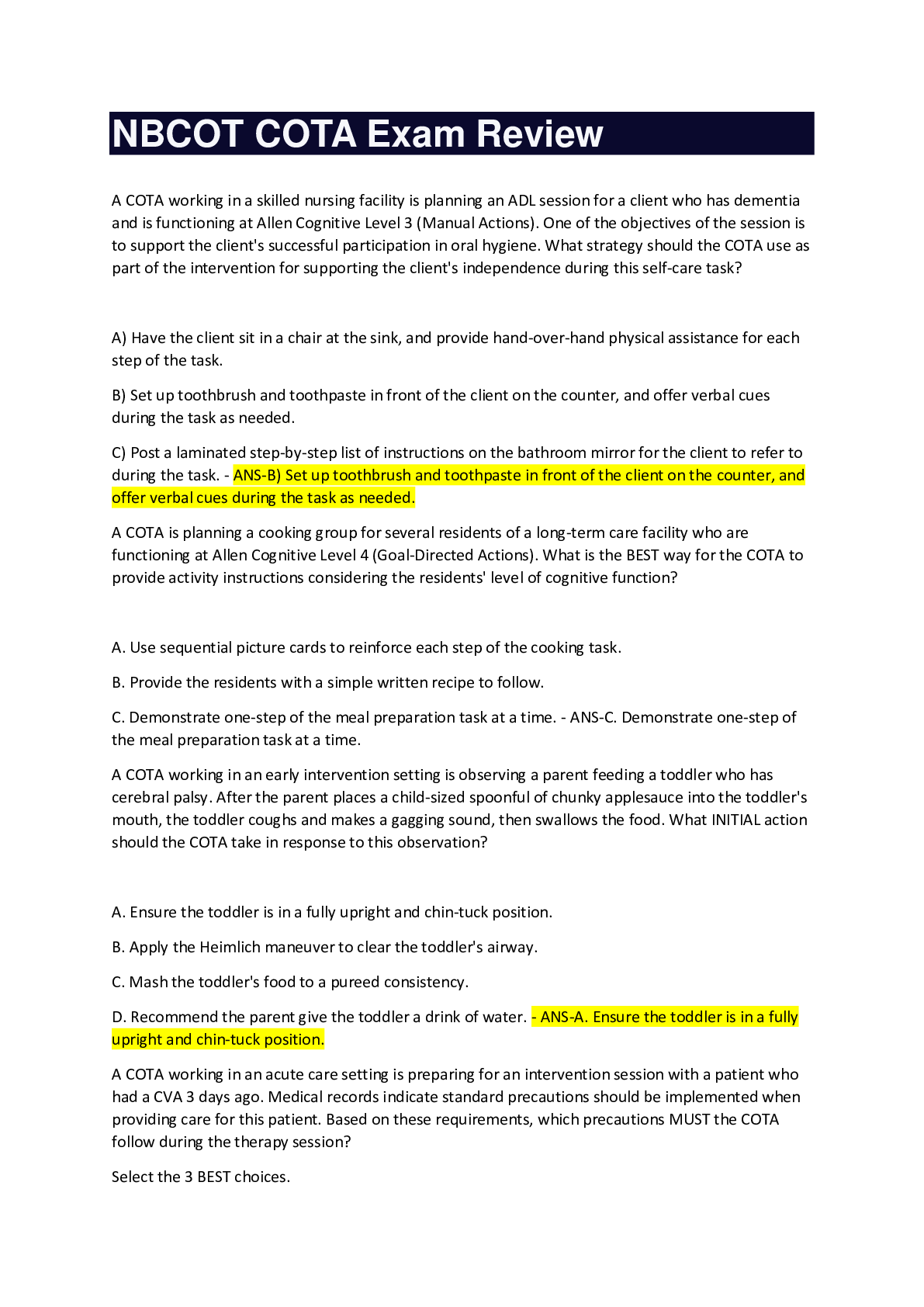
A COTA working in a skilled nursing facility is planning an ADL session for a client who has dementia
and is functioning at Allen Cognitive Level 3 (Manual Actions). One of the objectives of the session is
to support the client's successful participation in oral hygiene. What strategy should the COTA use as
part of the intervention for supporting the client's independence during this self-care task?
A) Have the client sit in a chair at the sink, and provide hand-over-hand physical assistance for each
step of the task.
B) Set up toothbrush and toothpaste in front of the client on the counter, and offer verbal cues
during the task as needed.
C) Post a laminated step-by-step list of instructions on the bathroom mirror for the client to refer to
during the task. - ANS-B) Set up toothbrush and toothpaste in front of the client on the counter, and
offer verbal cues during the task as needed.
A COTA is planning a cooking group for several residents of a long-term care facility who are
functioning at Allen Cognitive Level 4 (Goal-Directed Actions). What is the BEST way for the COTA to
provide activity instructions considering the residents' level of cognitive function?
A. Use sequential picture cards to reinforce each step of the cooking task.
B. Provide the residents with a simple written recipe to follow.
C. Demonstrate one-step of the meal preparation task at a time. - ANS-C. Demonstrate one-step of
the meal preparation task at a time.
A COTA working in an early intervention setting is observing a parent feeding a toddler who has
cerebral palsy. After the parent places a child-sized spoonful of chunky applesauce into the toddler's
mouth, the toddler coughs and makes a gagging sound, then swallows the food. What INITIAL action
should the COTA take in response to this observation?
A. Ensure the toddler is in a fully upright and chin-tuck position.
B. Apply the Heimlich maneuver to clear the toddler's airway.
C. Mash the toddler's food to a pureed consistency.
D. Recommend the parent give the toddler a drink of water. - ANS-A. Ensure the toddler is in a fully
upright and chin-tuck position.
A COTA working in an acute care setting is preparing for an intervention session with a patient who
had a CVA 3 days ago. Medical records indicate standard precautions should be implemented when
providing care for this patient. Based on these requirements, which precautions MUST the COTA
follow during the therapy session?
Select the 3 BEST choices.
A. Wear a surgical mask when in close proximity to the patient such as during transfer training.
B. Wash hands or use hand sanitizer before and after direct patient contact.
C. Place soiled clothing in a facility designated receptacle separate from routine laundry.
D. Don protective clothing including gown and gloves prior to entering the patient's room.
E. Limit patient movement from the hospital room to other treatment areas in the hospital.
F. Clean and disinfect therapy equipment according to facility procedures. - ANS-B. Wash hands or
use hand sanitizer before and after direct patient contact.
C. Place soiled clothing in a facility designated receptacle separate from routine laundry.
F. Clean and disinfect therapy equipment according to facility procedures.
A service competent school-based COTA is collaborating with an OTR prior to the initial evaluation of
a student who has a developmental delay. Which part of the student's evaluation is within the scope
of practice for the COTA to complete?
A.Documenting outcomes of unstructured parent interviews
B.Administering and scoring standardized handwriting assessments
C.Assessing fine motor patterns during classroom activities - ANS-C.Assessing fine motor patterns
during classroom activities
A client was diagnosed with a brain tumor 2 weeks ago. Symptoms include mild physical and
cognitive deficits. During an ADL session, the client stops the activity and begins to cry, stating: "I
really want to do this, but I am so upset about this diagnosis." What actions should the COTA take in
response to the client's comment?
[Show More]