HESI Exit V2 (Nurse Hero Review)
1.The LPN/LVN is preparing to ambulate a postoperative client after
cardiac surgery. The nurse plans to do which to enable the client to
best tolerate the ambulation?
1. Provide the c
...
HESI Exit V2 (Nurse Hero Review)
1.The LPN/LVN is preparing to ambulate a postoperative client after
cardiac surgery. The nurse plans to do which to enable the client to
best tolerate the ambulation?
1. Provide the client with a walker.
2. Remove the telemetry equipment.
3. Encourage the client to cough and deep breathe.
4. Premedicate the client with an analgesic before ambulating.
2. A client is wearing a continuous cardiac monitor, which begins to alarm
at the nurse's station. The nurse sees no electrocardiographic
complexes on the screen. The nurse should do which first?
a. Call a code blue.
b. Call the health care provider.
c. Check the client status and lead placement.
d. Press the recorder button on the ECG console.
3. 3) The LPN/LVN in a medical unit is caring for a client with heart
failure. The client suddenly develops extreme dyspnea, tachycardia,
and lung crackles, and the nurse suspects pulmonary edema. The
nurse immediately notifies the registered nurse and expects which
interventions to be prescribed? Select all that apply.
a. Administering oxygen
b. Inserting a Foley catheter
c. Administering furosemide (Lasix)
d. Administering morphine sulfate intravenously
e. Transporting the client to the coronary care unit
f. Placing the client in a low-Fowler's side-lying position
4. The nurse is monitoring a client following cardioversion.
Which observations should be of highest priority to the nurse?
a. Blood pressure
b. Status of airway
c. Oxygen flow rate
d. Level of consciousness
5. The nurse is assisting in caring for the client immediately
after insertion of a permanent demand pacemaker via the right
pg. 1FINAL “EXIT” HESI! Last day of Concorde LVN School – 04/16/2021
subclavian vein. The nurse prevents dislodgement of the pacing
catheter by implementing which intervention?
a. Limiting movement and abduction of the left arm
b. Limiting movement and abduction of the right arm
c. Assisting the client to get out of bed and ambulate with a
walker 4. Having the physical therapist do active range of
motion to the right arm
6. A client diagnosed with thrombophlebitis 1 day ago suddenly
complains of chest pain and shortness of breath, and the client is
visibly anxious. The LPN/LVN understands that a life-threatening
complication of this condition is which?
a. Pneumonia
b. Pulmonary edema
c. Pulmonary embolism
d. Myocardial infarction
7. A 24-year-old man seeks medical attention for complaints of
claudication in the arch of the foot. The nurse also notes superficial
thrombophlebitis of the lower leg. The nurse should check the client
for which next?
a. Smoking history
b. Recent exposure to allergens
c. History of recent insect bites
d. Familial tendency toward peripheral vascular disease
8. The nurse has reinforced instructions to the client with
Raynaud's disease about self-management of the disease
process. The nurse determines that the client needs further
teaching if the client states which?
a. "Smoking cessation is very important."
b. "Moving to a warmer climate should help."
c. "Sources of caffeine should be eliminated from the diet."
4. "Taking nifedipine (Procardia) as prescribed will
decrease vessel spasm."
9. A client with myocardial infarction suddenly becomes tachycardic,
shows signs of air hunger, and begins coughing frothy, pinktinged sputum. The nurse listens to breath sounds, expecting to
hear which breath sounds bilaterally?
a. Rhonchi
b. Crackles
c. Wheezes
pg. 2FINAL “EXIT” HESI! Last day of Concorde LVN School – 04/16/2021
d. Diminished breath sounds
10. The LPN/LVN is collecting data on a client with a diagnosis of
right sided heart failure. The nurse should expect to note which
specific characteristic of this condition?
a. Dyspnea
b. Hacking cough
c. Dependent edema
d. Crackles on lung auscultation
11. The LPN/LVN is checking the neurovascular status of a client
who returned to the surgical nursing unit 4 hours ago after
undergoing an aortoiliac bypass graft. The affected leg is warm, and
the nurse notes redness and edema. The pedal pulse is palpable
and unchanged from admission. The nurse interprets that the
neurovascular status is which?
a. Moderately impaired, and the surgeon should be called
b. Normal, caused by increased blood flow through the leg
c. Slightly deteriorating, and should be monitored for another
hour
d. Adequate from an arterial approach, but venous
complications are arising
12. A client with a diagnosis of rapid rate atrial fibrillation asks the
nurse why the health care provider is going to perform carotid
massage. The LPN/LVN responds that this procedure may stimulate
which?
a. Vagus nerve to slow the heart rate
b. Vagus nerve to increase the heart rate
c. Diaphragmatic nerve to slow the heart rate
d. Diaphragmatic nerve to increase the heart rate
13. A client is admitted to the hospital with possible rheumatic
endocarditis. The LPN/LVN should check for a history of which type
of infection?
a. Viral infection
b. Yeast infection
c. Streptococcal infection
d. Staphylococcal infection
14. A client has an Unna boot applied for treatment of a venous
stasis leg ulcer. The LPN/LVN notes that the client's toes are mottled,
pg. 3FINAL “EXIT” HESI! Last day of Concorde LVN School – 04/16/2021
and cool and the client verbalizes some numbness and tingling of the
foot. Which interpretation should the nurse make of these findings?
a. The boot has not yet dried.
b. The boot is controlling leg edema.
c. The boot is impairing venous return.
d. The boot has been applied too tightly.
15. A client with angina complains that the anginal pain is
prolonged and severe and occurs at the same time each day, most
often in the morning. On further data collection, the nurse notes that
the pain occurs in the absence of precipitating factors. How should
the LPN/LVN best describe this type of anginal pain?
a. Stable angina
b. Variant angina
c. Unstable angina
d. Nonanginal pain
16. The LPN/LVN is monitoring a client with an abdominal
aortic aneurysm (AAA). Which finding is probably unrelated to
the AAA?
a. Pulsatile abdominal mass
b. Hyperactive bowel sounds in the area
c. Systolic bruit over the area of the mass
d. Subjective sensation of "heart beating" in the abdomen
17. An emergency department client who complains of slightly
improved but unrelieved chest pain for 2 days is reluctant to take a
nitroglycerin sublingual tablet offered by the nurse. The client
states, "I don't need that—my dad takes that for his heart. There's
nothing wrong with my heart." Which description best describes the
client's response?
a. Angry
b. Denial
c. Phobic
d. Obsessive-compulsive
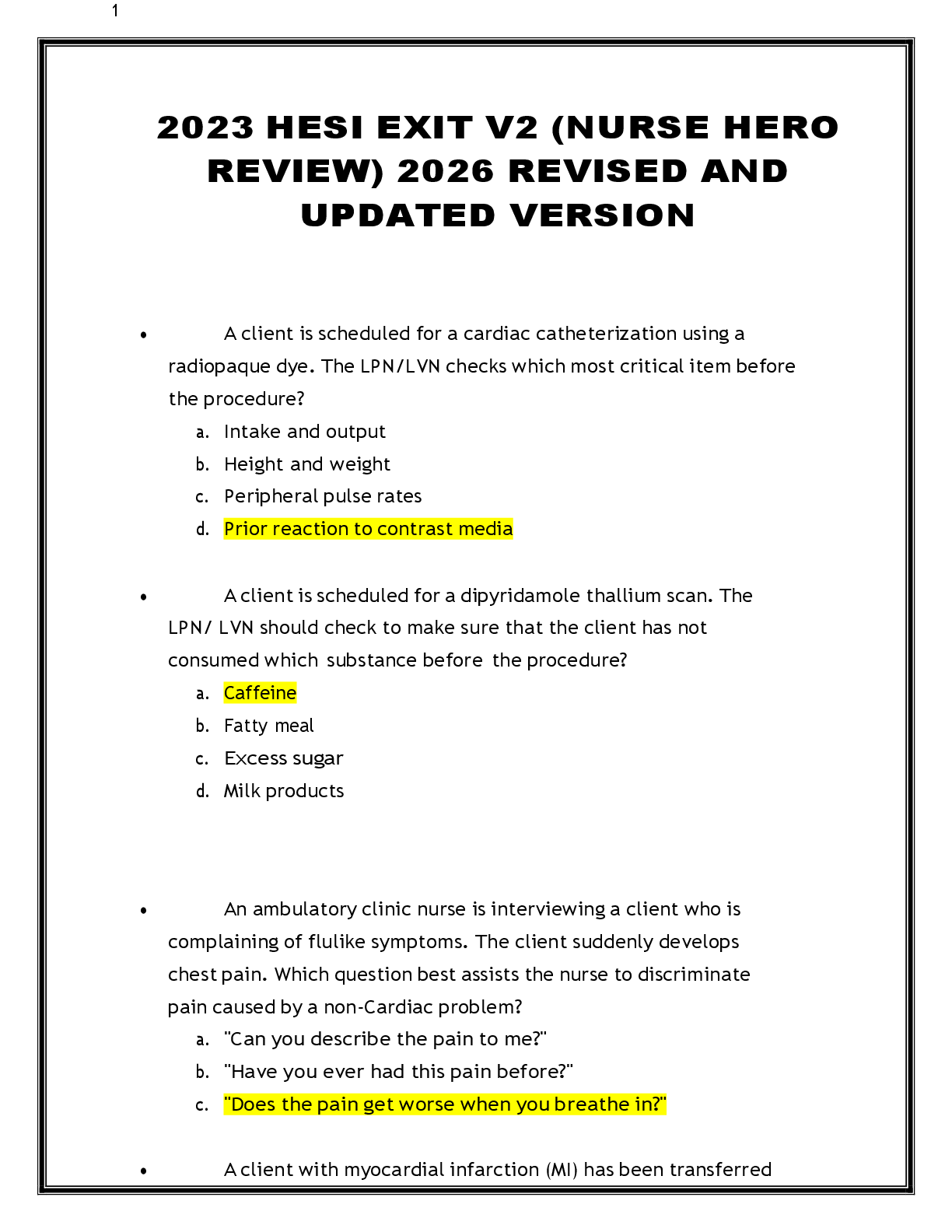
18. A client is scheduled for a cardiac catheterization using a
radiopaque dye. The LPN/LVN checks which most critical item before
the procedure?
a. Intake and output
b. Height and weight
c. Peripheral pulse rates
d. Prior reaction to contrast media
pg. 4FINAL “EXIT” HESI! Last day of Concorde LVN School – 04/16/2021
19. A client is scheduled for a dipyridamole thallium scan. The
LPN/ LVN should check to make sure that the client has not
consumed which substance before the procedure?
a. Caffeine
b. Fatty meal
c. Excess sugar
d. Milk products
20. An ambulatory clinic nurse is interviewing a client who is
complaining of flulike symptoms. The client suddenly develops
chest pain. Which question best assists the nurse to discriminate
pain caused by a non-Cardiac problem?
a. "Can you describe the pain to me?"
b. "Have you ever had this pain before?"
c. "Does the pain get worse when you breathe in?"
21. A client with myocardial infarction (MI) has been transferred
from the coronary care unit (CCU) to the general medical unit with
cardiac monitoring via telemetry. The nurse assisting in caring for
the client expects to note which type of activity prescribed?
a. Strict bed rest for 24 hours
b. Bathroom privileges and self-care activities
c. Unrestricted activities because the client is monitored
d. Unsupervised hallway ambulation with distances less than
200 feet
22. The LPN/LVN is preparing to care for a client who will be
arriving from the recovery room after an above-the-knee
amputation. The nurse ensures that which priority item is available
for emergency use?
a. Surgical tourniquet
b. Dry sterile dressings
c. Incentive spirometer
d. Over-the-bed trapeze
23. A client is diagnosed with thrombophlebitis. The nurse
should tell the client that which prescription is indicated?
a. Bed rest, with bathroom privileges only
b. Bed rest, keeping the affected extremity flat
c. Bed rest, with elevation of the affected extremity
d. Bed rest, with the affected extremity in a dependent
position
pg. 5FINAL “EXIT” HESI! Last day of Concorde LVN School – 04/16/2021
24. A client returns to the nursing unit after an above knee
amputation of the right leg. In which position should the nurse place
the client?
a. Prone with the head on a pillow
b. With the foot of the bed elevated
c. Reverse Trendelenburg's position
d. With the residual limb flat on the bed
25. The LPN/LVN is collecting data from a client about
medications being taken, and the client tells the nurse that he is
taking herbal supplements for the treatment of varicose veins. The
nurse understands that the client is most likely taking which?
a. Bilberry
b. Ginseng
c. Feverfew
d. Evening primrose
25. The LPN/LVN is planning to reinforce instructions to a client with
peripheral arterial disease about measures to limit disease
progression. The nurse should include which items on a list of
suggestions to be given to the client? Select all that apply.
a. Wear elastic stockings.
b. Be careful not to injure the legs or feet.
c. Use a heating pad on the legs to aid vasodilation.
d. Walk each day to increase circulation to the legs.
e. Cut down on the amount of fats consumed in the diet.
27. A client is at risk for developing disseminated intravascular
coagulopathy (DIC). The LPN/LVN should become concerned with
which fibrinogen level?
a. 90 mg/dL
b. 190 mg/dL
c. 290 mg/dL
d. 390 mg/dL
28. A hospitalized client with a history of angina pectoris is
ambulating in the corridor. The client suddenly complains of severe
substernal chest pain. The LPN/LVN should take which action first?
a. Check the client's vital signs.
b. Assist the client to sit or lie down.
c. Administer sublingual nitroglycerin.
d. Apply nasal oxygen at a rate of 2 L/min.
29. The LPN/LVN notes bilateral 2+ edema in the lower extremities
of a client with known coronary artery disease who was admitted to
the hospital 2 days ago. Based on this finding, the nurse should
implement which action?
pg. 6FINAL “EXIT” HESI! Last day of Concorde LVN School – 04/16/2021
a. Reviews the intake and output records for the last 2 days
b. Prescribes daily weights starting on the following morning
c. Changes the time of diuretic administration from morning to
evening
d. Requests a sodium restriction of 1 g/day from the health care
provider
30. A client brings the following medications to the clinic for a
yearly physical. The LPN/LVN realizes which medication has been
prescribed to treat heart failure?
a. Digoxin (Lanoxin)
b. Warfarin (Coumadin)
c. Amiodarone (Cordarone)
d. Potassium chloride (K-Dur)
31. A student nurse is assigned to assist in caring for a client with
acute pulmonary edema who is receiving digoxin (Lanoxin) and
heparin therapy. The nursing instructor reviews the plan of care
formulated by the student and tells the student that which
intervention is unsafe?
a. Restricting the client's potassium intake
b. Encouraging the client to rest after meals
c. Administering the heparin with a 25-gauge needle
d. Holding the digoxin for a heart rate less than 60 beats per
minute
32. A client has an inoperable abdominal aortic aneurysm
(AAA). Which measure should the nurse anticipate reinforcing
when teaching the client?
a. Bed rest
b. Restricting fluids
c. Antihypertensives
d. Maintaining a low-fiber diet
33. The LPN/LVN finds a client tensing while lying in bed staring at
the cardiac monitor. Which is the nurse's best response when the
client states, "There sure are a lot of wires around there. I sure hope
we don't get hit by lightning!"?
a. "Would you like a mild sedative to help you relax?"
b. "Oh, don't worry, the weather is supposed to be sunny
and clear today."
pg. 7FINAL “EXIT” HESI! Last day of Concorde LVN School – 04/16/2021
c. "Yes, this equipment is a little scary. Can we talk about
how the cardiac monitor works?"
d. "I can appreciate your concerns. Your family can stay
with you tonight if you want them to."
34. The LPN/LVN is asked to assist another health care member
in providing care to a client who is placed in a modified
Trendelenburg's position. The nurse interprets that the client is
likely being treated for which condition?
a. Shock
b. Kidney dysfunction
c. Respiratory insufficiency
d. Increased intracranial pressure
35. A client is seen in the health care provider's office for a
physical examination after experiencing unusual fatigue over the
last several weeks. Height is 5 feet, 8 inches, with a weight of
220 pounds. Vital signs are temperature 98.6° F oral, pulse 86
beats per minute, respirations 18 breaths per minute, and blood
pressure 184/96 mm Hg. Random blood glucose is 110 mg/dL. In
order to best collect relevant data, which question should the
LPN/LVN ask the client first?
a. "Do you exercise regularly?"
b. "Would you consider losing weight?"
c. "Is there a history of diabetes mellitus in your family?"
d. "When was the last time you had your blood pressure checked?"
36. The client scheduled for a right femoropopliteal bypass graft
is at risk for compromised tissue perfusion to the extremity. The
LPN/LVN takes which action before surgery to address this risk?
a. Having the client void before surgery
b. Completing a preoperative checklist
c. Marking the location of the pedal pulses on the right leg
d. Checking the results of any baseline coagulation studies
37. When preparing a client for a pericardiocentesis, which position
does the LPN/LVN place the client in?
a. Supine with slight lowering of the head
b. Lying on the right side with a pillow under the head
c. Lying on the left side with a pillow under the chest wall
d. Supine with the head of bed elevated at a 45- to 60-degree
angle
38. For a client diagnosed with pulmonary edema, the LPN/LVN
establishes a goal to have the client participate in activities that
reduce cardiac workload. Which client activities will contribute to
achieving this goal?
pg. 8FINAL “EXIT” HESI! Last day of Concorde LVN School – 04/16/2021
a. Elevating the legs when in bed
b. Sleeping in the supine position
c. Using a bedside commode for stools
d. Seasoning beef with a meat tenderizer
39. The LPN/LVN is caring for a client who is developing pulmonary
edema. The client exhibits respiratory distress, but the blood pressure
is unchanged from the client's baseline. As an immediate action
before help arrives, the nurse should perform which action?
a. Suction the client vigorously.
b. Place the client in high-Fowler's position.
c. Begin assembling medications that are anticipated to
be given.
d. Call the respiratory therapy department to request a
ventilator.
40. The LPN/LVN has reinforced home care instructions to a client
who had a permanent pacemaker inserted. Which educational
outcome has the greatest impact on the client's long-term cardiac
health?
a. Knowledge of when it is safe to resume sexual activity
b. The ability to take an accurate pulse in either the wrist or
neck
c. An understanding of the importance of proper microwave
oven usage
d. An understanding of why vigorous arm and shoulder
movement must be avoided initially
41. The clinic nurse is obtaining cardiovascular data on a client.
The LPN/LVN prepares to check the client's apical pulse and
places the stethoscope in which position?
a. Midsternum equal with the nipple line
b. At the midaxillary line on the left side of the chest
c. At the midline of the chest just below the xiphoid
process
d. At the midclavicular line at the fifth left intercostal
space
42. The LPN/LVN is caring for a client who has been admitted to
the hospital with a diagnosis of angina pectoris. The client is
receiving oxygen via nasal cannula at 2 L. The client asks the
nurse why the oxygen is necessary. The LPN/LVN bases the
response on which information?
pg. 9FINAL “EXIT” HESI! Last day of Concorde LVN School – 04/16/2021
a. Oxygen assists in calming the client.
b. Oxygen prevents the development of any thrombus
formation.
c. Deficient oxygenation to heart cells results in angina
pectoris pain.
d. Oxygen dilates the blood vessels, supplying more nutrients to
the heart muscle.
43. The licensed practical nurse (LPN) is assisting in caring for a
client with a diagnosis of myocardial infarction (MI). The client is
experiencing chest pain that is unrelieved by the administration of
nitroglycerin. The registered nurse administers morphine sulfate to
the client as prescribed by the health care provider. Following
administration of the morphine sulfate, the LPN plans to monitor
which indicator(s)?
a. Mental status
b. Urinary output
c. Respirations and blood pressure
d. Temperature and blood pressure
44. A client diagnosed with angina pectoris returns to the
nursing unit after experiencing an angioplasty. The nurse
reinforces instructions to the client regarding the procedure and
home care measures. Which statement by the client indicates an
understanding of the instructions?
a. "I am considering cutting my workload."
b. "I need to cut down on cigarette smoking."
c. "I am so relieved that my heart is repaired."
d. "I need to adhere to my dietary restrictions."
45. The LPN/LVN is caring for a client with a diagnosis of
myocardial infarction (MI) and is assisting the client in completing
the diet menu. Which beverage does the nurse instruct the client
to select from the menu?
a. Tea
b. Cola
c. Coffee
d. Lemonade
45. 46) The LPN/LVN is collecting data on a client with a diagnosis
of angina pectoris who takes nitroglycerin for chest pain. During
the admission, the client reports chest pain. The nurse immediately
asks the client which question?
a. "Are you having any nausea?"
b. "Where is the pain located?"
c. "Are you allergic to any medications?"
d. "Do you have your nitroglycerin with you?"
pg. 10FINAL “EXIT” HESI! Last day of Concorde LVN School – 04/16/2021
47. The LPN/LVN has reinforced dietary instructions to a client
with coronary artery disease. Which statement by the client
indicates an understanding of the dietary instructions?
a. "I need to substitute eggs and milk for meat."
b. "I will eliminate all cholesterol and fat from my diet."
c. "I should routinely use polyunsaturated oils in my
diet."
d. "I need to seriously consider becoming a strict
vegetarian."
47. The LPN/LVN is assisting in caring for a client in the telemetry
unit who is receiving an intravenous infusion of 1000 mL 5%
dextrose with 40 mEq of potassium chloride. Which occurrence
observed on the cardiac monitor indicates the presence of
hyperkalemia?
a. Tall, peaked T waves
b. ST segment depressions
c. Shortened P-R intervals
d. Shortening of the QRS complex
49. The LPN/LVN is assisting in caring for a client in the telemetry
unit and is monitoring the client for cardiac changes indicative of
hypokalemia. Which occurrence noted on the cardiac monitor
indicates the presence of hypokalemia?
a. Tall, peaked T waves
b. ST-segment depression
c. Prolonged P-R interval
d. Widening of the QRS complex
50. While the nurse is involved in preparing a client for a cardiac
catheterization, the client says, "I don't want to talk with you.
You're only the nurse. I want my doctor." Which response by the
nurse should be therapeutic?
a. "Your doctor expects me to prepare you for this
procedure."
b. "That's fine, if that's what you want. I'll call your
health care provider."
c. "So you're saying that you want to talk to your health care
provider?"
d. "I'm concerned with the way you've dismissed me. I know
what I am doing."
pg. 11FINAL “EXIT” HESI! Last day of Concorde LVN School – 04/16/2021
51. The LPN/LVN reinforces instructions to a client at risk
for thrombophlebitis regarding measures to minimize its occurrence.
Which statement by the client indicates an understanding of this
information?
a. "I need to avoid pregnancy by taking oral contraceptives."
b. "I should avoid sitting in one position for long periods of
time."
c. "I can finally stop wearing these support stockings that you
gave me."
d. "I will be sure to maintain my fluid intake to at least four
glasses daily."
52. A client with a history of angina pectoris tells the nurse that
chest
pain usually occurs after going up two flights of stairs or after
walking four blocks. The LPN/LVN interprets that the client is
experiencing which type of angina?
a. Stable
b. Variant
c. Unstable
d. Intractable
53. The LPN/LVN is teaching the client with angina pectoris about
disease management and lifestyle changes that are necessary in
order to control disease progression. Which statement by the client
indicates a need for further teaching?
a. "I will avoid using table salt with meals."
b. "It is best to exercise once a week for an hour."
c. "I will take nitroglycerin whenever chest discomfort
begins."
d. "I will use muscle relaxation to cope with stressful
situations."
54) The LPN/LVN is working with a client who has been diagnosed with
Prinzmetal's (variant) angina. The nurse plans to reinforce which
information about this type of angina when teaching the client?
a. Prinzmetal's angina is effectively managed by beta-blocking agents.
b. Prinzmetal's angina improves with a low-sodium, high-potassium
diet.
c. Prinzmetal's angina has the same risk factors as stable and unstable
angina.
d. Prinzmetal's angina is generally treated with calcium channel
blocking agents.
pg. 12FINAL “EXIT” HESI! Last day of Concorde LVN School – 04/16/2021
55. The LPN/LVN working in a long-term care facility is collecting
data from a client experiencing chest pain. The nurse should interpret
that the pain is likely a result of myocardial infarction (MI) if which
observation is made by the nurse?
a. The client is not experiencing nausea or vomiting.
b. The pain is described as substernal and radiating to the left
arm.
c. The pain has not been unrelieved by rest and nitroglycerin
tablets.
d. The client says the pain began while trying to open a stuck
dresser drawer.
56. The LPN/LVN is discussing smoking cessation with a
client diagnosed with coronary artery disease (CAD). Which
statement should the nurse make to the client to try to motivate the
client to quit smoking?
a. "Since the damage has already been done, it will be all
right to cut down a little at a time.
[Show More]



 Questions, Answers & Rationale, A+ Guide.png)