Adverse effects - ANSWER Drug effects that are not the desired therapeutic effects; may be unpleasant or even dangerous
Brand name (Trade Name) - ANSWER Name given to a drug by the PHARMACEUTICAL company that develope
...
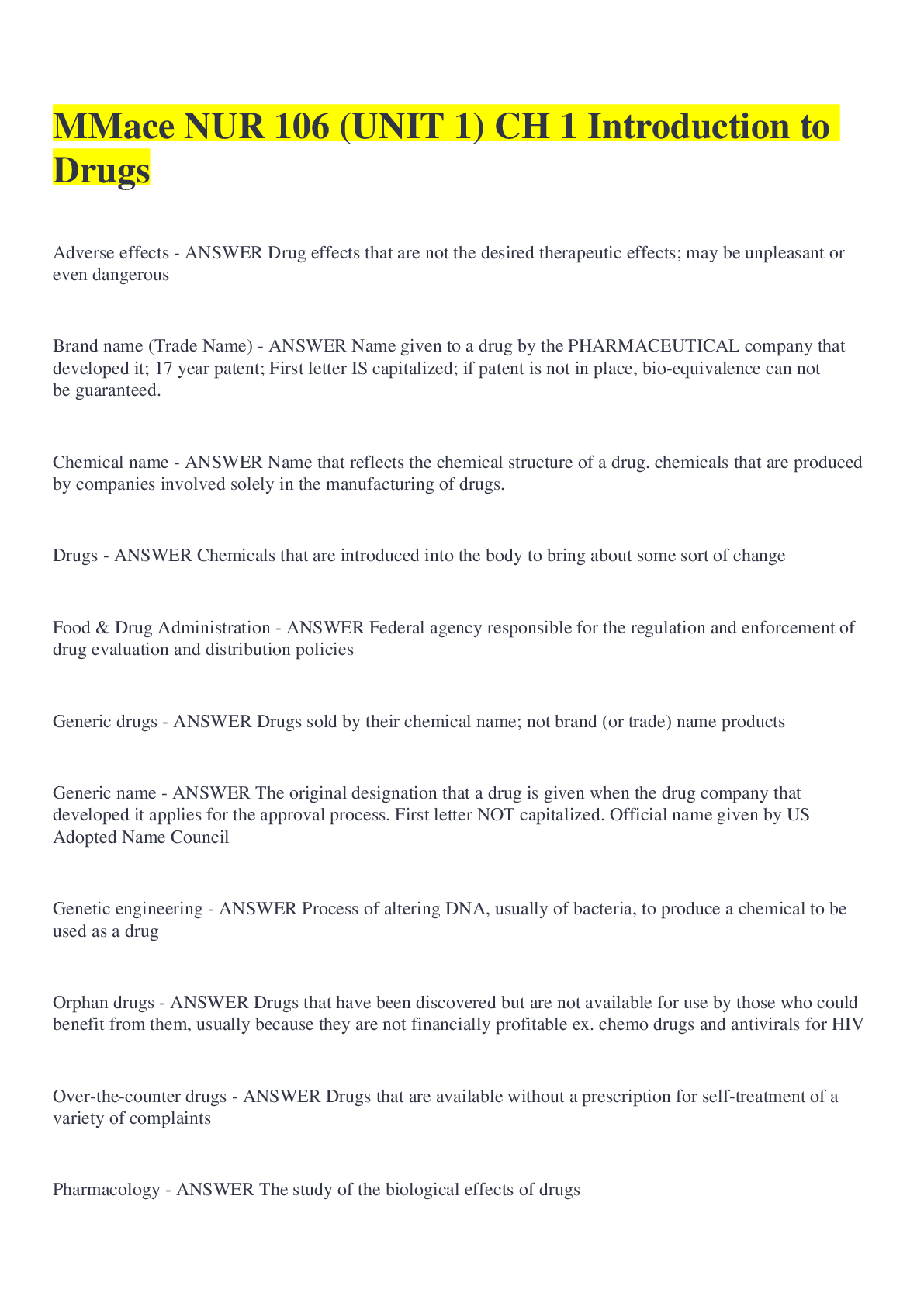
Adverse effects - ANSWER Drug effects that are not the desired therapeutic effects; may be unpleasant or even dangerous
Brand name (Trade Name) - ANSWER Name given to a drug by the PHARMACEUTICAL company that developed it; 17 year patent; First letter IS capitalized; if patent is not in place, bio-equivalence can not be guaranteed.
Chemical name - ANSWER Name that reflects the chemical structure of a drug. chemicals that are produced by companies involved solely in the manufacturing of drugs.
Drugs - ANSWER Chemicals that are introduced into the body to bring about some sort of change
Food & Drug Administration - ANSWER Federal agency responsible for the regulation and enforcement of drug evaluation and distribution policies
Generic drugs - ANSWER Drugs sold by their chemical name; not brand (or trade) name products
Generic name - ANSWER The original designation that a drug is given when the drug company that developed it applies for the approval process. First letter NOT capitalized. Official name given by US Adopted Name Council
Genetic engineering - ANSWER Process of altering DNA, usually of bacteria, to produce a chemical to be used as a drug
Orphan drugs - ANSWER Drugs that have been discovered but are not available for use by those who could benefit from them, usually because they are not financially profitable ex. chemo drugs and antivirals for HIV
Over-the-counter drugs - ANSWER Drugs that are available without a prescription for self-treatment of a variety of complaints
Pharmacology - ANSWER The study of the biological effects of drugs
Pharmacotherapeutics - ANSWER Clinical pharmacology, the branch of pharmacology that deals with drugs; chemicals that are used in medicine for the treatment, prevention and diagnoses of disease in humans
Preclinical trials - ANSWER Initial trial of a chemical thought to have therapeutic potential; uses laboratory ANIMALS, NOT HUMAN subjects
Phase I study - ANSWER A pilot study of a potential drug done with a small number of selected, healthy HUMAN VOLUNTEERS
Phase II study - ANSWER A clinical study of a drug by selected physicians using ACTUAL PATIENTS who have the disorder the drug is designed to treat; patients must informed consent.
Phase III study - ANSWER Use of a drug on a wide scale in the CLINICAL setting with patients who HAVE THE DISEASE the drug is thought to treat
Phase IV study - ANSWER CONTINUAL EVALUATION of a drug after it has been released for marketing
Teratogenic - ANSWER Having adverse effects on the fetus
1. Clinical pharmacology is the study of
a. the biological effects of chemicals.
b. drugs used to treat, prevent, or diagnose disease.
c. plant components that can be used as medicines.
d. binders and other vehicles for delivering medication. - ANSWER b. drugs used to treat, prevent, or diagnose disease.
Phase I drug studies involve
a. the use of laboratory animals to test chemicals.
b. patients with the disease the drug is designed to treat.
c. mass marketing surveys of drug effects in large numbers of people.
d. healthy human volunteers who are often paid for their participation. - ANSWER d. healthy human volunteers who are often paid for their participation.
The generic name of a drug is
a. the name assigned to the drug by the pharmaceutical company developing it.
b. the chemical name of the drug based on its chemical structure.
c. the original name assigned to the drug at the beginning of the evaluation process.
d. often used in advertising campaigns. - ANSWER c. the original name assigned to the drug at the beginning of the evaluation process.
An orphan drug is a drug that
a. has failed to go through the approval process.
b. is available in a foreign country but not in this country.
c. has been discovered but is not financially viable and therefore has not been "adopted" by any drug company.
d. is available without a prescription. - ANSWER c. has been discovered but is not financially viable and therefore has not been "adopted" by any drug company.
The FDA pregnancy categories
a. indicate a drug's potential or actual teratogenic effects, offering guidelines for use of a particular drug in pregnancy.
b. are used for research purposes only.
c. list drugs that are more likely to have addicting properties.
d. are tightly regulated by the DEA. - ANSWER a. indicate a drug's potential or actual teratogenic effects, offering guidelines for use of a particular drug in pregnancy.
The storing, prescribing, and distributing of controlled substances—drugs that are more apt to be addictive—are monitored by
a. the FDA.
b. the Department of Commerce.
c. the FBI.
d. the DEA. - ANSWER d. the DEA.
Healthy young women are not usually involved in Phase I studies of drugs because
a. male bodies are more predictable and responsive to chemicals.
b. females are more apt to suffer problems with ova, which are formed before birth and not formed in later years.
c. males can tolerate the unknown adverse effects of many drugs better than females.
d. there are no standards to use to evaluate the female response. - ANSWER b. females are more apt to suffer problems with ova, which are formed before birth and not formed in later years.
A patient has been taking fluoxetine (Prozac) for several years, but when picking up the prescription this month, found that the tablets looked different and became concerned. The nurse, checking with the pharmacist, found that fluoxetine had just become available in the generic form and the prescription had been filled with the generic product. The nurse should tell the patient
a. that the new tablet may not work and the patient should carefully monitor response.
b. that generic drugs are available without a prescription because they are very safe.
c. that the law requires that prescriptions be filled with the generic form if one is available to cut down the cost of medications.
d. that the pharmacist filled the prescription with the wrong drug and it should be returned to the pharmacy for a refund - ANSWER c. that the law requires that prescriptions be filled with the generic form if one is available to cut down the cost of medications.
Multiple Response: Select all that apply.
When teaching a patient about over-the-counter (OTC) drugs, which points should the nurse include?
a. These drugs are very safe and can be used freely to relieve your complaints.
b. These compounds are called drugs, but they aren't really drugs and don't need to be reported to your health care provider.
c. Some of these drugs were once prescription drugs, but are now thought to be safe when used as directed.
d. Reading the label of these drugs is very important; the active ingredient is very prominent; you should always check the ingredient name.
e. It is important to read the label to see what the recommended dose of the drug is; some of these drugs can cause serious problems if too much of the drug is taken.
f. It is important to report the use of any OTC drug to your physician, because many of them can interact with drugs that might be prescribed for you. - ANSWER c. Some of these drugs were once prescription drugs, but are now thought to be safe when used as directed.
d. Reading the label of these drugs is very important; the active ingredient is very prominent; you should always check the ingredient name.
e. It is important to read the label to see what the recommended dose of the drug is; some of these drugs can cause serious problems if too much of the drug is taken.
f. It is important to report the use of any OTC drug to your physician, because many of them can interact with drugs that might be prescribed for you.
A patient asks what generic drugs are and if he should be using them to treat his infection. Which of the following statements should be included in the nurse's explanation?
a. A generic drug is a drug that is sold by the name of the ingredient, not by brand name.
b. Generic drugs are always the best drugs to use because they are never any different from the familiar brand names.
c. Generic drugs are not available until the patent expires on a specific drug.
d. Generic drugs are usually cheaper than the well-known brand names and some insurance companies require that you receive a generic drug if one is available.
e. Generic drugs are forms of a drug that are available over the counter and do not require a prescription.
f. Your physician may want you to have the brand name of a drug, not the generic form, and DAW, or "dispense as written," will be on your prescription.
g. Generic drugs are less likely to cause adverse effects than brand-name drugs. - ANSWER a. A generic drug is a drug that is sold by the name of the ingredient, not by brand name.
c. Generic drugs are not available until the patent expires on a specific drug.
d. Generic drugs are usually cheaper than the well-known brand names and some insurance companies require that you receive a generic drug if one is available.
f. Your physician may want you to have the brand name of a drug, not the generic form, and DAW, or "dispense as written," will be on your prescription.
g. Generic drugs are less likely to cause adverse effects than brand-name drugs.
Nurses Responsibilities: Drugs - ANSWER 1. be KNOWLEDGEABLE
2. ADMINISTER drugs
3. ASSESS drug effects and adverse effects
4. INTERVENE to make the drug regimen more tolerable
5. PROVIDE PATIENT TEACHING about drugs and the regimen
6. MONITOR and PREVENT medication errors
pharmacogenetics - ANSWER the study of how clients respond to drugs. Customized medicine dose based on the genetics of the person taking the drug.
placebo - ANSWER used in phase 2 of drug trials, inert substance that serves as a control for the non treatment group.
Sources of Drugs: - ANSWER 1. PLANTS: alt. therapy movement
2. ANIMAL: hormones, replace human chems.
3. INORGANIC COMPOUNDS: salts of elements: iron or ferrous sulfate
4. SYNTHETIC SOURCES: gen engineer. bacteria to prod chem that are therapeutic: Interferons, Antibiotics
pharmacokinetics - ANSWER the study of the effect of the BODY on the drug. example: absorption, distribution, metabolism, excretion
pharmacodynamics - ANSWER study of the biochemical and physiological effects of drugs. The action and interaction of DRUGS on the body
toxicology - ANSWER study of poisons, adverse effects, contraindications
drugs - ANSWER Chemicals that are introduced into the body to bring about some sort of change
The "Three Checks" are: - ANSWER check the medication label three times while preparing the medication:
1st Check: when you get the medication or dosage package
2nd Check: before putting medication into medication cup or pouring liquid medications
3rd Check: After all of the medication has been prepared, just before you bring it to the patient
The "Five Rights of Medical Administration": - ANSWER When checking the medication against the MAR you look for:
1. Right Patient
2. Right Medication
3. Right Dose
4. Right Route
5. Right Time
This helps ensure accuracy when administering medication to the patient
MAR - ANSWER Medical Administration Record
FDA Pregnancy Categories - ANSWER The Food and Drug Administration (FDA) has established five categories to indicate the potential for a systemically absorbed drug to cause birth defects. The key differentiation among the categories rests on the degree (reliability) of documentation and the risk-benefit ratio.
Category A: - ANSWER Adequate studies in pregnant women have not demonstrated a risk to the fetus in the first trimester of pregnancy, and there is no evidence of risk in later trimesters.
Category B: - ANSWER Animal studies have not demonstrated a risk to the fetus but there are no adequate studies in pregnant women, or animal studies have shown an adverse effect, but adequate studies in pregnant women have not demonstrated a risk to the fetus during the first trimester of pregnancy, and there is no evidence of risk in later trimesters
Category C: - ANSWER Animal studies have shown an adverse effect on the fetus but there are no adequate studies in humans; the benefits from the use of the drug in pregnant women may be acceptable despite its potential risks, or there are no animal reproduction studies and no adequate studies in humans.
Category D: - ANSWER There is evidence of human fetal risk, but the potential benefits from the use of the drug in pregnant women may be acceptable despite its potential risks.
Category X: - ANSWER Studies in animals or humans demonstrate fetal abnormalities or adverse reaction; reports indicate evidence of fetal risk. The risk of use in a pregnant woman clearly outweighs any possible benefit.
DEA Schedules of Controlled Substances - ANSWER The Controlled Substances Act of 1970 regulates the manufacturing, distribution, and dispensing of drugs that are known to have abuse potential. The Drug Enforcement Agency (DEA) is responsible for the enforcement of these regulations. The controlled drugs are divided into five DEA schedules based on their potential for abuse and physical and psychological dependence.
Schedule I (C-I): - ANSWER High abuse potential and no accepted medical use (heroin, marijuana, LSD)
**NP can not prescribe**
Schedule II (C-II): - ANSWER High abuse potential with severe dependence liability (narcotics, amphetamines, and barbiturates)
**NP can not prescribe**
Schedule III (C-III): - ANSWER Less abuse potential than schedule II drugs and moderate dependence liability (nonbarbiturate sedatives, nonamphetamine stimulants, limited amounts of certain narcotics)
Schedule IV (C-IV): - ANSWER Less abuse potential than schedule III and limited dependence liability (some sedatives, antianxiety agents, and non-narcotic analgesics)
Schedule V (C-V): - ANSWER Limited abuse potential. Primarily small amounts of narcotics (codeine) used as antitussives or antidiarrheals. Under federal law, limited quantities of certain schedule V drugs may be purchased without a prescription directly from a pharmacist. The purchaser must be at least 18 years of age and must furnish suitable identification. All such transactions must be recorded by the dispensing pharmacist.
bioequivalence - ANSWER "two pharmaceutical products are bioequivalent if they are pharmaceutically equivalent and their bioavailabilities (rate and extent of availability) after administration in the same molar dose are similar to such a degree that their effects, with respect to both efficacy and safety, can be expected to be essentially the same.
Drug Classifications: - ANSWER Therapeutic, Pharmacologic, Drug Prototype
Therapeutic Classifications: - ANSWER What is being treated by the drug: ex: anticoagulant, antihyperlipidemic, antihypertensive, antianginal
Phamacologic Classifications: - ANSWER How the drug produces its effects on the body: ex: vasodilators (dilates peripheral blood vessels), diuretic (lowers plasma volume), adrenergic antagonist or blocker (blocks physiologic reaction to stress
Drug Prototype - ANSWER usually the first drug in a class or the drug all others in the class are compared with.
Drug Research: - ANSWER takes average of $800 million to discover and develop 1 new medicine.
takes 5-15 years to bring new medicine from laboratory to pharmacy use.
Legal Classes of Drugs: - ANSWER 1. Prescription (legend) Drugs: controlled substances
2. Nonprescription (OTC) drugs
3. Orphan drugs
4. Investigational drugs (trial drugs)
5. Illicit (street) drugs
Dispense as Written - ANSWER must use specific drug used; cannot be substituted with a generic drug
drugs that should not be substituted: - ANSWER cardiac drugs, seizure drugs, hormones (oral contraceptives)
Narcotic use in hospitals: - ANSWER narcotics discontinued after 48-72 hrs.
drug misuse: - ANSWER using drug for something it was not prescribed for (off-label use)
drug abuse: - ANSWER use of the drug to the point of possible dependence.
commonly abused drugs: - ANSWER caffeine, alcohol, nicotine, marijuana, stimulants, narcotics, barbiturates, antianxiety, antipsychotic, anabolic steroids
polypharmacy - ANSWER the use of multiple medications by a patient, especially when too many forms of medication are used by a patient, when more drugs are prescribed than is clinically warranted,[1] or even when all prescribed medications are clinically indicated but there are too many pills to take (pill burden)
[Show More]






.png)