Test Bank - Introduction to Critical Care Nursing 7e (Sole 2016)
Table of Contents
Table of Contents
Chapter 01: Overview of Critical Care Nursing
Chapter 02: Patient and Family Response to the Critical Care Experien
...
Test Bank - Introduction to Critical Care Nursing 7e (Sole 2016)
Table of Contents
Table of Contents
Chapter 01: Overview of Critical Care Nursing
Chapter 02: Patient and Family Response to the Critical Care Experience
Chapter 03: Ethical and Legal Issues in Critical Care Nursing
Chapter 04: Palliative and End-of-Life Care
Chapter 05: Comfort and Sedation
Chapter 06: Nutritional Therapy
Chapter 07: Dysrhythmia Interpretation and Management
Chapter 08: Hemodynamic Monitoring
Chapter 09: Ventilatory Assistance
Chapter 10: Rapid Response Teams and Code Management
Chapter 11: Organ Donation
Chapter 12: Shock, Sepsis, and Multiple Organ Dysfunction Syndrome
Chapter 13: Cardiovascular Alterations
Chapter 14: Nervous System Alterations
Chapter 15: Acute Respiratory Failure
Chapter 16: Acute Kidney Injury
Chapter 17: Gastrointestinal Alterations
Chapter 17: Hematological and Immune Disorders
Chapter 19: Endocrine Alterations
Chapter 20: Trauma and Surgical Management
Chapter 21: Burns
Test Bank - Introduction to Critical Care Nursing 7e (Sole 2016) 1Chapter 01: Overview of Critical Care Nursing
MULTIPLE CHOICE
1. Which of the following professional organizations best supports critical care nursing practice?
a. American Association of Critical-Care Nurses
b. American Heart Association
c. American Nurses Association
d. Society of Critical Care Medicine
ANS: A
The American Association of Critical-Care Nurses is the specialty organization that supports and represents
critical care nurses. The American Heart Association supports cardiovascular initiatives. The American Nurses
Association supports all nurses. The Society of Critical Care Medicine represents the multiprofessional critical
care team under the direction of an intensivist.
DIF: Cognitive Level: Knowledge REF: p. 4
OBJ: Discuss the purposes and functions of the professional organizations that support critical care practice.
TOP: Nursing Process Step: N/A
MSC: NCLEX: Safe and Effective Care Environment
2. A nurse has been working as a staff nurse in the surgical intensive care unit for 2 years and is interested in
certification. Which credential would be most applicable for her to seek?
a. ACNPC
b. CCNS
c. CCRN
d. PCCN
ANS: C
The CCRN certification is appropriate for nurses in bedside practice who care for critically ill patients. The
ACNPC certification is for acute care nurse practitioners. The CCNS certification is for critical care clinical
nurse specialists. The PCCN certification is for staff nurses working in progressive care, intermediate care, or
step-down unit settings.
DIF: Cognitive Level: Application REF: p. 5
OBJ: Explain certification options for critical care nurses. TOP: Nursing Process Step: N/A
MSC: NCLEX: Safe and Effective Care Environment
Test Bank - Introduction to Critical Care Nursing 7e (Sole 2016) 23. The main purpose of certification is to:
a. assure the consumer that you will not make a mistake.
b. prepare for graduate school.
c. promote magnet status for your facility.
d. validate knowledge of critical care nursing.
ANS: D
Certification assists in validating knowledge of the field, promotes excellence in the profession, and helps
nurses to maintain their knowledge of critical care nursing. Certification helps to assure the consumer that the
nurse has a minimum level of knowledge; however, it does not ensure that care will be mistake-free.
Certification does not prepare one for graduate school; however, achieving certification demonstrates
motivation for achievement and professionalism. Magnet facilities are rated on the number of certified nurses;
however, that is not the purpose of certification.
DIF: Cognitive Level: Analysis REF: pp. 4-5
OBJ: Explain certification options for critical care nurses. TOP: Nursing Process Step: N/A
MSC: NCLEX: Safe and Effective Care Environment
4. The synergy model of practice focuses on:
a. allowing unrestricted visiting for the patient 24 hours each day.
b. holistic and alternative therapies.
c. needs of patients and their families, which drives nursing competency.
d. patients needs for energy and support.
ANS: C
The synergy model of practice states that the needs of patients and families influence and drive competencies
of nurses. Nursing practice based on the synergy model would involve tailored visiting to meet the patients and
familys needs and application of alternative therapies if desired by the patient, but that is not the primary focus
of the model.
DIF: Cognitive Level: Application REF: p. 5 | Fig. 1-3
OBJ: Describe standards of professional practice for critical care nursing.
TOP: Nursing Process Step: N/A MSC: NCLEX: Safe and Effective Care Environment
5. The family of your critically ill patient tells you that they have not spoken with the physician in over 24
hours and they have some questions that they want clarified. During morning rounds, you convey this concern
to the attending intensivist and arrange for her to meet with the family at 4:00 PM in the conference room.
Which competency of critical care nursing does this represent?
Test Bank - Introduction to Critical Care Nursing 7e (Sole 2016) 3a. Advocacy and moral agency in solving ethical issues
b. Clinical judgment and clinical reasoning skills
c. Collaboration with patients, families, and team members
d. Facilitation of learning for patients, families, and team members
ANS: C
Although one might consider that all of these competencies are being addressed, communication and
collaboration with the family and physician best exemplify the competency of collaboration.
DIF: Cognitive Level: Analysis REF: p. 9
OBJ: Describe standards of professional practice for critical care nursing.
TOP: Nursing Process Step: N/A MSC: NCLEX: Safe and Effective Care Environment
6. The AACN Standards for Acute and Critical Care Nursing Practice use what framework to guide critical
care nursing practice?
a. Evidence-based practice
b. Healthy work environment
c. National Patient Safety Goals
d. Nursing process
ANS: D
The AACN Standards for Acute and Critical Care Nursing Practice delineate the nursing process as applied to
critically ill patients: collect data, determine diagnoses, identify expected outcomes, develop a plan of care,
implement interventions, and evaluate care. AACN promotes a healthy work environment, but this is not
included in the Standards. The Joint Commission has established National Patient Safety Goals, but these are
not the AACN Standards.
DIF: Cognitive Level: Analysis REF: p. 5 | Box 1-2
OBJ: Describe standards of professional practice for critical care nursing.
TOP: Nursing Process Step: N/A MSC: NCLEX: Safe and Effective Care Environment
7. The charge nurse is responsible for making the patient assignments on the critical care unit. She assigns the
experienced, certified nurse to care for the acutely ill patient with sepsis who also requires continuous renal
replacement therapy and mechanical ventilation. She assigns the nurse with less than 1 year of experience to
two patients who are more stable. This assignment reflects implementation of the:
a. crew resource management model
Test Bank - Introduction to Critical Care Nursing 7e (Sole 2016) 4b. National Patient Safety Goals
c. Quality and Safety Education for Nurses (QSEN) model
d. synergy model of practice
ANS: D
This assignment demonstrates nursing care to meet the needs of the patient. The synergy model notes that the
nurse competencies are matched to the patient characteristics. Crew resource management concepts related to
team training, National Patient Safety Goals are specified by The Joint Commission to promote safe care but
do not incorporate the synergy model. The Quality and Safety Education for Nurses initiative involves targeted
education to undergraduate and graduate nursing students to learn quality and safety concepts.
DIF: Cognitive Level: Analysis REF: p. 5 | Fig. 1-3
OBJ: Describe standards of professional practice for critical care nursing.
TOP: Nursing Process Step: N/A MSC: NCLEX: Safe and Effective Care Environment
8. The vision of the American Association of Critical-Care Nurses is a healthcare system driven by:
a. a healthy work environment.
b. care from a multiprofessional team under the direction of a critical care physician.
c. the needs of critically ill patients and families.
d. respectful, healing, and humane environments.
ANS: C
The AACN vision is a healthcare system driven by the needs of critically ill patients and families where critical
care nurses make their optimum contributions. AACN promotes initiatives to support a healthy work
environment as well as respectful and healing environments, but that is not the organizations vision. The
SCCM promotes care from a multiprofessional team under the direction of a critical care physician.
DIF: Cognitive Level: Knowledge REF: p. 4
OBJ: Discuss the purposes and functions of the professional organizations that support critical care practice.
TOP: Nursing Process Step: N/A
MSC: NCLEX: Safe and Effective Care Environment
9. The most important outcome of effective communication is to:
a. demonstrate caring practices to family members.
b. ensure that patient teaching is done.
c. meet the diversity needs of patients.
Test Bank - Introduction to Critical Care Nursing 7e (Sole 2016) 5d. reduce patient errors.
ANS: D
Many errors are directly attributed to faulty communication. Effective communication has been identified as an
essential strategy to reduce patient errors and resolve issues related to patient care delivery. Communication
may demonstrate caring practices, be used for patient/family teaching, and address diversity needs; however,
the main outcome of effective communication is patient safety.
DIF: Cognitive Level: Knowledge REF: pp. 8-9
OBJ: Describe quality and safety initiatives related to critical care nursing.
TOP: Nursing Process Step: N/A MSC: NCLEX: Safe and Effective Care Environment
10. You are caring for a critically ill patient whose urine output has been low for 2 consecutive hours. After a
thorough patient assessment, you call the intensivist with the following report. Dr. Smith, Im calling about
Mrs. P., your 65-year-old patient in CCU 10. Her urine output for the past 2 hours totaled only 40 mL. She
arrived from surgery to repair an aortic aneurysm 4 hours ago and remains on mechanical ventilation. In the
past 2 hours, her heart rate has increased from 80 to 100 beats per minute and her blood pressure has
decreased from 128/82 to 100/70 mm Hg. She is being given an infusion of normal saline at 100 mL per hour.
Her right atrial pressure through the subclavian central line is low at 3 mm Hg. Her urine is concentrated. Her
BUN and creatinine levels have been stable and in normal range. Her abdominal dressing is dry with no
indication of bleeding. My assessment suggests that Mrs. P. is hypovolemic and I would like you to consider
increasing her fluids or giving her a fluid challenge. Using the SBAR model for communication, the
information the nurse gives about the patients history and vital signs is:
a. Situation
b. Background
c. Assessment
d. Recommendation
ANS: B
The history and vital signs are part of the background. Information regarding the low urine output is the
situation. Information regarding possible hypovolemia is part of the nurses assessment, and the suggestion for
fluids is the recommendation.
DIF: Cognitive Level: Analysis REF: pp. 8-9
OBJ: Describe quality and safety initiatives related to critical care nursing.
TOP: Nursing Process Step: Assessment MSC: NCLEX: Safe and Effective Care Environment
11. The family members of a critically ill, 90-year-old patient bring in a copy of the patients living will to the
hospital, which identifies the patients wishes regarding health care. You discuss contents of the living will with
the patients physician. This is an example of implementation of which of the AACN Standards of Professional
Performance?
a. Acquires and maintains current knowledge of practice
Test Bank - Introduction to Critical Care Nursing 7e (Sole 2016) 6b. Acts ethically on the behalf of the patient and family
c. Considers factors related to safe patient care
d. Uses clinical inquiry and integrates research findings in practice
ANS: B
Discussing end-of-life issues is an example of a nurse acting ethically on behalf of the patient and family. The
example does not relate to acquiring knowledge, promoting patient safety, or using research in practice.
DIF: Cognitive Level: Analysis REF: p. 5 | Box 1-2
OBJ: Describe standards of care and performance for critical care nursing.
TOP: Nursing Process Step: Implementation
MSC: NCLEX: Safe and Effective Care Environment
12. Which of the following assists the critical care nurse in ensuring that care is appropriate and based on
research?
a. Clinical practice guidelines
b. Computerized physician order entry
c. Consulting with advanced practice nurses
d. Implementing Joint Commission National Patient Safety Goals
ANS: A
Clinical practice guidelines are being implemented to ensure that care is appropriate and based on research.
Some physician order entry pathways, but not all, are based on research recommendations. Some advanced
practice nurses, but not all, are well versed in evidence-based practices. The National Patient Safety Goals are
recommendations to reduce errors using evidence-based practices.
DIF: Cognitive Level: Analysis REF: p. 7
OBJ: Describe standards of professional practice for critical care nursing.
TOP: Nursing Process Step: N/A MSC: NCLEX: Safe and Effective Care Environment
13. Comparing the patients current (home) medications with those ordered during hospitalization and
communicating a complete list of medications to the next provider when the patient is transferred within an
organization or to another setting are strategies to:
a. improve accuracy of patient identification.
b. prevent errors related to look-alike and sound-alike medications.
Test Bank - Introduction to Critical Care Nursing 7e (Sole 2016) 7c. reconcile medications across the continuum of care.
d. reduce harms associated with administration of anticoagulants.
ANS: C
These are steps recommended in the National Patient Safety Goals to reconcile medications across the
continuum of care. Improving accuracy of patient identification is another National Patient Safety Goal.
Preventing errors related to look-alike and sound-alike medications is done to improve medication safety, not
medication reconciliation. Reducing harms associated with administration of anticoagulants is another National
Patient Safety Goal.
DIF: Cognitive Level: Comprehension REF: p. 6 | Box 1-3
OBJ: Describe quality and safety initiatives related to critical care nursing.
TOP: Nursing Process Step: N/A MSC: NCLEX: Safe and Effective Care Environment
14. As part of nursing management of a critically ill patient, orders are written to keep the head of the bed
elevated at 30 degrees, awaken the patient from sedation each morning to assess readiness to wean from
mechanical ventilation, and implement oral care protocols every 4 hours. These interventions are done as a
group to reduce the risk of ventilator-associated pneumonia. This group of evidence-based interventions is
often called a:
a. bundle of care.
b. clinical practice guideline.
c. patient safety goal.
d. quality improvement initiative.
ANS: A
A group of evidence-based interventions done as a whole to improve outcomes is termed abundle of care. This
is an example of the ventilator bundle. Oftentimes these bundles are derived from clinical practice guidelines
and are monitored for compliance as part of quality improvement initiatives. At some point, these may become
part of patient safety goals.
DIF: Cognitive Level: Analysis REF: p. 6
OBJ: Describe quality and safety initiatives related to critical care nursing.
TOP: Nursing Process Step: Implementation
MSC: NCLEX: Safe and Effective Care Environment
15. You work in an intermediate care unit that has experienced high nursing turnover. The nurse manager is
often considered to be an autocratic leader by staff members and her leadership style is contributing to
turnover. You have asked to be involved in developing new guidelines to prevent pressure ulcers in your
patient population. The nurse manager tells you that you do not yet have enough experience to be on the
prevention task force. This situation and setting is an example of:
a. a barrier to handoff communication.
Test Bank - Introduction to Critical Care Nursing 7e (Sole 2016) 8b. a work environment that is unhealthy.
c. ineffective decision making.
d. nursing practice that is not evidence-based.
ANS: B
These are examples of an unhealthy work environment. A healthy work environment values communication,
collaboration, and effective decision making. It also has authentic leadership. It is not an example of handoff
communication, which is communication that occurs to transition patient care from one staff member to
another. Neither does it relate to ineffective decision making. As a nurse, you can still implement evidencebased practice, but your influence in the unit is limited by the unhealthy work environment.
DIF: Cognitive Level: Analysis REF: p. 7
OBJ: Describe standards of professional practice for critical care nursing.
TOP: Nursing Process Step: N/A MSC: NCLEX: Safe and Effective Care Environment
16. Which of the following statements describes the core concept of the synergy model of practice?
a. All nurses must be certified in order to have the synergy model implemented.
b. Family members must be included in daily interdisciplinary rounds.
c. Nurses and physicians must work collaboratively and synergistically to influence care.
d. Unique needs of patients and their families influence nursing competencies.
ANS: D
The synergy model of practice is care based on the unique needs and characteristics of the patient and family
members. Although critical care certification is based on the synergy model, the model does not specifically
address certification. Inclusion of family members into the daily rounds is an example of implementation of the
synergy model. With the focus on patients and family members with nurse interaction, the synergy model does
not address physician collaboration.
DIF: Cognitive Level: Application REF: p. 5 | Fig. 1-3
OBJ: Describe standards of professional practice for critical care nursing.
TOP: Nursing Process Step: Implementation
MSC: NCLEX: Psychosocial Integrity
17. A nurse who plans care based on the patients gender, ethnicity, spirituality, and lifestyle is said to:
a. be a moral advocate.
b. facilitate learning.
Test Bank - Introduction to Critical Care Nursing 7e (Sole 2016) 9c. respond to diversity.
d. use clinical judgment.
ANS: C
Response to diversity considers all of these aspects when planning and implementing care. A moral agent helps
resolve ethical and clinical concerns. Consideration of these factors does not necessarily facilitate learning.
Clinical judgment uses other factors as well.
DIF: Cognitive Level: Comprehension REF: p. 3 | Box 1-1
OBJ: Describe standards of professional practice for critical care nursing.
TOP: Nursing Process Step: Planning MSC: NCLEX: Psychosocial Integrity
MULTIPLE RESPONSE
1. Which of the following is a National Patient Safety Goal? (Select all that apply.)
a. Accurately identify patients.
b. Eliminate use of patient restraints.
c. Reconcile medications across the continuum of care.
d. Reduce risks of healthcare-acquired infection.
ANS: A, C, D
All except for eliminating use of restraints are current National Patient Safety Goals. Hospitals have policies
regarding use of restraints and are attempting to reduce the use of restraints; however, this is not a National
Patient Safety Goal.
DIF: Cognitive Level: Analysis REF: p. 6 | Box 1-3
OBJ: Describe quality and safety initiatives related to critical care nursing.
TOP: Nursing Process Step: N/A MSC: NCLEX: Safe and Effective Care Environment
2. Which of the following is (are) official journal(s) of the American Association of Critical-Care Nurses?
(Select all that apply.)
a. American Journal of Critical Care
b. Critical Care Clinics of North America
c. Critical Care Nurse
d. Critical Care Nursing Quarterly
Test Bank - Introduction to Critical Care Nursing 7e (Sole 2016) 10ANS: A, C
American Journal of Critical Care and Critical Care Nurse are two official AACN publications. Critical Care
Clinics and Critical Care Nursing Quarterly are not AACN publications.
DIF: Cognitive Level: Knowledge REF: p. 4
OBJ: Discuss the purposes and functions of the professional organizations that support critical care practice.
TOP: Nursing Process Step: N/A
MSC: NCLEX: Safe and Effective Care Environment
3. The first critical care units were: (Select all that apply.)
a. burn units.
b. coronary care units
c. recovery rooms.
d. neonatal intensive care units.
ANS: B, C
Recovery rooms and coronary care units were the first units designated to care for critically ill patients. Burn
and neonatal intensive care units were established as specialty units evolved.
DIF: Cognitive Level: Knowledge REF: p. 2 OBJ: Define critical care nursing.
TOP: Nursing Process Step: N/A MSC: NCLEX: Safe and Effective Care Environment
4. Which of the following nursing activities demonstrates implementation of the AACN Standards of
Professional Performance? (Select all that apply.)
a. Attending a meeting of the local chapter of the American Association of Critical-Care Nurses in
which a continuing education program on sepsis is being taught
b. Collaborating with a pastoral services colleague to assist in meeting spiritual needs of the patient
and family
c. Participating on the units nurse practice council
d. Posting an article from Critical Care Nurse on management of venous thromboembolism for your
colleagues to read
e. Using evidence-based strategies to prevent ventilator-associated pneumonia
ANS: A, B, C, D, E
All answers are correct. Attending a program to learn about sepsisAcquires and maintains current knowledge
Test Bank - Introduction to Critical Care Nursing 7e (Sole 2016) 11and competency in patient care. Collaborating with pastoral servicesCollaborates with the healthcare team to
provide care in a healing, humane, and caring environment. Posting information for othersContributes to the
professional development of peers and other healthcare providers. Nurse practice councilProvides leadership
in the practice setting. Evidence-based practicesUses clinical inquiry in practice.
DIF: Cognitive Level: Analysis REF: p. 5 | Box 1-2
OBJ: Describe standards of professional practice for critical care nursing.
TOP: Nursing Process Step: N/A MSC: NCLEX: Safe and Effective Care Environment
5. Which scenarios contribute to effective handoff communication at change of shift? (Select all that apply.)
a. The nephrology consultant physician is making rounds and asks you to update her on the patients
status and assist in placing a central line for hemodialysis.
b. The noise level is high because twice as many staff members are present and everyone is giving
report in the nurses station.
c. The unit has decided to use a standardized checklist/tool for change-of-shift reports and patient
transfers.
d. You and the oncoming nurse conduct a standardized report at the patients bedside and review key
assessment findings.
ANS: C, D
A reporting tool and bedside report improve handoff communication by ensuring standardized communication
and review of assessment findings. Conducting report at the bedside also reduces noise that commonly occurs
at the nurses station during a change of shift. The nephrologist has created an interruption that can impede
handoff with the next nurse. Likewise, noise in the nurses station can cause distractions that can impair
concentration and listening.
DIF: Cognitive Level: Analysis REF: p. 8-9
OBJ: Describe quality and safety initiatives related to critical care nursing.
TOP: Nursing Process Step: N/A MSC: NCLEX: Safe and Effective Care Environment
6. Which strategy is important to addressing issues associated with the aging workforce? (Select all that apply.)
a. Allowing nurses to work flexible shift durations
b. Encouraging older nurses to transfer to an outpatient setting that is less stressful
c. Hiring nurse technicians that are available to assist with patient care, such as turning the patient
d. Remodeling patient care rooms to include devices to assist in patient lifting
ANS: A, C, D
Modifying the work environment to reduce physical demands is one strategy to assist the aging workforce.
Test Bank - Introduction to Critical Care Nursing 7e (Sole 2016) 12Examples include overhead lifts to prevent back injuries. Twelve-hour shifts can be quite demanding;
therefore, allowing nurses flexibility in choosing shifts of shorter duration is a good option as well. Adequate
staffing, including non-licensed assistive personnel, to help with nursing and non-nursing tasks is helpful.
Encouraging experienced, knowledgeable critical care nurses to leave the critical care unit is not wise as the
unit loses the expertise of this group.
DIF: Cognitive Level: Analysis REF: p. 11
OBJ: Identify current trends and issues in critical care nursing. TOP: Nursing Process Step: N/A
MSC: NCLEX: Safe and Effective Care Environment
7. Which of the following strategies will assist in creating a healthy work environment for the critical care
nurse? (Select all that apply.)
a. Celebrating improved outcomes from a nurse-driven protocol with a pizza party
b. Implementing a medication safety program designed by pharmacists
c. Modifying the staffing pattern to ensure a 1:1 nurse/patient ratio
d. Offering quarterly joint nurse-physician workshops to discuss unit issues
e. Using the Situation-Background-Assessment-Recommendation (SBAR) technique for handoff
communication
ANS: A, D, E
Meaningful recognition, true collaboration, and skilled communication are elements of a healthy work
environment. Implementing a medication safety program enhances patient safety, and if done without nursing
input, could have negative outcomes. Staffing should be adjusted to meet patient needs and nurse
competencies, not have predetermined ratios that are unrealistic and possibly not needed.
DIF: Cognitive Level: Analysis REF: p. 7
OBJ: Describe standards of professional practice for critical care nursing.
TOP: Nursing Process Step: Implementation
MSC: NCLEX: Safe and Effective Care Environment
Test Bank - Introduction to Critical Care Nursing 7e (Sole 2016) 13Chapter 02: Patient and Family Response to the Critical Care
Experience
MULTIPLE CHOICE
1. Family members have a need for information. Which interventions best assist in meeting this need?
a. Handing family members a pamphlet that explains all of the critical care equipment
b. Providing a daily update of the patients progress and facilitating communication with the
intensivist
c. Telling them that you are not permitted to give them a status report but that they can be present at
4:00 PM for family rounds with the intensivist
d. Writing down a list of all new medications and doses and giving the list to family members during
visitation
ANS: B
The nurse can give a status report related to the patients condition and current treatment plan as well as ensure
that the family has daily meeting time with the intensivist for an update on diagnoses, prognoses, and the like.
Pamphlets are helpful; however, the nurse should also explain the equipment that is at this patients bedside and
not assume that everyone can read and understand written material. Limiting the information to that provided
by the physician is unnecessary and will not meet the familys information needs. Most family members are
concerned about the patients general condition and treatment plan. They do not want or need a detailed list of
medications, doses, or other treatments.
DIF: Cognitive Level: Analysis REF: p. 20
OBJ: Describe common family needs and family-centered nursing interventions.
TOP: Nursing Process Step: Implementation
MSC: NCLEX: Psychosocial Integrity
2. The nurse is a member of a committee to design a critical care unit in a new building. Which design trend
would best to facilitate family-centered care?
a. Ensure that the patients room is large enough and has adequate space for a sleeper sofa and storage
for family members personal belongings.
b. Include a diagnostic suite in close proximity to the unit so that the patient does not have to travel
far for testing.
c. Incorporate a large waiting room on the top floor of the hospital with a scenic view and amenities
such as coffee and tea.
d. Provide access to a scenic garden for meditation.
ANS: A
Test Bank - Introduction to Critical Care Nursing 7e (Sole 2016) 14New unit design trends to promote family-centered care include larger patient rooms that include a larger
family space and comfortable furniture and storage to promote open visitation, including overnight stays in the
patients room. Ready access to diagnostic testing, including portable equipment, is an important trend;
however, the purpose for this is to prevent the need for transport, not to foster family-centered care. A waiting
room in close proximity to the unit with amenities is a nice feature; however, it does not need to be large if
adequate space is incorporated into the patients room. A scenic garden for medication may assist in reducing
family members stress, but proximity to the patient is the greatest need.
DIF: Cognitive Level: Analysis REF: Table 2-2
OBJ: Describe common family needs and family-centered nursing interventions.
TOP: Nursing Process Step: Planning MSC: NCLEX: Psychosocial Integrity
3. The nurse is caring for a patient who sustained a head injury and is unresponsive to painful stimuli. Which
intervention is most appropriate while bathing the patient?
a. Ask a family member to help you bathe the patient, and discuss the family structure with the family
member during the procedure.
b. Because she is unconscious, complete care as quickly and quietly as possible.
c. Tell the patient the day and time, and that you are bathing her. Reassure her that you are there.
d. Turn the television on to the evening news so that you and the patient can be updated to current
events.
ANS: C
Although unconscious, many patients can hear, understand, and respond to stimuli. Therefore, it is important to
converse with the patient and reorient her to the environment. Some, but not all, family members may want to
get involved in direct care; it is not known if this individual is a willing participant, and talking about whos
who in the family is not appropriate while providing direct care to the patient. Although she is unconscious,
communication and simple conversations remain important interventions. Use of the television to provide
sensory input that the patient regularly enjoys is a nursing intervention, but turning on the news for the sake of
the nurse is not appropriate.
DIF: Cognitive Level: Application REF: p. 16
OBJ: Describe stressors in the critical care environment and strategies to reduce them.
TOP: Nursing Process Step: Implementation
MSC: NCLEX: Psychosocial Integrity
4. Sleep often is disrupted for critically ill patients. Which nursing intervention is most appropriate to promote
sleep and rest?
a. Consult with the pharmacist to adjust medication times to allow periods of sleep or rest between
intervals.
b. Encourage family members to talk with the patient whenever they are present in the room.
c. Keep the television on to provide white noise and distraction.
Test Bank - Introduction to Critical Care Nursing 7e (Sole 2016) 15d. Leave the lights on in the room so that the patient is not frightened of his or her surroundings.
ANS: A
Planning care to promote periods of uninterrupted rest is important. Consulting with the pharmacist to adjust a
medication schedule is an excellent example of this intervention. It is important for family members to
communicate with the patient; however, rest periods must be scheduled. Family members can be present in the
room while remaining quiet during these scheduled times. The television may be useful if it is part of the
patients normal routine for sleep; however, it does not consistently provide white noise or distraction. Lights
should be dimmed during scheduled rest periods and at night to facilitate sleep and rest.
DIF: Cognitive Level: Analysis REF: p. 16
OBJ: Discuss the impact of critical care hospitalization on the patient and family.
TOP: Nursing Process Step: Implementation
MSC: NCLEX: Psychosocial Integrity
5. Family assessment is essential in order to meet family needs. Which of the following must be assessed first
to assist the nurse in providing family-centered care?
a. Assessment of patient and familys developmental stages and needs
b. Description of the patients home environment
c. Identification of immediate family, extended family, and decision makers
d. Observation and assessment of how family members function with each other
ANS: C
Assessment of the family structure is the first step and is essential before specific interventions can be
designed. It identifies immediate family, extended family, and decision makers in the family. Structural
assessment also includes ethnicity and religion. The developmental assessment is done after the structural
assessment and includes the developmental stages of the patient and family. Functional assessment is also
important to assess how family members function with each other; however, it is not done first. Assessment of
the home environment is important when identifying discharge planning needs.
DIF: Cognitive Level: Analysis REF: pp. 17-18
OBJ: Discuss the impact of critical care hospitalization on the patient and family.
TOP: Nursing Process Step: Assessment MSC: NCLEX: Psychosocial Integrity
6. Critical illness often results in family conflicts. Which scenario is most likely to result in the greatest
conflict?
a. A 21-year-old college student of divorced parents hospitalized with multiple trauma. She resides
with her mother. The parents are amicable with each other and have similar values. The father
blames the daughters boyfriend for causing the accident.
Test Bank - Introduction to Critical Care Nursing 7e (Sole 2016) 16b. A 36-year-old male admitted for a ruptured cerebral aneurysm. He has been living with his 34-
year-old girlfriend for 8 years, and they have a 4-year-old daughter. He does not have written
advance directives. His parents arrive from out-of-state and are asked to make decisions about his
health care. He has not seen them in over a year.
c. A 58-year-old male admitted for coronary artery bypass surgery. He has been living with his samesex partner for 20 years in a committed relationship. He has designated his sister, a registered
nurse, as his healthcare proxy in a written advance directive.
d. A 78-year-old female admitted with gastrointestinal bleeding. Her hemoglobin is decreasing to a
critical level. She is a Jehovahs Witness and refuses the treatment of a blood transfusion. She is
capable of making her own decisions and has a clearly written advance directive declining any
transfusions. Her son is upset with her and tells her she is committing suicide.
ANS: B
Each of these situations may result in family conflict. The situation with the unmarried couple without written
advance directives results in the distant parents being legally responsible for his healthcare decisions. Because
of his long-standing commitment with his partner, and lack of recent contact with his parents, this scenario is
likely to cause the most conflict. The parents may make decisions based on their wishes, as they may not be
knowledgeable of the patients wishes. The supportive parents of the college student may create conflict with
the boyfriend, but their ongoing friendship and shared values will assist in reducing conflict. The male
admitted for bypass surgery, although in a same-sex relationship, has clearly identified who he wants to make
healthcare decisions for him. The elderly female may have conflict with her son; however, she is capable of
making her own decisions and has written advance directives to support her decisions.
DIF: Cognitive Level: Analysis REF: pp. 17-18
OBJ: Discuss the impact of critical care hospitalization on the patient and family.
TOP: Nursing Process Step: Assessment MSC: NCLEX: Psychosocial Integrity
7. Which nursing interventions would best support the family of a critically ill patient?
a. Encourage family members to stay all night in case the patient needs them.
b. Give a condition update each morning and whenever changes occur.
c. Limit visitation from children into the critical care unit.
d. Provide beverages and snacks in the waiting room.
ANS: B
The need for information is one of the highest identified by family members of critically ill patients. New room
designs provide space for family members to spend the night if desired; however, if the patient is stable, family
members should be encouraged to sleep at home to ensure that they are well rested and can support the patient.
Restriction of children in the critical care unit is not supported by research evidence. Child visitation should be
individualized based on the needs and wishes of the patient and family. Beverages and snacks are important
but not as important as information.
DIF: Cognitive Level: Analysis REF: Box 2-2
Test Bank - Introduction to Critical Care Nursing 7e (Sole 2016) 17OBJ: Describe common family needs and family-centered nursing interventions.
TOP: Nursing Process Step: Implementation
MSC: NCLEX: Psychosocial Integrity
8. Which intervention is appropriate to assist the patient to cope with admission to the critical care unit?
a. Allowing unrestricted visiting by several family members at one time
b. Explaining all procedures in easy-to-understand terms
c. Providing back massage and mouth care
d. Turning down the alarm volume on the cardiac monitor
ANS: B
Communication and explanations of procedures are priority interventions to help patients cope with admission.
Comfort is an important intervention but not the priority. Noise control is an important intervention but not the
priority. Open visitation is recommended; however, the number of family members may need to be limited to
promote rest and sleep.
DIF: Cognitive Level: Analysis REF: pp. 20-21
OBJ: Describe stressors in the critical care environment and strategies to reduce them.
TOP: Nursing Process Step: Implementation
MSC: NCLEX: Psychosocial Integrity
9. The constant noise of a ventilator, monitor alarms, and infusion pumps predisposes the patient to:
a. anxiety.
b. pain.
c. powerlessness.
d. sensory overload.
ANS: D
Constant noise is a source of sensory overload. Pain and lack of information contribute to anxiety. Noise does
not cause physical pain. Lack of involvement in care causes powerlessness.
DIF: Cognitive Level: Application REF: pp. 14-15
OBJ: Describe stressors in the critical care environment and strategies to reduce them.
TOP: Nursing Process Step: Assessment MSC: NCLEX: Psychosocial Integrity
10. Which of the following statements about family assessment is false?
Test Bank - Introduction to Critical Care Nursing 7e (Sole 2016) 18a. Assessment of structure (who comprises the family) is the last step in assessment.
b. Interaction among family members is assessed.
c. It is important to assess communication among family members to understand roles.
d. Ongoing assessment is important, because family functioning may change during the course of
illness.
ANS: A
Assessment of structure should be done first so that the nurse can identify such things as who comprises the
family and who assumes leadership and decision-making responsibilities. This assessment also assists in
identifying which individuals are most important to the patient and how many people may be seeking
information. Family member interaction must be assessed, so this answer is true. Family member
communication must be assessed, so this answer is true. Ongoing assessment of family is necessary as
functions may change, so this answer is true.
DIF: Cognitive Level: Application REF: pp. 16-17
OBJ: Describe common family needs and family-centered nursing interventions.
TOP: Nursing Process Step: Assessment MSC: NCLEX: Psychosocial Integrity
11. Which intervention about visitation in the critical care unit is true?
a. The majority of critical care nurses implement restricted visiting hours to allow the patient to rest.
b. Children should never be permitted to visit a critically ill family member.
c. Visitation that is individualized to the needs of patients and family members is ideal.
d. Visiting hours should always be unrestricted.
ANS: C
Visiting should be based on the needs of patients and their families. There may be times that visiting needs to
be limited (e.g., to allow the patient to rest); however, it is important to individualize visitation. Sometimes it is
appropriate for children to visit; research has not found child visitation to be harmful to either the patient or the
child. Visiting should be adjusted to patient needs.
DIF: Cognitive Level: Analysis REF: pp. 21-22 | Box 2-2
OBJ: Describe common family needs and family-centered nursing interventions.
TOP: Nursing Process Step: Assessment MSC: NCLEX: Psychosocial Integrity
12. Elderly patients who require critical care treatment are at risk for increased mortality, functional decline, or
decreased quality of life after hospitalization. Assuming each of these patients was discharged from the
hospital, which of the following patients is at greatest risk for decreased functional status and quality of life?
Test Bank - Introduction to Critical Care Nursing 7e (Sole 2016) 19a. A 70-year-old who had coronary artery bypass surgery. He developed complications after surgery
and had difficulty being weaned from mechanical ventilation. He required a tracheostomy and
gastrostomy. He is being discharged to a long-term, acute care hospital. He is a widower.
b. A 79-year-old admitted for exacerbation of heart failure. She manages her care independently but
needed diuretic medications adjusted. She states that she is compliant with her medications but
sometimes forgets to take them. She lives with her 82-year-old spouse. Both consider themselves
to be independent and support each other.
c. A 90-year-old admitted for a carotid endarterectomy. He lives in an assisted living facility (ALF)
but is cognitively intact. He is the social butterfly at all of the events at the ALF. He is hospitalized
for 4 days and discharged to the ALF.
d. An 84-year-old who had stents placed to treat coronary artery occlusion. She has diabetes that has
been managed, lives alone, and was driving prior to hospitalization. She was discharged home
within 3 days of the procedure.
ANS: A
Although he is younger, the 70-year-old with the complicated critical care course, with limited social support,
who is being discharged to a long-term acute care facility, is at greatest risk for decreased quality of life and
functional decline. He will continue to need high-level nursing care and support for rehabilitation. The other
cases are examples of individuals with shorter hospital stays, uncomplicated courses, and social support
systems.
DIF: Cognitive Level: Analysis REF: p. 17
OBJ: Discuss the impact of critical care hospitalization on the patient and family.
TOP: Nursing Process Step: Evaluation MSC: NCLEX: Growth and Development
13. Patients often have recollections of the critical care experience. Which is likely the most common
recollection from a patient who required endotracheal intubation and mechanical ventilation?
a. Difficulty communicating
b. Inability to get comfortable
c. Pain
d. Sleep disruption
ANS: A
Although the patient may recall all of these potential experiences, recollection of difficult communication is
most likely secondary to the endotracheal tube placement.
DIF: Cognitive Level: Analysis REF: p. 16 | Box 2-1
OBJ: Discuss the impact of critical care hospitalization on the patient and family.
TOP: Nursing Process Step: Evaluation MSC: NCLEX: Psychosocial Integrity
Test Bank - Introduction to Critical Care Nursing 7e (Sole 2016) 2014. Many critically ill patients experience anxiety. The nurse can reduce anxiety with which approach?
a. Ask family members to limit their visitation to 2-hour periods in morning, afternoon, and evening.
You know that this is the best approach to ensure uninterrupted rest time for the patient. Tell the
patient, Mr. J., your family is in the waiting room. They will be permitted to come in at 2:00 PM
after you take a short nap.
b. Explain the unit routine. Mr. J., assessments are done every 4 hours; patients are bathed on the
night shift around 5:00 AM; family members are permitted to visit you after the physicians make
their morning rounds. They can spend the day. Lights are out every night at 10:00 PM.
c. State, Mr. J., its time to turn you. I am going to ask another nurse to come in and help me. We will
turn you to your left side. During the turn, Im going to inspect the skin on your back and rub some
lotion on your back. This should help to make you feel better.
d. Suction Mr. J.s endotracheal tube immediately when he starts to cough. Tell him, Mr. J., your tube
needs suctioned; you should feel better after Im done.
ANS: C
Anxiety is reduced when procedures are explained prior to completing them. In this example, the nurse clearly
explains what will be done and what the patient can expect during turning. Limiting family members,
especially if they are already present in the hospital, is not an approach that will reduce anxiety. Family
members can be present in the room while allowing the patient to rest. It is important to orient the patient to the
unit, but the explanation of a unit routine does not give the patient any control over things such as bathing,
sleep times, and visitors. Suctioning is important, but only when indicated, which might not be with every
coughing episode. Additionally, it is important to explain the procedure and tell the patient what to expect.
DIF: Cognitive Level: Analysis REF: pp. 16-17
OBJ: Describe stressors in the critical care environment and strategies to reduce them.
TOP: Nursing Process Step: Implementation
MSC: NCLEX: Psychosocial Integrity
15. Which statement is a likely response from someone who has survived a stay in the critical care unit?
a. I dont remember much about being in the ICU, but if I had to be treated there again, it would be
okay. Im glad I can see my grandchildren again.
b. If I get that sick again, do not take me to the hospital. I would rather die than go through having a
breathing tube put in again.
c. My family is thrilled that I am home. I know I need some extra attention, but my children have
rearranged their schedules to help me out.
d. Since I have been transferred out of the ICU, I cannot get enough to eat. They didnt let me eat in
the ICU, so Im making up for it now.
ANS: A
Test Bank - Introduction to Critical Care Nursing 7e (Sole 2016) 21Survivors of critical illness express a variety of concerns; however, most identify a willingness to undergo
critical care treatment to prolong survival. Most survivors are not going to decline treatment for future
hospitalizations (B). Although the patients family may be thrilled that he or she is home, challenges to family
dynamics often occur, especially if family members schedules and routines are disrupted (C). Many patients
have poor appetites after discharge from critical care, not ravenous ones (D).
DIF: Cognitive Level: Analysis REF: p. 17
OBJ: Discuss the impact of critical care hospitalization on the patient and family.
TOP: Nursing Process Step: Assessment MSC: NCLEX: Psychosocial Integrity
16. The nurse is assigned to care for a patient who is a non-native English speaker. What is the best way to
communicate with the patient and family to provide updates and explain procedures?
a. Conduct a Google search on the computer to identify resources for the patient and family in their
native language. Print these for their use.
b. Contact the hospitals interpreter service for someone to translate.
c. Get in touch with one of the residents that you know is fluent in the native language and ask him if
he can come up to the unit.
d. Use the 8-year old child who is fluent in both English and the native language to translate for you.
ANS: B
The best approach when communicating with someone whose primary language is not English is to contact the
interpreter services of the agency. These individuals are trained and knowledgeable. If the nurse conducted a
search on the computer, she would not know if the information retrieved was valid nor would she know if the
patient or family can read in their native language. Although one of the residents might be fluent in the
language, you do not know his abilities to translate. In addition, his availability is likely to be limited.
Although the child might be able to translate, the nurse cannot ensure that the child is translating healthcare
concepts correctly.
DIF: Cognitive Level: Analysis REF: p. 18
OBJ: Discuss the impact of critical care hospitalization on the patient and family.
TOP: Nursing Process Step: Implementation
MSC: NCLEX: Psychosocial Integrity
17. Family assessment can be challenging and each nurse may obtain additional information regarding family
structure and dynamics. What is the best way to share this information from shift to shift?
a. Create an informal family information sheet that is kept on the bedside clipboard. That way,
everyone can review it quickly when needed.
b. Develop a standardized reporting form for family information that is incorporated into the patients
medical record and updated as needed.
c. Require that the charge nurse have a detailed list of information about each patient and family
member. Thus, someone on the unit is always knowledgeable about potential issues.
Test Bank - Introduction to Critical Care Nursing 7e (Sole 2016) 22d. Try to remember to discuss family structure and dynamics as part of the change-of-shift report.
ANS: B
A standardized method for gathering data about family structure and function and recording it in an official
document is the best approach. This strategy ensures that data are collected and kept in the medical record.
Data are also easily retrievable by anyone who needs to know this information. Informal documentation is
often kept to assist in follow-up and change-of-shift reporting; however, this strategy is not recommended, as
data collected are likely to vary and not be part of a permanent record. Although the charge nurse often has
some information regarding families, the primary responsibility for assessment and follow-up belongs to the
bedside nurse. Family information should be shared at change of shift using a standardized format, not try to
remember to discuss .
DIF: Cognitive Level: Analysis REF: p. 18
OBJ: Discuss the impact of critical care hospitalization on the patient and family.
TOP: Nursing Process Step: Implementation
MSC: NCLEX: Psychosocial Integrity
18. The wife of a patient who is hospitalized in the critical care unit following resuscitation for a sudden
cardiac arrest at work demands to meet with the nursing manager. She states, I want you to reassign my
husband to another nurse. His current nurse is not in the room enough to make sure he is okay. The nurse
recognizes that this response most likely is due to the wifes:
a. desire to pursue a lawsuit if the assignment is not changed.
b. inability to participate in the husbands care.
c. lack of prior experience in a critical care setting.
d. sense of loss of control of the situation.
ANS: D
Demanding behaviors often occur when the family member has a sense of loss of control or has had adverse
outcomes in a previous hospitalization. Prevention of a lawsuit is not relevant to this scenario. No information
is provided regarding whether the family member is participating in care or not. It is not known if she had a
prior negative experience or not.
DIF: Cognitive Level: Analysis REF: pp. 17-18
OBJ: Discuss the impact of critical care hospitalization on the patient and family.
TOP: Nursing Process Step: Implementation
MSC: NCLEX: Psychosocial Integrity
19. Open visitation policies are expected by many professional organizations. Which statement reflects
adherence to current recommendations?
a. Allow animals on the unit; however, these can only be therapy animals through the hospitals pet
Test Bank - Introduction to Critical Care Nursing 7e (Sole 2016) 23therapy program.
b. Allow family visitation throughout the day except at change of shift and during rounds.
c. Determine, in collaboration with the patient and family, who can visit and when. Facilitate open
visitation policies.
d. Permit open visitation by adults 18 years of age and older; limit visits of children to 1 hour.
ANS: C
Open visitation is recommended by both the Society of Critical Care Medicine (SCCM) and the American
Association of Critical-Care Nurses. SCCM suggests developing visitation schedules in collaboration with the
patient and family. Animals do not need to be limited to therapy animals. Many patients benefit by the
presence of their personal pets that are brought to the unit according to hospital policy. Although many units
restrict visitation during report and rounds, the organizations encourage that such restrictions be loosened.
Many institutions encourage family participation during report and rounds. Children should not be banned
arbitrarily from the unit or have hours limited.
DIF: Cognitive Level: Analysis REF: pp. 21-22 | Box 2-2
OBJ: Identify strategies for promoting visitation and family presence in the critical care setting.
TOP: Nursing Process Step: Implementation
MSC: NCLEX: Psychosocial Integrity
20. The VALUE mnemonic is a helpful strategy to enhance communication with family members of critically
ill patients. Which of the following statements describes a VALUE strategy?
a. View the family as guests on the unit.
b. Acknowledge family emotions.
c. Learn as much as you can about family structure and function.
d. Use a trained interpreter if the family does not speak English.
e. Evaluate each encounter with the family.
ANS: B
The VALUE mnemonic includes the following:
VValue what the family tells you.
AAcknowledge family emotions.
LListen to the family members.
UUnderstand the patient as a person.
Test Bank - Introduction to Critical Care Nursing 7e (Sole 2016) 24EElicit (ask) questions of family members.
DIF: Cognitive Level: Comprehension REF: pp. 20-21 | Box 2-3
OBJ: Describe common family needs and family-centered nursing interventions.
TOP: Nursing Process Step: Implementation
MSC: NCLEX: Psychosocial Integrity
21. Changing visitation policies can be challenging. The nurse manager recognizes the following as an
effective strategy for promoting changes in practice:
a. Ask the clinical nurse specialist to lead a journal club on open visitation after each nurse is tasked
to read one research article about visitation.
b. Discuss pros and cons of open visitation at the next staff meeting.
c. Invite the nurses with the most experience to develop a revised policy.
d. Task the unit-based nurse practice council to invite volunteers to serve on the council to revise the
current policy toward more liberal visitation.
ANS: D
Changes in policy are most effective through willing champions as part of a unit-based, staff-led practice
council. Discussion of evidence-based findings is important, but it is not logical to expect every nurse to read a
research article and share findings. Discussion of pros and cons at a staff meeting is likely to be prolonged and
based on opinion rather than evidence. Nurses with the most experience are not necessarily the ones to develop
a new policy. They may be the least likely to change; therefore, it is important to solicit volunteers from all
staff members, not just the experienced ones.
DIF: Cognitive Level: Analysis REF: pp. 21-22 | Box 2-2
OBJ: Identify strategies for promoting visitation and family presence in the critical care setting.
TOP: Nursing Process Step: Implementation
MSC: NCLEX: Psychosocial Integrity
MULTIPLE RESPONSE
1. Nursing strategies to help families cope with the stress of critical illness include: (Select all that apply.)
a. asking the family to leave during the morning bath to promote the patients privacy.
b. encouraging family members to make notes of questions they have for the physician during family
rounds.
c. if possible, providing continuity of nursing care.
d. providing a daily update of the patients condition to the family spokesperson.
Test Bank - Introduction to Critical Care Nursing 7e (Sole 2016) 25ANS: B, C, D
Encouraging families to formulate questions assists in family care. Continuity of nursing care with consistent
staff members assists in reducing stress. Communication of patient condition update meets the need for
information. Family members often want to assist with simple activities of patient care, so limiting
participation is the exception to this list.
DIF: Cognitive Level: Application REF: pp. 18-19
OBJ: Describe common family needs and family-centered nursing interventions.
TOP: Nursing Process Step: Implementation
MSC: NCLEX: Psychosocial Integrity
2. Family presence is encouraged during resuscitation and invasive procedures. The nurse knows that nurses
are often reluctant to allow this to occur, yet families often perceive benefits. Which findings have been
reported in the literature? (Select all that apply.)
a. Families benefit by witnessing that everything possible was done.
b. Families report reduced anxiety and fear about what is being done to the patient.
c. Presence encourages family members to seek litigation for improper care.
d. Presence reduces nurses involvement in explaining things to the family.
ANS: A, B
Families benefit from witnessing procedures and resuscitation. Being present helps family members to remove
doubt about the condition, witness that everything was done, and decrease anxiety about what is occurring.
Increased litigation has not been associated with family presence. Policies and procedures are needed to
facilitate family presence. A facilitator is needed, and it may initially require more nursing involvement. It
does not eliminate nurses responsibility for communicating with the family.
DIF: Cognitive Level: Analysis REF: p. 22
OBJ: Identify strategies for promoting visitation and family presence in the critical care setting.
TOP: Nursing Process Step: Implementation
MSC: NCLEX: Psychosocial Integrity
3. Noise in the critical care unit can have negative effects on the patient. Which of the following interventions
assists in reducing noise levels in the critical care setting? (Select all that apply.)
a. Ask the family to bring in the patients i-Pod or other device with favorite music.
b. Invite the volunteer harpist to play on the unit on a regular basis.
c. Remodel the unit to have two-patient rooms to facilitate nursing care.
d. Remodel the unit to install acoustical ceiling tiles.
Test Bank - Introduction to Critical Care Nursing 7e (Sole 2016) 26e. Turn the volume of equipment alarms as low as they can be adjusted, and off if possible.
ANS: A, B, D
A personal device with favorite music and headphones can be helpful in reducing ambient unit noise. Music
therapy programs, such as harpists, can provide soothing sedative music that is often comforting to both
patients and family members. Acoustical tiles help to reduce noise in the critical care setting and should be
included in remodeling plans as well as new unit construction. Multiple patients in a single room would
increase noise levels and contribute to an increased risk of infection. Alarms on critical equipment must never
be turned off. The volume should be loud enough that the alarm can be heard by the nurse if outside the room.
The lowest setting may not be loud enough, depending on the unit layout and patient assignment.
DIF: Cognitive Level: Analysis REF: p. 15
OBJ: Describe stressors in the critical care environment and strategies to reduce them.
TOP: Nursing Process Step: Implementation
MSC: NCLEX: Psychosocial Integrity
4. It is important for critically ill patients to feel safe. Which nursing strategies help the patient to feel safe in
the critical care setting? (Select all that apply.)
a. Allow family members to remain at the bedside.
b. Be sure to consult with the charge nurse before making any patient care decisions.
c. Provide informal conversation by discussing your plans for after work.
d. Respond promptly to call bells or other communication for assistance.
ANS: A, D
Patients feel safe when nurses exhibit technical competence, meet their needs, and provide reorientation.
Family member presence may also contribute to feeling safe. Consulting with the charge nurse before making
decisions may be interpreted as incompetence or insecurity. The nurses personal activities should never be
discussed with patients.
DIF: Cognitive Level: Analysis REF: p. 16
OBJ: Describe stressors in the critical care environment and strategies to reduce them.
TOP: Nursing Process Step: Implementation
MSC: NCLEX: Psychosocial Integrity
5. The critical care environment is often stressful to a critically ill patient. Identify stressors that are common.
(Select all that apply.)
a. Alarms that sound from various devices
b. Bright, fluorescent lighting
Test Bank - Introduction to Critical Care Nursing 7e (Sole 2016) 27c. Lack of day-night cues
d. Sounds from the mechanical ventilator
e. Visiting hours tailored to meet individual needs
ANS: A, B, C, D
Adjustment of visiting hours to meet needs of patients and families assists in reducing the stress of critical
illness. All other responses are environmental stressors that increase anxiety, affect sleep, and the like.
DIF: Cognitive Level: Comprehension REF: pp. 15-16
OBJ: Describe stressors in the critical care environment and strategies to reduce them.
TOP: Nursing Process Step: Assessment MSC: NCLEX: Psychosocial Integrity
6. A patient and his family are excited that he is transferring from the critical care unit to the intermediate care
unit. However, they are also fearful of the change in environment and nursing staff. To reduce relocation stress,
the nurse can: (Select all that apply.)
a. ask the nurses on the intermediate care unit to give the family a tour of the new unit.
b. contact the intensivist to see if the patient can stay one additional day in the critical care unit so that
he and his family can adjust better to the idea of a transfer.
c. ensure that the patient will be located near the nurses station in the new unit.
d. invite the nurse who will be assuming the patients care to meet with the patient and family in the
critical care unit prior to transfer.
ANS: A, D
Patients often have stress when they are moved from the safety of the critical care unit. Introducing the patient
and his family to the nurse who will assume care and to the new environment are strategies to reduce relocation
stress. Although the patient and his family may feel safer in a room near the nurses station, bed placement is
determined by a variety of factors and cannot be guaranteed. Beds in the critical care unit are at a premium, and
once the physician has determined that the patient no longer meets critical care admission requirements, it is
essential that transfers be made once a bed on the intermediate care unit is available.
DIF: Cognitive Level: Analysis REF: p. 17
OBJ: Describe stressors in the critical care environment and strategies to reduce them.
TOP: Nursing Process Step: Implementation
MSC: NCLEX: Psychosocial Integrity
7. The critical care environment is stressful to the patient. Which interventions assist in reducing this stress?
(Select all that apply.)
a. Adjust lighting to promote normal sleep-wake cycles.
Test Bank - Introduction to Critical Care Nursing 7e (Sole 2016) 28b. Provide clocks, calendars, and personal photos in the patients room.
c. Talk to the patient about other patients you are caring for on the unit.
d. Tell the patient the day and time when you are providing routine nursing interventions.
ANS: A, B, D
Manipulation of the environment, such as adjusting lighting, is helpful in promoting sleep and rest; clocks,
calendars, photos, and other personal items promote orientation and personalize the environment; telling the
patient the day and time and other current events assists in maintaining the patients orientation. Conversations
about other patients are private and should take place away from other patients.
DIF: Cognitive Level: Analysis REF: pp. 15-16
OBJ: Describe stressors in the critical care environment and strategies to reduce them.
TOP: Nursing Process Step: Implementation
MSC: NCLEX: Psychosocial Integrity
Test Bank - Introduction to Critical Care Nursing 7e (Sole 2016) 29Chapter 03: Ethical and Legal Issues in Critical Care Nursing
MULTIPLE CHOICE
1. Ideally, an advance directive should be developed by the:
a. family, if the patient is in critical condition.
b. patient as part of the hospital admission process.
c. patient before hospitalization.
d. patients healthcare surrogate.
ANS: C
Advance directives should be made and signed while a person is in good health and in a state of mind to make
decisions about what should happen if he or she becomes incapacitated (e.g., during a critical illness). Families
help to make decisions based on written advance directives, but families are not responsible for developing
them for the patient. Developing advance directives during the admission process is not feasible, and the
patient may not be capable of making an advance directive. The surrogate or proxy is one who has been
already designated by a person to make healthcare decisions based on written advance directives.
DIF: Cognitive Level: Application REF: p. 33 | Table 3-2
OBJ: Discuss ethical principles and legal concepts related to critical care nursing.
TOP: Nursing Process Step: N/A MSC: NCLEX: Safe and Effective Care Environment
2. A critically ill patient has a living will in his chart. His condition has deteriorated. His wife says she wants
everything done, regardless of the patients wishes. Which ethical principle is the wife violating?
a. Autonomy
b. Beneficence
c. Justice
d. Nonmaleficence
ANS: A
Autonomy is respect for the individual and the ability of individuals to make decisions with regard to their own
health and future. The wife is violating the patients autonomy in decision making. Beneficence consists of
actions intended to benefit the patients or others. Justice is being fair. Nonmaleficence is the duty to prevent
harm.
DIF: Cognitive Level: Analysis REF: p. 27 | Box 3-1
OBJ: Discuss ethical principles and legal concepts related to critical care nursing.
TOP: Nursing Process Step: N/A MSC: NCLEX: Safe and Effective Care Environment
Test Bank - Introduction to Critical Care Nursing 7e (Sole 2016) 303. Which statement regarding ethical concepts is true?
a. A living will is the same as a healthcare proxy.
b. A signed donor card ensures that organ donation will occur in the event of brain death.
c. A surrogate is a competent adult designated by a person to make healthcare decisions in the event
the person is incapacitated.
d. A persistent vegetative state is the same as brain death in most states.
ANS: C
A surrogate is a competent adult designated by a person to make healthcare decisions if that person becomes
incapacitated. A living will is a witnessed document that states a persons wishes regarding life-prolonging
procedures, whereas a healthcare proxy is a person authorized by state statute to make healthcare decisions. In
many states, consent by family members or healthcare proxy is required for organ donation even if an
individual has a signed donor card. A persistent vegetative state is a permanent, irreversible unconscious
condition that demonstrates an absence of voluntary action or cognitive behavior, or an inability to
communicate or interact; brain death is cessation of brain function.
DIF: Cognitive Level: Analysis REF: p. 34
OBJ: Discuss ethical principles and legal concepts related to critical care nursing.
TOP: Nursing Process Step: N/A MSC: NCLEX: Safe and Effective Care Environment
4. Which of the following statements about resuscitation is true?
a. Family members should never be present during resuscitation.
b. It is not necessary for a physician to write do not resuscitate orders in the chart if a patient has a
healthcare surrogate.
c. Slow codes are ethical and should be considered in futile situations if advanced directives are not
available.
d. Withholding extraordinary resuscitation is legal and ethical if specified in advance directives and
physician orders.
ANS: D
Withholding resuscitation and other care is legal and ethical if based on the patients wishes. Formal orders
should be written that specify what is to be done if a patient suffers a cardiopulmonary arrest. Family presence
during resuscitation and invasive procedures should be encouraged. A written order for do not resuscitate must
be documented in the medical record. The decision to write the order is made in collaboration with the
healthcare surrogate. Slow codes sometimes occur in the clinical setting while attempts are made to contact the
healthcare surrogate or proxy; however, they are neither legal nor ethical. Specific written orders determine
what is to be done for resuscitation efforts.
DIF: Cognitive Level: Analysis REF: p. 33
Test Bank - Introduction to Critical Care Nursing 7e (Sole 2016) 31OBJ: Discuss ethical and legal issues that arise in the critical care setting.
TOP: Nursing Process Step: N/A MSC: NCLEX: Safe and Effective Care Environment
5. The nurse is caring for an elderly patient who is in cardiogenic shock. The patient has failed to respond to
medical treatment. The intensivist in charge of the patient conducts a conference to explain that they have
exhausted treatment options and suggest that the patient be made a do not resuscitate status. This scenario
illustrates the concept of:
a. brain death.
b. futility.
c. incompetence.
d. life-prolonging procedures.
ANS: B
This is the definition of futility. Brain death is cessation of brain function and is not described in this scenario.
Incompetence (in this chapter) is when a patient is unable to make decisions regarding healthcare treatment. A
life-prolonging procedure is one that sustains, restores, or supplants a spontaneous vital function.
DIF: Cognitive Level: Analysis REF: p. 28, 33
OBJ: Discuss ethical and legal issues that arise in the critical care setting.
TOP: Nursing Process Step: N/A MSC: NCLEX: Safe and Effective Care Environment
6. The nurse is caring for a patient admitted with a traumatic brain injury following a motor vehicle crash. The
patients Glasgow Coma Score is 3 and intermittently withdraws when painful stimuli are introduced. The
patient is ventilator dependent and occasionally takes a spontaneous breath. The physician explains to the
family that the patient has severe neurological impairment and he does not expect the patient to recover
consciousness. The nurse recognizes that this patient is:
a. an organ donor.
b. brain dead.
c. in a persistent vegetative state.
d. terminally ill.
ANS: C
A persistent vegetative state is a permanent, irreversible unconscious condition that demonstrates an absence of
voluntary action or cognitive behavior, or an inability to communicate or interact purposefully with the
environment. She is not brain dead, as occasionally she reacts to painful stimuli and takes a spontaneous
breath; therefore, she cannot be an organ donor at this time. Treatment of her condition may be considered
futile; however, she would not be defined as terminally ill.
DIF: Cognitive Level: Analysis REF: p. 34 | Table 3-2
Test Bank - Introduction to Critical Care Nursing 7e (Sole 2016) 32OBJ: Discuss ethical and legal issues that arise in the critical care setting.
TOP: Nursing Process Step: N/A MSC: NCLEX: Safe and Effective Care Environment
7. A nurse caring for a patient with neurological impairment often must use painful stimuli to elicit a patients
response. The nurse uses subtle measures of painful stimuli, such as nailbed pressure. She neither slaps the
patient nor pinches the nipple to elicit a response to pain. In this scenario, the nurse is exemplifying the ethical
principle of:
a. beneficence.
b. fidelity.
c. nonmaleficence.
d. veracity.
ANS: C
Nonmaleficence is not to intentionally harm others. Beneficence demonstrates actions intended to benefit the
patients or others. Fidelity is the moral duty to be faithful to the commitments that one makes to others.
Veracity is the obligation to tell the truth.
DIF: Cognitive Level: Analysis REF: p. 28 | Box 3-1
OBJ: Discuss ethical principles and legal concepts related to critical care nursing.
TOP: Nursing Process Step: N/A MSC: NCLEX: Safe and Effective Care Environment
8. Which of the following organizations requires a mechanism for addressing ethical issues?
a. American Association of Critical-Care Nurses
b. American Hospital Association
c. Society of Critical Care Medicine
d. The Joint Commission
ANS: D
The Joint Commission requires that a formal mechanism be in place to address patients ethical concerns. The
other organizations do not address formal ethics committees.
DIF: Cognitive Level: Knowledge REF: p. 29
OBJ: Discuss ethical principles and legal concepts related to critical care nursing.
TOP: Nursing Process Step: N/A MSC: NCLEX: Safe and Effective Care Environment
9. The nurse is caring for a patient who is not responding to medical treatment. The intensivist holds a
conference with the family, and a decision is made to withdraw life support. The nurses religious beliefs are
Test Bank - Introduction to Critical Care Nursing 7e (Sole 2016) 33not in agreement with withdrawal. However, she assists with the process to avoid confronting the charge nurse.
Afterward she feels guilty and believes she killed the patient. This scenario is likely to cause:
a. abandonment.
b. family stress.
c. moral distress.
d. negligence.
ANS: C
Moral distress occurs when the nurse acts in a manner contrary to personal or professional values.
Abandonment is defined as the unilateral severance of a professional relationship while a patient is still in need
of health care. Family stress would not be impacted in this situation if the nurse responded appropriately during
the procedure. Negligence is failure to act according to the standard of care.
DIF: Cognitive Level: Comprehension REF: p. 29
OBJ: Discuss ethical and legal issues that arise in the critical care setting.
TOP: Nursing Process Step: N/A MSC: NCLEX: Safe and Effective Care Environment
10. The nurse is caring for a patient who has been declared brain dead. The patient is considered a potential
organ donor. In order to proceed with donation, the nurse understands that:
a. a signed donor card mandates that organs be retrieved in the event of brain death.
b. after brain death has been determined, perfusion and oxygenation of organs is maintained until
organs can be removed in the operating room.
c. the healthcare proxy does not need to give consent for the retrieval of organs.
d. once a patient has been established as brain dead, life support is withdrawn and organs are
retrieved.
ANS: B
After brain death has been determined, the organs must be perfused to maintain viability. Therefore, the patient
remains on life support even though he or she is legally dead. A signed donor card indicates the individuals
wishes; however, most organ procurement agencies require family consent even if a donor card has been
signed. In most states, the healthcare surrogate or proxy is required to give consent for organ donation. After
brain death has been determined, perfusion and oxygenation of organs are maintained until organs can be
removed in the operating room.
DIF: Cognitive Level: Analysis REF: p. 34
OBJ: Discuss ethical and legal issues that arise in the critical care setting.
TOP: Nursing Process Step: Assessment MSC: NCLEX: Safe and Effective Care Environment
Test Bank - Introduction to Critical Care Nursing 7e (Sole 2016) 3411. The nurse is caring for a patient who is declared brain dead and is an organ donor. The following events
occur: 1300 Diagnostic tests for brain death are completed. 1330 Intensivist reviews diagnostic test results and
writes in the progress note that the patient is brain dead. 1400 Patient is taken to the operating room for organ
retrieval. 1800 All organs have been retrieved for donation. The ventilator is discontinued. 1810 Cardiac
monitor shows flatline. What is the official time of death recorded in the medical record?
a. 1300
b. 1330
c. 1400
d. 1800
e. 1810
ANS: B
The time of death is when brain death is confirmed and documented in the chart, even though the patients heart
is still beating. Organs are retrieved after brain death has been documented.
DIF: Cognitive Level: Analysis REF: p. 34
OBJ: Discuss ethical and legal issues that arise in the critical care setting.
TOP: Nursing Process Step: Assessment MSC: NCLEX: Safe and Effective Care Environment
12. The nurse is caring for a critically ill patient on mechanical ventilation. The physician identifies the need
for a bronchoscopy, which requires informed consent. If the physician were to obtain consent from the patient,
the patient must be able to:
a. be weaned from mechanical ventilation.
b. have knowledge and competence to make the decision.
c. nod his head that it is okay to proceed.
d. read and write in English.
ANS: B
Informed consent requires that a person know what is to be done and have the competence to make an
informed decision. Most critically ill patients do not have this capacity; however, an assessment should be
made to determine the patients capacity. Some patients on mechanical ventilation are able to give written
consent. Reading and writing in English are not requirements for informed consent.
DIF: Cognitive Level: Analysis REF: p. 30
OBJ: Discuss ethical and legal issues that arise in the critical care setting.
TOP: Nursing Process Step: Assessment MSC: NCLEX: Safe and Effective Care Environment
Test Bank - Introduction to Critical Care Nursing 7e (Sole 2016) 3513. The nurse is caring for a critically ill patient with terminal cancer. The monitor alarms and shows
ventricular tachycardia. The patient does not have a do not resuscitate order written on the chart. What is the
appropriate nursing action?
a. Contact the attending physician immediately to determine if CPR should be initiated.
b. Contact the family immediately to determine if they want CPR to be started.
c. Give emergency medications but withhold intubation.
d. Initiate CPR and call a code.
ANS: D
Because no orders have been written, it is imperative that a code be called. In this example, decisions regarding
resuscitation status should be determined as soon as possible before a code event. The physician and family
should be contacted immediately to determine treatment options, but CPR is not withheld. It is not appropriate
to conduct a partial code by giving medications only.
DIF: Cognitive Level: Analysis REF: p. 33
OBJ: Discuss ethical and legal issues that arise in the critical care setting.
TOP: Nursing Process Step: Implementation
MSC: NCLEX: Safe and Effective Care Environment
14. When addressing an ethical dilemma, contextual, physiological, and personal factors of the situation must
be considered. Which of the following is an example of a personal factor?
a. The hospital has a policy that everyone must have an advanced directive on the chart.
b. The patient has lost 20 pounds in the past month and is fatigued all of time.
c. The patient has told you what quality of life means and his or her wishes.
d. The physician considers care to be futile in a given situation.
ANS: C
Personal factors include competence, stated wishes, goals and hopes, definition of quality of life, and family
relationships. Hospital policy is a contextual factor. Weight loss and fatigue are physiological factors. The
physicians belief is a contextual factor.
DIF: Cognitive Level: Analysis REF: Figure 3-1
OBJ: Apply the components of a systematic, ethical decision-making model.
TOP: Nursing Process Step: N/A MSC: NCLEX: Safe and Effective Care Environment
15. A specific request made by a competent person that directs medical care related to life-prolonging
procedures if the patient loses capacity to make decisions is called a:
Test Bank - Introduction to Critical Care Nursing 7e (Sole 2016) 36a. do not resuscitate order.
b. healthcare proxy.
c. informed consent.
d. living will.
ANS: D
A living will is a formal advance directive that directs medical care related to life-prolonging procedures when
a person does not have the capacity to make decisions regarding health care and treatment. A do not resuscitate
order is a legal medical order prohibiting resuscitation measures in the event of clinical death. A healthcare
proxy is an individual designated by the person to make decisions if incapacitated. Informed consent involves
decisions regarding treatments and procedures following explanation of risks and benefits.
DIF: Cognitive Level: Knowledge REF: p. 33 | Table 3-2
OBJ: Discuss ethical principles and legal concepts related to critical care nursing.
TOP: Nursing Process Step: N/A MSC: NCLEX: Safe and Effective Care Environment
16. The American Nurses Credential Center Magnet Recognition Program supports many actions to ensure that
nurses are engaged and empowered to participate in ethical decision making. Which of the following would
assist nurses in being involved in research studies?
a. Education on protection of human subjects
b. Participation of staff nurses on ethics committees
c. Written descriptions of how nurses participate in ethics programs
d. Written policies and procedures related to response to ethical issues
ANS: A
Completion of education related to human subject protection assists nurses in research. Ethics committees,
ethics programs, and policies address ethics issues rather than prepare nurses for research.
DIF: Cognitive Level: Comprehension REF: p. 29 | Box 3-2
OBJ: Discuss ethical principles and legal concepts related to critical care nursing.
TOP: Nursing Process Step: N/A MSC: NCLEX: Safe and Effective Care Environment
17. The critical care nurse wants a better understanding of when to initiate an ethics consult. After attending an
educational program, she understands that the following situation would require an ethics consultation:
a. Conflict has occurred between the physician and family regarding treatment decisions. A family
conference is held, and the family and physician agree to a treatment plan that includes aggressive
treatment for 24 hours followed by re-evaluation.
Test Bank - Introduction to Critical Care Nursing 7e (Sole 2016) 37b. Family members disagree as to a patients course of treatment. The patient has designated a
healthcare proxy and has a written advance directive.
c. Patient postoperative coronary artery bypass surgery who sustained a cardiopulmonary arrest in the
operating room. He was successfully resuscitated, but now is not responding to treatment. He has a
written advance directive and his wife is present.
d. Patient with multiple trauma and is not responding to treatment. No family members are known,
and care is considered futile.
ANS: D
In the case of a seriously ill patient who is incapacitated and does not have a surrogate, an ethics consultation is
warranted. The conflict has been resolved in the case of the family and physician agreeing on a course of
treatment for 24 hours followed by re-evaluation. Although family members disagree, if a patient has a written
advance directive and a designated healthcare proxy, an ethics consultation is not warranted; the patients
wishes are clearly known. The cardiac surgery patient has a written directive to guide his treatment.
DIF: Cognitive Level: Analysis REF: p. 29 | Box 3-3
OBJ: Discuss ethical principles and legal concepts related to critical care nursing.
TOP: Nursing Process Step: N/A MSC: NCLEX: Safe and Effective Care Environment
18. The nurse is aware that a shortage of organs exists. She knows that which of the following statements is
true?
a. Anyone who is comfortable approaching the family should discuss the option of organ donation.
b. Brain death determination is required before organs can be retrieved for transplant.
c. Donation of selected organs after cardiac death is ethically acceptable.
d. Family members should consider withdrawing life support so that the patient can become an organ
donor.
ANS: C
Donation of selected organs after cardiac death is ethically and legally appropriate. Specific policies and
procedures for donation after cardiac death facilitate this procedure. Only designated requestors who are
knowledgeable and trained in organ donation should approach the family to discuss donation. Organs can be
retrieved not only after brain death but also after cardiac death. The decision to withdraw life support should be
made separately from the decision to donate organs.
DIF: Cognitive Level: Analysis REF: p. 34
OBJ: Discuss ethical principles and legal concepts related to critical care nursing.
TOP: Nursing Process Step: N/A MSC: NCLEX: Safe and Effective Care Environment
MULTIPLE RESPONSE
1. Warning signs that can assist the critical care nurse in recognizing that an ethical dilemma may exist include
Test Bank - Introduction to Critical Care Nursing 7e (Sole 2016) 38which of the following? (Select all that apply.)
a. Family members are confused about what is happening to the patient.
b. Family members are in conflict as to the best treatment options. They disagree with each other and
cannot come to consensus.
c. The family asks that the patient not be told of treatment plans.
d. The patients condition has changed dramatically for the worse and is not responding to
conventional treatment.
e. The physician is considering trying a medication that is not approved to treat the patients condition.
ANS: A, B, C, D, E
All of these are potential signs of an ethical dilemma.
DIF: Cognitive Level: Analysis REF: p. 27
OBJ: Apply the components of a systematic, ethical decision-making model.
TOP: Nursing Process Step: Assessment MSC: NCLEX: Safe and Effective Care Environment
2. The nurse is caring for a patient whose condition has deteriorated and who is not responding to standard
treatment. The physician calls for an ethical consultation with the family to discuss potential withdrawal versus
aggressive treatment. The nurse understands that applying a model for ethical decision making involves which
of the following? (Select all that apply.)
a. Burden versus benefit
b. Familys wishes
c. Patients wishes
d. Potential outcomes of treatment options
ANS: A, C, D
According to the ethical decision-making process, decisions should be made in light of the patients wishes
(autonomy), burden versus benefit (beneficence), other relevant principles, and potential outcomes of various
options. The patients wishes may differ from those of the family.
DIF: Cognitive Level: Analysis REF: p. 27-28 | Fig 3-1
OBJ: Apply the components of a systematic, ethical decision-making model.
TOP: Nursing Process Step: Assessment MSC: NCLEX: Safe and Effective Care Environment
3. The nurse understands that many strategies are available to address ethical issues that may occur; these
strategies include which of the following? (Select all that apply.)
Test Bank - Introduction to Critical Care Nursing 7e (Sole 2016) 39a. Change-of-shift report updates
b. Ethics consultation services
c. Formal multiprofessional ethics committees
d. Pastoral care services
ANS: B, C
Formal mechanisms such as multiprofessional ethics committees or referral services are strategies to address
ethical issues. Nurse-to-nurse communication can help share information from shift to shift, but it is not the
best way to address ethical issues. Pastoral care representatives may serve on an ethics committee; however,
their primary role is to support the spiritual needs of the patient and family.
DIF: Cognitive Level: Comprehension REF: p. 30
OBJ: Discuss ethical principles and legal concepts related to critical care nursing.
TOP: Nursing Process Step: N/A MSC: NCLEX: Safe and Effective Care Environment
4. The nurse is caring for a patient with severe neurological impairment following a massive stroke. The
physician has ordered tests to determine brain death. The nurse understands that criteria for brain death
include: (Select all that apply.)
a. absence of cerebral blood flow.
b. absence of brainstem reflexes on neurological examination.
c. Cheyne-Stokes respirations.
d. flat electroencephalogram.
ANS: A, B, D
Criteria for brain death include absence of cerebral blood flow, absence of brainstem reflexes, and flat
electroencephalograph. The presence of Cheyne-Stokes respirations would indicate some brain function.
DIF: Cognitive Level: Analysis REF: Table 3-2
OBJ: Discuss ethical and legal issues that arise in the critical care setting.
TOP: Nursing Process Step: Assessment MSC: NCLEX: Safe and Effective Care Environment
5. The nurse is caring for 80-year-old patient who has been treated for gastrointestinal bleeding. The family has
agreed to withhold or withdraw additional treatment. The patient has a written advance directive specifying
requests. The directive notes that the patient wants food and fluid to be continued. The nurse anticipates that
several orders may be written to comply with this request, including which of the following? (Select all that
apply.)
a. Do not resuscitate.
Test Bank - Introduction to Critical Care Nursing 7e (Sole 2016) 40b. Change antibiotic to a less expensive medication.
c. Discontinue tube feeding.
d. Stop any further blood transfusions.
ANS: A, D
All orders except antibiotic adjustment may be considered withdrawal or withholding of life support and
should be written only after informed consent from the healthcare surrogate or family has been obtained.
Because the patient has expressed a request to not have food or fluids withdrawn, it would not be appropriate
for the physician to write an order to discontinue the tube feeding.
DIF: Cognitive Level: Analysis REF: p. 33
OBJ: Discuss ethical and legal issues that arise in the critical care setting.
TOP: Nursing Process Step: Implementation
MSC: NCLEX: Safe and Effective Care Environment
Test Bank - Introduction to Critical Care Nursing 7e (Sole 2016) 41Chapter 04: Palliative and End-of-Life Care
MULTIPLE CHOICE
1. A patient who is undergoing withdrawal of mechanical ventilation appears anxious and agitated. The patient
is on a continuous morphine infusion and has an additional order for lorazepam (Ativan) 1 to 2 mg IV as
needed (prn). The patient has received no lorazepam (Ativan) during this course of illness. What is the most
appropriate nursing intervention to control agitation?
a. Administer fentanyl (Duragesic) 25 mg IV bolus.
b. Administer lorazepam (Ativan) 1 mg IV now.
c. Increase the rate of the morphine infusion by 50%.
d. Request an order for a paralytic agent.
ANS: B
Lorazepam (Ativan) 1 mg IV is an appropriate loading dose for a patient who is benzodiazepine nave and
experiencing agitation during withdrawal of life support. Fentanyl treats pain and morphine controls pain.
Paralytic agents are not warranted.
DIF: Cognitive Level: Analysis REF: Figure 4-1
OBJ: Describe nursing interventions to support the patient and family during the end-of-life stage.
TOP: Nursing Process Step: Implementation
MSC: NCLEX: Physiological Integrity
2. A 75-year-old patient, who suffered a massive stroke 3 weeks ago, has been unresponsive and has required
ventilatory support since the time of the stroke. The physician has approached the spouse regarding placement
of a permanent feeding tube. The spouse states that the patient never wanted to be kept alive by tubes and
personally didnt want what was being done. After holding a family conference with the spouse, the medical
team concurs and the feeding tube is not placed. This situation is an example of:
a. euthanasia.
b. palliative care.
c. withdrawal of life support.
d. withholding of life support.
ANS: D
Because the tube feeding had not been placed in the care of this patient, this scenario is an example of
withholding of life support. Withholding of life support does not constitute euthanasia. Withdrawal of life
support involves discontinuation of previously established therapies in a terminally ill patient.
DIF: Cognitive Level: Analysis REF: p. 40
Test Bank - Introduction to Critical Care Nursing 7e (Sole 2016) 42OBJ: Discuss concepts of end-of-life care, including palliative care; communication and conflict resolution;
withholding or withdrawing therapy; and psychological support of the patient, family members, and healthcare
providers. TOP: Nursing Process Step: Planning
MSC: NCLEX: Safe and Effective Care Environment
3. What were the findings of the Study to Understand Prognoses and Preferences for Outcomes and Risks of
Treatment (SUPPORT)?
a. Clear communication is typical in the relationships between most patients and healthcare providers.
b. Critical care units often meet the needs of dying patients and their families.
c. Disparities exist between patients care preferences and actual care provided.
d. Pain and suffering of patients at end of life is well controlled in the hospital.
ANS: C
Disparities and lack of communication are common in the relationships between patients and healthcare
providers. Critical care units are often poorly equipped to meet the needs of dying patients. The SUPPORT
study demonstrated that pain and suffering is widespread in hospitals.
DIF: Cognitive Level: Knowledge REF: p. 37
OBJ: Discuss concepts of end-of-life care, including palliative care; communication and conflict resolution;
withholding or withdrawing therapy; and psychological support of the patient, family members, and healthcare
providers. TOP: Nursing Process Step: Assessment
MSC: NCLEX: Safe and Effective Care Environment
4. A statement that provides a legally recognized description of an individuals desires regarding care at the end
of life is a (an):
a. advance directive.
b. guardianship ad litem.
c. healthcare proxy.
d. power of attorney.
ANS: A
Legally recognized documents that provide guidance on an individuals end-of-life choices are advance
directives. Advance directives include living wills, durable power of attorney for health care, and healthcare
surrogate designations. A guardianship ad litem is a parent who files legal action on the behalf of a child. A
healthcare proxy is an individual who is legally designated through statute to make decisions for an
incapacitated person. A power of attorney is an individual who is, through filing of legal papers, authorized to
act on the behalf of an incapacitated person in legal matters.
DIF: Cognitive Level: Comprehension REF: p. 42
Test Bank - Introduction to Critical Care Nursing 7e (Sole 2016) 43OBJ: Describe ethical and legal concerns related to end-of-life care.
TOP: Nursing Process Step: Assessment MSC: NCLEX: Safe and Effective Care Environment
5. A 65-year-old patient with a history of metastatic lung carcinoma has been unresponsive to chemotherapy.
The medical team has determined that there are no additional treatments available that will prolong life or
improve the quality of life in any meaningful way. Despite the poor prognosis, the patient continues to receive
chemotherapy and full nutrition support. This is an example of what end-of-life concept?
a. Medical futility
b. Palliative care
c. Terminal weaning
d. Withdrawal of treatment
ANS: A
Medical futility is a situation in which therapy or interventions will not provide a foreseeable possibility of
improvement in the patients health status. Palliative care focuses on symptom relief and is not limited to the
dying. Terminal weaning refers to withdrawal of artificial ventilation interventions. Withdrawal of treatment
refers to removal of established therapies in a terminally ill patient.
DIF: Cognitive Level: Analysis REF: Box 4-1
OBJ: Discuss concepts of end-of-life care, including palliative care; communication and conflict resolution;
withholding or withdrawing therapy; and psychological support of the patient, family members, and healthcare
providers. TOP: Nursing Process Step: Assessment
MSC: NCLEX: Safe and Effective Care Environment
6. Designated healthcare surrogates should base healthcare decisions on:
a. personal beliefs and values.
b. recommendations of family members and friends.
c. recommendations of the physician and healthcare team.
d. wishes previously expressed by the patient.
ANS: D
Healthcare surrogates attempt to have decisions match the wishes of the patient. Although suggestions of
family and friends may provide insight into patient desires, actual decisions should be based upon known
patient wishes. The physician and healthcare team may provide recommendations, but decisions should be
based upon the patients wishes.
DIF: Cognitive Level: Analysis REF: p. 38
OBJ: Describe ethical and legal concerns related to end-of-life care.
Test Bank - Introduction to Critical Care Nursing 7e (Sole 2016) 44TOP: Nursing Process Step: Planning MSC: NCLEX: Psychosocial Integrity
7. Which statement made by a staff nurse identifying guidelines for palliative care would need corrected?
a. Basic nursing care is a critical element in palliative care management.
b. Common conditions that require palliative management are nausea, agitation, and sleep
disturbance.
c. Palliative care practices are reserved for the dying client.
d. Palliative care practices relieve symptoms that negatively affect the quality of life of a patient.
ANS: C
The purpose of palliative care is to relieve negative symptoms that affect the quality of life of a patient.
Palliative care is an integral part of every injured or ill patients care. Basic nursing care, including
repositioning, skin care, and provision of a peaceful environment, promote comfort. These conditions all
commonly require palliative care techniques.
DIF: Cognitive Level: Analysis REF: p. 38
OBJ: Discuss concepts of end-of-life care, including palliative care; communication and conflict resolution;
withholding or withdrawing therapy; and psychological support of the patient, family members, and healthcare
providers. TOP: Nursing Process Step: Planning
MSC: NCLEX: Safe and Effective Care Environment
8. Which statement is true regarding the impact of culture on end-of-life decision making?
a. African-Americans prefer more conservative, less invasive care options during the end of life.
b. Caucasians prefer aggressive and more invasive care options during the end of life.
c. Culture and religious beliefs may affect end-of-life decision making.
d. Perspectives regarding end-of-life care are similar between and within religious groups.
ANS: C
Religious doctrines and cultural beliefs have profound impact on end-of-life decisions.
African-Americans prefer more aggressive and invasive end-of-life care options. Caucasians prefer less
aggressive care options at the end of life. Perspectives on end-of-life care vary within and between religious
groups.
DIF: Cognitive Level: Analysis REF: p. 43 | Box 4-3
OBJ: Discuss cultural considerations in end-of-life care.
TOP: Nursing Process Step: Assessment MSC: NCLEX: Psychosocial Integrity
Test Bank - Introduction to Critical Care Nursing 7e (Sole 2016) 459. The most critical element of effective early end-of-life decision making is:
a. control of distressing symptoms such as nausea, anxiety, and pain.
b. effective communication between the patient, family, and healthcare team throughout the course of
the illness.
c. organizational support of palliative care principles.
d. relocation the dying patient from the critical care unit to a lower level of care.
ANS: B
The failure of clinicians, family members, and patients to openly discuss prognoses, end-of-life wishes, and
preferences contributes to care conflicts such as in the Schiavo case. Early discussion of end-of-life wishes is
required to promote positive outcomes for the patient and family, and actually should predate illness. Even
though symptom control is a significant dimension of palliative care, it is not involved in initial end-of-life
decision making. Adequate staffing and facility policies that support the dying patient are critical but should
not impact family decision making. The patient should be cared for in an environment that best supports the
needs of the patient and family. Even though organizational support of palliative principles is important, it
should not drive individual decision making.
DIF: Cognitive Level: Analysis REF: p. 38 | Box 4-2
OBJ: Discuss concepts of end-of-life care, including palliative care; communication and conflict resolution;
withholding or withdrawing therapy; and psychological support of the patient, family members, and healthcare
providers. TOP: Nursing Process Step: Assessment
MSC: NCLEX: Psychosocial Integrity
10. A patient with end-stage heart failure is experiencing considerable dyspnea. Appropriate pharmacological
management of this symptom includes:
a. administration of 6 mg of midazolam (Versed) and initiation of a continuous midazolam infusion.
b. administration of morphine, 5 mg IV bolus, and initiation of a continuous morphine infusion.
c. hourly increases of the midazolam (Versed) infusion by 100% dose increments.
d. hourly increases of the morphine infusion by 100% dose increments.
ANS: B
Morphine is an excellent agent to control the symptom of dyspnea. A 5-mg IV bolus and initiation of a
morphine drip is an appropriate initial intervention to control dyspnea. Initial dosing of midazolam should be 2
to 4 mg, and more is indicated for anxiety. The morphine dose should be titrated incrementally by 50% dose
increases. Midazolam is indicated for management of dyspnea and is titrated incrementally by 50% dose
increases.
DIF: Cognitive Level: Analysis REF: Figure 4-1
OBJ: Describe nursing interventions to support the patient and family during the end-of-life stage.
Test Bank - Introduction to Critical Care Nursing 7e (Sole 2016) 46TOP: Nursing Process Step: Implementation
MSC: NCLEX: Physiological Integrity
11. Which statement is consistent with societal views of dying in the United States?
a. Dying is viewed as a failure on the part of the system and providers.
b. Most Americans would prefer to die in a hospital to spare loved ones the burden of care.
c. People die of indistinct, complex illness for which a cure is always possible.
d. The purpose of the healthcare system is to prevent disease and treat symptoms.
ANS: A
Death is viewed as a failure by society and healthcare providers that results in aggressive management of
disease, even in unfavorable situations. Research has indicated that most Americans would prefer to die at
home. There is a commonly held belief that people die of distinct diseases, implying that a cure is possible.
There is a commonly held belief that the healthcare system exists to treat illness, disease, and injury and to
save lives.
DIF: Cognitive Level: Comprehension REF: pp. 37-38
OBJ: Discuss concepts of end-of-life care, including palliative care; communication and conflict resolution;
withholding or withdrawing therapy; and psychological support of the patient, family members, and healthcare
providers. TOP: Nursing Process Step: Assessment
MSC: NCLEX: Safe and Effective Care Environment
12. Which nursing intervention would need to be corrected on a care plan for a patient in order to be consistent
with the principles of effective end-of-life care?
a. Control of distressing symptoms such as dyspnea, nausea, and pain through use of pharmacological
and nonpharmacological interventions
b. Limitation of visitation to reduce the emotional distress experienced by family members
c. Patient and family education on anticipated patient responses to withdrawal of therapy
d. Provision of spiritual care resources as desired by the patient and family
ANS: B
Active involvement of family is a critical dimension of end-of-life care. Family members should have access to
the patient and inclusion in care to the degree they desire. Limitation of visitors is not consistent with effective
end-of-life care practices.
Control of distressing symptoms is a dimension of end-of-life care. Family education and anticipatory guidance
are critical elements of end-of-life care. Meeting the emotional and psychological needs of the patient and
family through provision of spiritual resources and bereavement care is a critical element of end-of-life care.
Test Bank - Introduction to Critical Care Nursing 7e (Sole 2016) 47DIF: Cognitive Level: Application REF: p. 37
OBJ: Describe nursing interventions to support the patient and family during the end-of-life stage.
TOP: Nursing Process Step: Implementation
MSC: NCLEX: Psychosocial Integrity
13. In which of the following situations would a healthcare surrogate or proxy assume the end-of-life decisionmaking role for a patient?
a. When a dying patient requires extensive heavy sedation, such as benzodiazepines and narcotics, to
control distressing symptoms
b. When a dying patient who is competent requests to withdraw treatment against the wishes of the
family
c. When a dying patient who is competent requests to continue treatment against the
recommendations of the healthcare team
d. When a dying patient who is competent is receiving prn treatment for pain and anxiety
ANS: A
A patient who requires heavy sedation, such as IV infusions of pain medications or anxiolytic medications,
would not be competent to make healthcare decisions. A healthcare proxy or surrogate would be required in
this situation. A patient who is deemed competent by the medical team may be responsible for healthcare
decisions even if these are not consistent with family beliefs. A surrogate would not assume decision-making
responsibilities in this situation. A healthcare team member who cannot support decisions would be
responsible for finding an alternative care provider who could support the patients wishes.
DIF: Cognitive Level: Analysis REF: p. 37
OBJ: Describe ethical and legal concerns related to end-of-life care.
TOP: Nursing Process Step: Evaluation MSC: NCLEX: Safe and Effective Care Environment
14. Which statement is true regarding the effects of caring for dying patients on nurses?
a. Attendance at funerals is inappropriate and will only create additional stress in nurses who are
already at risk for burnout.
b. Caring for dying patients is an expected part of nursing and will not affect the emotional health of
the nurse if he or she maintains a professional approach with each patient and family.
c. Most nurses who work with dying patients are able to balance care needs of patients with personal
emotional needs.
d. Provision of aggressive care to patients for whom they believe it is futile may result in personal
ethical conflicts and burnout for nurses.
ANS: D
Test Bank - Introduction to Critical Care Nursing 7e (Sole 2016) 48Burnout may occur when nurses must provide aggressive care to patients for whom they believe it is futile or
when care choices made by patients and/or surrogates differ from those of clinicians. Attendance at funerals
may relieve emotional strain in some situations. Meeting the emotional needs of patients and families often
requires that the nurse invest emotionally while providing care. Maintaining a professional, healthy distance
and being human when working with the dying is a difficult task that requires a great deal of balancing.
DIF: Cognitive Level: Analysis REF: p. 38
OBJ: Discuss concepts of end-of-life care, including palliative care; communication and conflict resolution;
withholding or withdrawing therapy; and psychological support of the patient, family members, and healthcare
providers. TOP: Nursing Process Step: N/A
MSC: NCLEX: Health Promotion and Maintenance
15. The family is considering withdrawing life-sustaining measures from the patient. The nurse knows that
ethical principles for withholding or withdrawing life-sustaining treatments include which of the following?
a. Any treatment may be withdrawn and withheld, including nutrition, antibiotics, and blood
products.
b. Doses of analgesic and anxiolytic medications must be adjusted carefully and should not exceed
usual recommended limits.
c. Life-sustaining treatments may be withdrawn while a patient is receiving paralytic agents.
d. The goal of withdrawal and withholding of treatments is to hasten death and thus relieve suffering.
ANS: A
Any treatment that is used to sustain life, including nutrition, fluids, antibiotics, blood products, and respiratory
support, may be withdrawn in consultation with the patient and/or surrogate provided that the patient has been
deemed terminal or persistently vegetative. Any dose of anxiolytics or analgesics may be used to relieve
suffering, although these may have the potential to hasten death. Life-sustaining treatment should not be
withdrawn while the patient is receiving paralytic treatments. Death occurs as a consequence of the underlying
disease, and the goal of care is to relieve suffering, not hasten death.
DIF: Cognitive Level: Analysis REF: p. 40 | Box 4-3
OBJ: Describe ethical and legal concerns related to end-of-life care.
TOP: Nursing Process Step: Planning MSC: NCLEX: Safe and Effective Care Environment
16. The patients husband is terrified by the prospect of removing life-sustaining treatments from the patient. He
asks why anyone would do that. The nurse explains,
a. It is to save you money so you wont have such a large financial burden.
b. It will preserve limited resources for the hospital so other patients may benefit from them.
c. It is to discontinue treatments that are not helping your wife and may be very uncomfortable for
her.
d. We have done all we can for your wife and any more treatment would be futile.
Test Bank - Introduction to Critical Care Nursing 7e (Sole 2016) 49ANS: C
The goal of withdrawal of life-sustaining treatments is to remove treatments that are not beneficial and may be
uncomfortable.
DIF: Cognitive Level: Application REF: p. 40, 42
OBJ: Discuss concepts of end-of-life care, including palliative care; communication and conflict resolution;
withholding or withdrawing therapy; and psychological support of the patient, family members, and healthcare
providers. TOP: Nursing Process Step: Implementation
MSC: NCLEX: Safe and Effective Care Environment
17. All of the patients children are distressed by the possibility of removing life-support treatments from their
mother. The child who is most upset tells the nurse, This is the same as killing her! I thought you were
supposed to help her! The nurse explains to the family,
a. This is a process of allowing your mother to die naturally after the injuries that she sustained in a
serious accident.
b. The hospital would never allow us to do that kind of thing.
c. Lets talk about this calmly, and I will explain why assisted suicide is appropriate in this case.
d. Shes lived a long and productive life.
ANS: A
Forgoing life-sustaining treatments is not the same as active euthanasia or assisted suicide. Killing is an action
causing anothers death, whereas allowing dying is avoiding any intervention that interferes with a natural death
following illness or trauma.
DIF: Cognitive Level: Application REF: p. 40
OBJ: Discuss concepts of end-of-life care, including palliative care; communication and conflict resolution;
withholding or withdrawing therapy; and psychological support of the patient, family members, and healthcare
providers. TOP: Nursing Process Step: Implementation
MSC: NCLEX: Safe and Effective Care Environment
18. To prevent any unwanted resuscitation after life-sustaining treatments have been withdrawn, the nurse
should ensure that:
a. do-not-resuscitate (DNR) orders are written before discontinuation of the treatments.
b. the family is not allowed to visit until the death occurs.
c. DNR orders are written as soon as possible after the discontinuation of the treatments.
d. the change-of-shift report includes the information that the patient is not to be resuscitated.
Test Bank - Introduction to Critical Care Nursing 7e (Sole 2016) 50ANS: A
DNR orders should be written before withdrawal of life support; this will prevent any unfortunate errors in
unwanted resuscitation during the time period between initiation of withdrawal and the actual death.
DIF: Cognitive Level: Application REF: p. 33
OBJ: Describe ethical and legal concerns related to end-of-life care.
TOP: Nursing Process Step: Implementation
MSC: NCLEX: Safe and Effective Care Environment
19. The patients husband is very upset because his wife, who is near death, has dyspnea and restlessness. The
nurse explains to him that there are some ways to decrease her discomfort, including:
a. respiratory therapy treatments.
b. opioid medications given as needed.
c. incentive spirometry.
d. increased hydration.
ANS: B
Dyspnea is best managed with close evaluation of the patient and the use of opioids, sedatives, and
nonpharmacologic interventions (oxygen, positioning, and increased ambient air flow).
DIF: Cognitive Level: Application REF: Figure 4-1
OBJ: Describe nursing interventions to support the patient and family during the end-of-life stage.
TOP: Nursing Process Step: Planning MSC: NCLEX: Physiological Integrity
20. The patients husband, experiencing anticipatory grieving, tells the nurse that he doesnt see any point in
continuing to visit at the bedside, because the patient is unresponsive. The best response for the nurse supports
him by saying,
a. Youre right, she is not aware of anything going on around her now.
b. Although she is not responding, she may be able to hear you and benefit from your presence.
c. Ill call you if she starts responding again.
d. Why dont you check to see if any other family member would like to visit her?
ANS: B
The patient may still be able to hear despite appearing to be nonresponsive.
DIF: Cognitive Level: Application REF: p. 42
Test Bank - Introduction to Critical Care Nursing 7e (Sole 2016) 51OBJ: Describe nursing interventions to support the patient and family during the end-of-life stage.
TOP: Nursing Process Step: Planning MSC: NCLEX: Psychosocial Integrity
21. Which of the following statements about comfort care is accurate?
a. Withholding and withdrawing life-sustaining treatment are distinctly different in the eyes of the
legal community.
b. Each procedure should be evaluated for its effect on the patients comfort before being
implemented.
c. Only the patient can determine what constitutes comfort care for him or her.
d. Withdrawing life-sustaining treatments is considered euthanasia in most states.
ANS: B
The goal of comfort care is to provide treatments that do not cause pain or other discomfort to the patient.
DIF: Cognitive Level: Comprehension REF: p. 38
OBJ: Discuss concepts of end-of-life care, including palliative care; communication and conflict resolution;
withholding or withdrawing therapy; and psychological support of the patient, family members, and healthcare
providers. TOP: Nursing Process Step: N/A
MSC: NCLEX: Psychosocial Integrity
MULTIPLE RESPONSE
1. Select interventions that may be included during terminal weaning include which of the following?(Select
all that apply.)
a. Complete extubation following ventilator withdrawal
b. Discontinuation of artificial ventilation but maintenance of the artificial airway
c. Discontinuation of anxiolytic and pain medications
d. Titration of ventilator support based upon blood gas determinations
e. Titration of ventilator support to minimal levels based upon patient assessment of comfort
ANS: A, B, E
Terminal weaning may include titration of ventilator support to minimal levels, removal of the ventilator with
maintenance of the artificial airway, and complete extubation. Pain and anxiolytic medications may be required
to control dyspnea and anxiety that may accompany ventilator withdrawal. Blood gas determinations would be
used in therapeutic ventilator management.
DIF: Cognitive Level: Analysis REF: p. 40 | Fig. 4-1 | Clinical Alert
Test Bank - Introduction to Critical Care Nursing 7e (Sole 2016) 52OBJ: Describe nursing interventions to support the patient and family during the end-of-life stage.
TOP: Nursing Process Step: Implementation
MSC: NCLEX: Physiological Integrity
2. Which therapeutic interventions may be withdrawn or withheld from the terminally ill client?(Select all that
apply.)
a. Antibiotics
b. Dialysis
c. Nutrition
d. Pain medications
e. Simple nursing interventions such as repositioning and hygiene
ANS: A, B, C
Any treatment that is life sustaining may be withheld from a terminally ill patient during the end of life. These
treatments include nutrition, dialysis, fluids, antibiotics, respiratory support, therapeutic medications, and blood
products. Any dose of analgesic or anxiolytic medication may be used to prevent suffering and should not be
withdrawn.
Dignity should be maintained during the course of dying. This would include ongoing provision of basic
nursing care and comfort.
DIF: Cognitive Level: Analysis REF: p. 40 | Box 4-3
OBJ: Describe ethical and legal concerns related to end-of-life care.
TOP: Nursing Process Step: Assessment MSC: NCLEX: Physiological Integrity
3. Which interventions can the nurse use to facilitate communication with patients and families who are in the
process of making decisions regarding end-of- life care options? (Select all that apply.)
a. Communication of uniform messages from all healthcare team members
b. An integrated plan of care that is developed collaboratively by the patient, family, and healthcare
team
c. Facilitation of continuity of care through accurate shift-to-shift and transfer reports
d. Limitation of time for families to express feelings in order to control family grief
e. Reassuring the patient and family that they will not be abandoned as the goals of care shift from
aggressive treatment to comfort care
ANS: A, B, C, E
Test Bank - Introduction to Critical Care Nursing 7e (Sole 2016) 53Effective and consistent communication between the patient, family, and healthcare team members is required
to promote positive outcomes during end-of-life care.
Family members should be provided ample time to express feelings in order to improve the level of satisfaction
and prevent dysfunctional bereavement patterns.
DIF: Cognitive Level: Analysis REF: Box 4-2
OBJ: Describe nursing interventions to support the patient and family during the end-of-life stage.
TOP: Nursing Process Step: Implementation
MSC: NCLEX: Psychosocial Integrity
4. Palliation may include: (Select all that apply.)
a. relieving pain.
b. relieving nausea.
c. psychological support.
d. withdrawing life-support interventions.
e. withholding tube feedings.
ANS: A, B, C
Palliation includes relieving symptoms that may have a negative effect on the family or the patient.
DIF: Cognitive Level: Analysis REF: p. 38
OBJ: Discuss concepts of end-of-life care, including palliative care; communication and conflict resolution;
withholding or withdrawing therapy; and psychological support of the patient, family members, and healthcare
providers. TOP: Nursing Process Step: Implementation
MSC: NCLEX: Physiological Integrity
5. When providing palliative care, the nurse must keep in mind that the family may include which of the
following? (Select all that apply.)
a. Unmarried life partners of same sex
b. Unmarried life partners of opposite sex
c. Roommates
d. Close friends
e. Parents
Test Bank - Introduction to Critical Care Nursing 7e (Sole 2016) 54ANS: A, B, D, E
The definition of family varies and may include unmarried life partners of the same or opposite sex, close
friends, and other close individuals who have no legal relationship with the patient.
DIF: Cognitive Level: Analysis REF: p. 43
OBJ: Describe nursing interventions to support the patient and family during the end-of-life stage.
TOP: Nursing Process Step: Assessment MSC: NCLEX: Psychosocial Integrity
Test Bank - Introduction to Critical Care Nursing 7e (Sole 2016) 55Chapter 05: Comfort and Sedation
MULTIPLE CHOICE
1. Nociceptors differ from other nerve receptors in the body in that they:
a. adapt very little to continual pain response.
b. inhibit the infiltration of neutrophils and eosinophils.
c. play no role in the inflammatory response.
d. transmit only the thermal stimuli.
ANS: A
Nociceptors are stimulated by mechanical, chemical, or thermal stimuli. Nociceptors differ from other nerve
receptors in the body in that they adapt very little to the pain response. The body continues to experience pain
until the stimulus is discontinued or therapy is initiated. This is a protective mechanism so that the body tissues
being damaged will be removed from harm. Nociceptors usually initiate inflammatory responses near injured
capillaries. As such, the response promotes infiltration of injured tissues with neutrophils and eosinophils.
DIF: Cognitive Level: Remember/Knowledge REF: p. 54
OBJ:Discuss the physiology of pain and anxiety.
TOP:Nursing Process Step: Assessment
MSC: NCLEX Client Needs Category: Physiological Integrity
2. A postsurgical patient is on a ventilator in the critical care unit. The patient has been tolerating the ventilator
well and has not required any sedation. On assessment, the nurse notes the patient is tachycardic and
hypertensive with an increased respiratory rate of 28 breaths/min. The patient has been suctioned recently via
the endotracheal tube, and the airway is clear. The patient responds appropriately to the nurse’s commands.
The nurse should:
a. assess the patient’s level of pain.
b. decrease the ventilator rate.
c. provide sedation as ordered.
d. suction the patient again.
ANS: A
Pulse, respirations, and blood pressure frequently result from activation of the sympathetic nervous system by
the pain stimulus. Because the patient is postoperative, the patient should be assessed for the presence of pain
and need for pain medication. Decreasing the ventilator rate will not help in this situation. Providing sedation
may calm the patient but will not solve the problem if the physiological changes are from pain. The patient has
just been suctioned and the airway is clear. There is no need to suction again.
DIF: Cognitive Level: Analyze/Analysis REF: p. 55
OBJ: Describe the positive and negative effects of pain and anxiety in critically ill patients.
TOP:Nursing Process Step: Assessment
MSC: NCLEX Client Needs Category: Physiological Integrity
3. The assessment of pain and anxiety is a continuous process. When critically ill patients exhibit signs of
anxiety, the nurse’s first priority is to
a. administer antianxiety medications as ordered.
b. administer pain medication as ordered.
c. identify and treat the underlying cause.
d. reassess the patient hourly to determine whether symptoms resolve on their own.
Test Bank - Introduction to Critical Care Nursing 7e (Sole 2016) 56ANS: C
When patients exhibit signs of anxiety or agitation, the first priority is to identify and treat the underlying
cause, which could be hypoxemia, hypoglycemia, hypotension, pain, or withdrawal from alcohol and drugs.
Treatment is not initiated until assessment is completed. Medication may not be needed if the underlying cause
can be resolved.
DIF: Cognitive Level: Apply/Application REF: p. 70 | Table 5-11
OBJ: Describe methods and tools for assessing pain and anxiety in the critically ill patient.
TOP:Nursing Process Step: Assessment
MSC: NCLEX Client Needs Category: Physiological Integrity
4. Both the electroencephalogram (EEG) monitor and the Bispectral Index Score (BIS) or Patient State Index
(PSI) analyzer monitors are used to assess patient sedation levels in critically ill patients. The BIS and PSI
monitors are simpler to use because they
a. can be used only on heavily sedated patients.
b. can be used only on pediatric patients.
c. provide raw EEG data and a numeric value.
d. require only five leads.
ANS: C
The BIS and PSI have very simple steps for application, and results are displayed as raw EEG data and the
numeric value. A single electrode is placed across the patient’s forehead and is attached to a monitor. These
monitors can be used in both children and adults and in patients with varying levels of sedation.
DIF: Cognitive Level: Understand/Comprehension REF: p. 60
OBJ: Describe methods and tools for assessing pain and anxiety in the critically ill patient.
TOP:Nursing Process Step: Assessment
MSC: NCLEX Client Needs Category: Physiological Integrity
5. The nurse is caring for a patient who requires administration of a neuromuscular blocking agent to facilitate
ventilation with nontraditional modes. The nurse understands that neuromuscular blocking agents provide:
a. antianxiety effects.
b. complete analgesia.
c. high levels of sedation.
d. no sedation or analgesia.
ANS: D
Neuromuscular blocking (NMB) agents do not possess any sedative or analgesic properties. Patients who
receive NMBs must also receive sedatives and pain medication.
DIF: Cognitive Level: Remember/Knowledge REF: p. 72
OBJ: Discuss assessment and management challenges in subsets of critically ill patients.
TOP:Nursing Process Step: Implementation
MSC: NCLEX Client Needs Category: Physiological Integrity
6. The patient is receiving neuromuscular blockade. Which nursing assessment indicates a target level of
paralysis?
Test Bank - Introduction to Critical Care Nursing 7e (Sole 2016) 57a. Glasgow Coma Scale score of 3
b. Train-of-four yields two twitches
c. Bispectral index of 60
d. CAM-ICU positive
ANS: B
A train-of-four response of two twitches (out of four) using a peripheral nerve stimulator indicates adequate
paralysis. The Glasgow Coma Scale does not assess paralysis; it is an indicator of consciousness. The
bispectral index provides an assessment of sedation. The CAM-ICU is a tool to assess delirium.
DIF: Cognitive Level: Remember/Knowledge REF: p. 73
OBJ: Discuss assessment and management challenges in subsets of critically ill patients.
TOP:Nursing Process Step: Assessment
MSC: NCLEX Client Needs Category: Physiological Integrity
7. The nurse is concerned that the patient will pull out the endotracheal tube. As part of the nursing
management, the nurse obtains an order for
a. arm binders or splints.
b. a higher dosage of lorazepam.
c. propofol.
d. soft wrist restraints.
ANS: D
The priority in caring for agitated patients is safety. The least restrictive methods of keeping the patient safe
are appropriate. If possible, the tube or device causing irritation should be removed, but if that is not possible,
the nurse must prevent the patient from pulling it out. Restraints are associated with an increased incidence of
agitation and delirium. Therefore, restraints should not be used unless as a last resort for combative patients.
The least amount of sedation is also recommended; therefore, neither increasing the dosage of lorazepam nor
adding propofol is indicated and would be likely to prolong mechanical ventilation.
DIF: Cognitive Level: Apply/Application REF: p. 61
OBJ:Identify nonpharmacological and pharmacological strategies to promote comfort and reduce
anxiety.TOP:Nursing Process Step: Planning
MSC: NCLEX Client Needs Category: Safe and Effective Care Environment
8. The primary mode of action for neuromuscular blocking agents used in the management of some ventilated
patients is
a. analgesia.
b. anticonvulsant therapy.
c. paralysis.
d. sedation.
ANS: C
These agents cause respiratory muscle paralysis. They do not provide analgesia or sedation. They do not have
anticonvulsant properties.
DIF: Cognitive Level: Remember/Knowledge REF: p. 72
OBJ: Discuss assessment and management challenges in subsets of critically ill patients.
TOP:Nursing Process Step: Implementation
Test Bank - Introduction to Critical Care Nursing 7e (Sole 2016) 58MSC: NCLEX Client Needs Category: Physiological Integrity
9. The most important nursing intervention for patients who receive neuromuscular blocking agents is to
a. administer sedatives in conjunction with the neuromuscular blocking agents.
b. assess neurological status every 30 minutes.
c. avoid interaction with the patient, because he or she won’t be able to hear.
d. restrain the patient to avoid self-extubation.
ANS: A
Neuromuscular blocking agents cause paralysis only; they do not cause sedation. Therefore, concomitant
administration of sedatives is essential. Neurological status is monitored according to unit protocol. Nurses
should communicate with all critically ill patients, regardless of their status. If the patient is paralyzed,
restraining devices may not be needed.
DIF: Cognitive Level: Apply/Application REF: p. 72
OBJ: Discuss assessment and management challenges in subsets of critically ill patients.
TOP:Nursing Process Step: Implementation
MSC: NCLEX Client Needs Category: Physiological Integrity
10. The best way to monitor agitation and effectiveness of treating it in the critically ill patient is to use a/the:
a. Confusion Assessment Method (CAM-ICU).
b. FACES assessment tool.
c. Glasgow Coma Scale.
d. Richmond Agitation Sedation Scale.
ANS: D
Various sedation scales are available to assist the nurse in monitoring the level of sedation and assessing
response to treatment. The Richmond Agitation Sedation Scale is a commonly used tool that has been
validated. The CAM-ICU assesses for delirium. The FACES scale assesses pain. The Glasgow Coma Scale
assesses neurological status.
DIF: Cognitive Level: Remember/Knowledge REF: p. 59 | Table 5-5
OBJ: Describe methods and tools for assessing pain and anxiety in the critically ill patient.
TOP:Nursing Process Step: Assessment
MSC: NCLEX Client Needs Category: Physiological Integrity
11. The nurse is caring for a patient receiving intravenous ibuprofen for pain management. The nurse
recognizes which laboratory assessment to be a possible side effect of the ibuprofen?
a. Creatinine: 3.1 mg/dL
b. Platelet count 350,000 billion/L
c. White blood count 13, 550 mm3
d. ALT 25 U/L
ANS: A
Ibuprofen can result in renal insufficiency, which may be noted in an elevated serum creatinine level.
Thrombocytopenia (low platelet count) is another possible side effect. This platelet count is elevated. An
elevated white blood count indicates infection. Although ibuprofen is cleared primarily by the kidneys, it is
also important to assess liver function, which would show elevated liver enzymes, not low values such as
shown here.
Test Bank - Introduction to Critical Care Nursing 7e (Sole 2016) 59DIF: Cognitive Level: Analyze/Analysis REF: p. 71
OBJ:Identify nonpharmacological and pharmacological strategies to promote comfort and reduce
anxiety.TOP:Nursing Process Step: Evaluation
MSC: NCLEX Client Needs Category: Physiological Integrity
12. The nurse is assessing pain levels in a critically ill patient using the Behavioral Pain Scale. The nurse
recognizes __________ as indicating the greatest level of pain.
a. brow lowering
b. eyelid closing
c. grimacing
d. relaxed facial expression
ANS: C
The Behavioral Pain Scale issues the most points, indicating the greatest amount of pain, to assessment of
facial grimacing.
DIF: Cognitive Level: Understand/Comprehension REF: p. 58 | Table 5-3
OBJ: Describe methods and tools for assessing pain and anxiety in the critically ill patient.
TOP:Nursing Process Step: Assessment
MSC: NCLEX Client Needs Category: Physiological Integrity
13. The nurse wishes to assess the quality of a patient’s pain. Which of the following questions is appropriate
to obtain this assessment if the patient is able to give a verbal response?
a. “Is the pain constant or intermittent?”
b. “Is the pain sharp, dull, or crushing?”
c. “What makes the pain better? Worse?”
d. “When did the pain start?”
ANS: B
If the patient can describe the pain, the nurse can assess quality, such as sharp, dull, or crushing. The other
responses relate to continuous or intermittent presence, what provides relief, and duration.
DIF: Cognitive Level: Understand/Comprehension REF: p. 56
OBJ: Describe methods and tools for assessing pain and anxiety in the critically ill patient.
TOP:Nursing Process Step: Assessment
MSC: NCLEX Client Needs Category: Physiological Integrity
14. The nurse is assessing the patient’s pain using the Critical Care Pain Observation Tool. Which of the
following assessments would indicate the greatest likelihood of pain and need for nursing intervention?
a. Absence of vocal sounds
b. Fighting the ventilator
c. Moving legs in bed
d. Relaxed muscles in upper extremities
ANS: B
Fighting the ventilator is rated with the greatest number of points for compliance with the ventilator, and could
indicate pain or anxiety. Absence of vocal sounds (e.g., no crying) and relaxed muscles do not indicate pain
and are not given a point value. The patient may be moving the legs as a method of range of motion, not
Test Bank - Introduction to Critical Care Nursing 7e (Sole 2016) 60necessarily in response to pain. The patient needs to be assessed for restlessness if the movement is excessive.
DIF: Cognitive Level: Apply/Application REF: p. 59 | Table 5-4
OBJ: Describe methods and tools for assessing pain and anxiety in the critically ill patient.
TOP:Nursing Process Step: Assessment
MSC: NCLEX Client Needs Category: Physiological Integrity
15. The nurse is caring for four patients on the progressive care unit. Which patient is at greatest risk for
developing delirium?
a. 36-year-old recovering from a motor vehicle crash; being treated with an evidence-based alcohol
withdrawal protocol.
b. 54-year-old postoperative aortic aneurysm resection with a 40 pack-year history of smoking
c. 86-year-old from nursing home with dementia, postoperative from colon resection, still being
mechanically ventilated
d. 95-year-old with community-acquired pneumonia; family has brought in eyeglasses and hearing aid
ANS: C
From this list, the 86-year-old postoperative nursing home resident is at greatest risk due to advanced age,
cognitive impairment, and some degree of respiratory failure. The 96-year-old has been provided eyeglasses
and a hearing aid, which will decrease the risk of delirium. Smoking is a possible risk for delirium. The 36-
year-old is receiving medications as part of an alcohol withdrawal protocol, which should decrease the risk for
delirium.
DIF: Cognitive Level: Analyze/Analysis REF: p. 61 | Table 5-8
OBJ: Describe methods and tools for assessing pain and anxiety in the critically ill patient.
TOP:Nursing Process Step: Assessment
MSC: NCLEX Client Needs Category: Physiological Integrity
16. The nurse is caring for a patient with hyperactive delirium. The nurse focuses interventions toward keeping
the patient:
a. comfortable.
b. nourished.
c. safe.
d. sedated.
ANS: C
The greatest priority in managing delirium is to keep the patient safe. Sedation may contribute to the
development of delirium. Comfort and nutrition are important, but they are not priorities.
DIF: Cognitive Level: Understand/Comprehension REF: p. 61
OBJ: Identify nonpharmacological and pharmacological strategies to promote comfort, reduce anxiety, and
prevent delirium. TOP: Nursing Process Step: Implementation
MSC: NCLEX Client Needs Category: Safe and Effective Care Environment
17. The nurse is caring for a critically ill trauma patient who is expected to be hospitalized for an extended
period. Which of the following nursing interventions would improve the patient’s well-being and reduce
anxiety the most?
a. Arrange for the patient’s dog to be brought into the unit (per protocol).
Test Bank - Introduction to Critical Care Nursing 7e (Sole 2016) 61b. Provide aromatherapy with scents such as lavender that are known to help anxiety.
c. Secure the harpist to come and play soothing music for an hour every afternoon.
d. Wheel the patient out near the unit aquarium to observe the tropical fish.
ANS: A
Nonpharmacological approaches are helpful in reducing stress and anxiety, and each of these activities has the
potential for improving the patient’s well-being. The patient is likely to benefit most from the presence of his
or her own dog rather than the other activities, however; if unit protocol does not allow the patient’s own dog,
the nurse should investigate the use of therapy animals or the other options.
DIF: Cognitive Level: Apply/Application REF: p. 64
OBJ: Identify nonpharmacological and pharmacological strategies to promote comfort, reduce anxiety, and
prevent delirium. TOP: Nursing Process Step: Intervention
MSC: NCLEX Client Needs Category: Psychological Integrity
18. The nurse recognizes that which patient is likely to benefit most from patient-controlled analgesia (PCA)?
a. Patient with a C4 fracture and quadriplegia
b. Patient with a femur fracture and closed head injury
c. Postoperative patient who had elective bariatric surgery
d. Postoperative cardiac surgery patient with mild dementia
ANS: C
The patient undergoing bariatric surgery (an elective procedure) is the best candidate for PCA as this patient
should be awake, cognitively intact, and will have the acute pain related to the surgical procedure. The
quadriplegic would be unable to operate the PCA pump. The cardiac surgery patient with mild dementia may
not understand how to operate the pump. Likewise, the patient with the closed head injury may not be
cognitively intact.
DIF: Cognitive Level: Analyze/Analysis REF: p. 71 | Box 5-6
OBJ: Identify nonpharmacological and pharmacological strategies to promote comfort, reduce anxiety, and
prevent delirium. TOP: Nursing Process Step: Intervention
MSC: NCLEX Client Needs Category: Physiological Integrity
19. The nurse is caring for a patient receiving a benzodiazepine intermittently. The nurse understands that the
best way to administer such drugs is to:
a. administer around the clock, rather than as needed, to ensure constant sedation.
b. administer the medications through the feeding tube to prevent complications.
c. give the highest allowable dose for the greatest effect.
d. titrate to a predefined endpoint using a standard sedation scale.
ANS: D
The best approach for administering benzodiazepines (and all sedatives) is to administer and titrate to a desired
endpoint using a standard sedation scale. Administering around the clock as well as giving the highest
allowable dose without basing it on an assessment target may result in excessive sedation. For greatest effect,
most benzodiazepines are given intravenously.
DIF: Cognitive Level: Apply/Application REF: p. 72
OBJ: Identify nonpharmacological and pharmacological strategies to promote comfort, reduce anxiety, and
prevent delirium. TOP: Nursing Process Step: Intervention
MSC: NCLEX Client Needs Category: Physiological Integrity
Test Bank - Introduction to Critical Care Nursing 7e (Sole 2016) 6220. The nurse is concerned about the risk of alcohol withdrawal syndrome in a postoperative patient. Which
statement by the nurse indicates understanding of management of this patient?
a. “Alcohol withdrawal is common; we see it all of the time in the trauma unit.”
b. “There is no way to assess for alcohol withdrawal.”
c. “This patient will require less pain medication.”
d. “We have initiated the alcohol withdrawal protocol.”
ANS: D
The most important treatment of alcohol withdrawal syndrome is prevention. Many units have protocols that
are initiated early to prevent the syndrome. Alcohol withdrawal syndrome is common; however, this statement
does not indicate knowledge of management. The patient experiencing alcohol withdrawal may exhibit a
variety of symptoms, such as disorientation, agitation, and tachycardia. Patients with substance abuse require
increased dosages of pain medications.
DIF: Cognitive Level: Understand/Comprehension REF: p. 74
OBJ: Identify nonpharmacological and pharmacological strategies to promote comfort, reduce anxiety, and
prevent delirium. TOP: Nursing Process Step: Intervention
MSC: NCLEX Client Needs Category: Physiological Integrity
MULTIPLE RESPONSE
1. Nonpharmacological approaches to pain and/or anxiety that may best meet the needs of critically ill patients
include: (Select all that apply.)
a. anaerobic exercise.
b. art therapy.
c. guided imagery.
d. music therapy.
e. animal therapy.
ANS: C, D, E
Guided imagery is a powerful technique for controlling pain and anxiety, especially that associated with
painful procedures. Similar to guided imagery, a music therapy program offers patients a diversionary
technique for pain and anxiety relief. Likewise animal therapy has many benefits for the critically ill patient.
Anaerobic exercise is not a nonpharmacological approach for managing pain and anxiety. Most critically ill
patients are not able to participate in art therapy.
DIF: Cognitive Level: Remember/Knowledge REF: pp. 62-64
OBJ:Identify nonpharmacological and pharmacological strategies to promote comfort and reduce
anxiety.TOP:Nursing Process Step: Implementation
MSC: NCLEX Client Needs Category: Physiological Integrity
2. Which of the following statements regarding pain and anxiety are true? (Select all that apply.)
a. Anxiety is a state marked by apprehension, agitation, autonomic arousal, and/or fearful withdrawal.
b. Critically ill patients often experience anxiety, but they rarely experience pain.
c. Pain and anxiety are often interrelated and may be difficult to differentiate because their
physiological and behavioral manifestations are similar.
d. Pain is defined by each patient; it is whatever the person experiencing the pain says it is.
e. While anxiety is unpleasant, it does not contribute to mortality or morbidity of the critically ill
patient.
ANS: A, C, D
Test Bank - Introduction to Critical Care Nursing 7e (Sole 2016) 63Pain is defined by each patient, anxiety is associated with marked apprehension, and pain and anxiety are often
interrelated. Critically ill patients commonly have both pain and anxiety. Anxiety does increase both morbidity
and mortality in critically ill patients, especially those with cardiovascular disease.
DIF: Cognitive Level: Understand/Comprehension REF: p. 53
OBJ: Define pain and anxiety. TOP: Nursing Process Step: Planning
MSC: NCLEX Client Needs Category: Physiological Integrity
3. Which of the following factors predispose the critically ill patient to pain and anxiety? (Select all that
apply.)
a. Inability to communicate
b. Invasive procedures
c. Monitoring devices
d. Nursing care
e. Preexisting conditions
ANS: A, B, C, D, E
All of these factors predispose the patient to pain or anxiety.
DIF: Cognitive Level: Remember/Knowledge REF: pp. 53-54
OBJ: Identify factors that place the critically ill patient at risk for developing pain and anxiety.
TOP:Nursing Process Step: Assessment
MSC: NCLEX Client Needs Category: Physiological Integrity
4. Choose the items that are common to both pain and anxiety. (Select all that apply.)
a. Cyclical exacerbation of one another
b. Require good nursing assessment for proper treatment
c. Response only to real phenomena
d. Subjective in nature
e. Perception may be influenced by prior experience
ANS: A, B, D, E
Both pain and anxiety are subjective in nature. One can exacerbate the other in a vicious cycle that often
requires good nursing assessment to manage the precipitating problem and break the cycle. Anxiety is a
response to a real or perceived fear. Pain is a response to real or “phantom” phenomenon but always involves
transmission of nerve impulses. Both relate to the patient’s perceptions of pain and fear. Previous experiences
of both pain and/or anxiety can influence the patient’s perception of both. Anxiety is a response to real or
perceived fear, and pain is a response to a real or “phantom” phenomenon.
DIF: Cognitive Level: Understand/Comprehension REF: pp. 53-54
OBJ: Identify factors that place the critically ill patient at risk for developing pain and anxiety.
TOP:Nursing Process Step: Assessment
MSC: NCLEX Client Needs Category: Physiological Integrity
5. Anxiety differs from pain in that: (Select all that apply.)
a. it is confined to neurological processes in the brain.
b. it is linked to reward and punishment centers in the limbic system.
c. it is subjective.
Test Bank - Introduction to Critical Care Nursing 7e (Sole 2016) 64d. there is no actual tissue injury.
e. it can be increased by noise and light.
ANS: A, B, D, E
Unlike pain, anxiety is linked to the reward and punishment centers in the limbic system of the brain. It is
totally neurological and does not involve tissue injury. Like pain, it is a subjective phenomenon. Noise, light,
and other stimuli can increase the intensity of anxiety. Both anxiety and pain are subjective in nature.
DIF: Cognitive Level: Understand/Comprehension REF: pp. 53-55
OBJ:Discuss the physiology of pain and anxiety.
TOP: Nursing Process Step: Assessment
6. Factors in the critical care unit that may predispose the client to increased pain and anxiety include: (Select
all that apply.)
a. an endotracheal tube.
b. frequent vital signs.
c. monitor alarms.
d. room temperature.
e. hostile environment.
ANS: A, B, C, D, E
Anxiety is likely to result from loss of control, the inability to communicate, continuous noise and lighting,
excessive stimulation (including repeated vital sign measurements), lack of mobility, and uncomfortable room
temperatures. Increased anxiety levels often lead to increased pain perception. Environments that are perceived
as hostile also contribute.
DIF: Cognitive Level: Understand/Comprehension REF: pp. 53-54
OBJ: Identify factors that place the critically ill patient at risk for developing pain and anxiety.
TOP:Nursing Process Step: Assessment
MSC: NCLEX Client Needs Category: Physiological Integrity
7. In the healthy individual, pain and anxiety: (Select all that apply.)
a. activate the sympathetic nervous system (SNS).
b. decrease stress levels.
c. help remove one from harm.
d. increase performance levels.
e. limit sympathetic nervous system activity.
ANS: A, C, D
In the healthy person, pain and anxiety are adaptive mechanisms used to increase performance levels or to
remove one from potential harm. The “fight or flight” response occurs in response to pain and/or anxiety and
involves the activation of the sympathetic nervous system. Pain and anxiety, however, can induce significant
stress. The SNS is activated, not limited, by pain and/or anxiety.
DIF: Cognitive Level: Remember/Knowledge REF: p. 55
OBJ: Describe the positive and negative effects of pain and anxiety in critically ill patients.
TOP:Nursing Process Step: Assessment
MSC: NCLEX Client Needs Category: Physiological Integrity
Test Bank - Introduction to Critical Care Nursing 7e (Sole 2016) 658. The nurse is caring for a patient who is intubated and on a ventilator following extensive abdominal surgery.
Although the patient is responsive, the nurse is not able to read the patient’s lips as the patient attempts to
mouth the words. Which of the following assessment tools would be the most appropriate for the nurse to use
when assessing the patient’s pain level? (Select all that apply.)
a. The FACES scale
b. Pain Intensity Scale
c. The PQRST method
d. The Visual Analogue Scale
e. The CAM tool
ANS: A, D
The PQRST method and the Pain Intensity Scale require verbalization and/or writing to communicate pain
level. The FACES scale and the Visual Analogue Scale can be used by simply having the patient point to the
appropriate place. Because of this, they are the easiest to use with children, people with language barriers, and
intubated patients. The CAM tool is used to assess delirium.
DIF: Cognitive Level: Apply/Application REF: pp. 57-58
OBJ: Describe methods and tools for assessing pain and anxiety in the critically ill patient.
TOP:Nursing Process Step: Assessment
MSC: NCLEX Client Needs Category: Physiological Integrity
9. In the critically ill patient, an incomplete assessment and/or management of pain or anxiety may be
hampered by which of the following? (Select all that apply.)
a. Administration of neuromuscular blocking agents
b. Delirium
c. Effective nurse communication and assessment skills
d. Nonverbal patients
e. Ventilated patient
ANS: A, B, D
Delirium appears in approximately 80% of patients in the intensive care unit. Delirium is characterized by
changing mental status, inattention, disorganized thinking, and altered levels of consciousness. Patients in the
intensive care unit may not be able to verbalize because of the presence of an artificial airway, sedative
medication, neuromuscular blocking agents, or brain injury. Effective nurse-to-patient communication and
assessment skills would facilitate assessment of pain and anxiety. There are tools and assessment methods to
assess pain in ventilated patients.
DIF: Cognitive Level: Understand/Comprehension REF: p. 56
OBJ: Describe methods and tools for assessing pain and anxiety in the critically ill patient.
TOP:Nursing Process Step: Assessment
MSC: NCLEX Client Needs Category: Physiological Integrity
10. Which of the following are accepted nonpharmacological approaches to managing pain and/or anxiety in
critically ill patients? (Select all that apply.)
a. Environmental manipulation
b. Explanations of monitoring equipment
c. Guided imagery
d. Music therapy
e. Provision of personal items
Test Bank - Introduction to Critical Care Nursing 7e (Sole 2016) 66ANS: A, B, C, D, E
Manipulating the environment so that it appears less hostile helps decrease anxiety, as does continually
reorienting the patient. Focus techniques such as guided imagery and music therapy can create a state of
relaxation. Personal items can reduce anxiety and provide a pleasant distraction.
DIF: Cognitive Level: Understand/Comprehension REF: pp. 61-64
OBJ:Identify nonpharmacological and pharmacological strategies to promote comfort and reduce
anxiety.TOP:Nursing Process Step: Implementation
MSC: NCLEX Client Needs Category: Physiological Integrity
11. The nurse is caring for a postoperative patient in the critical care unit. The physician has ordered patientcontrolled analgesia (PCA) for the patient. The nurse understands that the PCA: (Select all that apply.)
a. is a safe and effective method for administering analgesia.
b. has potentially fewer side effects than other routes of analgesic administration.
c. is an ideal method to provide most critically ill patients some control over their treatment.
d. provides good quality analgesia.
e. does not work well without family assistance.
ANS: A, B, D
PCA is safe and effective, provides good-quality analgesia, and has potentially fewer side effects than other
routes. PCA management is rarely appropriate for critically ill patients because most patients are unable to
depress the button, or they are too ill to manage their pain effectively. If the patient is cognitively intact, family
assistance is not needed to use this modality and is not advisable; the patient needs to be able to push the
button.
DIF: Cognitive Level: Understand/Comprehension REF: pp. 69-70
OBJ:Identify nonpharmacological and pharmacological strategies to promote comfort and reduce
anxiety.TOP:Nursing Process Step: Planning
MSC: NCLEX Client Needs Category: Physiological Integrity
12. A patient requires pancuronium as part of treatment of refractive increased intracranial pressure. The
nursing care for this patient includes: (Select all that apply.)
a. administration of sedatives concurrently with neuromuscular blockade.
b. dangling the patient’s feet over the edge of the bed and assisting the patient to sit up in a chair at
least twice each day.
c. ensuring that deep vein thrombosis prophylaxis is initiated.
d. providing interventions for eye care, oral care, and skin care.
e. ensuring good nutrition with frequent feedings throughout the day.
ANS: A, C, D
Pancuronium is a neuromuscular blocking agent (NMB) resulting in complete paralysis of the patient. Patients
receiving NMB must be provided total care, including eye, skin, and oral care interventions. Patients are at
high risk for deep vein thrombosis secondary to drug-induced paralysis and bed rest. Sedatives must be
administered concurrently with NMB, because NMBs have no sedative effects. Although many critically ill
patients are assisted to the chair, chair activity is not appropriate for patients receiving NMB; passive exercise
is most appropriate. Feeding the patient on an NMB orally is not possible.
DIF: Cognitive Level: Analyze/Analysis REF: p. 73
OBJ: Discuss assessment and management challenges in subsets of critically ill patients.
TOP:Nursing Process Step: Implementation
Test Bank - Introduction to Critical Care Nursing 7e (Sole 2016) 67MSC: NCLEX Client Needs Category: Physiological Integrity
13. The nurse is assessing the critically ill patient for delirium. The nurse recognizes which characteristics that
indicate hyperactive delirium? (Select all that apply.)
a. Agitation
b. Apathy
c. Biting
d. Hitting
e. Restlessness
ANS: A, C, D, E
All except for apathy are characteristics of hyperactive delirium. Apathy is seen in hypoactive cases.
DIF: Cognitive Level: Understand/Comprehension REF: p. 59 | Table 5-4
OBJ: Describe methods and tools for assessing pain and anxiety in the critically ill patient.
TOP:Nursing Process Step: Assessment
MSC: NCLEX Client Needs Category: Physiological Integrity
Test Bank - Introduction to Critical Care Nursing 7e (Sole 2016) 68Chapter 06: Nutritional Therapy
MULTIPLE CHOICE
1. A patient is having complications from abdominal surgery and remains NPO. Because enteral tube feedings
are not possible, the decision is to initiate parenteral feedings. What are the major complications for this
therapy?
a. Aspiration pneumonia and sepsis
b. Fluid and electrolyte imbalances and sepsis
c. Fluid overload and pulmonary edema
d. Hypoglycemia and renal insufficiency
ANS: B
Because of the high dextrose concentration, including the fluid and electrolyte content, the patient is placed at
high risk for sepsis and fluid and electrolyte imbalances. Aspiration pneumonia is a potential complication of
enteral feedings; sepsis is a potential complication of parenteral nutrition. Fluid overload is possible but
unlikely and is not a major complication of parenteral nutrition. Hyperglycemia is more of a concern than
hypoglycemia with parenteral nutrition; however, renal insufficiency is not related to parenteral nutrition.
DIF: Cognitive Level: Application REF: p. 89
OBJ: Describe strategies for monitoring and evaluating the nutrition care plan.
TOP: Nursing Process Step: Assessment MSC: NCLEX: Physiological Integrity
2. A patient is being ventilated and has been started on enteral feedings with a nasogastric small-bore feeding
tube. What is the primary reason the nurse must frequently assess tube placement?
a. To assess for paralytic ileus
b. To maintain the patency of the feeding tube
c. To monitor for skin breakdown on the nose
d. To prevent aspiration of the feedings
ANS: D
Patients who are on a ventilator and who are receiving tube feedings are at a high risk for aspiration and
ventilator-associated pneumonia. Assessment of tube placement will neither determine presence of paralytic
ileus nor maintain patency. Assessment of tube placement is performed to minimize aspiration risk, not skin
breakdown on the nose.
DIF: Cognitive Level: Application REF: p. 89 | Evidence-Based Practice box
OBJ: Describe strategies for monitoring and evaluating the nutrition care plan.
Test Bank - Introduction to Critical Care Nursing 7e (Sole 2016) 69TOP: Nursing Process Step: Assessment MSC: NCLEX: Physiological Integrity
3. The patient is to start parenteral nutrition. The nurse knows to prepare which site for catheter insertion?
a. Basilic vein
b. Femoral vein
c. Radial artery
d. Subclavian vein
ANS: D
Total parenteral nutrition is administered through a central intravenous line, such as the subclavian vein.
Arteries are never used. The femoral site is avoided. The basilic vein is not a central site.
DIF: Cognitive Level: Application REF: p. 83
OBJ: Discuss practice guidelines related to nutritional support.
TOP: Nursing Process Step: Implementation
MSC: NCLEX: Physiological Integrity
4. A patient has been admitted to the critical care unit after a stroke. After failing a swallow study, the patient is
placed on enteral feedings. Following placement of a nasogastric tube for tube feeding, what is the next critical
step?
a. Administer medications.
b. Cap off and wait 24 hours before starting feedings.
c. Obtain a chest radiograph.
d. Start the tube feeding.
ANS: C
Correct placement must be verified by radiograph before use of the tube.
DIF: Cognitive Level: Analysis REF: p. 83 | Clinical Alert
OBJ: Discuss practice guidelines related to nutritional support.
TOP: Nursing Process Step: Planning MSC: NCLEX: Physiological Integrity
5. A patients feeding tube has been successfully placed in the small intestine with continuous flow tube
feeding. The nurse knows that this approach was chosen because:
a. intermittent feedings cause increased nausea and vomiting.
Test Bank - Introduction to Critical Care Nursing 7e (Sole 2016) 70b. the increased filling of the stomach increases absorption.
c. the intestinal mucosa normally receives nutrients from the stomach in peristaltic waves.
d. this will prevent malabsorption syndrome.
ANS: C
The small intestine usually receives nutrients from the stomach in peristaltic waves; this simulates normal
peristalsis.
DIF: Cognitive Level: Analysis REF: p. 80
OBJ: Discuss practice guidelines related to nutritional support.
TOP: Nursing Process Step: Implementation
MSC: NCLEX: Physiological Integrity
6. A patient is being fed through a nasogastric tube placed in his stomach. The nurse would carry out which
intervention to minimize aspiration risk?
a. Add blue dye to the formula.
b. Assess the residual every hour.
c. Elevate the head of the bed 30 degrees.
d. Provide feedings via continuous infusion.
ANS: C
The head of the bed should be kept elevated at least 30 degrees if possible during tube feedings to minimize
reflux. Blue dye should not be used. Neither continuous feedings nor checking for residual will minimize
aspiration.
DIF: Cognitive Level: Analysis REF: Table 6-4
OBJ: Discuss practice guidelines related to nutritional support.
TOP: Nursing Process Step: Implementation
MSC: NCLEX: Physiological Integrity
7. A patient who is receiving continuous enteral feedings has just vomited 250 mL of milky green fluid. This is
a concern because this most likely demonstrates that the patient has:
a. a bowel obstruction.
b. developed an ileus.
c. gastrointestinal bleeding.
Test Bank - Introduction to Critical Care Nursing 7e (Sole 2016) 71d. tube feeding intolerance.
ANS: D
Nausea and vomiting are signs of tube feeding intolerance.
DIF: Cognitive Level: Analysis REF: p. 88
OBJ: Describe strategies for monitoring and evaluating the nutrition care plan.
TOP: Nursing Process Step: Assessment MSC: NCLEX: Physiological Integrity
8. A patient is receiving enteral feedings and has just vomited 250 mL of milky green liquid. The nurse holds
the tube feeding, which had been infusing at 100 mL/hr. The nurse knows that the next action should be:
a. connect the feeding tube to suction.
b. continue the tube feeding.
c. decrease the tube feeding.
d. recheck the residual in 2 hours.
ANS: D
The patient is not tolerating the tube feeding. It should be held until he has absorbed the remaining tube
feeding. Feedings may resume when residuals are less than 250 mL.
DIF: Cognitive Level: Analysis REF: p. 87
OBJ: Describe strategies for monitoring and evaluating the nutrition care plan.
TOP: Nursing Process Step: Implementation
MSC: NCLEX: Physiological Integrity
9. In addition to residual stomach volume, what other evidence suggests feeding intolerance?
a. Abdominal distention
b. Absence of tympany on percussion
c. Active bowel sounds
d. Elevated blood glucose by fingerstick
ANS: A
Abdominal distention is expected if the feedings are not being absorbed. Tympany occurs along with
distention.
Test Bank - Introduction to Critical Care Nursing 7e (Sole 2016) 72DIF: Cognitive Level: Application REF: p. 88
OBJ: Discuss methods for evaluating nutritional status.
TOP: Nursing Process Step: Evaluation MSC: NCLEX: Physiological Integrity
10. Approximately 5 days after starting tube feedings, a patient develops extreme diarrhea. A stool specimen is
collected to check for which possible cause?
a. Clostridium difficile
b. Escherichia coli
c. Occult blood
d. Ova and parasites
ANS: A
Patients receiving enteral nutrition who develop diarrhea are evaluated for antibiotic- associated causes,
including Clostridium difficile.
DIF: Cognitive Level: Application REF: Table 6-4
OBJ: Describe strategies for monitoring and evaluating the nutrition care plan.
TOP: Nursing Process Step: Assessment MSC: NCLEX: Physiological Integrity
11. A patient with acute pancreatitis is started on parenteral nutrition. The student nurse listed possible
interventions for this patient. Which intervention needs correction before finalizing the plan of care?
a. Change the intravenous tubing every 24 hours.
b. Infuse antibiotics through the intravenous line.
c. Monitor the blood glucose every 6 hours.
d. Monitor the fluid and electrolyte balance.
ANS: B
Medications should not be infused through the IV line infusing parenteral nutrition.
DIF: Cognitive Level: Analysis REF: p. 89
OBJ: Discuss practice guidelines related to nutritional support.
TOP: Nursing Process Step: Implementation
MSC: NCLEX: Physiological Integrity
12. In evaluating a patients nutrition, the nurse would monitor which blood test as the most sensitive indicator
of protein synthesis and catabolism?
Test Bank - Introduction to Critical Care Nursing 7e (Sole 2016) 73a. Albumin
b. BUN
c. Prealbumin
d. Triglycerides
ANS: C
Prealbumin is the most sensitive indicator of protein synthesis and catabolism.
DIF: Cognitive Level: Comprehension REF: Laboratory Alert
OBJ: Discuss methods for evaluating nutritional status.
TOP: Nursing Process Step: Evaluation MSC: NCLEX: Physiological Integrity
13. A patient is receiving enteral tube feedings and has developed drug-nutrient interactions. The nurse
recognizes which drug as having the potential for causing drug-nutrient reactions?
a. Aspirin
b. Enoxaparin
c. Ibuprofen
d. Phenytoin
ANS: D
Bioavailability of phenytoin is reduced when administered with enteral feedings.
DIF: Cognitive Level: Comprehension REF: p. 89
OBJ: Describe interventions to achieve nutritional goals.
TOP: Nursing Process Step: Assessment MSC: NCLEX: Physiological Integrity
14. Which statement is true about normal function of the gastrointestinal (GI) tract?
a. Failure of the tight junctions allows bacteria to invade the GI tract.
b. The gut lacks protective mechanisms; thus, infection is always a concern.
c. Water is reabsorbed at the beginning of the colon.
d. Without nutritional stimulation, mucosal villi atrophy.
Test Bank - Introduction to Critical Care Nursing 7e (Sole 2016) 74ANS: D
Mucosal villi replenish every 3 to 4 days; without nutritional stimulation, they atrophy.
DIF: Cognitive Level: Comprehension REF: p. 80
OBJ: Review the anatomy and physiology related to utilization of nutrients.
TOP: Nursing Process Step: Assessment MSC: NCLEX: Physiological Integrity
15. An important nutritional consideration in the elderly population is:
a. decreased protein requirements.
b. increasing caloric requirements with age.
c. potential for drug-nutrient interaction related to polypharmacy.
d. presence of other diseases that decrease caloric needs.
ANS: C
Patients taking multiple medications have a greater potential for drug-nutrient interactions; elderly persons
may be taking multiple medications.
DIF: Cognitive Level: Analysis REF: Geriatric Considerations box
OBJ: Describe interventions to achieve nutritional goals.
TOP: Nursing Process Step: Assessment MSC: NCLEX: Physiological Integrity
16. Objective data designating that the nutrition goals are not being met include:
a. hyperglycemia, normovolemia, and increased protein level.
b. overhydration, hypoglycemia, and weight gain.
c. weight gain, inconsistent glucose, and normovolemia.
d. weight loss, elevated glucose, and dehydration.
ANS: D
When nutritional goals are not being met, the patient experiences weight loss, elevated glucose levels, and
either overhydration or dehydration.
DIF: Cognitive Level: Analysis REF: p. 90
OBJ: Describe interventions to achieve nutritional goals.
TOP: Nursing Process Step: Evaluation MSC: NCLEX: Physiological Integrity
17. In trauma patients, enteral nutrition via nasogastric tube feedings into the small bowel is best initiated
Test Bank - Introduction to Critical Care Nursing 7e (Sole 2016) 75within what time frame following the injury?
a. 24 hours
b. 48 hours
c. 7 days
d. 72 hours
ANS: A
Feedings into the small bowel are frequently initiated within 24 hours after the injuryor illness.
DIF: Cognitive Level: Application REF: p. 83
OBJ: Discuss practice guidelines related to nutritional support.
TOP: Nursing Process Step: Implementation
MSC: NCLEX: Physiological Integrity
18. A patient with a history of emphysema, diabetes, and hyperlipidemia is in the critical care unit on a
ventilator. The nutrition assessment notes that the patient has a protein and vitamin deficiency and is
underweight. Which formula for nutritional assessment is most appropriate?
a. Elemental protein formula
b. Fiber-added formula
c. High mediumchain triglyceride formula
d. Lactose-free formula
ANS: B
Added fiber helps control blood glucose and reduce hyperlipidemia.
DIF: Cognitive Level: Analysis REF: p. 86
OBJ: Describe interventions to achieve nutritional goals.
TOP: Nursing Process Step: Implementation
MSC: NCLEX: Physiological Integrity
19. Select the physiological reasoning behind enteral therapy as the preferred source of nutritional therapy.
a. Gut overgrowth increases.
b. Gastroparesis increases.
Test Bank - Introduction to Critical Care Nursing 7e (Sole 2016) 76c. Bacterial translocation is initiated.
d. Gut mucosa is preserved.
ANS: D
Enteral feedings prevent bacterial overgrowth and potential bacterial translocation from the gastrointestinal
tract and preserve the gut mucosa.
DIF: Cognitive Level: Comprehension REF: p. 86
OBJ: Review the anatomy and physiology related to utilization of nutrients.
TOP: Nursing Process Step: Implementation
MSC: NCLEX: Physiological Integrity
20. The nurse identifies which patient at greatest risk for malabsorption of protein?
a. The patient with gallbladder obstruction
b. The patient with ileitis
c. The patient with distal colon resection
d. The patient with jejunal tumor
ANS: B
The ileum is where protein is broken down and absorbed; the patient with ileitis would be at greatest risk for
protein malabsorption.
DIF: Cognitive Level: Analysis REF: p. 81
OBJ: Review the anatomy and physiology related to utilization of nutrients.
TOP: Nursing Process Step: Assessment MSC: NCLEX: Physiological Integrity
21. The best nursing approach to prevent feeding tube obstruction is:
a. dilute the feeding to make it flow more easily.
b. flush the tube every 4 hours with 20 to 30 mL of tap water.
c. pass a stylet daily to keep the tubing clear.
d. use a larger bore tube where possible.
ANS: B
Test Bank - Introduction to Critical Care Nursing 7e (Sole 2016) 77Flushing the tubing every 4 hours helps prevent obstruction. Diluting tube feedings can cause water
intoxication. Stylets are never used to clear a tube, and the smallest bore possible should be used for best
tolerance.
DIF: Cognitive Level: Analysis REF: Table 6-4
OBJ: Discuss practice guidelines related to nutritional support.
TOP: Nursing Process Step: Assessment MSC: NCLEX: Physiological Integrity
22. Patients experiencing severe physiological stress increase their nutritional requirements to:
a. 20 kcal/kg/day.
b. 30 kcal/kg/day.
c. 35 kcal/kg/day.
d. 50 kcal/kg/day.
ANS: C
Severely stressed individuals require 35 kcal/kg/day; 50 kcal/kg/day exceeds caloric needs. A total of 20
kcal/kg/day is less than normal caloric requirements. A total of 30 kcal/kg/day is the caloric requirement for a
moderately stressed individual.
DIF: Cognitive Level: Application REF: Table 6-2
OBJ: Describe interventions to achieve nutritional goals.
TOP: Nursing Process Step: Assessment MSC: NCLEX: Physiological Integrity
23. Malnutrition contributes to infection risk by:
a. hampering normal gastrointestinal motility.
b. impairing immune function.
c. increasing blood glucose.
d. increasing drug interactions.
ANS: B
Malnutrition impairs immune function.
DIF: Cognitive Level: Application REF: p. 84
OBJ: Review the anatomy and physiology related to utilization of nutrients.
TOP: Nursing Process Step: Assessment MSC: NCLEX: Physiological Integrity
24. A patient, who has a tube feeding, requires a chest x-ray study for evaluation of a cough. To reduce the risk
Test Bank - Introduction to Critical Care Nursing 7e (Sole 2016) 78of aspiration, the nurse:
a. helps the radiology technician to position the patient to avoid dislodging the tube.
b. holds feedings until placement has been verified.
c. slows the infusion rate by half.
d. stops feedings 10 to 15 minutes before placing flat to obtain the radiograph.
ANS: D
Temporarily stopping feedings when flat minimizes the risk of aspiration if the patient will be supine.
DIF: Cognitive Level: Analysis REF: p. 89 | Table 6-4 | Evidence-Based Practice
OBJ: Describe strategies for monitoring and evaluating the nutrition care plan.
TOP: Nursing Process Step: Assessment MSC: NCLEX: Physiological Integrity
MULTIPLE RESPONSE
1. Which statement(s) about total parenteral nutrition is (are) true? (Select all that apply.)
a. Assessing fluid volume status and preventing infection are important nursing considerations.
b. Fingerstick glucose levels are assessed every 6 hours and prn.
c. Total parenteral nutrition is administered through a feeding tube and pump.
d. Total parenteral nutrition, with added lipids, provides adequate levels of protein, carbohydrates,
and fats.
ANS: A, B, D
All are correct except administration via a feeding tube and pump. A tube and pump are used to deliver enteral
nutrition.
DIF: Cognitive Level: Analysis REF: p. 89
OBJ: Describe strategies for monitoring and evaluating the nutrition care plan.
TOP: Nursing Process Step: Implementation
MSC: NCLEX: Physiological Integrity
2. Which intervention(s) is (are) critical during intravenous lipid administration? (Select all that apply).
a. Assess glucose levels.
b. Change the tubing every 24 hours.
Test Bank - Introduction to Critical Care Nursing 7e (Sole 2016) 79c. Hold lipids when administering antibiotics through the same line.
d. Monitor triglyceride levels.
ANS: B, D
Lipids are very good media for bacterial growth; lipid tubing should be changed every 24 hours. Triglyceride
levels must be monitored until stable when administering lipids.
DIF: Cognitive Level: Analysis REF: pp. 89-90
OBJ: Monitor and evaluate the nutrition plan of care.
TOP: Nursing Process Step: Implementation
MSC: NCLEX: Physiological Integrity
3. Calorie-dense feedings: (Select all that apply.)
a. are most useful in heart failure and liver disease.
b. are most useful in malabsorption syndromes.
c. contain 2 kcal/mL and 70 g protein/L.
d. include increased fiber.
ANS: A, C
Calorie-dense feedings are used when volume should be minimized and protein requirements are high, such as
in heart failure or liver disease. They contain 2 kcal/mL and 70 g protein/L.
DIF: Cognitive Level: Comprehension REF: Table 6-3
OBJ: Describe interventions to achieve nutritional goals.
TOP: Nursing Process Step: Implementation
MSC: NCLEX: Safe and Effective Care Environment
4. Risks of total parenteral nutrition include: (Select all that apply.)
a. diarrhea.
b. elevated blood sugar.
c. infection at the catheter site.
d. volume overload.
Test Bank - Introduction to Critical Care Nursing 7e (Sole 2016) 80ANS: B, C, D
Diarrhea is more common with enteral tube feedings; the other risks are common with total parenteral
nutrition.
DIF: Cognitive Level: Comprehension REF: p. 89
OBJ: Describe strategies for monitoring and evaluating the nutrition care plan.
TOP: Nursing Process Step: Implementation
MSC: NCLEX: Safe and Effective Care Environment
5. Which of the following statements is true about insulin and parenteral nutrition? (Select all that apply.)
a. Amount of parenteral insulin is adjusted based on the previous 24-hour laboratory values.
b. Insulin may be added to a parenteral nutrition solution.
c. Subcutaneous insulin is used on a sliding scale during parenteral nutrition.
d. Supplemental insulin is rarely required for patients receiving parenteral nutrition.
ANS: A, B, C
Hyperglycemia is common when receiving parenteral nutrition; insulin may be administered on a sliding scale
for glucose control and/or added to the parenteral solution. Amount of insulin added to the parenteral solution
is calculated based on the previous 24-hour laboratory values.
DIF: Cognitive Level: Analysis REF: p. 89
OBJ: Describe strategies for monitoring and evaluating the nutrition care plan.
TOP: Nursing Process Step: Assessment MSC: NCLEX: Physiological Integrity
COMPLETION
1. The correct order of actions for a patient starting enteral nutrition with a feeding tube is: _______________,
_______________, _______________, _______________, _______________. (Put a comma and space
between each answer choice.)
A. Initiate tube feeding.
B. Insert feeding tube.
C. Flush tube to verify patency.
D. Obtain chest radiograph.
E. Assess residuals.
ANS:
B, D, C, A, E
Initially the feeding tube will be inserted and final placement verified via chest radiograph. The next step is to
flush the feeding tube and start the tube feedings. Residuals are checked every 4 hours.
Test Bank - Introduction to Critical Care Nursing 7e (Sole 2016) 81DIF: Cognitive Level: Analysis REF: pp. 87-88
OBJ: Discuss practice guidelines related to nutritional support.
TOP: Nursing Process Step: Implementation
MSC: NCLEX: Physiological Integrity
Test Bank - Introduction to Critical Care Nursing 7e (Sole 2016) 82Chapter 07: Dysrhythmia Interpretation and Management
MULTIPLE CHOICE
1. The nurse is caring for a patient who is on a cardiac monitor. The nurse realizes that the sinus node is the
pacemaker of the heart because it is:
a. the fastest pacemaker cell in the heart.
b. the only pacemaker cell in the heart.
c. the only cell that does not affect the cardiac cycle.
d. located in the left side of the heart.
ANS: A
The cardiac cycle begins with an impulse that is generated from a small concentrated area of pacemaker cells
high in the right atria called the sinoatrial node (sinus node or SA node). The SA node has the fastest rate of
discharge and thus is the dominant pacemaker of the heart. The AV node has pacemaker properties and can
discharge an impulse if the SA node fails. The ventricles have pacemaker capabilities if the sinus node or the
AV node ceases to generate impulses.
DIF: Cognitive Level: Comprehension REF: p. 95
OBJ: Explain the relationships between electrical and mechanical events in the heart.
TOP: Nursing Process Step: Assessment MSC: NCLEX: Physiological Integrity
2. One of the functions of the atrioventricular (AV) node is to:
a. pace the heart if the ventricles fail.
b. slow the impulse arriving from the SA node.
c. send the impulse to the SA node.
d. allow for ventricular filling during systole.
ANS: B
The impulse from the SA node quickly reaches the atrioventricular (AV) node located in the area called the
AV junction, between the atria and the ventricles. Here the impulse is slowed to allow time for ventricular
filling during relaxation or ventricular diastole. The AV node has pacemaker properties and can discharge an
impulse if the SA node (not the ventricle) fails. The electrical impulse is then rapidly conducted through the
bundle of His to the ventricles (not the SA node) via the left and right bundle branches.
DIF: Cognitive Level: Comprehension REF: p. 95
OBJ: Explain the relationships between electrical and mechanical events in the heart.
TOP: Nursing Process Step: Assessment MSC: NCLEX: Physiological Integrity
Test Bank - Introduction to Critical Care Nursing 7e (Sole 2016) 833. The normal rate for the SA node when the patient is at rest is:
a. 40 to 60 beats per minute.
b. 60 to 100 beats per minute.
c. 20 to 40 beats per minute.
d. more than100 beats per minute.
ANS: B
The sinus node reaches threshold at a rate of 60 to 100 times per minute. Because this is the fastest pacemaker
in the heart, the SA node is the dominant pacemaker of the heart. The AV node has an inherent rate of 40 to 60
beats per minute and the His-Purkinje system can fire at a rate of 20 to 40 beats per minute. Sinus tachycardia
results when the SA node fires faster than 100 beats per minute.
DIF: Cognitive Level: Knowledge REF: p. 97, 112
OBJ: Explain the relationships between electrical and mechanical events in the heart.
TOP: Nursing Process Step: Assessment MSC: NCLEX: Physiological Integrity
4. When assessing the 12-lead electrocardiogram (ECG) or a rhythm strip, it is helpful to understand that the
electrical activity is viewed in relation to the positive electrode of that particular lead. When an electrical signal
is aimed directly at the positive electrode, the inflection will be:
a. negative.
b. upside down.
c. upright.
d. equally positive and negative.
ANS: C
When an electrical signal is aimed directly at the positive electrode, an upright inflection is visualized. If the
impulse is going away from the positive electrode, a negative deflection is seen; and if the signal is
perpendicular to the imaginary line between the positive and negative poles of the lead, the tracing is
equiphasic, with equally positive and negative deflection.
DIF: Cognitive Level: Comprehension REF: p. 98
OBJ: Explain the relationships between electrical and mechanical events in the heart.
TOP: Nursing Process Step: Assessment MSC: NCLEX: Physiological Integrity
5. The patient is admitted with a condition that requires cardiac rhythm monitoring. To apply the monitoring
electrodes, the nurse must first:
a. apply a moist gel to the chest.
Test Bank - Introduction to Critical Care Nursing 7e (Sole 2016) 84b. make certain that the electrode gel is dry.
c. avoid soaps to avoid skin irritation.
d. clip chest hair if needed.
ANS: D
Adequate skin preparation of electrode sites requires clipping the hair, cleansing the skin, and drying
vigorously (moisture gels are not applied). Cleansing includes washing with soap and water, or alcohol, to
remove skin debris and oils. Before application, the electrodes are checked to ensure that the gel is moist. It is
difficult for electrodes to adhere to the chest in the presence of chest hair. Clipping, not shaving, is
recommended since shaving may create small nicks that can become a portal for infection.
DIF: Cognitive Level: Application REF: p. 102
OBJ: Explain the relationships between electrical and mechanical events in the heart.
TOP: Nursing Process Step: Implementation
MSC: NCLEX: Physiological Integrity
6. Electrocardiogram (ECG) paper contains a standardized grid where the horizontal axis measures time and
the vertical axis measures voltage or amplitude. The nurse must understand that each horizontal box indicates:
a. 200 milliseconds or 0.20 seconds duration.
b. 40 milliseconds or 0.04 seconds duration.
c. 3 seconds duration.
d. millivolts of amplitude.
ANS: B
ECG paper contains a standardized grid where the horizontal axis measures time and the vertical axis measures
voltage or amplitude. Horizontally, the smaller boxes denote 0.04 seconds each or 40 milliseconds; the larger
box contains five smaller boxes and thus equals 0.20 seconds or 200 milliseconds.
DIF: Cognitive Level: Comprehension REF: p. 105
OBJ: Explain the relationships between electrical and mechanical events in the heart.
TOP: Nursing Process Step: Assessment MSC: NCLEX: Physiological Integrity
7. The nurse is examining the patients cardiac rhythm strip in lead II and notices that all of the P waves are
upright and look the same except one that has a different shape and is inverted. The nurse realizes that the P
wave with the abnormal shape is probably:
a. from the SA node since all P waves come from the SA node.
Test Bank - Introduction to Critical Care Nursing 7e (Sole 2016) 85b. from some area in the atria other than the SA node.
c. indicative of ventricular depolarization.
d. normal even though it is inverted in lead II.
ANS: B
Normally a P wave indicates that the SA node initiated the impulse that depolarized the atrium. However, a
change in the shape of the P wave may indicate that the impulse arose from a site in the atria other than the SA
node. The P wave represents atrial depolarization. It is usually upright in leads I and II and has a rounded,
symmetrical shape. The amplitude of the P wave is measured at the center of the waveform and normally does
not exceed three boxes, or 3 millimeters, in height.
DIF: Cognitive Level: Analysis REF: p. 105
OBJ: Explain the relationships between electrical and mechanical events in the heart.
TOP: Nursing Process Step: Assessment MSC: NCLEX: Physiological Integrity
8. The QT interval is the total time taken for ventricular depolarization and repolarization. Prolongation of the
QT interval:
a. decreases the risk of lethal dysrhythmias.
b. usually occurs when heart rate increases.
c. increases the risk of lethal dysrhythmias.
d. can only be measured with irregular rhythms.
ANS: C
The QT interval is measured from the beginning of the QRS complex to the end of the T wave. This interval
measures the total time taken for ventricular depolarization and repolarization. Abnormal prolongation of the
QT interval increases vulnerability to lethal dysrhythmias, such as ventricular tachycardia and fibrillation.
Normally, the QT interval becomes longer with slower heart rates and shortens with faster heart rates, thus
requiring a correction of the value (QTc). Generally, the QT interval is less than half the RR interval. QTc
accuracy is based on a regular rhythm. In irregular rhy
necessary because the QT varies from beat to beat.
DIF: Cognitive Level: Comprehension REF: p. 107
OBJ: Explain the relationships between electrical and mechanical events in the heart.
TOP: Nursing Process Step: Assessment MSC: NCLEX: Physiological Integrity
9. The patient has an irregular heart rhythm. To determine an accurate heart rate, the nurse first:
a. identifies the markers on the ECG paper that indicate a 6-second strip.
b. counts the number of large boxes between two consecutive P waves.
Test Bank - Introduction to Critical Care Nursing 7e (Sole 2016) 86c. counts the number of small boxes between two consecutive QRS complexes.
d. divides the number of complexes in a 6-second strip by 10.
ANS: A
Six-second method: A quick and easy estimate of heart rate can be accomplished by counting the number of P
waves or QRS waves within a 6-second strip to obtain atrial and ventricular heart rates per minute. This is the
optimal method for irregular rhythms. Identify the lines above the ECG paper that represent 6 seconds, and
count the number of P waves within the lines; then add a zero (multiply by 10) to identify the atrial heart rate
estimate for 1 minute. Next, identify the number of QRS waves in the 6-second strip and again add a zero to
identify the ventricular rate. Large box method: In this method, two consecutive P and QRS waves are located.
The number of large boxes between the highest points of two consecutive P waves is counted, and that number
of large boxes is divided into 300 to determine the atrial rate in beats per minute. The number of large boxes
between the highest points of two consecutive QRS waves is counted, and that number of large boxes is
divided into 300 to determine the ventricular rate. This method is accurate only if the rhythm is regular.
Small box method: The small box method is used to calculate the exact rate of a regular rhythm. In this
method, two consecutive P and QRS waves are located. The number of small boxes between the highest points
of these consecutive P waves is counted, and that number is divided into 1500 to determine the atrial rate in
beats per minute. The number of small boxes between the highest points of two consecutive QRS waves is
counted, and that number is divided into 1500 to determine the ventricular rate. This method is accurate only if
the rhythm is regular.
DIF: Cognitive Level: Application REF: p. 108
OBJ: Interpret the basic dysrhythmias generated from the sinoatrial node, the atria, the atrioventricular node,
and the ventricles. TOP: Nursing Process Step: Implementation
MSC: NCLEX: Physiological Integrity
10. The nurse is calculating the rate for a regular rhythm. There are 20 small boxes between each P wave and
20 small boxes between each R wave. What is the ventricular rate?
a. 50 beats/min
b. 75 beats/min
c. 85 beats/min
d. 100 beats/min
ANS: B
The rule of 1500 is used to calculate the exact rate of a regular rhythm. The number of small boxes between the
highest points of two consecutive R waves is counted, and that number of small boxes is divided into 1500 to
determine the ventricular rate. 1500/20 = 75 beats/min. This method is accurate only if the rhythm is regular.
DIF: Cognitive Level: Application REF: p. 108
OBJ: Describe appropriate interventions for common dysrhythmias.
TOP: Nursing Process Step: Implementation
Test Bank - Introduction to Critical Care Nursing 7e (Sole 2016) 87MSC: NCLEX: Physiological Integrity
11. The patient is admitted with a fever and rapid heart rate. The patients temperature is 103 F (39.4 C).The
nurse places the patient on a cardiac monitor and finds the patients atrial and ventricular rates are above 105
beats per minute. P waves are clearly seen and appear normal in configuration. QRS complexes are normal in
appearance and 0.08 seconds wide. The rhythm is regular, and blood pressure is normal. The nurse should
focus on providing:
a. medications to lower heart rate.
b. treatment to lower temperature.
c. treatment to lower cardiac output.
d. treatment to reduce heart rate.
ANS: B
Sinus tachycardia results when the SA node fires faster than 100 beats per minute. Sinus tachycardia is a
normal response to stimulation of the sympathetic nervous system. Sinus tachycardia is also a normal finding
in children younger than 6 years. Both atrial and ventricular rates are greater than 100 beats per minute, up to
160 beats per minute, but may be as high as 180 beats per minute. Sinus tachycardia is regular or essentially
regular. PR interval is 0.12 to 0.20 seconds. QRS interval is 0.06 to 0.10 seconds. P and QRS waves are
consistent in shape. P waves are small and rounded. A P wave precedes every QRS complex, which is then
followed by a T wave. The fast heart rhythm may cause a decrease in cardiac output because of the shorter
filling time for the ventricles. Lowering cardiac out further may complicate the situation. The dysrhythmia
itself is not treated, but the cause is identified and treated appropriately. For example, if the patient has a fever
or is in pain, the infection or pain is treated appropriately.
DIF: Cognitive Level: Analysis REF: p. 112
OBJ: Interpret the basic dysrhythmias generated from the sinoatrial node, the atria, the atrioventricular node,
and the ventricles. TOP: Nursing Process Step: Implementation
MSC: NCLEX: Physiological Integrity
12. The nurse is working on the night shift when she notices sinus bradycardia on the patients cardiac monitor.
The nurse should:
a. give atropine to increase heart rate.
b. begin transcutaneous pacing of the patient.
c. start a dopamine infusion to stimulate heart function.
d. assess for hemodynamic instability.
ANS: D
Sinus bradycardia may be a normal heart rhythm for some individuals such as athletes, or it may occur during
sleep. Assess for hemodynamic instability related to the bradycardia. If the patient is symptomatic,
interventions include administration of atropine. If atropine is not effective in increasing heart rate, then
Test Bank - Introduction to Critical Care Nursing 7e (Sole 2016) 88transcutaneous pacing, dopamine infusion, or epinephrine infusion may be administered. Atropine is avoided
for treatment of bradycardia associated with hypothermia.
DIF: Cognitive Level: Application REF: p. 113
OBJ: Interpret the basic dysrhythmias generated from the sinoatrial node, the atria, the atrioventricular node,
and the ventricles. TOP: Nursing Process Step: Implementation
MSC: NCLEX: Physiological Integrity
13. Which of the following is true about a patient diagnosed with sinus arrhythmia?
a. The heart rate varies, dependent on vagal tone and respiratory pattern.
b. Immediate treatment is essential to prevent death.
c. Sinus arrhythmia is not well tolerated by most patients.
d. PR and QRS interval measurements are prolonged.
ANS: A
Sinus arrhythmia is a cyclical change in heart rate that is associated with respiration. The heart rate increases
slightly during inspiration and slows slightly during exhalation because of changes in vagal tone. The ECG
tracing demonstrates an alternating pattern of faster and slower heart rate that changes with the respiratory
cycle. Interval measurements are normal. This rhythm is tolerated well, and no treatment is required.
DIF: Cognitive Level: Knowledge REF: p. 113
OBJ: Describe appropriate interventions for common dysrhythmias.
TOP: Nursing Process Step: Assessment MSC: NCLEX: Physiological Integrity
14. The patient is admitted with sinus pauses causing periods of loss of consciousness. The patient is
asymptomatic, awake and alert, but fatigued. He answers questions appropriately. When admitting this patient,
the nurse should first:
a. prepare the patient for temporary pacemaker insertion.
b. prepare the patient for permanent pacemaker insertion.
c. assess the patients medication profile.
d. apply transcutaneous pacemaker paddles.
ANS: C
AV nodal blocking medications (such as beta-blockers, calcium channel blockers, and digoxin) and increased
vagal tone may cause sinus exit block. Causes are explored, and prescribed medications may need to be
adjusted or discontinued. If patients are symptomatic, significant numbers of pauses may require treatment,
including temporary (including transcutaneous) and permanent implantation of a pacemaker.
Test Bank - Introduction to Critical Care Nursing 7e (Sole 2016) 89DIF: Cognitive Level: Application REF: p. 114
OBJ: Describe appropriate interventions for common dysrhythmias.
TOP: Nursing Process Step: Implementation
MSC: NCLEX: Physiological Integrity
15. The patients heart rate is 165 beats per minute. His cardiac monitor shows a rapid rate with narrow QRS
complexes. The P waves cannot be seen, but the rhythm is regular. The patients blood pressure has dropped
from 124/62 to 78/30. His skin is cold and diaphoretic and he is complaining of nausea. The nurse prepares the
patient for:
a. administration of beta-blockers.
b. administration of atropine.
c. transcutaneous pacemaker insertion.
d. emergent cardioversion.
ANS: D
If an abnormal P wave cannot be visualized on the ECG but the QRS complex is narrow, the term
supraventricular tachycardia (SVT) is often used. This is a generic term that describes any tachycardia that is
not ventricular in origin; it is also used when the source above the ventricles cannot be identified, usually
because the rate is too fast. Treatment is directed at assessing the patients tolerance of the tachycardia. If the
rate is higher than 150 beats per minute and the patient is symptomatic, emergent cardioversion is considered.
Cardioversion is the delivery of a synchronized electrical shock to the heart by an external defibrillator. Betablockers are a possibility if the patient is not symptomatic. Atropine is used in the treatment of bradycardia. If
atropine is not effective in increasing heart rate, then transcutaneous pacing is implemented.
DIF: Cognitive Level: Analysis REF: p. 123
OBJ: Describe appropriate interventions for common dysrhythmias.
TOP: Nursing Process Step: Implementation
MSC: NCLEX: Physiological Integrity
16. The nurse is reading the cardiac monitor and notes that the patients heart rhythm is extremely irregular and
there are no discernible P waves. The ventricular rate is 90 beats per minute, and the patient is
hemodynamically stable. The nurse realizes that the patients rhythm is:
a. atrial fibrillation.
b. atrial flutter.
c. atrial flutter with rapid ventricular response.
d. junctional escape rhythm.
Test Bank - Introduction to Critical Care Nursing 7e (Sole 2016) 90ANS: A
Atrial fibrillation arises from multiple ectopic foci in the atria, causing chaotic quivering of the atria and
ineffectual atrial contraction. The AV node is bombarded with hundreds of atrial impulses and conducts these
impulses in an unpredictable manner to the ventricles. The atrial rate may be as high 700 and no discernible P
waves can be identified, resulting in a wavy baseline and an extremely irregular ventricular response. Atrial
flutter arises from a single irritable focus in the atria. The atrial focus fires at an extremely rapid, regular rate,
between 240 and 320 beats per minute. The P waves are called flutter waves and may have a sawtooth
appearance. The ventricular response may be regular or irregular based on how many flutter waves are
conducted through the AV node. Atrial flutter with rapid ventricular response occurs when atrial impulses
cause a ventricular response greater than 100 beats per minute. A junctional escape rhythm is a ventricular rate
between 40 and 60 beats per minute with a regular rhythm. P waves may be absent, inverted, or follow the
QRS complex. If a P wave is present before the QRS complex, the PR interval is shortened less than 0.12
milliseconds. QRS complex is normal.
DIF: Cognitive Level: Analysis REF: p. 119
OBJ: Interpret the basic dysrhythmias generated from the sinoatrial node, the atria, the atrioventricular node,
and the ventricles. TOP: Nursing Process Step: Assessment
MSC: NCLEX: Physiological Integrity
17. The patients heart rhythm shows an inverted P wave with a PR interval of 0.06 seconds. The heart rate is
54 beats per minute. The nurse recognizes the rhythm as a junctional escape rhythm, and understands that the
rhythm is due to the:
a. loss of sinus node activity.
b. increased rate of the AV node.
c. increased rate of the SA node.
d. decreased rate of the AV node.
ANS: A
Junctional escape rhythm occurs when the dominant pacemaker, the SA node, fails to fire. The normal heart
rate of the AV node is 40 to 60 beats per minute, so the AV node rate has neither increased nor decreased. An
increased SA node rate would override the AV node.
DIF: Cognitive Level: Knowledge REF: p. 121
OBJ: Interpret the basic dysrhythmias generated from the sinoatrial node, the atria, the atrioventricular node,
and the ventricles. TOP: Nursing Process Step: Assessment
MSC: NCLEX: Physiological Integrity
18. The patients heart rate is 70 beats per minute, but the P waves come after the QRS complex. The nurse
correctly determines that the patients heart rhythm is:
a. a normal junctional rhythm.
b. an accelerated junctional rhythm.
Test Bank - Introduction to Critical Care Nursing 7e (Sole 2016) 91c. a junctional tachycardia.
d. atrial fibrillation.
ANS: B
The normal intrinsic rate for the AV node and junctional tissue is 40 to 60 beats per minute, but rates can
accelerate. An accelerated junctional rhythm has a rate between 60 and 100 beats per minute, and the rate for
junctional tachycardia is greater than 100 beats per minute. If P wave precedes QRS, it is inverted or upside
down; the P wave may not be visible, or it may follow the QRS. If a P wave is present before the QRS, the PR
interval is shortened less than 0.12 milliseconds. Atrial fibrillation arises from multiple ectopic foci in the atria,
causing chaotic quivering of the atria and ineffectual atrial contraction. The AV node is bombarded with
hundreds of atrial impulses and conducts these impulses in an unpredictable manner to the ventricles.
DIF: Cognitive Level: Analysis REF: p. 121
OBJ: Interpret the basic dysrhythmias generated from the sinoatrial node, the atria, the atrioventricular node,
and the ventricles. TOP: Nursing Process Step: Assessment
MSC: NCLEX: Physiological Integrity
19. The patient is having premature ventricular contractions (PVCs). The nurses greatest concern should be:
a. the proximity of the R wave of the PVC to the T wave of a normal beat.
b. the fact that PVCs are occurring, because they are so rare.
c. if the number of PVCs are decreasing.
d. if the PVCs are wider than 0.12 seconds.
ANS: A
The peak of the T wave through the downslope of the T wave is considered the vulnerable period, which
coincides with partial repolarization of the ventricles. If a PVC occurs during the T wave, ventricular
tachycardia may occur. When the R wave of PVC falls on the T wave of a normal beat, it is referred to as the
R-on-T phenomenon. PVCs may occur in healthy individuals and usually do not require treatment. The nurse
must determine if PVCs are increasing in number by evaluating the trend. If PVCs are increasing, the nurse
should evaluate for potential causes such as electrolyte imbalances, myocardial ischemia or injury, and
hypoxemia. Runs of nonsustained ventricular tachycardia may be a precursor to development of sustained
ventricular tachycardia. Because the stimulus depolarizes the ventricles in a slower, abnormal way, the QRS
complex appears widened and has a bizarre shape. The QRS complex is wider than 0.12 seconds and often
wider than 0.16 seconds.
DIF: Cognitive Level: Analysis REF: pp. 123-124
OBJ: Interpret the basic dysrhythmias generated from the sinoatrial node, the atria, the atrioventricular node,
and the ventricles. TOP: Nursing Process Step: Assessment
MSC: NCLEX: Physiological Integrity
20. The nurse notices ventricular tachycardia on the heart monitor. When the patient is assessed, the patient is
found to be unresponsive with no pulse. The nurse should:
Test Bank - Introduction to Critical Care Nursing 7e (Sole 2016) 92a. treat with intravenous amiodarone or lidocaine.
b. begin cardiopulmonary resuscitation and advanced life support.
c. provide electrical cardioversion.
d. ignore the rhythm since it is benign.
ANS: B
Ventricular tachycardia (VT) is a rapid, life-threatening dysrhythmia originating from a single ectopic focus in
the ventricles. Determine whether the patient has a pulse. If no pulse is present, provide emergent basic and
advanced life-support interventions, including defibrillation. If a pulse is present and the blood pressure is
stable, the patient can be treated with intravenous amiodarone or lidocaine. Cardioversion is used as an
emergency measure in patients who become hemodynamically unstable but continue to have a pulse. It also
may be used in nonemergency situations, such as when a patient has asymptomatic VT.
DIF: Cognitive Level: Application| Cognitive Level: Analysis REF: p. 126
OBJ: Describe appropriate interventions for common dysrhythmias.
TOP: Nursing Process Step: Implementation|Nursing Process Step: Assessment
MSC: NCLEX: Physiological Integrity
21. The nurse is talking with the patient when the monitor alarms and shows a wavy baseline without a PQRST
complex. The nurse should:
a. defibrillate the patient immediately.
b. initiate basic life support.
c. initiate advanced life support.
d. assess the patient and the electrical leads.
ANS: D
Ventricular fibrillation (VF) is a chaotic rhythm characterized by a quivering of the ventricles, which results in
total loss of cardiac output and pulse. VF is a life-threatening emergency, and the more immediate the
treatment is, the better the survival will be. VF produces a wavy baseline without a PQRST complex. Because
a loose lead or electrical interference can produce a waveform similar to VF, it is always important to
immediately assess the patient for pulse and consciousness.
DIF: Cognitive Level: Analysis| Cognitive Level: Application REF: p. 126
OBJ: Describe appropriate interventions for common dysrhythmias.
TOP: Nursing Process Step: Implementation|Nursing Process Step: Assessment
MSC: NCLEX: Physiological Integrity
22. The nurse notices that the patient has a first-degree AV block. Everything else about the rhythm is normal.
Test Bank - Introduction to Critical Care Nursing 7e (Sole 2016) 93The nurse should:
a. prepare to place the patient on a transcutaneous pacemaker.
b. give the patient atropine to shorten the PR interval.
c. monitor the rhythm and patients condition.
d. give the patient an antiarrhythmic medication.
ANS: C
First-degree AV block is a common dysrhythmia in the elderly and in patients with cardiac disease. As the
normal conduction pathway ages or becomes diseased, impulse conduction becomes slower than normal. It is
well tolerated. No treatment is required. Continue to monitor the patient and the rhythm.
DIF: Cognitive Level: Application| Cognitive Level: Analysis REF: p. 129
OBJ: Describe appropriate interventions for common dysrhythmias.
TOP: Nursing Process Step: Implementation|Nursing Process Step: Assessment
MSC: NCLEX: Physiological Integrity
23. The nurse understands that in a third-degree AV block:
a. every P wave is conducted to the ventricles.
b. some P waves are conducted to the ventricles.
c. none of the P waves are conducted to the ventricles.
d. the PR interval is prolonged.
ANS: C
In first-degree AV block, a P wave precedes every QRS complex, which is followed by a T wave indicating
complete conduction. It is represented on the ECG as a prolonged PR interval. Second-degree heart block
refers to AV conduction that is intermittently blocked. Therefore, some P waves are conducted and some are
not. Third-degree block is often called complete heart block because no atrial impulses are conducted through
the AV node to the ventricles.
DIF: Cognitive Level: Knowledge REF: pp. 131-132
OBJ: Interpret the basic dysrhythmias generated from the sinoatrial node, the atria, the atrioventricular node,
and the ventricles. TOP: Nursing Process Step: Assessment
MSC: NCLEX: Physiological Integrity
24. The patient is asymptomatic but is diagnosed with second-degree heart block Mobitz I. The patient is on
digitalis medication at home. The nurse should expect that:
Test Bank - Introduction to Critical Care Nursing 7e (Sole 2016) 94a. the patient has had an anterior wall myocardial infarction.
b. the physician will order the digitalis to be continued in the hospital.
c. a digitalis level would be ordered upon admission.
d. the patient will require a transcutaneous pacemaker.
ANS: C
Digitalis toxicity is a major cause of this rhythm, and further digitalis doses should not be given until a digitalis
level is obtained. Other causes of Mobitz I include AV nodal blocking drugs, acute inferior wall myocardial
infarction or right ventricular infarction, ischemic heart disease, and excess vagal response. This type of block
is usually well tolerated and no treatment is indicated unless the dropped beats occur frequently.
DIF: Cognitive Level: Analysis REF: pp. 129-130
OBJ: Describe appropriate interventions for common dysrhythmias.
TOP: Nursing Process Step: Assessment MSC: NCLEX: Physiological Integrity
25. The patient is scheduled to have a permanent pacemaker implanted. The patient asks the nurse, How long
will the battery in this thing last? The nurse should answer,
a. Life expectancy is about 1 year. Then it will need to be replaced.
b. Pacemaker batteries can last up to 25 years with constant use.
c. Battery life varies depending on usage, but it can last up to 10 years.
d. Pacemakers are used to treat temporary problems so the batteries dont last long.
ANS: C
Implanted permanent pacemakers are used to treat chronic conditions. These devices have a battery life of up
to 10 years, which varies based on the manufacturers recommendations.
DIF: Cognitive Level: Knowledge REF: p. 132
OBJ: Explain the basic concepts of cardiac pacing.
TOP: Nursing Process Step: Assessment MSC: NCLEX: Physiological Integrity
26. The patient is in chronic junctional escape rhythm with no atrial activity noted. Studies have demonstrated
normal AV node function. This patient may be a candidate for which type of pacing?
a. Atrial pacing
b. Ventricular pacing
c. Dual-chamber pacing
Test Bank - Introduction to Critical Care Nursing 7e (Sole 2016) 95d. Transcutaneous pacing
ANS: A
Pacemakers may be used to stimulate the atrium, ventricle, or both chambers (dual-chamber pacemakers).
Atrial pacing is used to mimic normal conduction and to produce atrial contraction, thus providing atrial kick.
This is the case in the scenario provided. Ventricular pacing stimulates ventricular depolarization and is
commonly used in emergency situations or when pacing is required infrequently. Dual-chamber pacing allows
for stimulation of both atria and ventricles as needed to synchronize the chambers and mimic the normal
cardiac cycle. However, with this patient, ventricular and AV function are normal.
DIF: Cognitive Level: Analysis REF: p. 133
OBJ: Explain the basic concepts of cardiac pacing.
TOP: Nursing Process Step: Assessment MSC: NCLEX: Physiological Integrity
27. The patient has a permanent pacemaker inserted. The provider has set the pacemaker to the demand mode
at a rate of 60 beats per minute. The nurse realizes that:
a. the pacemaker will pace only if the patients intrinsic heart rate is less than 60 beats per minute.
b. the demand mode often competes with the patients own rhythm.
c. the demand mode places the patient at risk for the R-on-T phenomenon.
d. the fixed rate mode is safer and is the mode of choice.
ANS: A
Pacemakers can be operated in a demand mode or a fixed rate (asynchronous) mode. The demand mode paces
the heart when no intrinsic or native beat is sensed. For example, if the rate control is set at 60 beats per
minute, the pacemaker will only pace if the patients heart rate drops to less than 60. The fixed rate mode paces
the heart at a set rate, independent of any activity the patients heart generates. The fixed rate mode may
compete with the patients own rhythm and deliver an impulse on the T wave (R-on-T phenomenon), with the
potential for producing ventricular tachycardia or fibrillation. The demand mode is safer and is the mode of
choice.
DIF: Cognitive Level: Comprehension REF: p. 133
OBJ: Explain the basic concepts of cardiac pacing.
TOP: Nursing Process Step: Assessment MSC: NCLEX: Physiological Integrity
28. The patient has a permanent pacemaker in place with a demand rate set at 60 beats/min. The cardiac
monitor is showing a heart rate of 44 beats/min with no pacemaker spikes. The nurse realizes this as:
a. normal pacemaker function.
b. failure to capture.
Test Bank - Introduction to Critical Care Nursing 7e (Sole 2016) 96c. failure to pace.
d. failure to sense.
ANS: C
Failure to pace or fire occurs when the pacemaker fails to initiate an electrical stimulus when it should fire. The
problem is noted by absence of pacer spikes on the rhythm strip. Causes of failure to pace include battery or
pulse generator failure, fracture or displacement of a pacemaker wire, or loose connections. This is not normal
pacemaker function. When the pacemaker generates an electrical impulse (pacer spike) and no depolarization
is noted, it is described a failure to capture. On the ECG, a pacer spike is noted, but it is not followed by a P
wave (atrial pacemaker) or a QRS complex (ventricular pacemaker). Common causes of failure to capture
include output (milliamperes) set too low, or displacement of the pacing lead wire from the myocardium
(transvenous or epicardial leads). Other causes of failure to capture include battery failure, fracture of the
pacemaker wire, or increased pacing threshold as a result of medication or electrolyte imbalance. When the
pacemaker does not sense the patients own cardiac rhythm and initiates an electrical impulse, it is called failure
to sense. Failure to sense manifests as pacer spikes that fall too closely to the patients own rhythm, earlier than
the programmed rate. The most common cause is displacement of the pacemaker electrode wire.
DIF: Cognitive Level: Analysis REF: p. 135 | Figure 7-61
OBJ: Explain the basic concepts of cardiac pacing.
TOP: Nursing Process Step: Assessment MSC: NCLEX: Physiological Integrity
29. The rhythm on the cardiac monitor is showing numerous pacemaker spikes, but no P waves or QRS
complexes following the spikes. The nurse realizes this as:
a. normal pacemaker function.
b. failure to capture.
c. failure to pace.
d. failure to sense.
ANS: B
When the pacemaker generates an electrical impulse (pacer spike) and no depolarization is noted, it is
described a failure to capture. On the ECG, a pacer spike is noted, but it is not followed by a P wave (atrial
pacemaker) or a QRS complex (ventricular pacemaker). Common causes of failure to capture include output
(milliamperes) set too low, or displacement of the pacing lead wire from the myocardium (transvenous or
epicardial leads). Other causes of failure to capture include battery failure, fracture of the pacemaker wire, or
increased pacing threshold as a result of medication or electrolyte imbalance. This is not normal pacemaker
function. Failure to pace or fire occurs when the pacemaker fails to initiate an electrical stimulus when it
should fire. The problem is noted by absence of pacer spikes on the rhythm strip. Causes of failure to pace
include battery or pulse generator failure, fracture or displacement of a pacemaker wire, or loose connections.
When the pacemaker does not sense the patients own cardiac rhythm and initiates an electrical impulse, it is
called failure to sense. Failure to sense manifests as pacer spikes that fall too closely to the patients own
rhythm, earlier than the programmed rate. The most common cause is displacement of the pacemaker electrode
wire.
DIF: Cognitive Level: Analysis REF: p. 135 | Figure 7-62
Test Bank - Introduction to Critical Care Nursing 7e (Sole 2016) 97OBJ: Explain the basic concepts of cardiac pacing.
TOP: Nursing Process Step: Assessment MSC: NCLEX: Physiological Integrity
30. Interpret the following rhythm:
a. Normal sinus rhythm
b. Sinus bradycardia
c. Sinus tachycardia
d. Sinus arrhythmia
ANS: A
Normal sinus rhythm (NSR) reflects normal conduction of the sinus impulse through the atria and ventricles.
Atrial and ventricular rates are the same and range from 60 to 100 beats per minute. Rhythm is regular or
essentially regular. PR interval is 0.12 to 0.20 seconds. QRS interval is 0.06 to 0.10 seconds. P and QRS waves
are consistent in shape. Sinus tachycardia results when the SA node fires faster than 100 beats per minute.
Bradycardia is defined as a heart rate less than 60 beats per minute. Sinus arrhythmia is a cyclical change in
heart rate that is associated with respiration. The heart rate slightly increases during inspiration and slightly
slows during exhalation because of changes in vagal tone.
DIF: Cognitive Level: Analysis REF: p. 111 | Figure 7-24
OBJ: Interpret the basic dysrhythmias generated from the sinoatrial node, the atria, the atrioventricular node,
and the ventricles. TOP: Nursing Process Step: Assessment
MSC: NCLEX: Physiological Integrity
31. Interpret the following rhythm:
a. Normal sinus rhythm
b. Sinus bradycardia
c. Sinus tachycardia
Test Bank - Introduction to Critical Care Nursing 7e (Sole 2016) 98d. Sinus arrhythmia
ANS: C
Normal sinus rhythm (NSR) reflects normal conduction of the sinus impulse through the atria and ventricles.
Atrial and ventricular rates are the same and range from 60 to 100 beats per minute. Rhythm is regular or
essentially regular. PR interval is 0.12 to 0.20 seconds. QRS interval is 0.06 to 0.10 seconds. P and QRS waves
are consistent in shape. Sinus tachycardia results when the SA node fires faster than 100 beats per minute.
Bradycardia is defined as a heart rate less than 60 beats per minute. Sinus arrhythmia is a cyclical change in
heart rate that is associated with respiration. The heart rate slightly increases during inspiration and slightly
slows during exhalation because of changes in vagal tone.
DIF: Cognitive Level: Analysis REF: p. 112 | Figure 7-25
OBJ: Interpret the basic dysrhythmias generated from the sinoatrial node, the atria, the atrioventricular node,
and the ventricles. TOP: Nursing Process Step: Assessment
MSC: NCLEX: Physiological Integrity
32. Interpret the following rhythm:
a. Normal sinus rhythm
b. Sinus bradycardia
c. Sinus tachycardia
d. Sinus arrhythmia
ANS: B
Normal sinus rhythm (NSR) reflects normal conduction of the sinus impulse through the atria and ventricles.
Atrial and ventricular rates are the same and range from 60 to 100 beats per minute. Rhythm is regular or
essentially regular. PR interval is 0.12 to 0.20 seconds. QRS interval is 0.06 to 0.10 seconds. P and QRS waves
are consistent in shape. Sinus tachycardia results when the SA node fires faster than 100 beats per minute.
Bradycardia is defined as a heart rate less than 60 beats per minute. Sinus arrhythmia is a cyclical change in
heart rate that is associated with respiration. The heart rate increases slightly during inspiration and slows
slightly during exhalation because of changes in vagal tone.
DIF: Cognitive Level: Analysis REF: pp. 112-113 | Figure 7-26
OBJ: Interpret the basic dysrhythmias generated from the sinoatrial node, the atria, the atrioventricular node,
and the ventricles. TOP: Nursing Process Step: Assessment
MSC: NCLEX: Physiological Integrity
Test Bank - Introduction to Critical Care Nursing 7e (Sole 2016) 9933. Interpret the following rhythm:
a. Sinus rhythm with PACs
b. Normal sinus rhythm
c. Sinus tachycardia
d. Sinus bradycardia
ANS: A
The underlying rhythm is identified first. Following this step, the dysrhythmia that is occurring to disrupt the
underlying rhythm is then determined. A premature atrial contraction (PAC) is a single ectopic beat arising
from atrial tissue, not the sinus node. The PAC occurs earlier than the next normal beat and interrupts the
regularity of the underlying rhythm. The P wave of the PAC has a different shape than the sinus P wave
because it arises from a different area in the atria; it may follow or be in the T wave of the preceding normal
beat. If the early P wave is in the T wave, this T wave will look different from the T wave of a normal beat.
Normal sinus rhythm (NSR) reflects normal conduction of the sinus impulse through the atria and ventricles.
Atrial and ventricular rates are the same and range from 60 to 100 beats per minute. Rhythm is regular or
essentially regular. PR interval is 0.12 to 0.20 seconds. QRS interval is 0.06 to 0.10 seconds. P and QRS waves
are consistent in shape. Sinus tachycardia results when the SA node fires faster than 100 beats per minute.
Bradycardia is defined as a heart rate less than 60 beats per minute.
DIF: Cognitive Level: Analysis REF: p. 114, 116 | Figure 7-29A
OBJ: Interpret the basic dysrhythmias generated from the sinoatrial node, the atria, the atrioventricular node,
and the ventricles. TOP: Nursing Process Step: Assessment
MSC: NCLEX: Physiological Integrity
34. Interpret the following rhythm:
a. Atrial flutter with variable conduction
b. Ventricular fibrillation
c. Atrial fibrillation
Test Bank - Introduction to Critical Care Nursing 7e (Sole 2016) 100d. Atrial flutter with RVR (rapid ventricular response)
ANS: B
Atrial flutter arises from a single irritable focus in the atria. The atrial focus fires at an extremely rapid, regular
rate, between 240 and 320 beats per minute. The P waves are called flutter waves and may have a sawtooth
appearance. The ventricular response may be regular or irregular based on how many flutter waves are
conducted through the AV node. The number of flutter waves to each QRS complex is called the conduction
ratio.The conduction ratio may remain the same or vary depending on the number of flutter waves that are
conducted to the ventricles. The description of atrial flutter might be constant at 2:1, 3:1, 4:1, 5:1, and so forth,
or it may be variable. Because this patients rhythm has varying P waves for each QRS, the ventricular
conduction (rate) varies from 2:1 to 6:1. Atrial flutter with RVR occurs when atrial impulses cause a
ventricular response greater than 100 beats per minute. Atrial fibrillation arises from multiple ectopic foci in
the atria, causing chaotic quivering of the atria and ineffectual atrial contraction.
DIF: Cognitive Level: Analysis REF: pp. 118-119 | Figure 7-33
OBJ: Interpret the basic dysrhythmias generated from the sinoatrial node, the atria, the atrioventricular node,
and the ventricles. TOP: Nursing Process Step: Assessment
MSC: NCLEX: Physiological Integrity
35. Interpret the following rhythm:
a. Atrial Fibrillation
b. Atrial Flutter
c. Atrial flutter with RVR
d. Junctional escape rhythm
ANS: A
Atrial fibrillation arises from multiple ectopic foci in the atria, causing chaotic quivering of the atria and
ineffectual atrial contraction. The AV node is bombarded with hundreds of atrial impulses and conducts these
impulses in an unpredictable manner to the ventricles. The atrial rate may be as high 700 and no discernible P
waves can be identified, resulting in a wavy baseline and an extremely irregular ventricular response. Atrial
flutter arises from a single irritable focus in the atria. The atrial focus fires at an extremely rapid, regular rate,
between 240 and 320 beats per minute. The P waves are called flutter waves and may have a sawtooth
appearance. The ventricular response may be regular or irregular based on how many flutter waves are
conducted through the AV node. Atrial flutter with RVR occurs when atrial impulses cause a ventricular
response greater than 100 beats per minute. A junctional escape rhythm is a ventricular rate between 40 and 60
beats per minute with a regular rhythm. P waves may be absent, inverted, or follow the QRS complex. If a P
wave is present before the QRS complex, the PR interval is shortened to less than 0.12 milliseconds. QRS
complex is normal.
Test Bank - Introduction to Critical Care Nursing 7e (Sole 2016) 101DIF: Cognitive Level: Analysis REF: p. 119 | Figure 7-34
OBJ: Interpret the basic dysrhythmias generated from the sinoatrial node, the atria, the atrioventricular node,
and the ventricles. TOP: Nursing Process Step: Assessment
MSC: NCLEX: Physiological Integrity
36. Interpret the following rhythm:
a. Junctional rhythm
b. An accelerated junctional rhythm
c. A junctional tachycardia
d. Atrial fibrillation
ANS: A
The normal intrinsic rate for the AV node and junctional tissue is 40 to 60 beats per minute, but rates can
accelerate. An accelerated junctional rhythm has a rate between 60 and 100 beats per minute, and the rate for
junctional tachycardia is greater than 100 beats per minute. If P wave precedes QRS, it is inverted or upside
down; the P wave may not be visible, or it may follow the QRS. If a P wave is present before the QRS, the PR
interval is shortened to less than 0.12 milliseconds. Atrial fibrillation arises from multiple ectopic foci in the
atria, causing chaotic quivering of the atria and ineffectual atrial contraction. The AV node is bombarded with
hundreds of atrial impulses and conducts these impulses in an unpredictable manner to the ventricles.
DIF: Cognitive Level: Analysis REF: pp. 120-121 | Figure 7-37B
OBJ: Interpret the basic dysrhythmias generated from the sinoatrial node, the atria, the atrioventricular node,
and the ventricles. TOP: Nursing Process Step: Assessment
MSC: NCLEX: Physiological Integrity
37. Interpret the following rhy
[Show More]



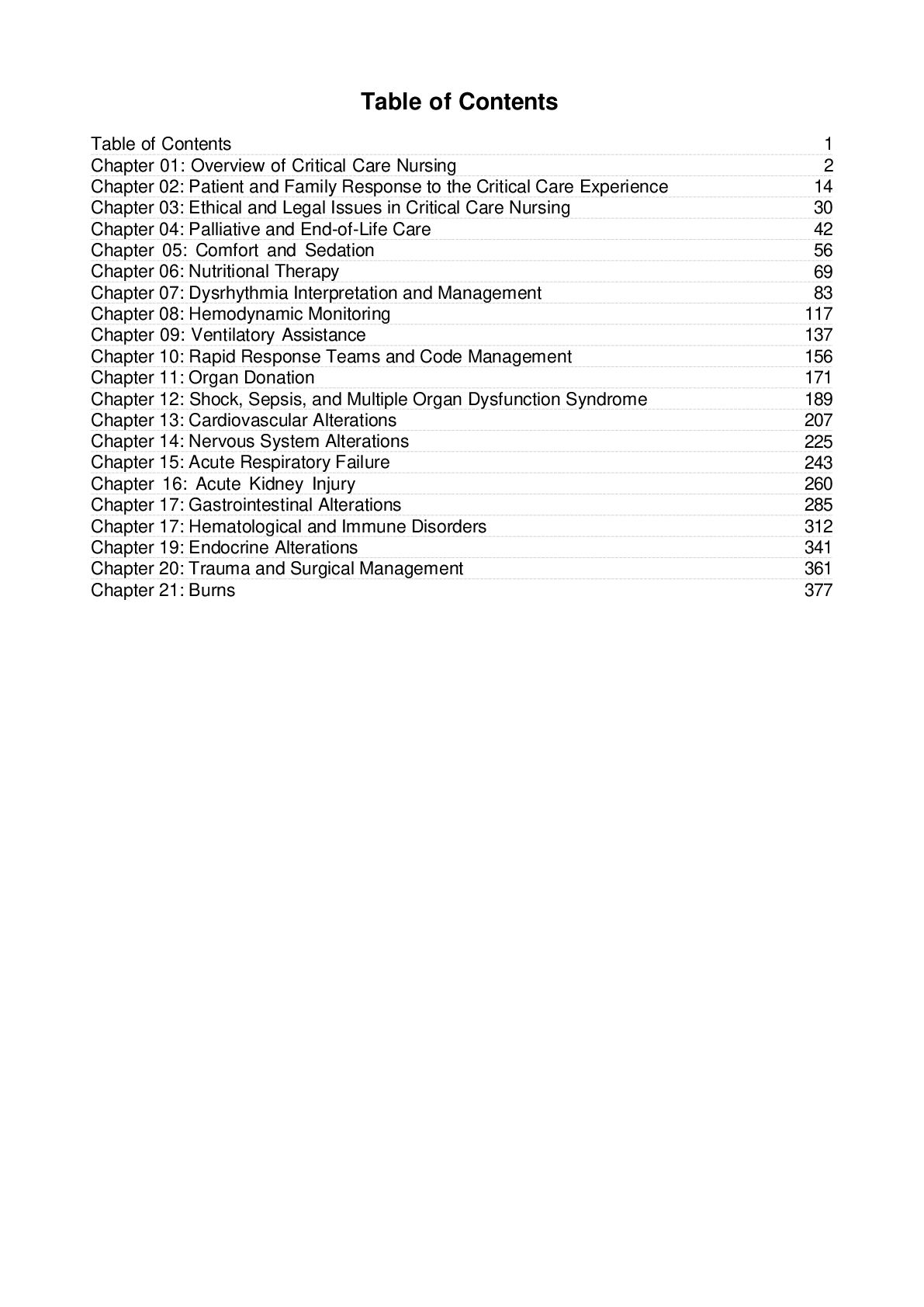
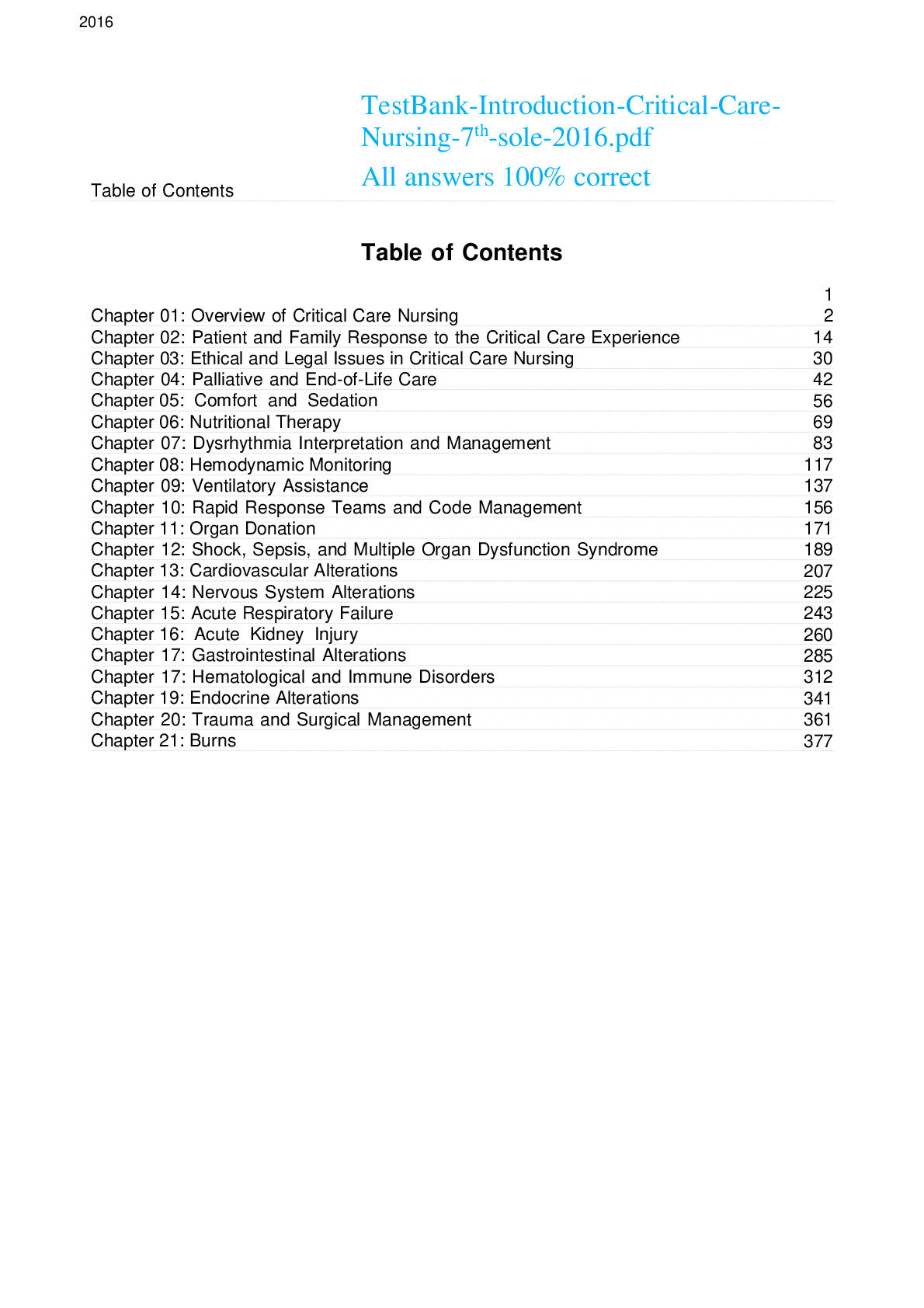
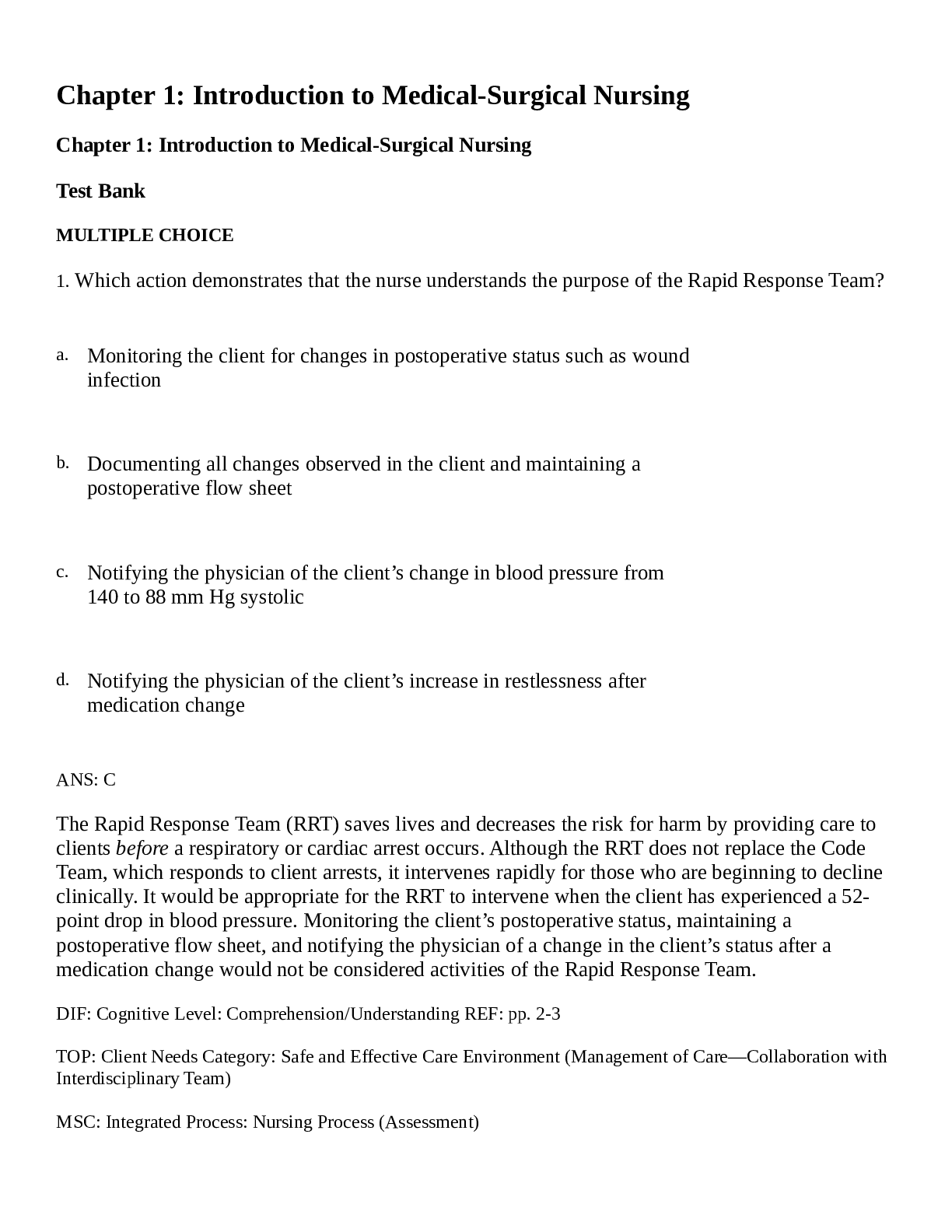
 UPDATED ON MARCH 19, 2022, BSN, R.png)