LEG 100 - Week 3 Quiz 1 test questions with answers version 1-4 2020
Question 1
If the President vetoes a bill and if both the House and Senate repass the bill by a two-thirds margin, the bill becomes law.
...
LEG 100 - Week 3 Quiz 1 test questions with answers version 1-4 2020
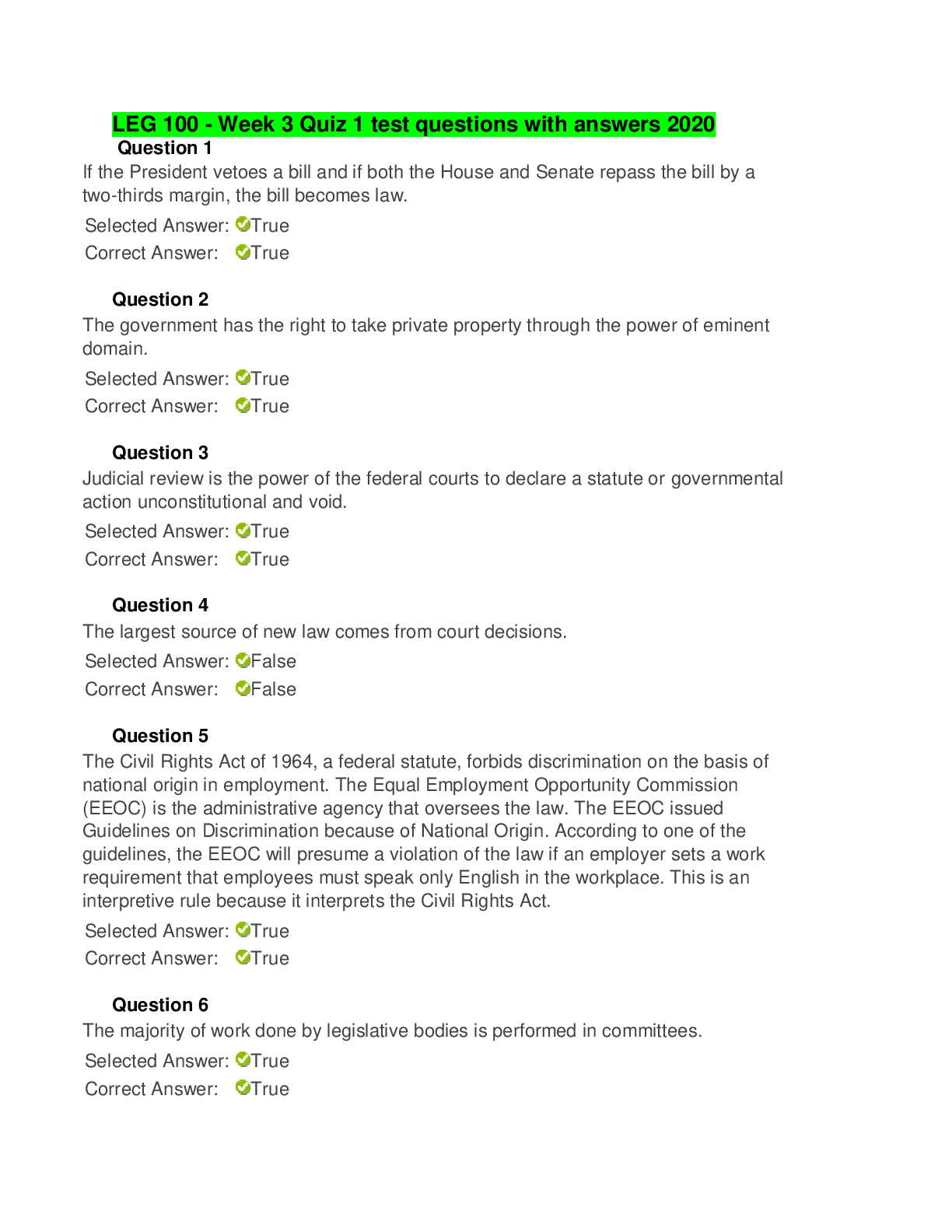
Question 1
If the President vetoes a bill and if both the House and Senate repass the bill by a two-thirds margin, the bill becomes law.
Question 2
The government has the right to take private property through the power of eminent domain.
Question 3
Judicial review is the power of the federal courts to declare a statute or governmental action unconstitutional and void.
Question 4
The largest source of new law comes from court decisions.
Question 5
The Civil Rights Act of 1964, a federal statute, forbids discrimination on the basis of national origin in employment. The Equal Employment Opportunity Commission (EEOC) is the administrative agency that oversees the law. The EEOC issued Guidelines on Discrimination because of National Origin. According to one of the guidelines, the EEOC will presume a violation of the law if an employer sets a work requirement that employees must speak only English in the workplace. This is an interpretive rule because it interprets the Civil Rights Act.
Question 6
The majority of work done by legislative bodies is performed in committees.
Question 7
The doctrine of stare decisis, though vital to the creation of the common law when this country was settled, is not important to our modern, complex society.
Question 8
Wilfred was driving too fast for the icy road conditions and hit Sally's car. Sally can sue Wilfred in criminal court.
Question 9
Congress passed a law imposing penalties for displaying "indecent" material online where children could see it. If the U.S. Supreme Court subsequently rules that the statute conflicts with the First Amendment of the U.S. Constitution, the statute is void.
Question 10
In 1994, the Arizona Supreme Court decided the case of Hernandez v. Arizona Board of Regents and found a duty of care to avoid furnishing alcohol to underage consumers. If in 2008 a Flagstaff, Arizona plaintiff brings a lawsuit against an Arizona university’s fraternity for providing alcohol to members under the legal drinking age, the Hernandez v. Arizona Board of Regents case will serve as precedent.
Question 11
If the President vetoes a bill, it can still become law if both the House and the Senate approve it with a 51% majority.
Question 12
In order to determine if the case she was hearing broke the law, Judge Jane referred to prior rulings on the same subject. In other words, the judge is relying on precedent to make her decision.
Question 13
DoorWay Computers, Inc., the trademark owner of "DoorWay," sought a court injunction to prevent Handyman Hardware, Inc. from using the domain name, "DoorWay.com." A jury will decide whether DoorWay is entitled to this remedy.
Question 14
The Occupational Safety and Health Administration promulgated a rule requiring warehouse employees to wear hardhats when in the vicinity of an operating forklift. The purpose of the hardhats is to protect employees from danger of falling objects. This rule is
Question 15
Jurisdiction can be described as
Question 16
In order for a federal court to have jurisdiction, there must be a federal question involved and at least $75,000 in dispute.
Question 17
Primary methods of alternative dispute resolution include litigation and mediation.
Question 18
In reaching their verdicts, appellate courts conduct trials and rehear all evidence.
Question 19
A _______ is a ruling by the court that no trial is necessary because there are no essential facts in dispute.
Question 20
After being served with a summons and a copy of the complaint, a defendant usually files a pleading known as an answer, briefly replying to each allegation in the complaint.
Version 2
Question 1
In a civil case, the plaintiff must prove the case
Question 2
A _______ is a ruling by the court that no trial is necessary because there are no essential facts in dispute.
Question 3
In order for a federal court to have jurisdiction, there must be a federal question involved and at least $75,000 in dispute.
Question 4
Primary methods of alternative dispute resolution include litigation and mediation.
Question 5
According to your text, the biggest change in litigation in the last decade has been
Question 6
In reaching their verdicts, appellate courts conduct trials and rehear all evidence.
Question 7
The government has the right to take private property through the power of eminent domain.
Question 8
If the President vetoes a bill and if both the House and Senate repass the bill by a two-thirds margin, the bill becomes law.
Question 9
The largest source of new law comes from court decisions.
Question 10
The majority of work done by legislative bodies is performed in committees.
Question 11
The Civil Rights Act of 1964, a federal statute, forbids discrimination on the basis of national origin in employment. The Equal Employment Opportunity Commission (EEOC) is the administrative agency that oversees the law. The EEOC issued Guidelines on Discrimination because of National Origin. According to one of the guidelines, the EEOC will presume a violation of the law if an employer sets a work requirement that employees must speak only English in the workplace. This is an interpretive rule because it interprets the Civil Rights Act.
Question 12
The doctrine of stare decisis, though vital to the creation of the common law when this country was settled, is not important to our modern, complex society.
Question 13
The amendments to the U.S. Constitution protect the people from the power of state and federal governments.
Question 14
In 1994, the Arizona Supreme Court decided the case of Hernandez v. Arizona Board of Regents and found a duty of care to avoid furnishing alcohol to underage consumers. If in 2008 a Flagstaff, Arizona plaintiff brings a lawsuit against an Arizona university’s fraternity for providing alcohol to members under the legal drinking age, the Hernandez v. Arizona Board of Regents case will serve as precedent.
Question 15
DoorWay Computers, Inc., the trademark owner of "DoorWay," sought a court injunction to prevent Handyman Hardware, Inc. from using the domain name, "DoorWay.com." A jury will decide whether DoorWay is entitled to this remedy.
Question 16
In order to determine if the case she was hearing broke the law, Judge Jane referred to prior rulings on the same subject. In other words, the judge is relying on precedent to make her decision.
Question 17
If the President vetoes a bill, it can still become law if both the House and the Senate approve it with a 51% majority.
Question 18
The three branches of government in the United States are
Question 19
Wilfred was driving too fast for the icy road conditions and hit Sally's car. Sally can sue Wilfred in criminal court.
Question 20
The Occupational Safety and Health Administration promulgated a rule requiring warehouse employees to wear hardhats when in the vicinity of an operating forklift. The purpose of the hardhats is to protect employees from danger of falling objects. This rule is
Version 3
Question 1
In order to determine if the case she was hearing broke the law, Judge Jane referred to prior rulings on the same subject. In other words, the judge is relying on precedent to make her decision.
Question 2
Wilfred was driving too fast for the icy road conditions and hit Sally's car. Sally can sue Wilfred in criminal court.
Question 3
The Occupational Safety and Health Administration promulgated a rule requiring warehouse employees to wear hardhats when in the vicinity of an operating forklift. The purpose of the hardhats is to protect employees from danger of falling objects. This rule is
Question 4
Congress passed a law imposing penalties for displaying "indecent" material online where children could see it. If the U.S. Supreme Court subsequently rules that the statute conflicts with the First Amendment of the U.S. Constitution, the statute is void.
Question 5
Deontologists would agree that the increasing medical concern over obesity in the United States justifies federal regulation of high fat, high sugar, low nutrition food advertising during children’s television programs.
Question 6
Unethical behavior is a bar to financial success.
Question 7
Which of the following statements best exemplifies how society as a whole benefits from ethical behavior?
Question 8
John Rawls' suggestion that society should reward behavior that provides the most benefit to the community as a whole is referred to as
Question 9
According to your text, the biggest change in litigation in the last decade has been
Question 10
Jurisdiction can be described as
Question 11
A _______ is a ruling by the court that no trial is necessary because there are no essential facts in dispute.
Question 12
Primary methods of alternative dispute resolution include litigation and mediation.
Question 13
The Miranda warning insures that the criminal suspects understand their constitutional rights relating to
Question 14
A misdemeanor is distinguished from a felony based upon
Question 15
Every criminal defendant has a right to a jury trial.
Question 16
The Federal sentencing guidelines are just guidelines. Judges do not have to follow them.
Question 17
The doctrine of stare decisis, though vital to the creation of the common law when this country was settled, is not important to our modern, complex society.
Question 18
Judicial review is the power of the federal courts to declare a statute or governmental action unconstitutional and void.
Question 19
If the President vetoes a bill and if both the House and Senate repass the bill by a two-thirds margin, the bill becomes law.
Question 20
The amendments to the U.S. Constitution protect the people from the power of state and federal governments.
Sunday, July 19, 2015
Version 4
Question 1
A misdemeanor is distinguished from a felony based upon
Question 2
When a judge orders a criminal defendant to reimburse the victim, it is called
Question 3
The Miranda warning insures that the criminal suspects understand their constitutional rights relating to
Question 4
The parties to a criminal trial are the government and the defendant.
Question 5
The Civil Rights Act of 1964, a federal statute, forbids discrimination on the basis of national origin in employment. The Equal Employment Opportunity Commission (EEOC) is the administrative agency that oversees the law. The EEOC issued Guidelines on Discrimination because of National Origin. According to one of the guidelines, the EEOC will presume a violation of the law if an employer sets a work requirement that employees must speak only English in the workplace. This is an interpretive rule because it interprets the Civil Rights Act.
Question 6
If the President vetoes a bill and if both the House and Senate repass the bill by a two-thirds margin, the bill becomes law.
Question 7
The majority of work done by legislative bodies is performed in committees.
Question 8
Judicial review is the power of the federal courts to declare a statute or governmental action unconstitutional and void.
Question 9
In reaching their verdicts, appellate courts conduct trials and rehear all evidence.
Question 10
In order for a federal court to have jurisdiction, there must be a federal question involved and at least $75,000 in dispute.
Question 11
Jurisdiction can be described as
Question 12
According to your text, the biggest change in litigation in the last decade has been
Question 13
In order to determine if the case she was hearing broke the law, Judge Jane referred to prior rulings on the same subject. In other words, the judge is relying on precedent to make her decision.
Question 14
DoorWay Computers, Inc., the trademark owner of "DoorWay," sought a court injunction to prevent Handyman Hardware, Inc. from using the domain name, "DoorWay.com." A jury will decide whether DoorWay is entitled to this remedy.
Question 15
If the President vetoes a bill, it can still become law if both the House and the Senate approve it with a 51% majority.
Question 16
The three branches of government in the United States are
Question 17
Utilitarian ethics holds that decisions should be made on the basis of practicality, and whatever action is most convenient should be favored.
Question 18
John Rawls' suggestion that society should reward behavior that provides the most benefit to the community as a whole is referred to as
Question 19
Which of the following statements best exemplifies how society as a whole benefits from ethical behavior?
Question 20
Deontologists would agree that the increasing medical concern over obesity in the United States justifies federal regulation of high fat, high sugar, low nutrition food advertising during children’s television programs.
[Show More]



 answers.png)


