Longitudinal Waves Lab | all answers are 100% correct | 7 pages
Document Content and Description Below
2. Identify: Longitudinal waves have two important features. Compressions are regions where
particles are squished together. Rarefactions are regions where particles are spread apart.
In your diagram above, draw a red
...
[Show More]
Last updated: 3 years ago
Preview 1 out of 7 pages
Instant download

Buy this Document to get the Full Access Instantly
Provided by Students Who Aced it
We Verify Document Content to Gurantee Accuracy
Reviews( 0 )
Document information
Connected school, study & course
About the document
Uploaded On
Aug 25, 2022
Number of pages
7
Written in
All

Additional information
This document has been written for:
Uploaded
Aug 25, 2022
Downloads
0
Views
222
Document Keyword Tags
Recommended For You
Get more on GIZMOS »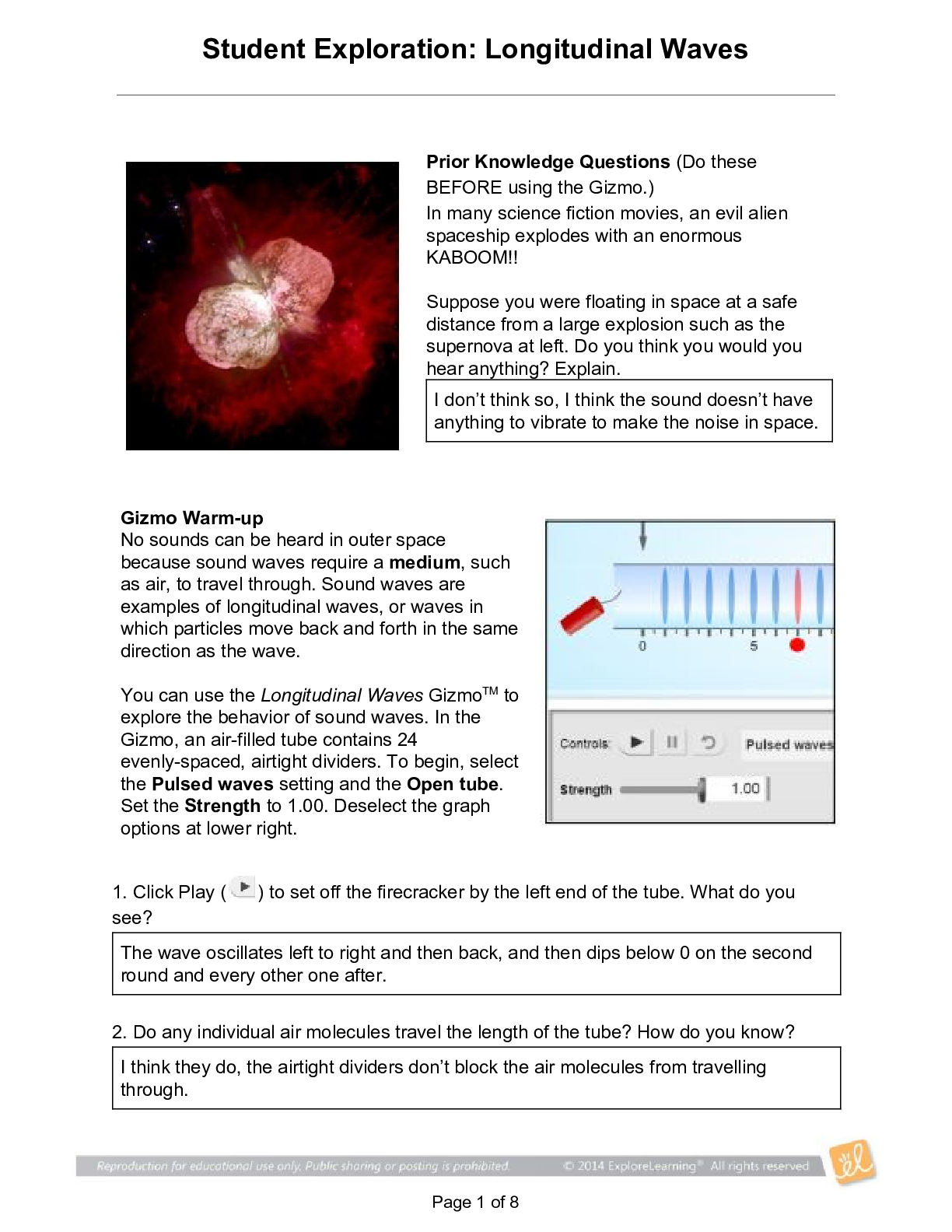
$8
8 Pages
Student Exploration Longitudinal Waves | answers are 100% corr...
$7
20 Pages
University of California, Los AngelesPHYSICS 6CFall 2011 Midte...

$13
609 Pages
Maternal-Child-Nursing-5th-Edition-by-McKinney TESTBANK ( COMP...

$15
412 Pages
Lowdermilk-Maternity and Womens Health Care TESTBANK ( COVERS...
$15
367 Pages
Medical-Surgical Nursing- Concepts and Practice 3th Edition de...


$8
4 Pages
Gizmos_Solubility_and_Temperature ( ALL ANSWERS ARE 100% CORRE...

$11
15 Pages
HESI RN V1-V3. Mental Health. Questions and Answers all are 10...
$65
55 Pages
HESI A2 All-Inclusive (2025) - Test Items & Correct Answers fo...
$8
2 Pages
BIO 202L LAB 15 WORKSHEET Electrolytes, Water, Acids & Bases |...
$22
713 Pages
Test Bank for Physics for Scientists and Engineers A Strategic...


More related documents below

 (1).png)

.png)

.png)

.png)

