Firefighter 1 Final Test 2022(Scored 100%)
What is the mission of the fire service? (21)
A. To provide a variety of services
B. To determine how fire loss occurs
C. To save lives and protect property
D. To reg
...
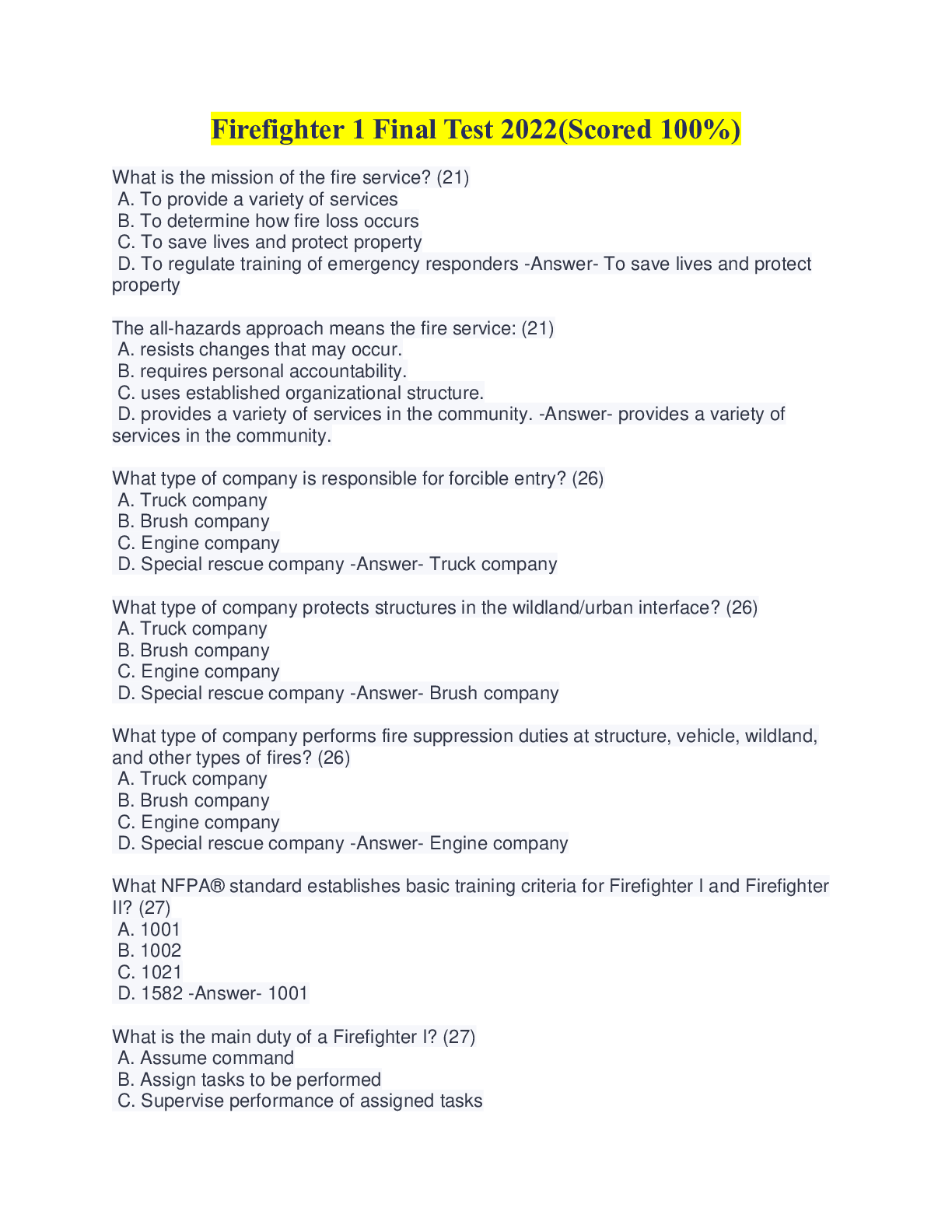
Firefighter 1 Final Test 2022(Scored 100%)
What is the mission of the fire service? (21)
A. To provide a variety of services
B. To determine how fire loss occurs
C. To save lives and protect property
D. To regulate training of emergency responders -Answer- To save lives and protect property
The all-hazards approach means the fire service: (21)
A. resists changes that may occur.
B. requires personal accountability.
C. uses established organizational structure.
D. provides a variety of services in the community. -Answer- provides a variety of services in the community.
What type of company is responsible for forcible entry? (26)
A. Truck company
B. Brush company
C. Engine company
D. Special rescue company -Answer- Truck company
What type of company protects structures in the wildland/urban interface? (26)
A. Truck company
B. Brush company
C. Engine company
D. Special rescue company -Answer- Brush company
What type of company performs fire suppression duties at structure, vehicle, wildland, and other types of fires? (26)
A. Truck company
B. Brush company
C. Engine company
D. Special rescue company -Answer- Engine company
What NFPA® standard establishes basic training criteria for Firefighter I and Firefighter II? (27)
A. 1001
B. 1002
C. 1021
D. 1582 -Answer- 1001
What is the main duty of a Firefighter I? (27)
A. Assume command
B. Assign tasks to be performed
C. Supervise performance of assigned tasks
D. Perform assigned tasks under supervision -Answer- Perform assigned tasks under supervision
Which of the following fire service organizational principles works to prevent duplication of effort? (33)
A. Span of control
B. Division of labor
C. Unity of command
D. Chain of command -Answer- Division of labor
In 2010 the leading causes of fire fatalities were: (46)
A. live fire training.
B. overexertion and falls.
C. stress and overexertion.
D. overexertion and being struck by an object. -Answer- stress and overexertion.
Which of the following NFPA® standards establishes the design criteria for protective clothing and equipment? (55)
A. 1403
B. 1582
C. 1851
D. 1977 -Answer- 1977
The risk management model assumes that responders will risk their lives ___ to save savable lives. (62)
A. a lot
B. a little
C. not at all
D. sometimes -Answer- a lot
Firefighters should ___ and put all tools in a ready state before storing. (76)
A. inspect, clean,
B. modify, clean,
C. modify as needed
D. inspect as needed -Answer- inspect, clean,
Any power tool not marked double insulated should: (76)
A. have a two-prong plug.
B. have a three-prong plug.
C. not ever be used outside.
D. not ever be used with an extension cord. -Answer- have a three-prong plug.
Which of the following is a way to prevent accidents with power saws? (76)
A. Use whatever saw is most convenient
B. Refuel gasoline-powered saws immediately
C. Store blades and cutting chains separately
D. Keep blades and cutting chains well sharpened -Answer- Keep blades and cutting chains well sharpened
Which of the following BEST describes the action first taken after an alert to the station? (101)
A. Recording of incident information
B. Processing of post incident paperwork
C. Dispatching of emergency services responders
D. Training of emergency responders for annual certification -Answer- Dispatching of emergency services responders
Which of the following regulates all radio communication in the United States? (109)
A. Public Safety Answering Point (PSAP)
B. Federal Communications Commission (FCC)
C. National Fire Incident Reporting System (NFIRS)
D. Emergency Service Specific Telecommunications Center -Answer- Federal Communications Commission (FCC)
The use of ten-codes in radio transmissions was replaced when agencies began to adopt which of the following? (109)
A. Incident Action Plan (IAP)
B. Incident Command System (ICS)
C. National Fire Protection Association (NFPA®)
D. National Incident Management System (NIMS) -Answer- National Incident Management System (NIMS)
Which of the following terms refers to a substance remaining chemically the same, but changing in size, shape or appearance? (208)
A. Chemical shift
B. Physical change
C. Chemical reaction
D. Parallel alteration -Answer- Physical change
When a substance changes from one type of matter to another, it has had a: (208)
A. chemical shift.
B. physical change.
C. chemical reaction.
D. physical alteration. -Answer- chemical reaction.
Which of the following represents the amount of energy that an object can release in the future? (209)
A. Kinetic
B. Thermal
C. Potential
D. Mechanical -Answer- Potential
The energy possessed by a moving object is called: (209)
A. kinetic energy.
B. thermal energy.
C. potential energy.
D. mechanical energy. -Answer- kinetic energy.
The potential chemical energy of fuel in fire behavior is converted to: (209)
A. sound energy.
B. thermal energy.
C. electrical energy.
D. mechanical energy. -Answer- thermal energy.
The process of ignition causes pyrolysis in solid fuels and ___ in liquid fuels. (210)
A. melting
B. freezing
C. vaporization
D. kinetic reaction -Answer- vaporization
What product of combustion causes the most fire deaths? (215)
A. Toxic smoke
B. Thermal energy
C. Carbon dioxide
D. Hydrogen cyanide -Answer- Toxic smoke
What product of combustion is the most common product in structure fires? (215)
A. Toxic smoke
B. Thermal energy
C. Hydrogen cyanide
D. Carbon monoxide -Answer- Carbon monoxide
[Show More]