NSG 6430 Womens Health. Week 1 to Week 10 Knowledge Check Quizzes Compilation. Scored 100%. South University.
Question 1 (1 point)
The nurse practitioner student is preparing for an upcoming exam and understands tha
...
NSG 6430 Womens Health. Week 1 to Week 10 Knowledge Check Quizzes Compilation. Scored 100%. South University.
Question 1 (1 point)
The nurse practitioner student is preparing for an upcoming exam and understands that the Tanner Scale includes ____ stages of sexual maturity
Question 1 options:
3 stages
5 stages
6 stages
8 stages
Question 2 (1 point)
What approach does Health People 2020 use to achieve its goals and objectives?
Question 2 options:
Social determinants of health
Evidence-based determinants of health
Quality-of-life determinants of health
Longevity promotion determinants of health
Save
Next Page
Question 3 (1 point)
The nurse practitioner is performing a speculum exam on a 42 year-old female patient. Which reproductive anatomy should be assessed during the speculum exam? Select all that apply.
Question 3 options:
ovaries
cervix
vagina
clitoris
Question 4 (1 point)
The nurse practitioner is interviewing a new patient to the practice. Which of the following should not be a part of taking a health history?
Question 4 options:
Taking a family health history
Seeking information on stressors or personal problems
Asking about exercise and sleep patterns
Counseling for tobacco-use cessation
Save
Next Page
Question 5 (1 point)
The nurse practitioner is reviewing the U.S. Preventative Services Task Force (USPSTF) recommendations. What does a service grade of D represent?
Question 5 options:
Service carries insufficient evidence to recommend it
Service is found to be beneficial
Service is found to be either of no benefit or potentially harmful
Service should not be routinely provided
Week 2 knowledge check NSG 6430 South University
A patient has been diagnosed with secondary dysmenorrhea. Which of the following statements is true regarding the diagnosis?
Question 1 options:
Absence of menstruation due to an underlying pathology.
Painful menstruation in the absence of pathology.
An underlying pathology causing pain symptoms during menstrual flow.
Painful menstruation that occurs in women after the age of 35.
The nurse practitioner understands that which of the following pharmacologic therapies is an effective treatment for patients with PMS and PMDD?
Question 2 options:
SSRIs
MAO Inhibitors
Acetaminophen
B complex vitamins
The nurse practitioner understands that the following classification is used to standardize Abnormal Uterine Bleeding related to structural etiology:
Question 3 options:
COIEN
PALM
Bethesda System
ASC-US
The nurse practitioner student is studying the ovarian cycle of the woman. Which of the following phases are comprised in the ovarian cycle? Select all that apply.
Question 4 options:
Follicular
Proliferative
Luteal
Secretory
What is a good first question for the nurse practitioner to ask a woman who presents with a concern about abnormal bleeding?
Question 5 options:
What is a normal pattern for you?
How long has this persisted?
What was your last menstrual cycle like?
How many times has this occurred?
100%
Week 3 knowledge check NSG 6430 South University
The nurse practitioner is prescribing a depot medroxyprogesterone acetate (DMPA) injection for a patient. This medication is given at _______ week intervals.
Question 1 options:
3
6
9
12
When comparing COCs to the contraceptive patch and vaginal ring, which of the following statements by the nurse practitioner is correct?
Question 2 options:
The ring, patch, and COCs have the same theoretical efficacy.
The vaginal ring offers more opportunity for user error.
The patch has lower failure rates in obese women.
COCs have fewer variety of formulations.0
Although barrier contraception methods are less effective in preventing pregnancy than more modern methods, the nurse practitioner understands that interest in barrier methods is on the rise because they:
Question 3 options:
can help protect against STIs, including HIV
are coitus dependent and require planning
are nonallergenic and male controlled
involve the use of hormones
The nurse practitioner is discussing contraceptive efficacy with a patient. This term refers to:
Question 4 options:
The rate of success in those who are spacing their pregnancies.
The likelihood of pregnancy when a method is used exactly as prescribed.
The number of pregnancies when a method is used improperly or inconsistently.
The likelihood of user failure or typical-use failure rates in different populations.
A patient is being counseled about emergency contraceptive methods. All of the following methods may be used for emergency contraception except:
Question 5 options:
Copper IUD
Ulipristal acetate
Yuzpe regimen
Progestin implant
Made 100%
Week 4 knowledge check NSG 6430 South University
A patient is diagnosed with cyclic mastalgia. Which of the following statements is true regarding the diagnosis?
Question 1 options:
It more likely causes unilateral, localized pain that is sharp or burning in nature.
It has an increased risk of occurrence in women whose diets are low in fat.
It occurs most frequently in women who are 18 to 30 years old.
It is caused by hormonal changes associated with menstruation.
Next Page
The nurse practitioner understands that a woman’s lifetime risk of being diagnosed with breast cancer is:
Question 2 options:
1 in 3
1 in 8
1 in 29
1 in 233
The nurse practitioner understands that a patient with hyperandrogenism may present with which of the following?
Question 3 options:
Irritable bowel syndrome
Decreased sebum secretion in the skin
Decreased muscle mass
Acne associated with menstrual dysfunction
For women younger than 35, infertility is defined as failure to achieve a successful pregnancy after __________ of regular unprotected intercourse.
Question 4 options:
6 weeks
6 months
12 weeks
12 months
The nurse practitioner is examining a woman with excessive terminal hair growth, which is known as:
Question 5 options:
Hirsutism
Alopecia
Viralization
Hyperthecosis
Week 5 knowledge check NSG 6430 South University
The nurse practitioner is assessing a patient in her last month of pregnancy. Lightening typically occurs during this time, in which the height of the __________ drops slightly.
Question 1 options:
alveoli
cervix
umbilicus
fundus
The nurse practitioner is performing a pelvic exam on a new OB patient. The cervix shows Goodell’s sign when __________; and it shows Chadwick’s sign when __________.
Question 2 options:
it thickens; the mucus plug forms
it turns bluish in color; the mucus plug forms
it softens; it turns bluish in color
hyperplasia occurs; it becomes firm to palpation
The nurse practitioner is providing prenatal education regarding pregnancy signs and symptoms. Which of the following is not a sign or symptom associated with pregnancy in the first 6 to 8 weeks?
Question 3 options:
Breast tenderness
Urinary frequency
Migraine headaches
Nausea and vomitting
The nurse practitioner understands that Group B Streptococcus and Escherichia coli are the primary causes of ____________ during pregnancy.
Question 4 options:
urinary tract infections
miscarriage
toxoplasmosis
vaginal bleeding
After delivery, the nurse practitioner understands the process by which the uterus returns to a pre-pregnant state is called:
Question 5 options:
Involution
deciduation
dilation
adaptation
100 %
Week 6 knowledge check NSG 6430 South University
Lichen sclerosis is a benign, chronic, progressive disease of the skin in which the most common symptom reported by the patient is:
Question 1 options:
vulvar pruritis
vaginal discharge
postcoital bleeding
dyspareunia
The nurse practitioner educates a patient recently diagnosed with a functional ovarian cyst that it will resolve within:
Question 2 options:
six months
three months
six weeks
one year
A patient presents with intense pelvic pain that is less than three months’ duration. The correct term for this type of pain is:
Question 3 options:
Terminal pelvic pain
Cyclic pelvic pain
Chronic pelvic pain
Acute pelvic pain
The nurse practitioner student was taught to use the mnemonic “OLD CAARTS” when performing a pain history on a patient. What does the “S” stand for?
Question 4 options:
Severity
Scale
Somatic
Superficial
Janice is being evaluated due to her complaint of chronic pelvic pain. The nurse practitioner informs her that one of the most common gynecological-related causes of chronic pelvic pain is:
Question 5 options:
Cervical cancer
Amenorrhea
Dysmenorrhea
Endometriosis
100%
Week 7 knowledge check NSG 6430 South University
Question 1 (1 point)
Saved
Kristin presents for an office visit due to an abnormal discharge with a fishy odor. What is the likely diagnosis for Kristin based on her presenting symptoms?
Question 1 options:
Candidiasis
Condyloma Accuminata
Bacterial Vaginosis
Cervicitis
Question 2 (1 point)
Saved
Which organism causes 90% of vulvovaginal candidiasis episodes in women?
Question 2 options:
Candida tropicalis
Candida albicans
Candida glabrata
Candida krusei
The nurse practitioner is reviewing reproductive anatomy and understands that the Bartholin’s glands are located within the posteriorlateral vulvar vestibule at ______ and _______.
Question 3 options:
11:00 and 1:00
9:00 and 3:00
12:00 and 6:00
5:00 and 7:00
Microscopic exam of the vaginal secretions of a patient with chlamydia may reveal the presence of numerous _____________.
Question 4 options:
pseudohyphae
clue cells
white blood cells
lactobacilli
Next Page
The nurse practitioner understands that an alternative term sometimes used in place of intimate partner violence is ___________.
Question 5 options:
domestic violence
sexual assault
rape
neglect
Week 8 knowledge check NSG 6430 South University
Which of the following tests should the nurse practitioner order for HIV confirmation?
Question 1 options:
EIA
ELISA
Western blot
CD4 count
Which one of the following is the definition of the term gender identity?
Question 2 options:
People who respond erotically to both sexes
A self-label, regardless of biologic or natal sex
People who are similar in age, class, and sexual status
A label for behavior not usually associated with one’s natal sex
Which one of the following is not among the ways clinicians can provide a welcoming, safe environment for LBQT patients?
Question 3 options:
Avoid the heterosexual assumption by using gender-neutral language.
Explain whether and how information will be documented in the patient’s medical record.
Ignore the sexual status or gender identity of all patients.
Offer mainstream referrals that are culturally sensitive to this population.
The factors that enable women to enjoy and control their sexual and reproductive lives, including a physical and emotional state of well-being and the quality of sexual and other close relationships, make up a woman’s:
Question 4 options:
sexual health
gender identity
gender role behaviors
psychosocial orientation
The nurse practitioner may include any of the following methods when managing sexual arousal disorders in women except:.
Question 5 options:
treatments that decrease blood flow to the genital tissues.
the use of vaginal lubricants to increase stimulation.
use of the Eros-CTD, a clitoral therapy device.
localized estrogen therapy.
100%
Week 9 knowledge check NSG 6430 South University
Red highlight is correct answer 100% correct
Question 1.
The nurse practitioner is counseling a patient about midlife health issues in women and informs the patient that the number one cause of mortality in the United States is
Primary osteoporosis.
Cardiovascular disease.
overweight and obesity.
cancer (of the lung and bronchus, breast, and colon).
Question 2
The nurse practitioner understands that an age-related anatomic change that can lead to urinary incontinence is:
The shortening of the urethra
The reduction in bladder capacity
The increase in habitual preventative emptying of the bladder
The decline in number of urethral striated muscle fibers
The urethral striated muscle fiber is one of the anatomic structures that prevent urinary incontinence at the onset of abdominal pressure. The two anatomic structures that prevent urinary incontinence are; supportive system and sphincteric system. The urethral striated muscle fiber contributes to the closure of the vesical neck in the urethra to prevent incontinence. The urethral striated muscle fiber decreases as one age. This will have the effect of reducing the of the sphincter muscles to stand the abdominal pressure and prevent urinary incontinence. The shortening of the urethra only occurs in women and this means it does not happen for men. The change in the bladder capacity is a physiological change and not an anatomic change. For this reason, the decline in the number of urethral striated muscle fibers is the cause of urinary incontinence among the aged
3. Pelvic muscle contraction that is strategically timed to increase intraurethral pressure just before and after the event that causes urinary incontinence?
Kegel contraction
Detrusor maneuver
Reverse bladder contraction
Knack maneuver
Question 4
The nurse practitioner is evaluating a patient for pyelonephritis and understands it is distinguished from cystitis in that:
The infection has descended to the bladder.
The infection has ascended to the kidneys.
The infection is caused by E. coli bacteria.
The infection occurs only in pregnant women.
The nurse practitioner understands that pyelonephritis is distinguished from cystitis based on the ascendance to the kidney. Cystitis only affects the bladder while the pyelonephritis affects the kidneys. Both conditions are caused by E.coli bacteria
Question 5
The nurse practitioner is reviewing antibiotic treatment guidelines for uncomplicated lower UTIs and the latest recommendations include which of the following?
Seven-day regimens are now recommended.
Three times a day of oral antibiotics are now recommended.
Three-day regimens are now recommended.
A single dose is now recommended.
Week 10 knowledge check NSG 6430 South University
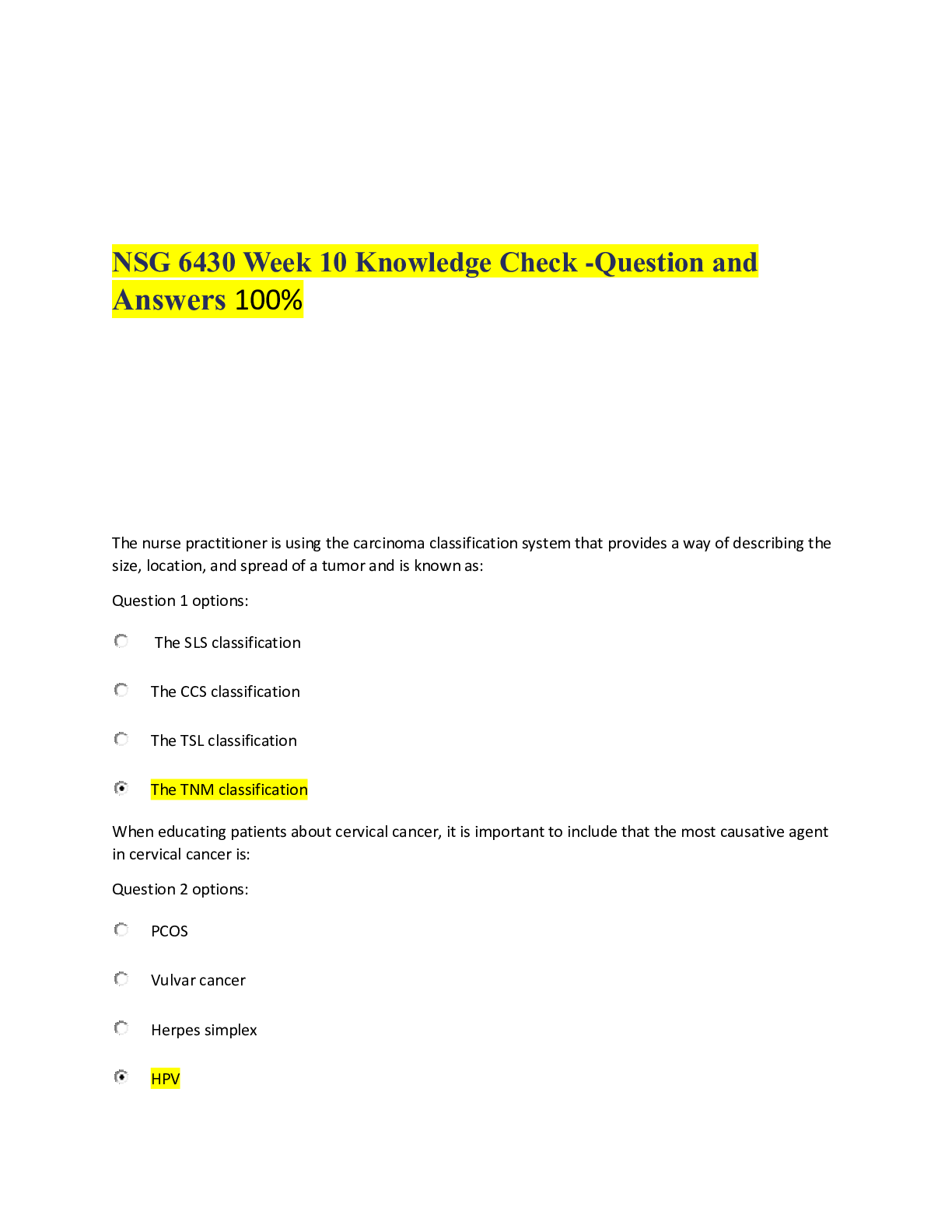
The nurse practitioner is using the carcinoma classification system that provides a way of describing the size, location, and spread of a tumor and is known as:
Question 1 options:
The SLS classification
The CCS classification
The TSL classification
The TNM classification
When educating patients about cervical cancer, it is important to include that the most causative agent in cervical cancer is:
Question 2 options:
PCOS
Vulvar cancer
Herpes simplex
HPV
Which of the following factors is correct when educating women about the causes of Type I endometrial cancer?
Question 3 options:
an excess of estrogen exposure
polyps in the endometrium
heredity
infertility treatments
When educating women about preventative measures against vulvar cancer, the nurse practitioner should include:
Question 4 options:
Avoiding exposure to HIV
Not smoking
There is no way to prevent it
Colposcopy
Save
Next Page
Page 4 of 5
________________________________________
The nurse practitioner understands that an early symptom of ovarian cancer is:
Question 5 options:
Vague abdominal pain
Ascites
Palpable pelvic mass
Vaginal bleeding
100%
[Show More]















.png)