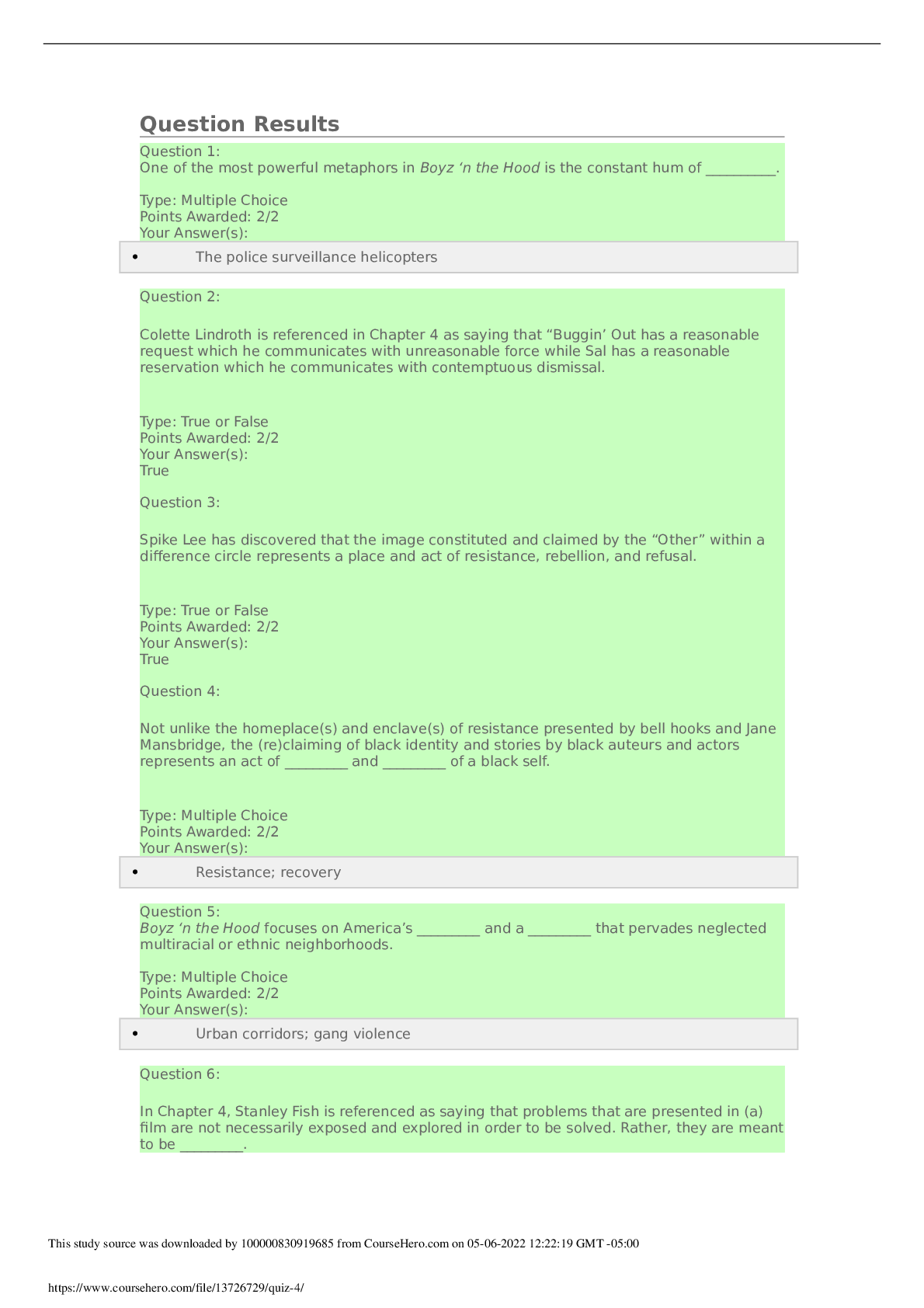
Question 1:
Colette Lindroth is referenced in Chapter 4 as saying that “Buggin’ Out has a
reasonable request which he communicates with unreasonable force while Sal has a
reasonable reservation which he communicates w
...
Question 1:
Colette Lindroth is referenced in Chapter 4 as saying that “Buggin’ Out has a
reasonable request which he communicates with unreasonable force while Sal has a
reasonable reservation which he communicates with contemptuous dismissal.
Question 2:
Spike Lee had hoped that Do the Right Thing would encourage a _________ on
racism that would possibly lead to a better understanding of race and then better race
relations.
Question 3: Recognition does not guarantee a common or universal understanding
among different people.
Question 4:
Perhaps the most visible partner and co-author in the Hood is the _________ and the
conditions that are created by an exercise of creating and maintaining ________ in
urban centers.
Question 5:
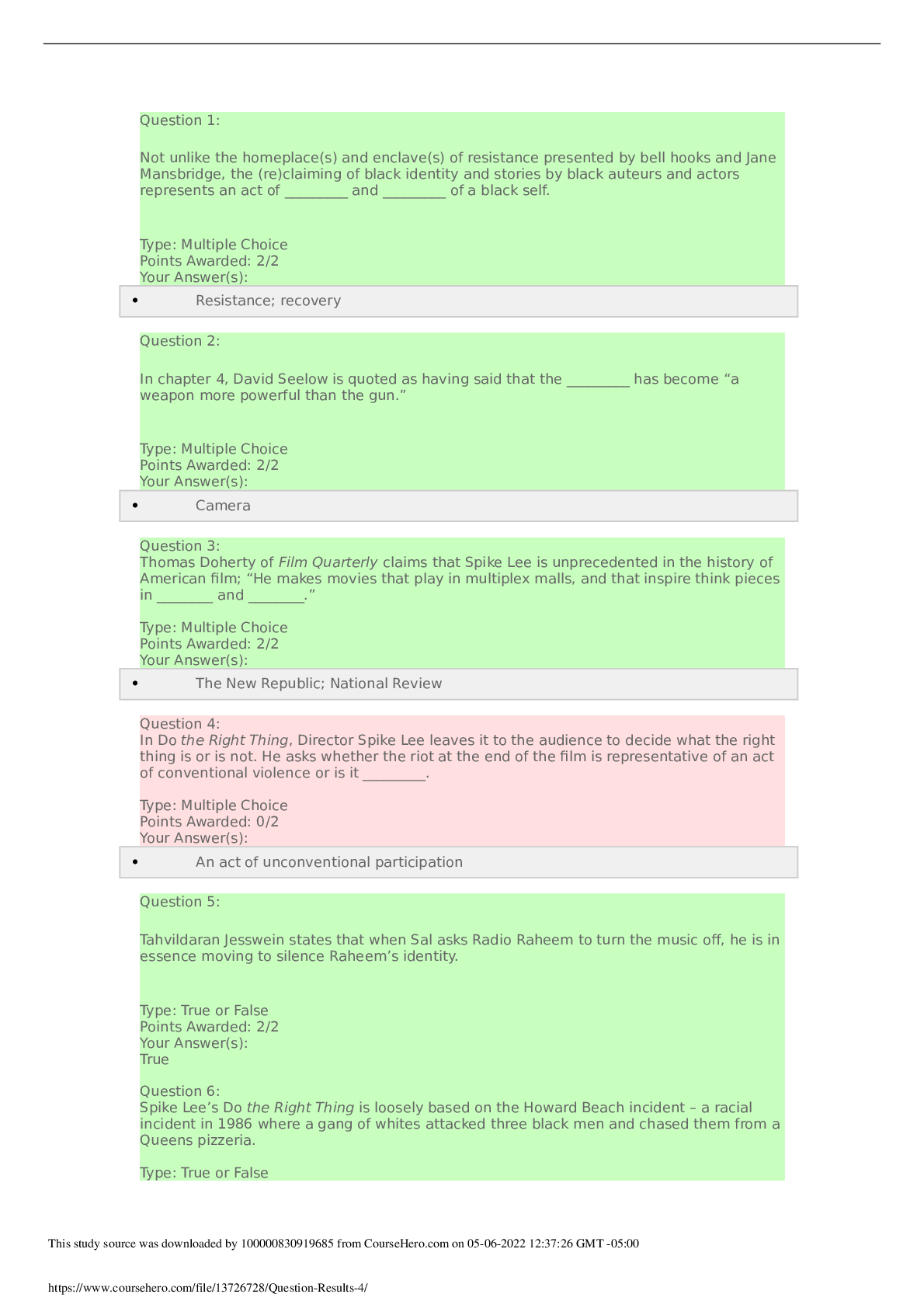
In chapter 4, David Seelow is quoted as having said that the _________ has become
“a weapon more powerful than the gun.”
• Camera
Question 6:
Spike Lee’s Do the Right Thing is loosely based on the Howard Beach incident – a
racial incident in 1986 where a gang of whites attacked three black men and chased
them from a Queens pizzeria.
Question 7:
Spike Lee’s works, and Do the Right Thing specifically, present the complexities of
both black and white identity from a _________ perspective.
• Black
Question 8:
In Do the Right Thing, Director Spike Lee juxtaposes the teaching of two historically
powerful black leaders. They are _________ and _________.
Question 9:
The way people view this film and how they reconcile the messages regarding
violence has a lot to do with a moviegoer’s experiences and memories.
Question 10:
Michael Dyson states that Boyz ‘n the Hood opens with both a ________ and
________ in a battle to reinterpret and redeem the Black male experience.
Question 11:
According to David Seelow, the helicopters in Boyz ‘n the Hood have the effect of a
social panoptican mobile enough to transform an entire metropolitan region into an
invisible prison.
Question 12:
Tahvildaran Jesswein states that when Sal asks Radio Raheem to turn the music off,
he is in essence moving to silence Raheem’s identity.
Question 13:
In Chapter 4, Stanley Fish is referenced as saying that problems that are presented in
(a) film are not necessarily exposed and explored in order to be solved. Rather, they
are meant to be _________.
Question 14:
Do the Right Thing is didactic and goes after, in a direct fashion, ________ in U.S.
culture and society.
Question 15:
In Do the Right Thing, Buggin’ Out, a would-be activist attempts a boycott of Sal’s
Famous Pizzeria. What is the premise behind the boycott?
Question 16:
The competing messages presented in Do the Right Thing illustrate a conflict between
two well-known philosophies regarding violence. Those philosophies can be
described as violence as a tool in the fight against racism in the protection of the self
(self-defense) and non-violence.
Question 17:
Not unlike the homeplace(s) and enclave(s) of resistance presented by bell hooks and
Jane Mansbridge, the (re)claiming of black identity and stories by black auteurs and
actors represents an act of _________ and _________ of a black self.
Question 18:
In Do the Right Thing, Spike Lee plays protagonist _________, a young man who is
working only to “get paid” as a delivery boy at _________.
Question 19:
Tahvildaran Jesswein argues that Spike Lee’s body of work is a revival in many ways
of Black Nationalism. In that he is presenting black identity and black film characters
through the eyes of a black director, actors, and film crews in resistance to an
historical Hollywood depiction of black Americans.
Question 20:
Spike Lee has discovered that the image constituted and claimed by the “Other”
within a difference circle represents a place and act of resistance, rebellion, and
refusal.
Question 21:
What song is continually playing on Radio Raheem’s “ghetto blaster”?
Question 22:
Thomas Doherty of Film Quarterly claims that Spike Lee is unprecedented in the
history of American film; “He makes movies that play in multiplex malls, and that
inspire think pieces in ________ and ________.”
Question 23:
Radio Raheem’s boom box or ghetto blaster represents his ________.
Question 24:
Boyz ‘n the Hood focuses on America’s _________ and a _________ that pervades
neglected multiracial or ethnic neighborhoods.
Question 25:
In John Singleton’s Boyz ‘n the Hood, the black male image is one fashioned and
focused on _________ and _________.
Question 1:
Perhaps the most visible partner and co-author in the Hood is the _________ and the
conditions that are created by an exercise of creating and maintaining ________ in
urban centers.
Question 2:
Spike Lee has discovered that the image constituted and claimed by the “Other”
within a difference circle represents a place and act of resistance, rebellion, and
refusal.
Question 3:
Spike Lee had hoped that Do the Right Thing would encourage a _________ on
racism that would possibly lead to a better understanding of race and then better race
relations.
Question 4:
In John Singleton’s Boyz ‘n the Hood, the black male image is one fashioned and
focused on _________ and _________.
Question 5:
Radio Raheem’s boom box or ghetto blaster represents his ________.
Question 6:
In Do the Right Thing, Director Spike Lee juxtaposes the teaching of two historically
powerful black leaders. They are _________ and _________.
Question 7:
Spike Lee’s Do the Right Thing is loosely based on the Howard Beach incident – a
racial incident in 1986 where a gang of whites attacked three black men and chased
them from a Queens pizzeria.
Question 8:
According to Tahvildaran Jesswein there are four difficult themes in Boyz ‘n the
Hood. They are: 1. The relationship between adult black men and women; 2.
Depiction of (a) single Black women; 3. Devastating effects of a crack economy; 4.
Public arts policies in Los Angeles.
Question 9: Recognition does not guarantee a common or universal understanding
among different people.
Question 10:
Do the Right Thing is didactic and goes after, in a direct fashion, ________ in U.S.
culture and society.
Question 11:
Tahvildaran Jesswein argues that Spike Lee’s body of work is a revival in many ways
of Black Nationalism. In that he is presenting black identity and black film characters
through the eyes of a black director, actors, and film crews in resistance to an
historical Hollywood depiction of black Americans.
Question 12:
Tahvildaran Jesswein states that when Sal asks Radio Raheem to turn the music off,
he is in essence moving to silence Raheem’s identity.
Question 13:
Thomas Doherty of Film Quarterly claims that Spike Lee is unprecedented in the
history of American film; “He makes movies that play in multiplex malls, and that
inspire think pieces in ________ and ________.”
Question 14:
The way people view this film and how they reconcile the messages regarding
violence has a lot to do with a moviegoer’s experiences and memories.
Question 15:
Michael Dyson states that Boyz ‘n the Hood opens with both a ________ and
________ in a battle to reinterpret and redeem the Black male experience.
Question 16:
Not unlike the homeplace(s) and enclave(s) of resistance presented by bell hooks and
Jane Mansbridge, the (re)claiming of black identity and stories by black auteurs and
actors represents an act of _________ and _________ of a black self.
Question 17:
In chapter 4, David Seelow is quoted as having said that the _________ has become
“a weapon more powerful than the gun.”
• Camera
Question 18:
The competing messages presented in Do the Right Thing illustrate a conflict between
two well-known philosophies regarding violence. Those philosophies can be
described as violence as a tool in the fight against racism in the protection of the self
(self-defense) and non-violence.
Question 19:
In Chapter 4, Stanley Fish is referenced as saying that problems that are presented in
(a) film are not necessarily exposed and explored in order to be solved. Rather, they
are meant to be _________.
• Experienced
Question 20:
In Do the Right Thing, Buggin’ Out, a would-be activist attempts a boycott of Sal’s
Famous Pizzeria. What is the premise behind the boycott?
Question 21:
Spike Lee’s works, and Do the Right Thing specifically, present the complexities of
both black and white identity from a _________ perspective.
Question 22:
Tahvildaran Jesswein, amongst others, characterizes Gus Van Sant’s My Own Private
Idaho as associative, and Spike Lee’s Do the Right Thing as _________, in that it
strives to promote social transformation through the engagement of difference via a
dialogue and a continued discussion or debate outside of the theatre.
Question 23:
John Singleton is committed to reclaiming a Black male voice and its rightful
partnership in the African American community.
Question 24:
John Singleton was influenced by white coming-of-age films like _________ and
_________.
Question 25:
The challenge for filmmakers who identify as being on the periphery, as black
independent filmmakers, is resisting consumption by a dominant cultural hegemon
and all that comes with that domination – socially and politically.
[Show More]
.png)





 5e William Bianco David Canon.png)