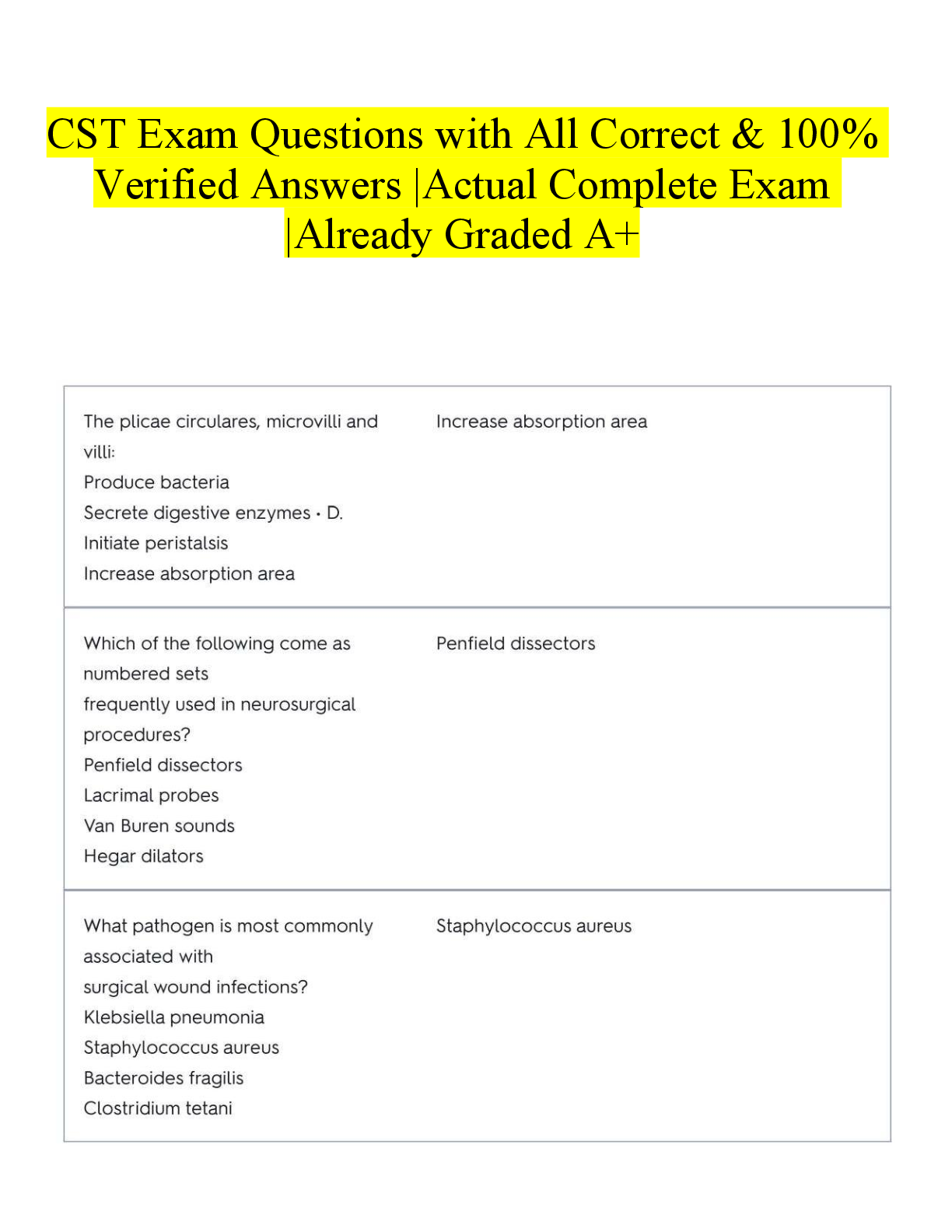
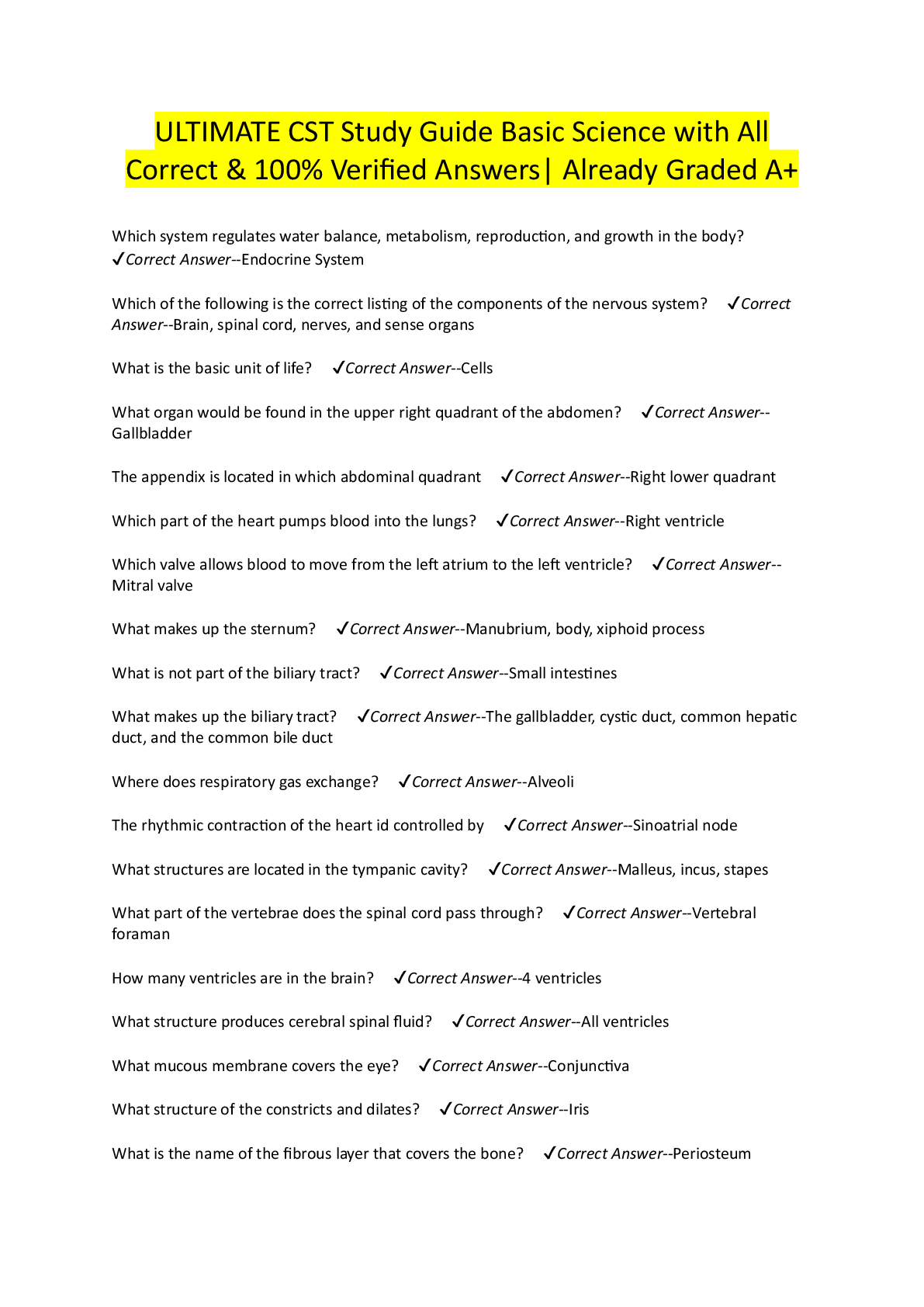
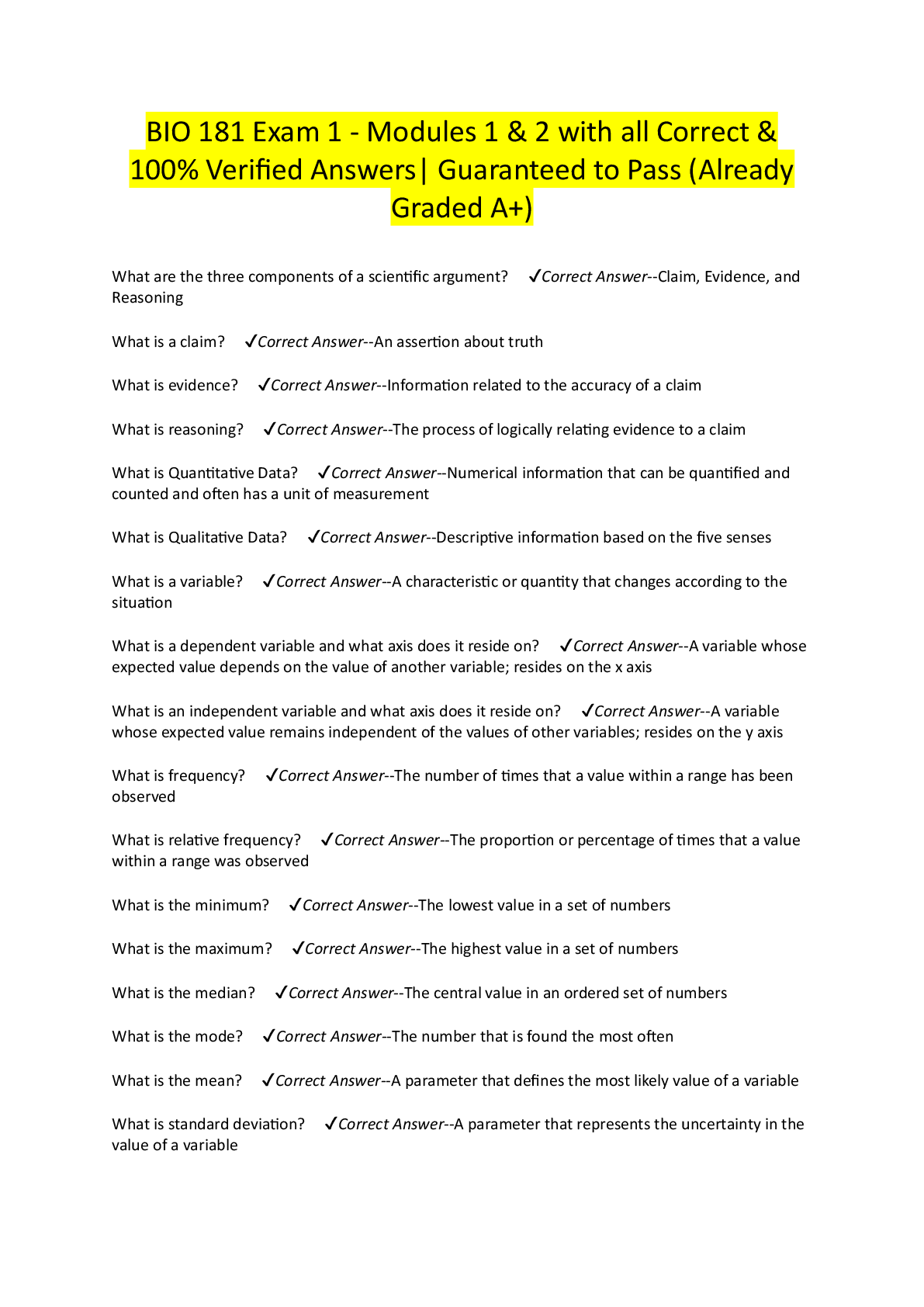
Biology > EXAM > BIO 210 Lec Exam 1 (GRADED A) Questions and Answers- Greenville Technical College (All)
BIO 210 Lec Exam 1 (GRADED A) Questions and Answers- Greenville Technical College
Document Content and Description Below
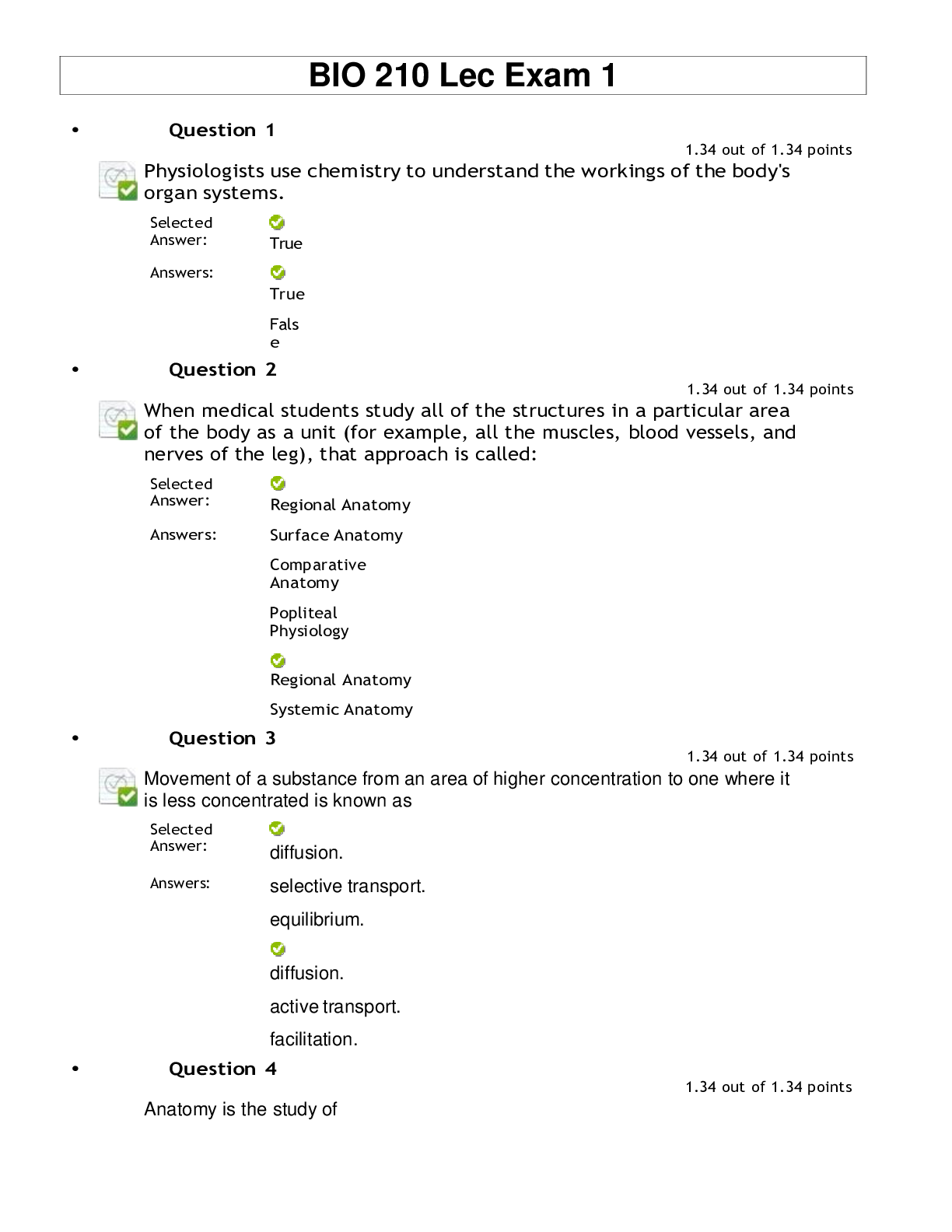
• Question 1 1.34 out of 1.34 points Physiologists use chemistry to understand the workings of the body's organ systems. Selected Answer: True Answers: True Fals e • Question 2 ... 1.34 out of 1.34 points When medical students study all of the structures in a particular area of the body as a unit (for example, all the muscles, blood vessels, and nerves of the leg), that approach is called: Selected Answer: Regional Anatomy Answers: Surface Anatomy Comparative Anatomy Popliteal Physiology Regional Anatomy Systemic Anatomy • Question 3 1.34 out of 1.34 points Movement of a substance from an area of higher concentration to one where it is less concentrated is known as Selected Answer: diffusion. Answers: selective transport. equilibrium. diffusion. active transport. facilitation. • Question 4 Anatomy is the study of 1.34 out of 1.34 points Selected Answer: structure and form. Answers: sharp tools. function. word histories. stars. structure and form. • Question 5 1.34 out of 1.34 points When a cell is placed in a solution with a very low solute concentration, water diffuses into the cell. Such a solution is called a(n) solution. Selected Answer: hypotonic Answers: isotonic endergonic hypotonic hypertonic • Question 6 1.34 out of 1.34 points The are responsible for synthesizing most of a human body cell's ATP. Selected Answer: mitochondria Answers: nucleoli ribosomes microfilament s mitochondria lysosomes • Question 7 The three forms of matter are Selected 1.34 out of 1.34 points Answer: solids, liquids, and gases. Answers: blood, bone, and air. vapor, water, and solid. air, water, and solids. solids, liquids, and gases. • Question 8 1.34 out of 1.34 points Both anatomists and physiologists are aware that form and function are interrelated. Selected Answer: True Answers: True Fals e • Question 9 1.34 out of 1.34 points During osmosis, water moves toward the solution with the solute concentration. Selected Answer: greater Answers: greater lesser • Question 10 Ionic bonds involve Selected 0 out of 1.34 points Answer: the release of protons by negatively charged particles. Answers: the sharing of electrons between two atoms of the same element. the attraction between water and salts. the release of protons by negatively charged particles. electrostatic interactions between anions and cations. • Question 11 Disease is often considered the result of 1.34 out of 1.34 points Selected Answer: failure of homeostatic systems. Answers: failure of homeostatic systems. feedback loops. negative feedback. maintenance of set point. • Question 12 0 out of 1.34 points The sodium-potassium pump moves both potassium and sodium down their concentration gradients, from higher to lower concentration. Selected Answer: True Answers: True Fals e • Question 13 1.34 out of 1.34 points An element's atomic number is determined by the number of in one atom of that element. Selected Answer: protons Answers: protons nuclei electrons neutrons atomic mass units • Question 14 1.34 out of 1.34 points Shrinkage of tissue by a decrease in either cell number or cell size is termed Selected Answer: atrophy. Answers: metaplasia. fibrosis. neoplasia. atrophy. hypertrophy. • Question 15 Which is a passive transport process? Selected Answer: Osmosis Answers: Pinocytosis Osmosis Receptor-mediated endocytosis Ion pump Phagocytosis • Question 16 1.34 out of 1.34 points 1.34 out of 1.34 points Structures composed of two or more tissue types that work together to perform a specific function is referred to as: Selected Answer: organs Answers: syste ms organs cells • Question 17 Osmosis is the diffusion of: Selected Answer: water across a membrane. Answers: water within the inside of the cell. water across a membrane. solutes within the inside of a cell. solutes across a membrane. 1.34 out of 1.34 points • Question 18 1.34 out of 1.34 points When a tissue grows rapidily out of control, thereby developing a tumor or abnormal growth, this is referred to as: Selected Answer: neoplasia Answers: hyperplasi a hypertrop hy neoplasia necrosis • Question 19 Glycogen is a polymer of molecules. Selected Answer: glucose Answers: fructose glucose starch amino acid • Question 20 1.34 out of 1.34 points 0 out of 1.34 points The lipid that stabilizes the membrane at extreme temperatures and is found in the hydrophobic regions of the bilayer is Selected Answer: glycolipid. Answers: glycolipid. cholesterol. the polar head. the nonpolar tails. glycocalyx. • Question 21 1.34 out of 1.34 points The organelle responsible for the modification, packaging and sorting of proteins is: Selected Answer: Golgi Apparatus Answers: Rough Endoplasmic Reticulum Golgi Apparatus Peroxisomes Smooth Endoplasmic Reticulum • Question 22 1.34 out of 1.34 points The various chemical reactions that organisms carry out are collectively called Selected Answer: metabolism. Answers: homeostasis. metabolism. reproduction. responsiveness. development. • Question 23 The most common lipids in the body are Selected 1.34 out of 1.34 points Answer: triglycerides, and they are used for energy storage in adipose. Answers: eicosanoids, and they are used as hormonal messengers. glycoproteins, and they are used as backbones for cell membranes. triglycerides, and they are used for energy storage in adipose. steroids, and they are used as signaling molecules in inflammatory responses. phospholipids, and they are used as key ingredients of bile salts. • Question 24 1.34 out of 1.34 points The organelle responsible for detoxification of drugs, alcohols, and poisons is: Selected Answer: Smooth Endoplasmic Reticulum Answers: Rough Endoplasmic Reticulum Golgi Apparatus Peroxisomes Smooth Endoplasmic Reticulum • Question 25 1.34 out of 1.34 points Epithelial tissue tends to have many nerves and is highly regenerative. Selected Answer: True Answers: True Fals e • Question 26 Respiratory physiology is primarily the study of Selected 1.34 out of 1.34 points Answer: how gases are transferred between the lungs and the blood vessels supplying them. Answers: the branching pattern of the small airways of the lungs. how gases are transferred between the lungs and the blood vessels supplying them. cell shape within the alveoli of the lungs. the tissue composition of the airways, air sacs, and blood vessels. • Question 27 1.34 out of 1.34 points The part of the homeostatic control mechanism that brings about change is the Selected Answer: effector. Answers: control center. effector. stimulus. receptor. • Question 28 1.34 out of 1.34 points Solutions that have a greater concentration of OH- than H+ will be considered acidic. Selected Answer: Fals e Answers: True Fals e • Question 29 1.34 out of 1.34 points When hyperplasia proceeds out of control, a tumor may develop. This condition is termed Selected Answer: neoplasia. Answers: hypertrophy. neoplasia. metaplasia. atrophy. fibrosis. • Question 30 1.34 out of 1.34 points Proteins that are embedded within, and extend across, the phospholipid bilayer are called proteins. Selected Answer: integral Answers: catalytic integral cytoskelet on peripheral transport • Question 31 A base is described as a proton donor. Selected Answer: Fals e Answers: True Fals e • Question 32 C 6H 12O 6 is an example of a formula. Selected Answer: molecular Answers: structural molecular • Question 33 1.34 out of 1.34 points 1.34 out of 1.34 points 1.34 out of 1.34 points Over time, diffusion results in the even distribution of a substance throughout an area. Selected Answer: True Answers: True Fals e • Question 34 1.34 out of 1.34 points The is responsible for forming the outer, limiting barrier of a cell. Selected Answer: plasma membrane Answers: plasma membrane peroxisome centrosome mitochondrion ribosome • Question 35 1.34 out of 1.34 points Proteins that assist the movement of a substance across the membrane are called proteins. Selected Answer: transport Answers: identification transport intercellular attachment catalytic cytoskeleton • Question 36 Generally, a chemical buffer is described as Selected 1.34 out of 1.34 points Answer: a weak acid and weak base that help prevent big changes in pH. Answers: a weak acid that makes a solution slightly more basic by its presence. a neutral molecule that does not influence the pH in any way. a weak acid and weak base that help prevent big changes in pH. a strong acid or strong base that brings the pH of a solution to 7.0. • Question 37 1.34 out of 1.34 points When you are exposed to bright light, a reflex is initiated and the muscles of your iris contract to decrease your pupil size. The iris muscles are acting as a(n) Selected Answer: effector. Answers: receptor. effector. control center. positive feedback. • Question 38 Another name for the intracellular fluid is: Selected Answer: cytosol. Answers: interstitial fluid. intercellular matrix. cytoplasm. cisternae. cytosol. • Question 39 1.34 out of 1.34 points 1.34 out of 1.34 points In what tissue would you expect to find very little, if any, extracellular matrix? Selected Answer: Epithelial tissue Answers: Nervous tissue Immune tissue Epithelial tissue Muscle tissue Connective tissue • Question 40 The control center of a homeostatic mechanism Selected 1.34 out of 1.34 points Answer: integrates sensory input and signals for change as needed. Answers: detects a change in a variable that is being regulated. is a change in the external environment. brings about change to the internal environment. integrates sensory input and signals for change as needed. • Question 41 Which branch of microscopic anatomy is the study of tissues? Selected Answer: Histology Answers: Surgical anatomy 1.34 out of 1.34 points Histology Cytology Developmental anatomy Embryology • Question 42 The simple sugar glucose is an example of a: Selected Answer: monosacchari de. 1.34 out of 1.34 points Answers: monosacchari de. lipid. polysaccharid e. polymer. glycogen. • Question 43 An exocrine gland has two parts: Selected Answer: a duct and a secretory portion. Answers: a duct and a basement membrane. a basement membrane and a goblet cell. a brush border and a glandular portion. an acinus and a brush border. 1.34 out of 1.34 points a duct and a secretory portion. • Question 44 1.34 out of 1.34 points The type of membrane that lines many of the body's joints is a membrane. Selected Answer: synovial Answers: cutaneous metastatic serous synovial mucous • Question 45 1.34 out of 1.34 points Proteins that are embedded within, and extend across, the phospholipid bilayer are called proteins. Selected Answer: integral Answers: catalytic integral cytoskeleton peripheral • Question 46 The three forms of matter are: Selected Answer: solids, liquids, and gases. Answers: air, water, and solids. vapor, water, and solid. blood, bone, and air. 1.34 out of 1.34 points solids, liquids, and gases. • Question 47 An ion is an atom or group of atoms that has: Selected Answer: lost or gained an electron Answers: a different number of neutrons than most atoms of that element. lost or gained a proton lost or gained an electron a biological half life due to radioactive decay • Question 48 There are four types of body membranes. Select the exception. Selected Answer: Cartilaginous Answers: Serous Cartilaginous Cutaneous Synovial Mucous • Question 49 1.34 out of 1.34 points 1.34 out of 1.34 points 1.34 out of 1.34 points If a person were unable to form saliva, what type of gland could be missing or malfunctioning? Selected Answer: Merocrine glands Answers: Apocrine glands Holocrine glands Merocrine glands • Question 50 1.34 out of 1.34 points The are responsible for synthesizing most of a human body cell's ATP. Selected Answer: mitochondri a Answers: lysosomes Microfilamen ts Nucleoli ribosomes mitochondri a • Question 51 Peroxisomes are membrane-bound organelles. Selected Answer: True Answers: 1.34 out of 1.34 points True Fals e • Question 52 1.34 out of 1.34 points The membrane lines body cavities that do not open to the external environment. Selected Answer: serous Answers: mucous serous cutaneo us synovial • Question 53 1.34 out of 1.34 points If your body temperature starts to decline, your body responds by exciting skeletal muscles so that you shiver and your temperature returns to normal. This is an example of negative feedback. Selected Answer: True Answers: True Fals e • Question 54 What is it called when the body's homeostasis is lost? Selected Answer: illness Answers: neutralizati on illness good health immunity • Question 55 1.34 out of 1.34 points 1.34 out of 1.34 points In a water molecule, each oxygen can form up to hydrogen bonds with other water molecules. Selected Answer: 2 Answers: 4 2 3 5 • Question 56 1.34 out of 1.34 points The general name given to the phenomenon that occurs when a mature epithelium changes to a different form is: Selected Answer: metaplasi a Answers: mesotheli a hyperplasi a hypertrop hy metaplasi a neoplasia • Question 57 1.34 out of 1.34 points If your body temperature starts to decline, your body responds by exciting skeletal muscles so that you shiver and your temperature returns to normal. This is an example of negative feedback. Selected Answer: True Answers: True Fals e • Question 58 Another name for the intracellular fluid is Selected Answer: cytosol. Answers: intercellular matrix. cytosol. cytoplasm. interstitial fluid. cisternae. • Question 59 Diagnosing a disease involves determining the Selected Answer: cause of the homeostatic imbalance. 1.34 out of 1.34 points 1.34 out of 1.34 points Answers: multiple side effects of a drug. effector and the set point. cause of the homeostatic imbalance. negativity of the feedback. • Question 60 Which is avascular (lacks blood vessels)? Selected Answer: Epithelial tissue Answers: Nervous tissue Epithelial tissue Connective tissue Muscle tissue All of the choices are correct. • Question 61 1.34 out of 1.34 points 1.34 out of 1.34 points Shrinkage of tissue by a decrease in either cell number or cell size is termed: Selected Answer: atrophy Answers: hypertrop hy neoplasiaa atrophy metaplasi a fibrosis • Question 62 1.34 out of 1.34 points Sometimes the relationship between anatomy and physiology is not obvious. The spleen is located in the upper left quadrant of the abdominal cavity and destroys old red blood cells and pathogens in the blood. This description of the spleen illustrates: Selected Answer: Both Anatomy and Physiology Answers: Anatomy Physiology Both Anatomy and Physiology Neither Anatomy and Physiology • Question 63 The higher the concentration of H + is, the lower the pH is. Selected Answer: True Answers: 1.34 out of 1.34 points True Fals e • Question 64 1.34 out of 1.34 points If carbon dioxide levels rise in the body, negative feedback mechanisms will trigger Selected Answer: an increase in breathing so that carbon dioxide levels decline to the set point. Answers: an increase in breathing so that carbon dioxide levels rise further above set point. a decrease in breathing so that carbon dioxide levels rise to the set point. an increase in breathing so that carbon dioxide levels decline to the set point. a decrease in breathing so that carbon dioxide levels decline below set point. • Question 65 1.34 out of 1.34 points The smallest structural unit that exhibits the characteristics of living things is Selected Answer: a cell. Answers: an individual. an organ. a system. a cell. tissue. • Question 66 1.34 out of 1.34 points During homeostatic regulation, the control center can involve which systems? Selected Answer: Nervous and Endocrine Answers: Nervous and Skeletal Nervous and Endocrine Nervous and Integumentary Nervous and Circulatory • Question 67 1.34 out of 1.34 points The largest of the body membranes, commonly called the skin, is the membrane. Selected Answer: cutaneous Answers: cutaneous synovial cartilaginous mucous serous • Question 68 1.34 out of 1.34 points Two atoms that differ only in the number of neutrons they contain are known as Selected Answer: isotopes. Answers: isotopes. ions. isomers. anions. • Question 69 Identify the organelle that provides enzymes for autolysis. Selected Answer: Lysosomes Answers: Smooth ER Peroxisomes Mitochondria Golgi apparatus Lysosomes • Question 70 Endocrine glands Selected Answer: lack ducts and secrete their products into the bloodstream or into interstitial fluid. 1.34 out of 1.34 points 1.34 out of 1.34 points Answers: possess short ducts and secrete their products directly onto the skin surface. lack ducts and secrete their products onto the skin surface. possess ducts to secrete their products into the bloodstream or into interstitial fluid. lack ducts and secrete their products into the bloodstream or into interstitial fluid. secrete mucus directly into a body cavity. • Question 71 1.34 out of 1.34 points The type of exocrine gland in which the entire cell disintegrates, liberating any accumulated products, is the gland. Selected Answer: holocrine Answers: apocrine goblet cell merocrine holocrine None of the choices is correct. • Question 72 0 out of 1.34 points All cells must obtain nutrients, form new chemical structures, and dispose of waste molecules. Selected Answer: Fals e Answers: True Fals e • Question 73 Peroxisomes are membrane-bound organelles. Selected Answer: True Answers: 1.34 out of 1.34 points True Fals e • Question 74 Which is an active transport process? Selected Answer: Facilitated diffusion Answers: Osmosis Facilitated diffusion Ion pump Bulk filtration Simple diffusion 0 out of 1.34 points Starch and cellulose are examples of polysaccharides found in plants. Selected Answer: Fals e Answers: True Fals e [Show More]
Last updated: 3 years ago
Preview 1 out of 24 pages
Buy this document to get the full access instantly
Instant Download Access after purchase
Buy NowInstant download
We Accept:

Reviews( 0 )
$15.00
Can't find what you want? Try our AI powered Search
Document information
Connected school, study & course
About the document
Uploaded On
Aug 26, 2022
Number of pages
24
Written in
All

Additional information
This document has been written for:
Uploaded
Aug 26, 2022
Downloads
0
Views
115



 Questions and Answers 100% VERIFIED.png)
 Questions and Answers 100% correct Solutions.png)