JSPENA NCLEX RN MENTORING PROGRAM
MODULE 3: MENTAL HEALTH CONCEPTS
EVALUATION EXAM
1. A recently widowed client says, “I lived my whole life for my husband and children. Now he’s
dead and my daughter and son have eac
...
JSPENA NCLEX RN MENTORING PROGRAM
MODULE 3: MENTAL HEALTH CONCEPTS
EVALUATION EXAM
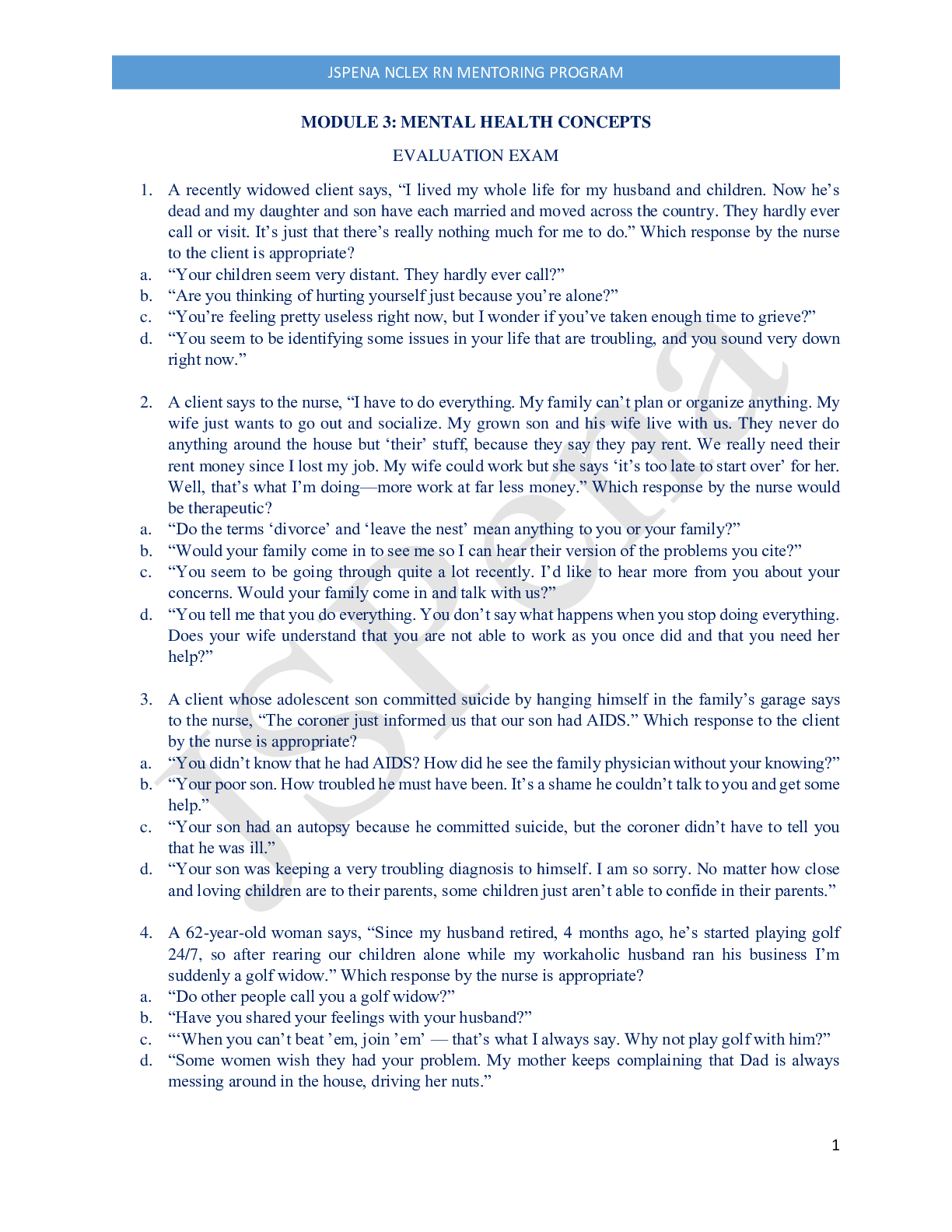
1. A recently widowed client says, “I lived my whole life for my husband and children. Now he’s
dead and my daughter and son have each married and moved across the country. They hardly ever
call or visit. It’s just that there’s really nothing much for me to do.” Which response by the nurse
to the client is appropriate?
a. “Your children seem very distant. They hardly ever call?”
b. “Are you thinking of hurting yourself just because you’re alone?”
c. “You’re feeling pretty useless right now, but I wonder if you’ve taken enough time to grieve?”
d. “You seem to be identifying some issues in your life that are troubling, and you sound very down
right now.”
2. A client says to the nurse, “I have to do everything. My family can’t plan or organize anything. My
wife just wants to go out and socialize. My grown son and his wife live with us. They never do
anything around the house but ‘their’ stuff, because they say they pay rent. We really need their
rent money since I lost my job. My wife could work but she says ‘it’s too late to start over’ for her.
Well, that’s what I’m doing—more work at far less money.” Which response by the nurse would
be therapeutic?
a. “Do the terms ‘divorce’ and ‘leave the nest’ mean anything to you or your family?”
b. “Would your family come in to see me so I can hear their version of the problems you cite?”
c. “You seem to be going through quite a lot recently. I’d like to hear more from you about your
concerns. Would your family come in and talk with us?”
d. “You tell me that you do everything. You don’t say what happens when you stop doing everything.
Does your wife understand that you are not able to work as you once did and that you need her
help?”
3. A client whose adolescent son committed suicide by hanging himself in the family’s garage says
to the nurse, “The coroner just informed us that our son had AIDS.” Which response to the client
by the nurse is appropriate?
a. “You didn’t know that he had AIDS? How did he see the family physician without your knowing?”
b. “Your poor son. How troubled he must have been. It’s a shame he couldn’t talk to you and get some
help.”
c. “Your son had an autopsy because he committed suicide, but the coroner didn’t have to tell you
that he was ill.”
d. “Your son was keeping a very troubling diagnosis to himself. I am so sorry. No matter how close
and loving children are to their parents, some children just aren’t able to confide in their parents.”
4. A 62-year-old woman says, “Since my husband retired, 4 months ago, he’s started playing golf
24/7, so after rearing our children alone while my workaholic husband ran his business I’m
suddenly a golf widow.” Which response by the nurse is appropriate?
a. “Do other people call you a golf widow?”
b. “Have you shared your feelings with your husband?”
c. “‘When you can’t beat ’em, join ’em’ — that’s what I always say. Why not play golf with him?”
d. “Some women wish they had your problem. My mother keeps complaining that Dad is always
messing around in the house, driving her nuts.”2
JSPENA NCLEX RN MENTORING PROGRAM
5. A 16-year-old client says, “My dad thinks I’m evil, but we get into fights because I let things build
up. He never has any time for me because he’s always glued to the TV. He doesn’t even look at me
when he talks.” Which statement by the nurse encourages the client to use assertive behavior with
his father?
a. “So you’re saying that you let your feelings build up and then you just explode?”
b. “Have you tried standing in front of the television when your dad is watching it?”
c. “What makes you feel that you have the right to fly off the handle just because you feel ignored?”
d. "Have you tried saying that directly to your dad? For example, you could say, ‘I notice that you
watch television when I’m telling you things that are important to me.’"
6. The 45-year-old husband of a client with breast cancer who just died says to the nurse, “If our
doctor had operated sooner, my wife would be alive now.” Which statement by the nurse would be
therapeutic?
a. Say nothing. Simply nod and say “Mm-hmm” noncommittally.
b. “Sounds as if you’re feeling angry and pretty helpless right now.”
c. “Let’s focus not on what was not done but instead on what was done for your wife.”
d. “Your doctor did all he could for your wife. You know, physicians can only apply their best clinical
judgment.”
7. A client who has been referred for group therapy asks the nurse about the therapy. The nurse tells
the client that this type of therapy is focused on:
a. Social skills training
b. Social functioning in groups
c. Cognitive behavioral therapy
d. The development of interpersonal skills, resolution of family problems, and effective use of
community support
8. A client who recently lost his hand in a workplace accident says to the nurse, “I don’t know how
I’m going to support my family with a plastic hand. I might as well be dead.” Which nursing
response would be therapeutic?
a. “Perhaps you need to focus on being happy that you survived.”
b. “You’re saying basically that you feel useless without your hand?”
c. “Don’t worry about all of that at this point. You’re going to be fine.”
d. “You’ll never need to worry about work again, because your employer will cover all of your
expenses and make a settlement that will support you for life.”
9. An older adult client who is dying says to the nurse, “My son is 40 years old, but he works in a
very poorly paying job and is always borrowing money from me. I don’t know how he’s going to
manage without me.” Which response by the nurse would be therapeutic?
a. “Could you share your feelings with your son just as you have with me?”
b. “Sounds as if your son will never grow up and learn to take care of himself.”
c. “Goodness. At 22, I supported myself and never asked my mother for anything.”
d. “I wonder why you’re so worried about your adult son when you need to concentrate on you.”3
JSPENA NCLEX RN MENTORING PROGRAM
10. During a one-to-one nurse-client session, the client plays with her pack of cigarettes and says, “I
just get a couple of DVDs and watch movies so I won’t have to look at my husband or talk to him.”
Which coping mechanism does the nurse recognize in the client’s behaviors?
a. Self-blame
b. Avoidance
c. Reframing
d. Wishful thinking
11. A 56-year-old client says to the nurse, “I’m a guidance counselor at the middle school, and the kids
like to come to see me for help, but I just found out from my wife that my 22-year-old daughter is
a lesbian, and now I’m the one who needs advice. How am I supposed to accept that? She was the
boy we didn’t have, and I made a tomboy of her by taking her to baseball games with me. Is that
why she’s gay?” Which statement by the nurse would be therapeutic?
a. “Are you prejudiced against lesbian and gay people?”
b. “You’re good at talking with middle schoolers, but how about young adults?”
c. “How did your wife happen to tell you about this? Did your daughter ask her to tell you?”
d. “It sounds like you and your daughter were very close but she kept her sexual orientation from you.”
12. A 12-year-old client who has been reported for drawing sexually explicit scenes in her textbooks
during class says to the psychiatric nurse, “I just felt like it.” Which response by the nurse would
be therapeutic and aid assessment of abuse-related symptoms?
a. “Well, a picture paints a thousand words.”
b. “You just felt like destroying your textbooks?”
c. “Your parents and teachers are very concerned about your drawings.”
d. “I am concerned about you. Are you being or have you ever been abused?”
13. The wife of a client who is dying says to the nurse, “I am able to take off the 6 months from work
our doctor feels that my husband will live, but what if he lives beyond that time?” Which therapeutic
response should the nurse make?
a. “Only you and your husband can determine how you should best allocate your work leave.”
b. “Your husband has managed to be active up to now, so he could live longer than predicted, but his
actual lifespan remains unclear.”
c. “Are there other options for you in taking work leave? Perhaps you could simply reduce your work
hours at first so that you can extend your compassionate leave.”
d. “Why not write down the pros and cons of taking work leave all at once and any other options and
then decide with your husband and family which would be most helpful?”
14. A client comes to the mental health clinic after losing all of his personal belongings in a hurricane.
The client tells the nurse that the loss of his possessions is his fault because he didn’t prepare for
the storm. The nurse determines that the client is coping ineffectively and develops goals with the
client. Which of the following goals is the least realistic?
a. The client will identify effective coping skills.
b. The client will develop and use adaptive coping patterns.
c. The client will express and share his feelings about this crisis.
d. The client will stop blaming himself for the loss of his belongings.4
JSPENA NCLEX RN MENTORING PROGRAM
15. During a mental health intake interview, a young adult client who lives with his family rent free
says, “I’m tired of not being able to offer my friends a beer just because my folks don’t believe in
taking a drink socially.” Which nursing response would be therapeutic?
a. “Well, I guess you could move out and live on your own if you wanted to.”
b. “It seems that your parents expect you to follow their rules when you live under their roof.”
c. “You tell me you live rent free, yet you expect the same privileges as an adult who supports the
household?”
d. “Well, if you directly discussed your concerns with them, I guess it’s a case of ‘When in Rome, do
as the Romans do.’”
16. A client says to the nurse, “My doctor says he thinks I’m ready to taper off my pain medication,
but the new painkiller he prescribed doesn’t relieve my pain the way the other pill did. I get pain
when I try to do things.” Which nursing response would be most supportive to the client?
a. “Your physician feels that your body is physically ready to make the change in medication.”
b. “I think you need to listen to your physician when it comes to taking such strong medication.”
c. “Well, your doctor is concerned that you will become physically dependent on the first painkiller.”
d. “Perhaps if I medicate you about a half-hour before you plan to start your daily activities, the
medicine will be more effective.”
17. A university professor meeting with the mental health nurse for his weekly therapy session says, “I
have a very intelligent student who keeps disrupting my classroom by bragging, and all I want to
do is say, ‘OK, you’re great and you know it all! Now shut up!’ But I just don’t want to be rude.”
Which statement by the nurse is therapeutic?
a. “Sounds like you feel pretty helpless, yet you are the professor here.”
b. “Just say, ‘Gee where did you earn your doctorate?’ and move on with your lecture.”
c. “Just smile and say nothing. Go on with your lecture and then talk with the student after class.”
d. “You’re having a pretty strong reaction to this student, aren’t you? Why not ask the student to leave
the room and use the time to write down his or her thoughts so you can give the others your
complete attention?”
18. A client who is an attorney says to the clinic nurse, “I’m worried about my wife. She’s been so
distant and disorganized since our son died of leukemia 4 months ago. She never suggests that we
go out or take our other children anywhere. Is this normal, or do I need to get her to a doctor?”
Which of the following statements by the nurse would be therapeutic?
a. “Absolutely. It sounds as if she may be experiencing a severe depression.”
b. “To be safe, it would not hurt to have her see your family doctor, or maybe you have a member of
the clergy she can talk to.”
c. “The reluctance to resume activities and overprotect your other children is a normal part of
bereavement and will subside in 2 months.”
d. “It’s normal, but by the end of a year you can expect that your wife is improving and able to redirect
her energy. Have you expressed your concerns to her?”
19. The wife of an alcoholic client says to the nurse, “I can’t afford to bail my husband out of this mess.
Our business is filing for bankruptcy, and the Internal Revenue Service has posted a notice of
auction on our home.” Which statement by the nurse would be therapeutic?
a. “You’re having a very difficult time, and the problem stems entirely from your husband’s drinking.”5
JSPENA NCLEX RN MENTORING PROGRAM
b. “It’s a shame. So many troubling things have been happening to you both because of the disease of
alcoholism.”
c. “The lack of money has stopped you from saving your husband? It sounds like you need to help
yourself right now. What do you think?”
d. “You’re codependent with your husband. Don’t you see this? Are you willing to attend some group
meetings to learn about ways to deal more effectively with your problem?”
20. The family of a client who is being discharged after trying to kill himself with one of his father’s
guns asks for a family meeting with the nurse to discuss their son’s situation. Which statement by
the nurse would be the most therapeutic start to the meeting?
a. “I must begin by saying that I am uncomfortable meeting without your son here to talk for himself.”
b. “Let’s start by introducing ourselves and talking about what is most troubling to each of you about
having your son home.”
c. “Why don’t we all introduce ourselves and say what our relationship is to your son? I’ll begin,
because I’m the nurse who’ll be seeing him after he comes home.”
d. “I am going to begin by talking in general terms about your son’s return home and some of the
things that might happen. I can suggest measures that might be helpful, and then you can ask
questions.”
21. A client is going to receive instruction in biofeedback technique to lower his stress level. The client
asks the nurse to describe this technique, and the nurse tells the client that:
a. It is a technique that trains the mind to elicit a relaxation response
b. It is the purposeful use of one’s imagination to achieve relaxation and control
c. It involves learning to contract and relax muscles in a systematic way and may be combined with
breathing exercises
d. It is a therapeutic modality that enables an individual to monitor skin temperature, muscle activity,
heart rate, blood pressure, and other bodily functions, then learn to control these physiologic
responses to stressful or challenging events
22. A client says to the nurse, “I’ve started a journal because my physician suggested it, and I’m writing
about the things that bother me each day. Sometimes I dictate my feelings and what happened
during the day into a recorder and write them up before I go to bed — and, do you know, they seem
silly to me then. Is this helping me?” Which response by the nurse would be appropriate?
a. “I’m not certain that using a tape recorder will help you with the journal-keeping.”
b. “Well, I wonder about the dictation, because the writing is what helps reduce stress.”
c. “Well, it will take some time, but let’s see how you’re doing over a month. In the meantime, keep
writing.”
d. “It seems that people who write in their journals and can share traumatic events improve their selfawareness.”
23. A 35-year-old client says to the nurse, “I got divorced less than a year after getting married. I left
the Navy SEALs shortly after I joined. Now I teach in the air marshal program to avoid being
recalled for war, but I’d really like to quit. I start something, am great at it, then get bored and move
on. I date, but I’m still living at home. I never seem to be on my own like other guys my age.”
Which response by the nurse is most appropriate?
a. “You made the Navy SEALs but can’t live on your own like an adult and can’t stick with anything.”6
JSPENA NCLEX RN MENTORING PROGRAM
b. “Can you tell me more about your marriage and relationships? If you leave home, what do you fear
will happen?”
c. “You have many years to find a new relationship, but moving out of your parents’ home is a first
step to growing up.”
d. “When will your mother let you go? Seems to me that jobs have come easy to you but that you
can’t grow up and separate from your parents.”
24. The slightly overweight mother of a morbidly obese 11-year-old girl says, “My family physician is
wild over my daughter’s weight gain. He says she’s not eating correctly and is too sedentary, and
now she’s at risk for diabetes. He says the sugar in her blood was up this month. It’s all my fault
because I eat the wrong things, too, and I never get off the couch.” Which statement by the nurse
would be therapeutic in easing the client’s self-blame?
a. “Well, it seems very bleak to you, but your daughter is responsible for her eating and exercising,
too.”
b. “What about her father? Isn’t it partly his fault, too? I want to meet with you, him, and your daughter
tomorrow.”
c. “It’s all this fast food and TV-watching these days. If our kids aren’t watching television, they’re
playing with their computers.”
d. “Your daughter has a serious problem, but there are many successful programs that you can join
with her to lose weight and improve your overall lifestyle.”
25. A client’s son and daughter were killed during a fellow student’s murderous rampage at their high
school 9 months ago. The client says to the nurse, “My wife and I just feel empty and exhausted. I
can’t believe that I had a vasectomy after our son and daughter were born because we wanted to
give them both whatever they needed. We have college funds for both of them that they’ll never
use now.” The nurse should make which appropriate statement to the client?
a. “My parents would be devastated if they lost me and my sister, too. How can I be of service to
you?”
b. “Your feelings are appropriate for the extent of your loss and how your children’s deaths happened.”
c. “Your loss touches me so. How truly devastated you both must be. Can you share what things you
have been doing to grieve?”
d. “Your loss is incalculable. Perhaps you could consider some ways in which to commemorate their
lives for you and in your community.”
26. A client says to the nurse, “My doctor wants me to start keeping a journal every day about what’s
happening in my job.” Which response by the nurse is appropriate?
a. “You can erase your stresses by identifying things that set off negative physical experiences.”
b. “Well, it has always helped me to write down daily happenings and relate them to my stress level.”
c. “Yes, that is an excellent suggestion. You need to keep a meticulous diary of your day with all of
the details.”
d. “Journal-keeping that identifies what seems to cause a strain in a person’s life is a good way of
improving one’s health.”
27. A client who is experiencing suicidal thoughts says to the nurse, “Life is just not worth it anymore.”
What is the appropriate initial response?
a. “You have a lot to live for.”
b. “Tell me what you mean by that.”7
JSPENA NCLEX RN MENTORING PROGRAM
c. “A good night’s sleep will help you feel better.”
d. “You should feel grateful for everything you have.”
28. A client says to the nurse, “I’ve been following my diet and taking my medication. What else do
you want to talk about today?” Which response would be most helpful during the working phase
of the therapeutic alliance?
a. “Sounds fine to me. Let’s meet again in 6 months.”
b. “I don’t believe that you have been following your diet, because you haven’t lost any weight.”
c. “Well, you’ve talked about diet in your terms, but perhaps I should test you on specific things.”
d. “Some people have added exercise to diet and medication therapy and gotten positive results. Do
you think that this would work for you?”
29. A 45-year-old client says to the nurse, “Since I left my wife and children, I can hardly make ends
meet between child support and trying to support myself. I don’t know why I bother going to work
when my wife and kids take just about everything I make.” Which nursing statement would be
therapeutic?
a. “I wonder why you left your wife and children.”
b. “What would you expect your wife and children to do? They didn’t leave you.”
c. “You seem to be very angry about carrying out your responsibility to your children.”
d. “Do you feel that child support is designed to help children, not punish spouses who leave?”
30. A victim of sexual assault is being seen in the crisis center. The client states that she still feels “as
though the assault just happened,” even though it has been a few months since she was attacked.
Which supportive statement should the nurse make to the client?
a. “Things like this take time to get over.”
b. “Be realistic. Remember, the assault didn’t just happen.”
c. “Why keep thinking about this? It’ll only make matters worse.”
d. “Tell me more about why you feel like the assault just occurred.”
31. A nurse developing a plan of care for a client whose spouse recently died formulates a nursing
diagnosis of dysfunctional grieving. Which priority intervention does the nurse incorporate into the
plan?
a. Monitoring the client’s sleep pattern
b. Obtaining a physician’s prescription for an antidepressant
c. Assessing the client’s risk for violence toward self and others
d. Assisting the client in resolving the grief through emotional, cognitive, and behavioral means
32. A 68-year-old client whose husband died 2 months ago says to the nurse, “I’m having trouble
sleeping lately, even though I don’t nap in the daytime. I’ve been using warm milk without any
results.” Which statement by the nurse would be therapeutic?
a. “So you’ve started having sleeping problems but no other problems?”
b. “Perhaps you should join the grieving spouses group that meets on Monday nights.”
c. “Since you’ve lost your husband, have you experienced any other problems besides trouble
sleeping?”
d. “One of the things that I’ve found has helped others is a small snack with your warm milk before
sleep and a moderate increase in walking during the day. Is that something you could try?”8
JSPENA NCLEX RN MENTORING PROGRAM
33. A client who delivered a baby 4 weeks ago says, “I’m feeling as if I’m hanging on by a thread to
keep my wits about me.” Which statement by the nurse would be therapeutic?
a. “Can your husband help you with the baby and your chores? Is he on paternity leave?
b. “You have a beautiful new baby, and caring for her will help you feel better. Your hormones will
be back in balance soon.”
c. “Can you share with me more specifically how you feel that you’re hanging on by a thread? Are
you having thoughts of hurting yourself?”
d. “You seem to be experiencing postpartum depression. I suggest that you have someone take your
baby for a while until your hormones level off.”
34. A client says to the nurse at the mental health clinic, “My husband and sister-in-law both have
terminal illnesses, and my family thinks that because I’m a nurse I should be able to handle
everything.” Which nursing response would be therapeutic?
a. “Are you saying you are overly involved and will need to emotionally distance yourself to be
therapeutic for your family?”
b. “Shame on them for expecting so much from you. Perhaps we need to schedule a family meeting
so I can help you set them straight.”
c. “I’m sorry to hear that your loved ones are so ill. As a nurse, you should be able to assist them by
using your professional expertise. Perhaps that’s what your family expects from you.”
d. “You’ve seen your loved ones dealing with some troubling events recently. Sounds as if you feel
that your family expects more from you than from others in the family because you’re a nurse.”
35. A nurse reviews the nursing care plan of a client being seen in the mental health clinic and notes
that the client is experiencing dysfunctional grieving after losing his spouse. Which of the following
is the appropriate outcome for the treatment plan for this client?
a. The client plans to attend a community grief group.
b. The client reports that he is trying to use coping strategies.
c. The client verbalizes an absolute need to spend time with friends.
d. The client verbalizes the relationship between significant loss and depression.
36. A client whose husband died 2 months ago says to the nurse, “After church, I visit my husband’s
grave and talk to him. It comforts me, but my daughter thinks I’m morbid and crazy and is upset
with me because I don’t want to meet her for coffee after church like I used to.” Which statement
by the nurse would be therapeutic?
a. “You need to stop your visits immediately, or your daughter will have you examined for a mental
disorder.”
b. “Perhaps you could reduce your visits to his grave to once a month and meet your daughter for
coffee like you used to.”
c. “I think your visits are perfectly normal. After all, you were married for a long time. You’ll stop
when the winter weather comes.”
d. “Sounds as if you have had difficulty letting your husband go from your life. What would happen
if you visited his grave less frequently?”
37. The widow of a man who was killed a week ago in a hit-and-run accident while walking the family
dog says, “I should have just let the dog run in the backyard or gone with my husband. Our own
parish priest hit my husband and finally surrendered to the police. He brought a lawyer with him9
JSPENA NCLEX RN MENTORING PROGRAM
because he’s worried about himself, not my husband. I hate him so much, my stomach hurts.”
Which nursing statement would be therapeutic?
a. “Of course you’re angry. Who wouldn’t be? Yet nothing is ever clear cut, is it?”
b. “You not only lost your husband but also learned it was at the hands of someone you looked up to.”
c. “You’re having stomach pain? You should get checked for an ulcer or other gastric problem.”
d. “I wouldn’t blame you if you never entered a church again. This is a terrible thing for the head of
a church to do.”
38. The wife of a dying man is ignoring his rapid physiological decline and imminent death. She
continues with her usual activities, exhibits inability to remember what others have just told her,
and misses important appointments. Which therapeutic statement should the nurse make to the
wife?
a. “It isn’t unusual for family to suffer from anticipatory grief when a loved one is dying.”
b. “I cannot emphasize how much your husband needs you to be there for him right now. He is in the
stage of denial.”
c. “You will need to concentrate on getting to these appointments on time and write down what
everyone says so you will remember.”
d. “Can you talk about what’s happening to you right now? Your behavior is not appropriate at this
stage of your husband’s illness. You seem to be having sympathy pains for him, like men during
their wives’ pregnancies.”
39. A 52-year-old client is admitted to the hospital for surgery to treat lung cancer. The client says to
the nurse, “I was an alcoholic for 15 years, and now that I’m 25 years sober, I’m being punished.”
Which statement by the nurse would be therapeutic?
a. “You started drinking at 12 years of age — is that why you feel that the cancer is retribution?”
b. “Because you seem to be blaming yourself unnecessarily, perhaps we can talk about your illness
and what you can expect after surgery.”
c. “Sounds like you feel that you’re being punished for your drinking, yet you’ve been sober, so
perhaps you’re being rewarded by having a cancer that’s curable.”
d. “You feel that you’re being punished even though you’ve been sober for 25 years. Your doctor
must have told you that the cancer is unrelated to alcohol.”
40. A nurse is teaching assertiveness training to a client with anger-management issues. Which of the
following instructions would the nurse give for helping the client assertively confront someone?
a. Emphasize how much you like the person but insist that the other person make the changes you
need.
b. Tell the person that the behavior has become intolerable for you and that the behavior must be
changed immediately.
c. Demonstrate that you understand how the other person feels but state that you still expect the other
person to make the changes you need.
d. Ask for private time to talk and point out the facts without being accusatory, then determine areas
of mutual misunderstanding and request the changes you need.10
JSPENA NCLEX RN MENTORING PROGRAM
41. A client in group therapy says to the two nurses conducting the group, “You two are great at
psychoanalyzing us, but what about you two? Do you have trouble being assertive with your bosses
or the doctors like we do?” Which statement by one of the nurses would be most therapeutic?
a. “Maybe some others in this group want to talk about the assignment that we all agreed would be
completed today.”
b. “Why do I feel attacked by someone whom I’m trying to help? Could it be that you don’t want to
work in this group anymore?”
c. “You’re interested in talking with us about our assertiveness, but this group is for all of you here
to help you to deal with problems more effectively.”
d. “Your deflection from your own problems here in this group is inappropriate. Let us remind you
that you signed up for this group and agreed to participate in it.”
42. The parents of an adopted child schedule an appointment at a psychiatric clinic, and when they
arrive the nurse conducts an initial assessment. One of the parents says to the nurse, “We need to
speak to a psychiatrist about our adopted daughter. Could you please get one for us?” Which of the
following interventions by the nurse would be therapeutic?
a. "I’d like to accommodate you both, but he is busy right now and you will have to talk to me.”
b. “Do you feel that I am incompetent to talk with you? Everyone who comes here sees me first.”
c. “That is not the procedure here. If you can’t work with the system, you’re free to go elsewhere.”
d. “The doctors here feel that clients are best served when I conduct the initial assessment, after which
the psychiatrist will see you with complete information.”
43. The mother of a 3-year-old child tells the nurse that her child hit her doll after the mother scolded
her for picking the neighbors’ flowers. Which defense mechanism used by the child does the nurse
identify in the mother’s report?
a. Projection
b. Sublimation
c. Displacement
d. Identification
44. A nursing student is assigned to work in the emergency department to assist victims after a tornado.
The student says to the nurse in charge, “I don’t know how to help these parents. Their son was just
decapitated by a flying piece of glass, and they won’t leave him. They did mention that they are
Catholic.” Which intervention does the nurse suggest for inclusion in a plan of immediate care for
the family?
a. Telling the student not to disturb the family until the end of shift
b. Calling their family priest immediately to come help them to let their son go
c. Asking the emergency department physician to join the student in requesting that the family let the
nursing staff care for their son
d. Joining the family and, after they have been able to be with their son for some time, helping them
relinquish their son’s body to the nurses
45. A nurse is evaluating the coping skills of a client with a diagnosis of depression. Which statement
indicates to the nurse the need to help the client learn and appropriately use these skills?
a. “I need to take my medications.”
b. “I know that I can’t do everything.”
c. “I won’t ever be depressed again.”11
JSPENA NCLEX RN MENTORING PROGRAM
d. “I have learned ways to deal with stress.”
46. A client who was employed as a corporate manager before being laid off says to the nurse, “My
wife thinks that I should work in a menial job to maintain our lifestyles until I find another job as
a corporate manager, but I don’t feel I should have to humiliate myself like that.” Which nursing
response would be therapeutic?
a. “Have you shared your feelings with your wife?”
b. “You seem to feel that a less prestigious job would be humiliating for you.”
c. “Oh, I agree with you. Let her get another job if she needs that much money.”
d. “How soon will you be able to find work? If this is permanent, you may need to swallow your
pride.”
47. A dying client says to the nurse, “How do I tell my parents that I am dying of AIDS when they
didn’t even know that I’m gay?” Which statement by the nurse would be therapeutic?
a. “Well, isn’t it better that they learn from you than for them to learn on their own?”
b. “Sounds as if you’re thinking that it’s time for you to tell your parents about your disease.”
c. “I’ve worked with this illness for many years now, and there just doesn’t seem to be an easy way
to do this.”
d. “Are you saying that your parents don’t know about your sexual orientation and must learn about
that and of your illness, too?”
48. A 35-year-old recently divorced parent of twins comes to the intake office of the psychiatric clinic
for the first time with a possible diagnosis of generalized anxiety disorder. The client says to the
nurse, “My mother always called me a worrywart like my nana, so I guess I come by my problems
naturally. I keep worrying about things I can’t change, like my divorce, and blaming myself when
I know I’m not the only one responsible for the divorce.” Which nursing statement would be
therapeutic?
a. “Yet you seem to be dwelling on the thought that the divorce is all your fault.”
b. “Can you tell me more about the worrying and blaming you are experiencing?”
c. “I wonder whether you think you’re responsible for making everything turn out right.”
d. “So you’re a natural worrywart, divorced with twins. I guess you can be forgiven for a little
worrying, but tell me about the blaming you’ve been doing.”
49. The husband of a terminally ill client says to the nurse, “My Company went bankrupt, my son is a
drug addict, my daughter is an alcoholic, and now this! My doctor wants me to try some stress
reduction because my blood pressure is up. Whose wouldn’t be? I’ve tried music and relaxation,
but they don’t work.” Which of the following statements by the nurse would be therapeutic?
a. “Let’s talk more about what has been helpful to you in the past.”
b. “Before we talk about stress management, let’s discuss your children.”
c. “You have a lot of problems. How long does your wife have to live, and what is her relationship
with your children?”
d. “Can you afford to pay for therapy sessions? I see that your benefits are pretty much maxed out,
and I’d hate to ask you to take on any additional burden.”12
JSPENA NCLEX RN MENTORING PROGRAM
50. A 74-year-old widower of 3 months says to the nurse, “When my wife died, I lost my love and my
best friend. Everyone I cared about is dead. We both were only children, and we had no kids. I’m
more than ready to go when the time comes.” Which of the following nursing responses should the
nurse make?
a. “Are you thinking of ending your life because your time has come?”
b. “Did you know that many people live happier lives without children?”
c. “It must seem very lonely to you. I can’t believe that you never had any children.”
d. “When my dad died, my mother said some of the things you’re saying now, and she had three kids.”
51. A nurse is developing a plan of care for a client who recently received a diagnosis of acquired
immunodeficiency syndrome and is experiencing difficulty adjusting to the illness. Which of the
following actions is an inappropriate intervention for this client?
a. Monitoring the client for signs of self-harm
b. Helping the client verbalize concerns related to fear
c. Assisting the client with problem-solving and decision-making
d. Discouraging social networking to prevent the spread of infection
52. A client who was formerly a workaholic has lost his job and is being supported financially by his
wife. The client says to the nurse, “I know that my wife is disappointed in me, but I can’t seem to
get a job doing what I’ve done for 25 years. Why should I take a low-level job when she’s able to
support us financially?” Which response by the nurse would be therapeutic?
a. “Can you tell me a little more about this?”
b. “I would dig ditches if it contributed to my family’s well-being.”
c. “Sounds as if you’re lucky to have your wife’s job to fall back on.”
d. “I’m surprised that such a hardworking man is not able to find a job.”
53. A single mother whose only son died 2 months ago says to the nurse, “I’ve been bothered at work
with thoughts of my son. Suddenly I’ll think of something awful I said to him years ago or some
punishment I gave him because he’d been bad.” Which of the following plans should the nurse
include in caregiving?
a. Scheduling the client for an appointment with the psychiatrist, because this is a pathological
manifestation.
b. Calling the physician to report that the client is a high risk for suicide and increasing the frequency
of visits with the client.
c. Seeking emergency certification for the psychiatric inpatient unit at the community hospital
because of high lethality concerns and visiting the client daily.
d. Explaining that bereaved persons often describe intrusive thoughts of negative experiences with
the deceased and then increasing the frequency of nurse-client visits.
54. A young nurse has just completed postmortem care of a 16-year-old client who died of cancer. The
nurse says to the nurse manager, “I never get sick, and this client kept telling me that he couldn’t
remember not being ill. I feel terrible and so bad for him and about what he went through.” Which
statement by the nurse manager would be therapeutic?
a. “Next time, take someone else in with you for postmortem care, OK?”
b. “Your feelings are normal and will go away after a good night’s sleep.”
c. “Let’s go for coffee and talk about this some more, shall we? We’re both due for our coffee breaks.”13
JSPENA NCLEX RN MENTORING PROGRAM
d. “I should never have assigned you someone so close to your own age. I’ll be more careful in the
future.”
55. A client who is a physician says to the nurse, after receiving a diagnosis of terminal lung cancer,
“All my life I took care of my clients, and now my family is taking care of me.” Which of the
following statements is a therapeutic nursing response?
a. “Your family is caring for you now.”
b. “Well, you’d expect them to care for you, wouldn’t you?”
c. “It is an honor for all of us to care for you. We want to help you.”
d. “You can look back on so many wonderful people you saved and cared for.”
56. A client with an alcohol problem who has been sober for 8 months asks the nurse, “Do you think I
should add individual therapy to my treatment plan?” Which response by the nurse would be
therapeutic?
a. “What do you think? What is the individual therapy all about?”
b. “Are you feeling that you’re vulnerable to a slip? If not, why complicate treatment further?”
c. “Okay, what’s going on with you? You had to be coerced into treatment, but now you seem to want
the full Monty.”
d. “The best time to add individual therapy seems to be after 2 to 5 years of sobriety. Individuals vary,
though, and it may be that you are asking because you feel ready to work on your issues.”
57. A psychiatric nurse is caring for a 15-year-old girl who has been hospitalized for bipolar disorder.
The client tells the nurse that she had her hair styled just like her young math teacher, whom she
admires. The nurse recognizes that the client is using the defense mechanism of:
a. Projection
b. Regression
c. Identification
d. Intellectualization
58. A young adult client who is dying says to the nurse, “I keep asking my wife what I can do for her
and our daughter before I die, but she refuses to tell me.” On the basis of the client’s statement,
what is the appropriate nursing intervention?
a. Teaching the client’s wife to write down her thoughts and feelings and to read them to her husband
b. Saying to the client, “It sounds to me like your wife is truly comfortable and doesn’t want you to
worry needlessly”
c. Talking with both the client and his wife about the importance of expressing their feelings and how
to do it in healthy ways
d. Talking with all family members, including the daughter, about the importance of expressing their
concerns and feelings to the dying client
59. A client says to the nurse, “My doctor tells me that I need to start progressive muscle relaxation
(PMR) to ease my stress, but I just can’t get the hang of it.” Which response by the nurse would be
most helpful?
a. “PMR requires training sessions. Let’s check into classes that you can attend to learn the technique.”
b. “I want you to practice it as often as you can. Play soft, soothing music in the background when
you practice your exercises.”14
JSPENA NCLEX RN MENTORING PROGRAM
c. “For it to be effective and produce deep relaxation, the technique requires your complete receptivity
to its benefit and your need for it.”
d. “I could never master the technique myself, so I understand your frustration. Would you like me to
explain its difficulty for you to the doctor?”
60. A home care nurse makes a new-baby visit to a young husband and wife. The visit takes two-anda-half hours because the parents are so detailed in giving information and asking questions of the
nurse. Which intervention by the nurse would be therapeutic?
a. Ordering a follow-up visit to the family pediatrician and mental health clinical specialist
b. Informing all home care nurses to schedule their visits to the couple as their last visit of the day
c. Having the home care office secretary call the nurse’s cell phone 20 minutes after starting the visit
to expedite the nurse’s departure
d. Blocking out more time for the next visit and scheduling a follow-up visit as soon as possible to
assess how they are coping and gauge their level of anxiety
61. As the nurse prepares to interview a client being admitted to the mental health unit, the client says,
“I asked my family to bring me in here to talk to someone, but now I don’t know where to begin.”
Which of the following responses by the nurse would be most helpful?
a. “Why not just start talking and see where it takes you?”
b. “If I were you, I’d begin with what you were doing this morning.”
c. “Perhaps you can start by sharing some of your most recent concerns.”
d. “Don’t worry. Everyone who comes in here for the first time feels reluctant to talk.”
62. A mental health home care nurse says to the client, “Do you feel ready to try attending a group
session at the clinic?” The client shakes his head. Which nursing statement would be therapeutic?
a. “No? Why not?”
b. “You seem to be saying no. Would you tell me more about your reluctance?”
c. “OK, but I hope you will let me know when you feel ready to attend a group session at the clinic.”
d. “Perhaps a group session would be too overwhelming for you right now. How about just seeing
me?”
63. A client who has been admitted to a surgical unit with a diagnosis of cancer is scheduled for surgery
in the morning. When the nurse enters the room and begins the surgical preparation, the client states,
“I’m not having surgery — you must have the wrong person! My test results were negative. I’ll be
going home tomorrow.” The nurse recognizes that the client is engaging in the defense mechanism
of:
a. Denial
b. Psychosis
c. Delusions
d. Displacement
64. The parents of a 20-year-old who was killed while driving drunk say to the nurse, “We’re so
devastated, but we are also angry that she would drink and drive when we told her over and over
not to.” Which statement by the nurse would be therapeutic?
a. “Young people don’t always obey their parents.”
b. “Everyone feels guilt or anger when they lose a loved one.”
c. “Does anyone in the family have a drinking or drug problem?”15
JSPENA NCLEX RN MENTORING PROGRAM
d. “Your sadness over losing your daughter is mixed with anger at her driving while intoxicated.”
65. A nurse is reading the medical record of a client who has a diagnosis of moderate anxiety and notes
that the physician has documented that the client exhibits eustress. On the basis of this information,
which of the following findings would the nurse expect to encounter while assessing the client?
a. The client complains of fatigue.
b. The client complains of feeling drained.
c. The client complains of feeling anxious.
d. The client engages in purposeful movement.
66. A client says to the nurse, “What does my psychiatrist mean when she says that my illness is
biologically based?” Which nursing statement would be the most informative?
a. “Mental illness always has its roots in the family.”
b. “Mental illness is a result of environmental factors.”
c. “Today we know that all mental illness is genetically inherited.”
d. “There are many possible physical causes of mental illness, and they include problems in the brain.”
67. A dying client with agoraphobia says to the nurse, “I’ve been unable to leave this house without
tremendous effort for so long, and now it doesn’t matter.” Which statement by the nurse would be
therapeutic?
a. “It doesn’t matter? Can you share your feelings with me?”
b. “Your gardens are beautiful now. Would you like to stroll in them after our work?”
c. “Did you go through systematic desensitization with your doctor? I understand that it works well.”
d. “I know what you mean. I spent more than $2,000 on a dental implant and still wound up with false
teeth.”
68. A 25-year-old client says to the nurse, “I got my degree in criminal justice. I graduated first in my
class from the police academy and had just started as a patrolman when my partner and I responded
to a domestic violence call in the most rural part of our patrol area. Someone started shooting at us,
and I’m terrified. Maybe I’m not right for this job.” Which statement by the nurse would be
therapeutic?
a. “You’re saying that because you felt afraid in a violent situation, you may not be right for the job?”
b. “Did you really think that you wouldn’t be frightened? You’re fortunate if this is the first time
you’ve ever been afraid.”
c. “You seem to be surprised that you were frightened by the violence. Have you talked with your coworkers about their experiences?”
d. “My earlier work as a nurse involved trips through our local crack houses. Wait until you’ve had
some experience working narcotics and then tell me how you feel.”
69. The parent of a 25-year-old man who has just been found to have a left frontal brain tumor says to
the nurse, “At the local hospital, our doctor thought that his headaches were nothing and prescribed
an analgesic. If I hadn’t insisted on a CT scan, no one would have found the tumor.” Which of the
following statements by the nurse would be therapeutic?
a. “What’s being planned for your son now?”
b. “You and your son are having a very trying time. What’s happened since your son’s diagnosis?”
c. “These days only the squeaky wheel gets the grease in medicine. Your squeaking was excellent
advocacy.”16
JSPENA NCLEX RN MENTORING PROGRAM
d. “Sounds like you have to be your own doctor these days — good for you! — but I’m sure your
doctor was following medical protocol.”
70. A 45-year-old fireman says to the nurse, “I’ve worked at some fires recently that were just
devastating, but last week was the worst. I carried this little girl from a fire — she was badly burned
and lived just a few minutes after I brought her out, and she said to me, ‘Tell my mom and Rudy I
love them both very much.’ Her mom told me that Rudy is their dog, and he just mopes around the
house since the little girl died. I keep thinking about her and just don’t know if I can go on.” Which
response by the nurse would be therapeutic?
a. “Maybe you could help the mother find a home for Rudy, and then your troubling thoughts would
go away.”
b. “Would you listen to yourself? You’ve seen firemen stress out before. What is your responsibility
in all this?”
c. “You’ve helped victims of some horrific fires lately, and yet you question your calling. Do you feel
the need to resign?”
d. “You’re questioning your job because you’re upset about the little girl you tried to save. Work
stress can be treated and help you cope better. It is so important for you to seek treatment.”
71. A young adult client says to the nurse, “All my friends are married and have children. I can’t seem
to meet anyone, and I know I’ll never be happy until I meet someone I can care about enough to
marry.” Which statement by the nurse would assist the client in reframing the situation?
a. “Sounds as if you’re exaggerating your situation and looking only at the half-full glass.”
b. “It seems that you measure your life and what you need to do against the behaviors of others.”
c. “Aren’t you a little young to be thinking in such negative terms? You do still have plenty of time
before your biological clock winds down.”
d. “You can’t seem to meet someone that you care about? You can still find enjoyment in friendships,
work, books, and other things as well.”
72. A physician tells a client that she has cancer, that her illness is terminal, and that she has a 6-month
prognosis. After the physician leaves the client’s room, which therapeutic statement should the
nurse make to the client?
a. “I am so sorry about this. You are my favorite client, and I will take good care of you.”
b. “What did your doctor tell you about your condition? Can you tell me what you’re thinking about?”
c. “Do you have any questions about what is happening with you? I can assure you that I will do
everything I can to help minimize your pain.”
d. “Do you want me to get the phone so you can talk to your loved
[Show More]