MIDTERM NURSING INTEGRATION 2019.
1. TPN care: IV pump required, change tubing and bag every 24h, do not add medications,
Lipids piggybacked in TPN
COMPLICATIONS: hyperglycemia, infection. Monitor weight, I&O, elect
...
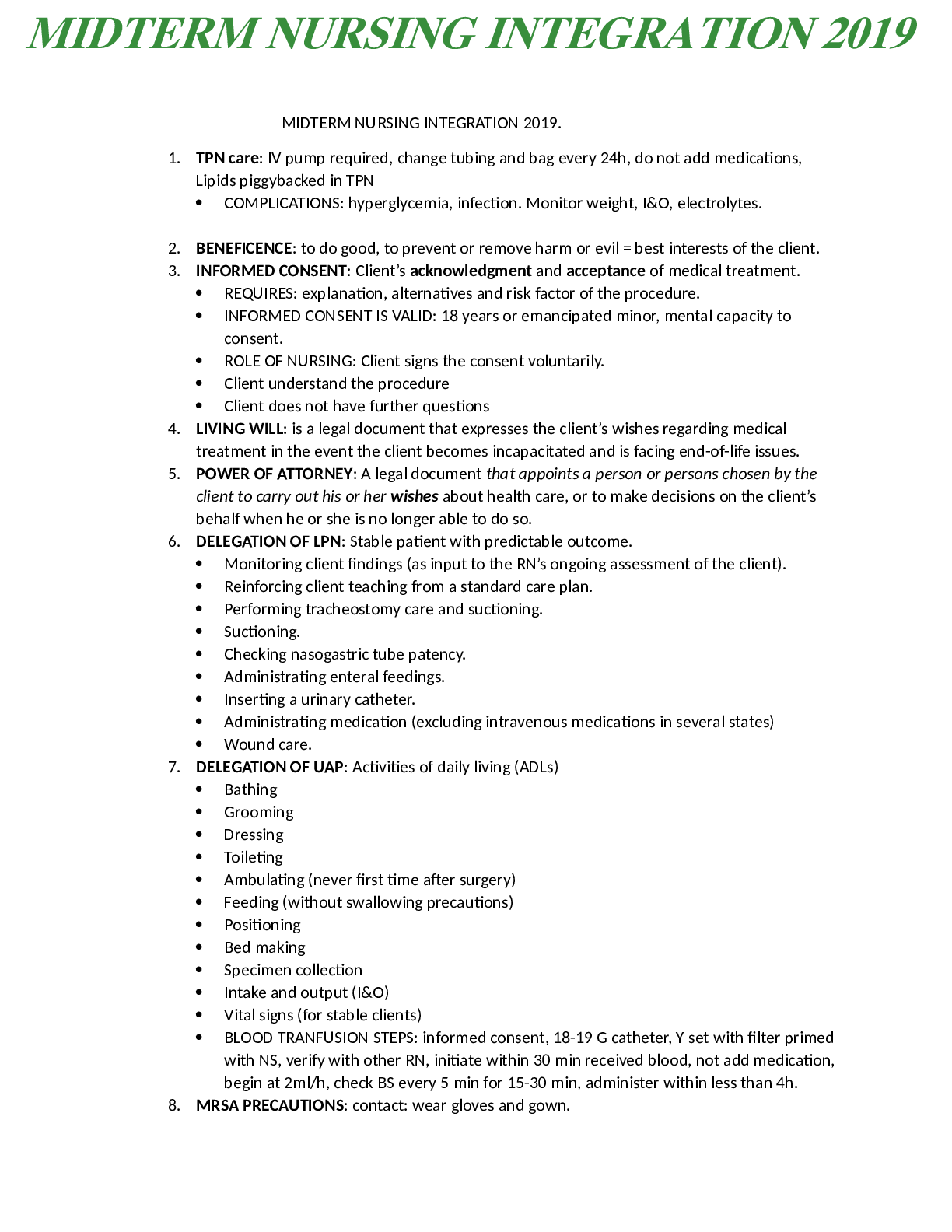
MIDTERM NURSING INTEGRATION 2019.
1. TPN care: IV pump required, change tubing and bag every 24h, do not add medications,
Lipids piggybacked in TPN
COMPLICATIONS: hyperglycemia, infection. Monitor weight, I&O, electrolytes.
2. BENEFICENCE: to do good, to prevent or remove harm or evil = best interests of the client.
3. INFORMED CONSENT: Client’s acknowledgment and acceptance of medical treatment.
REQUIRES: explanation, alternatives and risk factor of the procedure.
INFORMED CONSENT IS VALID: 18 years or emancipated minor, mental capacity to
consent.
ROLE OF NURSING: Client signs the consent voluntarily.
Client understand the procedure
Client does not have further questions
4. LIVING WILL: is a legal document that expresses the client’s wishes regarding medical
treatment in the event the client becomes incapacitated and is facing end-of-life issues.
5. POWER OF ATTORNEY: A legal document that appoints a person or persons chosen by the
client to carry out his or her wishes about health care, or to make decisions on the client’s
behalf when he or she is no longer able to do so.
6. DELEGATION OF LPN: Stable patient with predictable outcome.
Monitoring client findings (as input to the RN’s ongoing assessment of the client).
Reinforcing client teaching from a standard care plan.
Performing tracheostomy care and suctioning.
Suctioning.
Checking nasogastric tube patency.
Administrating enteral feedings.
Inserting a urinary catheter.
Administrating medication (excluding intravenous medications in several states)
Wound care.
7. DELEGATION OF UAP: Activities of daily living (ADLs)
Bathing
Grooming
Dressing
Toileting
Ambulating (never first time after surgery)
Feeding (without swallowing precautions)
Positioning
Bed making
Specimen collection
Intake and output (I&O)
Vital signs (for stable clients)
BLOOD TRANFUSION STEPS: informed consent, 18-19 G catheter, Y set with filter primed
with NS, verify with other RN, initiate within 30 min received blood, not add medication,
begin at 2ml/h, check BS every 5 min for 15-30 min, administer within less than 4h.
8. MRSA PRECAUTIONS: contact: wear gloves and gown.
MIDTERM NURSING INTEGRATION 2019
9. RESTRAINS PROTOCOLS: needs physician order, PRN prescriptions are not allowed, informed
consent is required, renew every 24h.
10. TRACHEOSTOMY CARE: observe for excess secretions, air obstruction and coughing, remove
soiled dressing, after disconnecting remove inner tube for cleaning, clean exposed parts of
the outer tube, without removing trach tube install new ties and removed the old ones.
11. Thrombophlebitis Nursing Interventions: warm compresses
12. Chemotherapy and certain foods to avoid:
Hot, spicy (hot pepper, curry, Cajun)
High fiber (raw fruit and vegetables, coarse whole grain)
Fatty, greasy, or fried foods
Rich deserts
Nuts, seeds, or dried fruits.
13. Endotracheal Tube (Care and measurement): Observe for right bronchi mono-intubation,
Mark incisor tooth or lip line, reposition side to side, Check cuff pressure frequently: 15 -
20 mmHg, Drain condensate water in tubing.
14. Steven Johnson Syndrome signs and symptoms/Precautions: tiredness, lethargy, headache,
fever, rash, blisters, flu-like
Prevention: avoid the medications that trigger it.
15. Placenta Previa: bright red and painless bleeding
16. PLACENTA ABRUPTIA: dark red, painful bleeding
17. NONSTRESS TEST: fetal heart rate monitoring.
REACTIVE: two or more decelerations of 15 bpm lasting 15 seconds over 20 min
NON-REACTIVE: test does not meet criteria after 40 min (is the baby is sleeping try test
for 20 min more).
18. Variable Decelerations: the shapes vary V, U, or W. Can be not necessarily associated with
the mother’s contractions, abrupt <30 sec from onset to nadir
ETIOLOGY: cord compression, oligohydramnios, cord prolapse.
19. Mastitis Nursing Interventions: Instruct the mother in breast hygiene measures.
Apply heat or cold to the site as prescribed.
Maintain lactation in a breastfeeding mother.
Encourage manual expression of breast milk or use of a breast pump every 4 hours.
Support her breasts with a supportive bra.
Administer analgesics or antibiotics as prescribed
20. G- GRAVITY
a. T- TERM BIRTHS (PAST 38 WEEKS)
b. P- PRETERM (20-37 WEEKS)
c. A-ABORTIONS
d. L- CURRENT LIVING CHILDREN
21. FUNDUS LOCATION: 12-14 weeks: slightly above the symphysis pubis.
16 weeks: between symphysis pubis and umbilicus
20-22 weeks: level of umbilicus
36 weeks: at xiphoid process
22. Subinvolution: Incomplete involution or failure of the uterus to return to its normal size and
condition after delivery.
CAUSES: retained placental fragments & infections.
23. Pregnancy and HTN: SYSTOLIC > 130 DIASTOLIC > 75 (diet and lifestyle changes)
24. PREECLAMSIA: appears after 20 weeks gestation-6 weeks post delivery
BP 140/90
Proteinuria
Edema
TX: Metildopa, labetalol, hydralazine PO
25. ECLAMPSIA: BP 160/110
PROTEINURIA
Anasarca (generalized edema)
Triggers DIC (disseminated intravascular coagulation)
Seizures, coma
Tx: IV hydralazine, Mg sulfate (anticonvulsant)
26. Mg assessment: RR: 12-16
DTR: +2, +3
DIURESIS: 30 ml/h
MG blood level 5-8
27. Ectopic Pregnancy signs and symptoms: pelvic pain, lower abdominal pain, scan and dark
vaginal bleeding, missed period.
28. INSULIN AND PREGNANCY: should decrease in the first trimester because of increased
insulin production by the pancreas and increased peripheral sensitivity to insulin.
29. APGAR SCORE: 1, 5, 10 min
INTERPRETATION: 7-10 healthy
3-6 moderately depressed
0-2 severely depressed.
30. Newborn Jaundice Assessment: Pathologic: appears in first 24h
Physiologic: appears after 24h and is benign.
Assessment Findings:
Jaundice
Elevated serum bilirubin level
Enlarged liver
Poor muscle tone, lethargy, and a poor sucking reflex
31. ACUTE OTITIS MEDIA: risk increase when the child lives in smoking environment (passive
smoking)
Medications: Acetaminophen (Tylenol) or ibuprofen (Advil) to provide analgesia and reduce
fever
Antibiotics: Amoxicillin (Amoxil), amoxicillin-clavulanate (Augmentin), and azithromycin
(Zithromax), Benzocaine (Americaine-Otic): Ear drops for topical pain relief.
32. AFP: Used to detect neural tube defects
33. PKU: inherited error in metabolism, babies are tested 24h after milk and retest 7-10 days to
catch early false negative. Can cause: mental retardation, convulsions, behavior problems,
skin rash, musty body odor. If positive NO meat, da
[Show More]