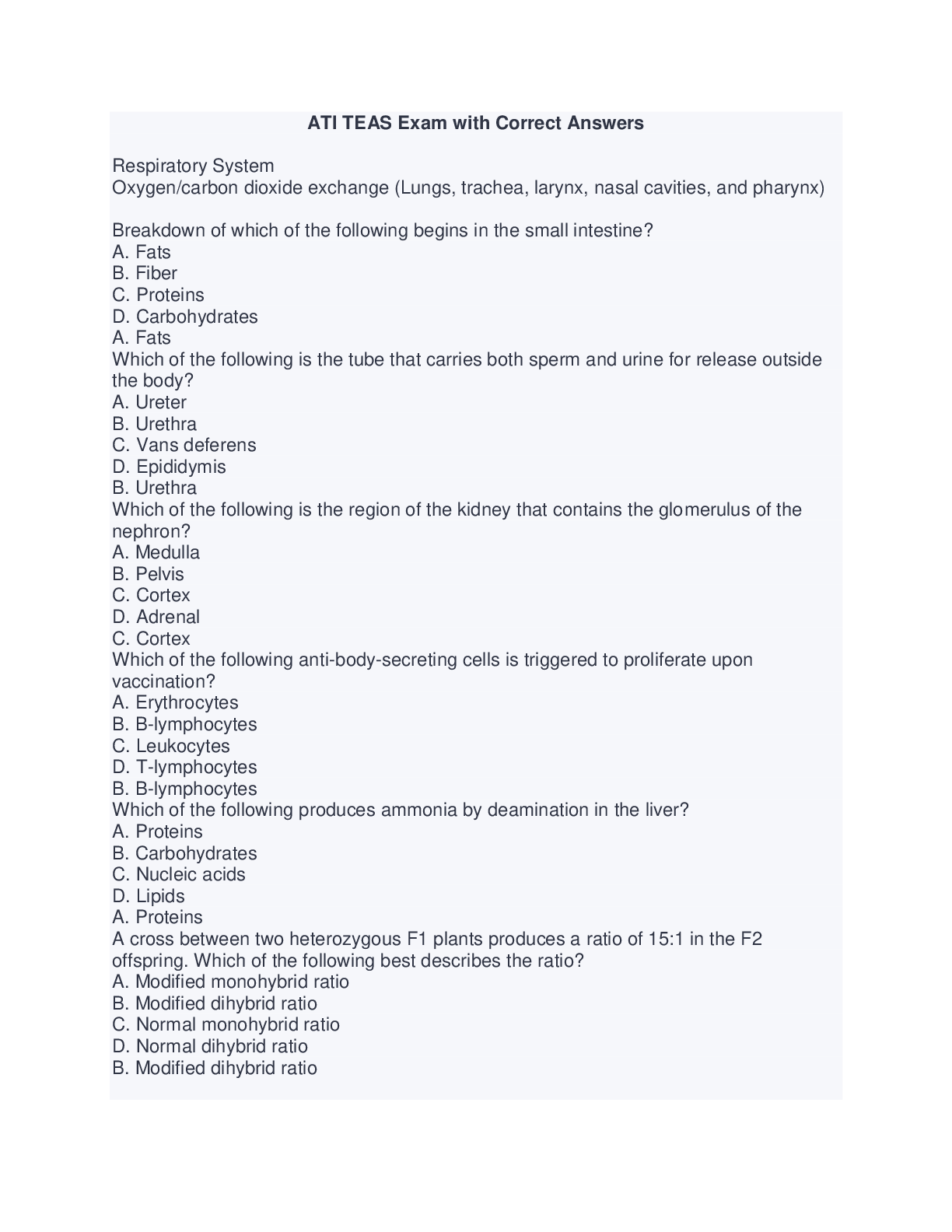
ATI TEAS Exam with Correct Answers
Health Care > EXAM > BIO 202L Lab 14 Worksheet- The Urinary System (All)
Lab 14 The Urinary System BIO202L Student Name: Michelle Reed Access Code (located on the lid of your lab kit): AC-85IRQVO Pre-Lab Questions 1. What is the function of the ureter? They ... are muscular tubules that link the kidneys to the bladder. 2. Compare and contrast the male and female urethra. Females urethra is only for urinating, but males urethra is for both urination and ejaculation. 3. Describe the two layers of the kidneys. Renal capsule = a layer of collagen fibers that cover the outer surface of the organ Perinephric fat = stabilizes the organ Experiment 1: Kidney Filtration Table 1: Solutions Present in Each Container Before 60 Minutes Submersion Solution Dialysis Tubing Beaker Congo Red yes no Yellow Food Coloring yes no Table 2: Solutions Present in Each Container After 60 Minutes Submersion Solution Dialysis Tubing Beaker Congo Red yes no Yellow Food Coloring no yes Lab 14 The Urinary System BIO202L Post-Lab Questions ”1. What specific part of the kidney does the dialysis tubing represent? What is this part’s function?” The dialysis tubing represents the kidneys filtration through the ureter, which transports urine towards the urinary bladder. ”2. What does the yellow food coloring represent at the end of the experiment? What does the Congo Red represent? ” Yellow represents the urine being filtered by the nephrons at the end of the experiment, and congo red represents blood. ”3. Why is it important that the kidney filters the blood? ” To be sure that blood has the correct chemical composition, and is free of wastes and toxins. Wastes are sent to the blood, and if the kidneys did not remove them, these could cause damage to the body. Experiment 2: Urinalysis Table 3: Urine Test Test Normal Abnormal pH 4.5 - 7.5 Acidic Urine (below 4.5) - Diabetes, starvation, dehydration, respiratory acidosis. Alkaline Urine (above 7.5) - Kidney disease, kidney failure, urinary tract infection, respiratory alkalosis. Glucose None Glucose present (red or green color after test); diabetes mellitus. Protein None Protein present (violet color after test); kidney disease. Yeast None Yeast present (bubbles form after test); yeast infection in urinary tract. Ketones Little or None Large amount of ketones present (sweet smell of urine); starvation, prolonged vomiting, diabetes, hyperthyroidism, and other metabolic disorders. Table 4: Simulated Urine pH Test Simulated Urine Sample pH A 7 [Show More]
Last updated: 3 years ago
Preview 1 out of 10 pages

Buy this document to get the full access instantly
Instant Download Access after purchase
Buy NowInstant download
We Accept:

Can't find what you want? Try our AI powered Search
Connected school, study & course
About the document
Uploaded On
Aug 31, 2022
Number of pages
10
Written in
All
This document has been written for:
Uploaded
Aug 31, 2022
Downloads
0
Views
74
Scholarfriends.com Online Platform by Browsegrades Inc. 651N South Broad St, Middletown DE. United States.
We're available through e-mail, Twitter, Facebook, and live chat.
FAQ
Questions? Leave a message!
Copyright © Scholarfriends · High quality services·