*NURSING > QUESTIONS & ANSWERS > CEN Practice Exam 1. Questions and answers, Graded A+. 2022 update (All)
CEN Practice Exam 1. Questions and answers, Graded A+. 2022 update
Document Content and Description Below
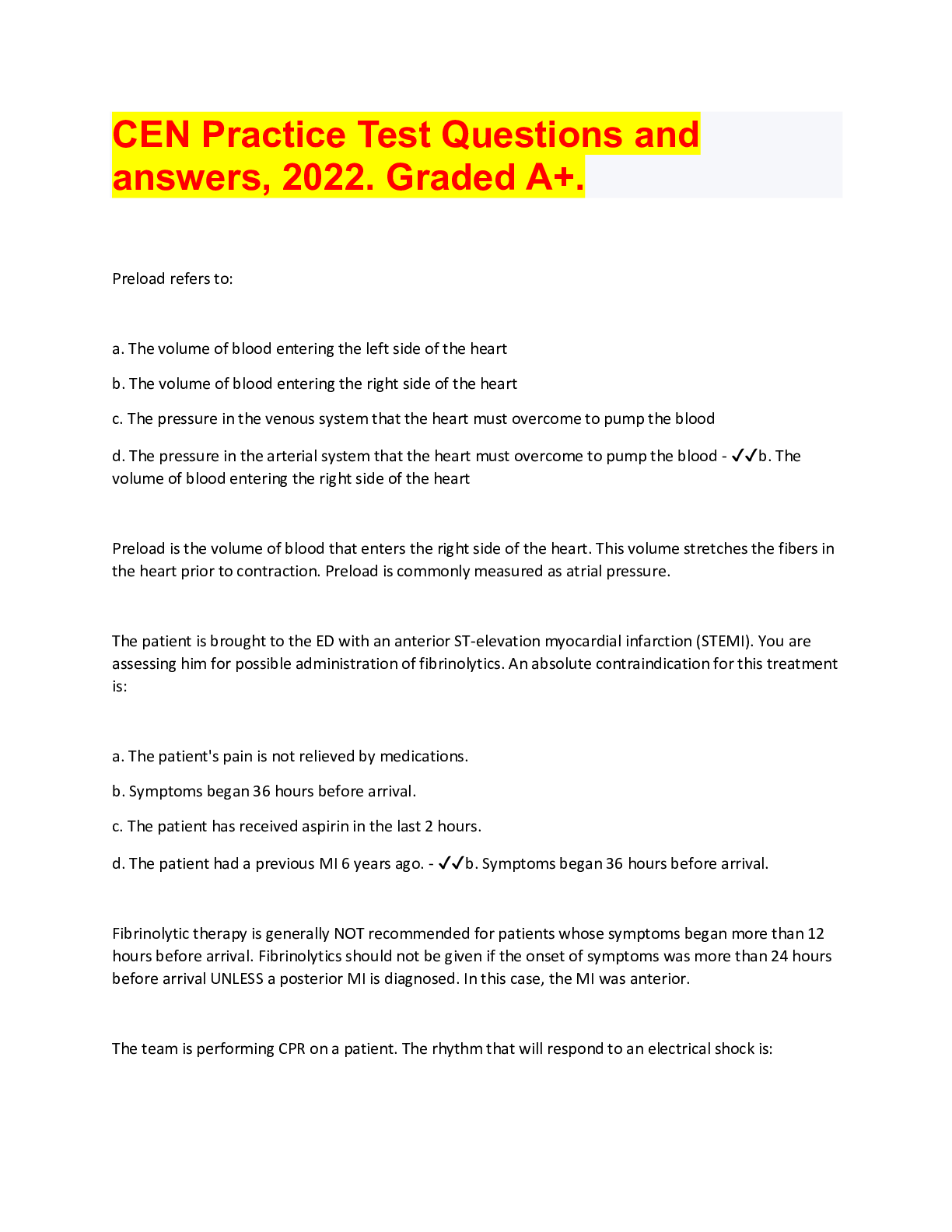
CEN Practice Exam 1. Questions and answers, Graded A+. 2022 update A. The use of supplemental oxygen in normoxic patients has not been established. In patients with potential coronary artery synd ... rome, withholding of additional supplemental oxygen should be considered for those in the prehospital or in-patient hospital setting and the emergency department. - ✔✔A patient presents to the emergency department with chest pain and diaphoresis, and denies dyspnea. Vital signs are BP 148/70 mm Hg, HR 72 beats/minute, RR 18 breaths/minute, Sp02 98% on room air. Breath sounds are clear and equal. rlhe electrocardiogram shows an inferior wall ST segment elevation. You anticipate the following oxygen order. A. No supplemental oxygen at this time B. Nasal cannula at 6 L per minute C. Partial rebreather mask at 10 L per minute D. Nonrebreather mask at 15 L per minute C. Chest pain that radiates to both shoulders has a likelihood ratio of 7.1, and pain that radiates to the right shoulder has a stronger likelihood ratio of 2.9 of predicting acute COronary syndro compared with pain that radiates only to the left shoulder. - ✔✔A patient complains of chest pain, dyspnea, and diaphoresis. Which of the following assessment factors would indicate a possible diagnosis of acute coronary syndrome? A. Pleuritic chest pain B. Positional chest pain C. Chest pain that radiates to the shoulders, with pain in the right shoulder worse than pain in the left shoulder D. Pain reproducible with chest wall palpation D. Adrenal gland stimulation causes the adrenals to release two catecholamines: epinephrine and norepinephrine. Epinephrine increases heart rate and peripheral vasoconstriction and triggers glycogenolysis. - ✔✔Whichofthefollowinghuman compensatorymechanisms to the presence ofshocktriggersglycogenolysis? A. Chemoreceptor activation B. Clotting cascade activation C. Cerebral autoregulation stimulation D. Adrenal gland stimulation D. Patients with Ehler—Danlos syndrome may be identified by hypermobile joints and skin that is hyper-extensible, has a soft velvety-like appearance, is fragile, and tears or bruises easily. Ehler—Danlos syndrome is a connective tissue disorder that places patients at risk for the presence of aortic aneurysm and dissection. - ✔✔A patient presents to the emergency department with abdominal pain and "ripping" back pain. Which condition places the patient at risk for abdominal aortic dissection? A. Down syndrome [Show More]
Last updated: 3 years ago
Preview 1 out of 3 pages

Buy this document to get the full access instantly
Instant Download Access after purchase
Buy NowInstant download
We Accept:

Also available in bundle (1)
Click Below to Access Bundle(s)
CEN bundle, Questions with accurate answers
Comprises of all CEN exams Questions and answers
By bundleHub Solution guider 3 years ago
$32
7
Reviews( 0 )
$10.00
Can't find what you want? Try our AI powered Search
Document information
Connected school, study & course
About the document
Uploaded On
Sep 01, 2022
Number of pages
3
Written in
All
Seller

Reviews Received
Additional information
This document has been written for:
Uploaded
Sep 01, 2022
Downloads
1
Views
330