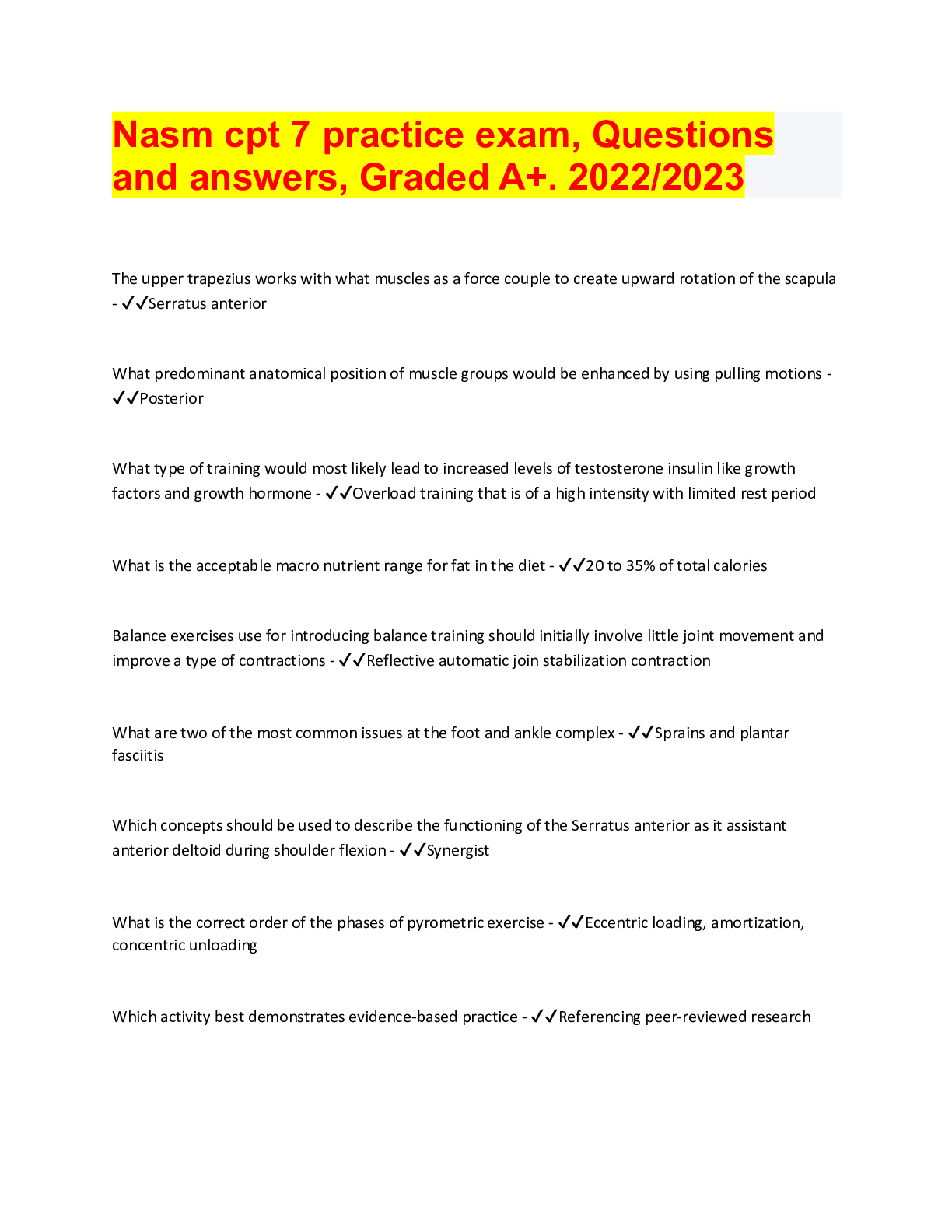
NASM CPT EXAM, Questions and answers, 2022 update, Graded A+.
Name the structures that make up the
lumbo-pelvic-hip complex (LPHC). - ✔✔Lumbar spine, pelvic girdle, abdomen,
and hip joint
Dysfunction within t
...
NASM CPT EXAM, Questions and answers, 2022 update, Graded A+.
Name the structures that make up the
lumbo-pelvic-hip complex (LPHC). - ✔✔Lumbar spine, pelvic girdle, abdomen,
and hip joint
Dysfunction within the connective
tissue of the kinetic chain that is
treated by the body as an injury,
initiating this repair process. - ✔✔Cumulative injury cycle
Name four core-strength exercises. - ✔✔Ball Crunch, Back Extensions, Reverse
Crunch, Cable Rotations
The type of flexibility training that
applies gentle force to an adhesion,
altering the elastic muscle fibers from
a bundled position to a straighter
alignment with the direction of the
muscle and/or fascia. - ✔✔Self-myofascial release
Exercises in the core-stabilization level
are identified through these
characteristics. - ✔✔They involve little motion through the
spine and pelvis
What are four common ways a stressor
causes breakdown or injury? - ✔✔Stress fractures, muscle strains, joint
pain, emotional fatigue
Name four core-stabilization exercises. - ✔✔Marching, Floor Bridge, Floor Prone
Cobra, Prone Iso-abs
Law stating that soft tissue models
along the lines of stress. - ✔✔Davis's law
Referred to as a co-contraction of
global muscles, such as the rectus
abdominis, external obliques, and
quadratus lumborum. - ✔✔Bracing
It is critical that the core training
program is designed to achieve these
three functional outcomes in the right
order. - ✔✔1. Intervertebral stability, 2. Lumbo-pelvic stability, 3. Movement efficiency.
What are the proper backside
mechanics during sprinting? - ✔✔Ankle plantar flexion, knee extension,
hip extension, and neutral pelvis
What are the proper frontside
mechanics during sprinting? - ✔✔Ankle dorsiflexion, knee flexion, hip
flexion, and neutral pelvis
The ability to accelerate, decelerate,
stabilize, and change direction quickly,
while maintaining proper posture. - ✔✔Agility
The ability to react and change body
position with maximum rate for force
production, in all planes of motion and
from all body positions, during
functional activities. - ✔✔Quickness
The ability to move the body in one
intended direction as fast as possible. - ✔✔Speed
Name four core-power exercises. - ✔✔Rotation Chest Pass, Ball Medicine
Pullover Throw, Front Medicine Ball
Oblique Throw, Soccer Throw
The ability of the body to produce high
levels of force for prolonged periods of
time. - ✔✔Muscular endurance
What is a component of core-power
exercises that make them easy to
identify? - ✔✔Explosive movements with medicine
balls
Name five balance-stabilization
exercises. - ✔✔Single-leg Balance, Single-leg Balance
Reach, Single-leg Hip Internal and
External Rotation, Single-leg Lift and
Chop, Single-leg Throw and Catch
Name five balance-strength exercises. - ✔✔Single-leg Squat, Single-leg Squat
Touchdown, Single-leg Romanian
Deadlift, Step-up to Balance,
Multiplanar Lunge to Balance
Name three balance-power exercises. - ✔✔Multiplanar Hop with Stabilization,
Multiplanar Single-leg Box Hop-up with
Stabilization, Multiplanar Single-leg
Box Hop-down with Stabilization
What are four plyometric-stabilization
exercises? - ✔✔SQUAT JUMP WITH STABILIZATION, BOX JUMP-UP WITH STABILIZATION, BOX JUMP-DOWN WITH STABILIZATION, MULTIPLANAR JUMP WITH STABILIZATION.
Name four plyometric-strength
exercises. - ✔✔Squat Jump, Tuck Jump, Butt Kick,
Power Step-up
Name three plyometric-power
exercises. - ✔✔Ice Skater, Single-leg Power Step-up,
Proprioceptive Plyometrics
Exercises that use quick powerful
movements involving an eccentric
action immediately followed by an
explosive concentric contraction. - ✔✔Plyometric training
Body position progressions in balance
training. - ✔✔TWO-LEG STABLE, SINGLE-LEG STABLE, TWO-LEG UNSTABLE, SINGLE-LEG
Give examples of chest exercises used
in the Stabilization Level of the OPT
model. - ✔✔Ball Dumbbell Chest Press, Push-up,
Ball Push-up: hands on the ball,
Standing Cable Chest Press
What are the two techniques used in
corrective flexibility according to the
integrated flexibility continuum? - ✔✔SMR (self-myofascial release) and
static stretching
Give examples of total-body power
exercises - ✔✔Two-arm Push Press, Barbell Clean,
Dumbbell Snatch, Squat Thrust,
Kettlebell Hang, Clean and Jerk
What is the minimum amount of time
static stretches should be held? - ✔✔30 seconds
Name two different leg-stabilization
exercises. - ✔✔Ball Squat and Multiplanar Step-up to
Balance
What are three things that a client
should have established prior to
incorporating a dynamic stretching
program? - ✔✔Good levels of tissue extensibility, core
stability, and balance capabilities
Name two strength level exercises for
the legs. - ✔✔Leg Press and Barbell Squat
Name two power level exercises for
the legs. - ✔✔Squat Jump and Tuck Jump
Give 3 examples of shoulder power exercises. - ✔✔Front Medicine Ball Oblique Throw,
Overhead Medicine Ball Throw, Speed
Tubing Shoulder Press
Give examples of total-body strength
exercises. - ✔✔Lunge to Two-arm Dumbbell Press;
Squat, Curl, to Two-arm Press; Step-up
to Overhead Press: sagittal plane;
Romanian Deadlift, Shrug to Calf Raise
Based on the exercise selection
continuum what exercises should be
selected for the adaptation of
stabilization? - ✔✔Total-body, multi-joint or single joint,
controlled unstable
Total-body, multi-joint or single joint,
controlled unstable - ✔✔Marching, Floor Bridge, Floor Prone
Cobra, Prone Iso-abs
Give four examples of core-strength
exercises. - ✔✔Ball Crunches, Back Extensions,
Reverse Crunches, Cable Rotations
Body position progressions used for
balance training. - ✔✔1. Two-leg stable 2. Single-leg stable 3.
Two-legs unstable 4. Single-leg
unstable
Three types of core systems. - ✔✔Local stabilization system, Global
stabilization system, Movement
system
What are the seven methods for
prescribing exercise intensity? - ✔✔Peak VO2, VO2 reserve, Peak
metabolic equivalent (MET), Peak
maximal heart rate, Heart rate reserve,
Rating of perceived exertion, Talk test
The cumulative sensory input to the
central nervous system from all
mechanoreceptors that sense position
and limb movements. - ✔✔Proprioception
What are the acute variables for static
stretching? - ✔✔1-2 sets, hold each stretch for 30
seconds
What is the mechanism of action that
occurs in active-isolated stretching? - ✔✔Reciprocal inhibition
When is the appropriate time to utilize
dynamic stretching? - ✔✔After self-myofascial release when
training in Phase 5
How long should the cardiorespiratory
portion of the warm-up last? - ✔✔5-10 minutes
What does F.I.T.T.E. stand for? - ✔✔Frequency, Intensity, Time, Type,
Enjoyment
Example of a Zone 1 cardiorespiratory
activity and intensity level. - ✔✔Walking or jogging at 65-75% of
maximal heart rate
Example of a Zone 2 cardiorespiratory
activity and intensity level. - ✔✔Group exercise classes or spinning at
76-85% of maximal heart rate
Example of a Zone 3 cardiorespiratory
activity and intensity level. - ✔✔Sprinting at 86-95% of maximal heart
rate
Type of training that has been found to
be just as beneficial as traditional
forms of cardiorespiratory training. - ✔✔Circuit training
Name the structures that make up the
core. - ✔✔Lumbo-pelvic-hip complex, pelvic
girdle, abdomen, and hip joint
Name the five muscles of the Local
Stabilization System of the core. - ✔✔Transverse abdominis, internal
oblique, lumbar multifidus, pelvic floor
muscles, diaphragm
Name the four muscles of the
movement system of the core. - ✔✔Latissimus dorsi, hip flexors, hamstring
complex, quadriceps
The normal extensibility of all soft
tissues that allows the full range of
motion of a joint. - ✔✔Flexibility
The tendency of the body to seek the
path of least resistance during
functional movement patterns. - ✔✔Relative flexibility
What are the benefits of a warm-up? - ✔✔Increased heart rate and respiratory
rate, increased tissue temperature,
and increased psychological
preparation for bouts of exercise.
The concept of muscle inhibition,
caused by a tight agonist, which
inhibits its functional antagonist. - ✔✔Altered reciprocal inhibition
The principle that states the body will
adapt to the specific demands that are
placed on it. - ✔✔SAID Principle or Principle of Specificity
What does the acronym SAID in SAID
Principle stand for? - ✔✔Specific Adaptation to Imposed
Demands
What kinetic chain deviations must a
certified personal trainer watch for in
the cardiorespiratory portion of the
workout for clients who possess
rounded shoulders? - ✔✔On steppers and treadmills watch for
the grasping of the handles; on
stationary bikes, treadmills and
elliptical trainers watch for rounding of
the shoulders.
Feedback used after the completion of
a movement to help inform clients
about the outcome of their
performance. - ✔✔Knowledge of results
Feedback that provides information
about the quality of the movement
during exercise. - ✔✔Knowledge of performance
The type of specificity that refers to
the weight and movements placed on
the body. - ✔✔Mechanical specificity
The state where there is an elevation
of the body's metabolism after
exercise. - ✔✔Excess post-exercise oxygen
consumption (EPOC)
The three stages in the General
Adaptation Syndrome. - ✔✔Alarm reaction, resistance
development, exhaustion
Four performance adaptive benefits
from resistance training. - ✔✔Increased strength, increased power,
increased endurance, increased
neuromuscular control
SAQ training can be used with what
three nonathletic populations? - ✔✔Youth, weight-loss clients, seniors
What is the drawing-in Maneuver? - ✔✔A maneuver that is used to recruit the
local core stabilizers by drawing the
naval towards the spine.
Benefits of a cool-down include the
following: - ✔✔Reduced heart rate and breathing
rates, gradually cools body
temperature, returns muscles to their
optimal length-tension relationships,
prevents venous pooling of blood in
lower extremities, restores
physiological systems close to baseline
Give examples of total-body
stabilization exercises. - ✔✔Single-leg Squat Touchdown, Curl, to
Overhead Press; Single-leg Romanian
Deadlift, Curl, to Overhead Press;
Single-leg Squat to Row; Ball Squat,
Curl, to Press; Multiplanar Step-up
Balance, Curl, to Overhead Press
Give examples of chest exercises used
in the Strength Level of the OPT model. - ✔✔Incline Dumbbell Chest Press; Incline
Barbell Bench Press; Flat Dumbbell
Chest Press; Barbell Bench Press
Give examples of chest exercises used
in the Power Level of the OPT model. - ✔✔Two-arm Medicine Ball Chest Pass;
Rotation Chest Pass; Speed Tubing
Chest Press; Plyometric Push-up
Give examples of back exercises used
in the Stabilization Level of the OPT
model. - ✔✔Single-leg Pull-down; Ball Cobra;
Standing Cable Row; Ball Dumbbell
Row
Give examples of back exercises used
[Show More]