Test Bank for Essentials of Community Corrections, 1st Edition, 1e by Robert D. Hanser TEST BANK ISBN-13: 9781506359762 Full chcapter included Chapter 1 • Definitions, History, and Development of Community Correctio
...
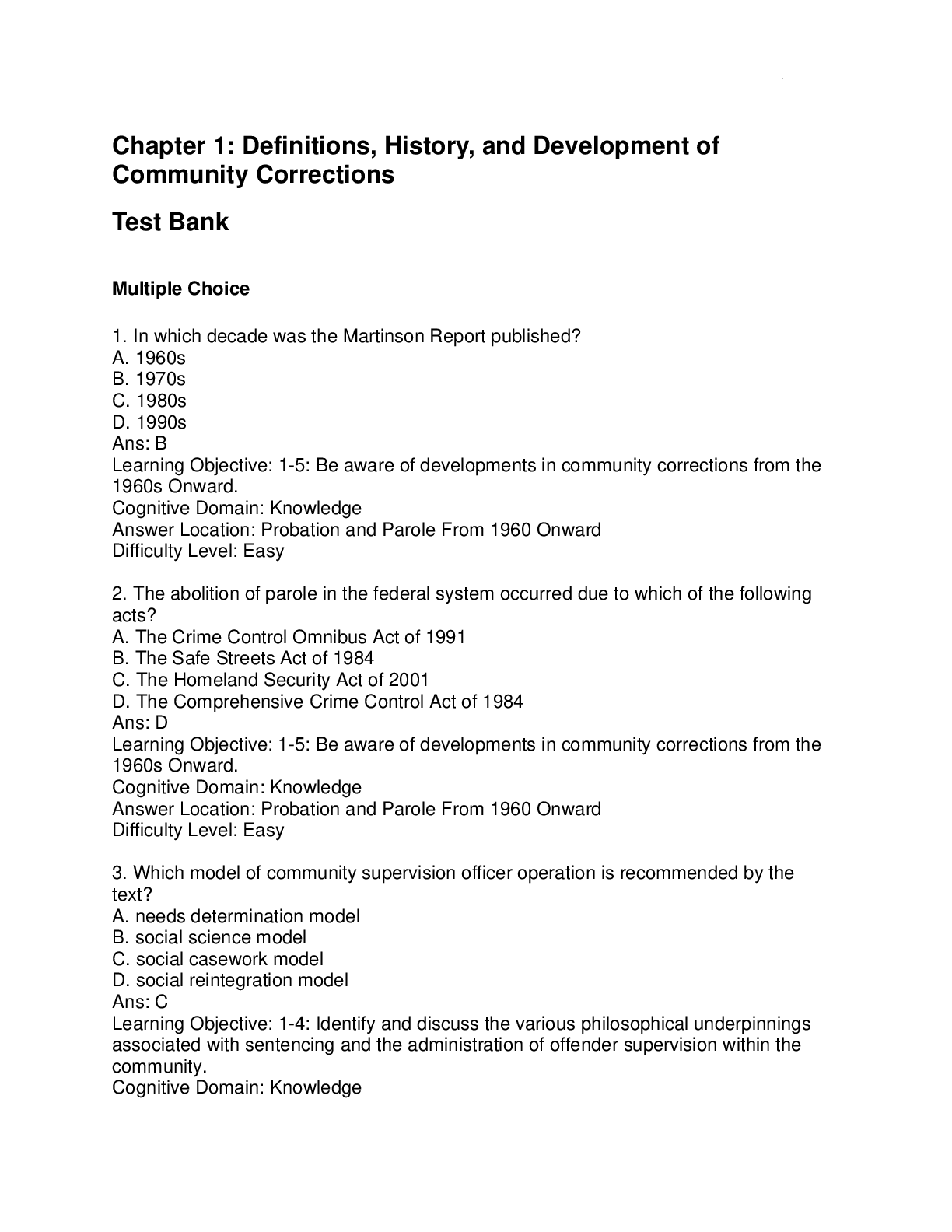
Test Bank for Essentials of Community Corrections, 1st Edition, 1e by Robert D. Hanser TEST BANK ISBN-13: 9781506359762 Full chcapter included Chapter 1 • Definitions, History, and Development of Community Corrections Learning Objectives Introduction Early Alternative Sanctions: Sanctuary Early Alternative Sanctions: Benefit of Clergy Early Alternative Sanctions: Judicial Reprieve Early Alternative Sanctions: Recognizance The Beginning of Probation The Beginning of Parole • Cross-National Perspective: The History of Probation in England Philosophical Basis of Community Corrections—Both Probation and Parole • Applied Theory: Classical Criminology, Behavioral Psychology, and Community Corrections Suggested Theoretical Approach to Reintegration and Offender Treatment Probation and Parole From 1960 Onward Conclusion Key Terms End-of-Chapter Review: Sharing Your Opinion “What Would You Do?” Applied Exercise Food for Thought Chapter 2 • Community Corrections: Public Safety Is Job One Learning Objectives Introduction Key Criminological and Psychological-Theoretical Perspectives Routine Activities Theory: A Model Theory for Improving Public Safety • Applied Theory: The Connections Among Routine Activities Theory, Community Justice, and the Community Supervision Agency Excessive Caseloads and Their Impact on Community Protection Using the Community to Improve Safety: Volunteers and Neighborhood Programs • Cross-National Perspective: The Use of Volunteers With Probation Agencies in Japan Improving Public Safety: How Individual Volunteers Can Make a Difference Conclusion Key Terms End-of-Chapter Review: Sharing Your Opinion “What Would You Do?” Applied Exercise Food for Thought Chapter 3 • Assessment and Risk Prediction Learning Objectives Introduction The Presentence Investigation Report (PSI) The Basics of Risk Assessment False Positives and False Negatives Static and Dynamic Risk Factors The Appropriate Use of Subjective and Objective Assessments Subjective Assessment Objective Assessment Recidivism Prediction The Link Between Theory and Risk Prediction • Applied Theory: Criminological Theory and Risk Prediction Better Diagnosis: The Need for Improved Assessment • Cross-National Perspective: The Adult Actuarial Risk Instrument (AARI)— A Model Risk-Assessment Instrument From Australia Classification Conclusion Key Terms End-of-Chapter Review: Sharing Your Opinion “What Would You Do?” Applied Exercise Food for Thought Chapter 4 • The Role of the Practitioner Learning Objectives Introduction Tasks and Nature of Work for Probation Officers Pay and Demographics of Probation Officers Role Confusion, Stress, and Burnout Related to the Job of Probation Officers Education, Training, and Qualifications for Probation Officers Tasks and Nature of Work for Parole Officers • Applied Theory: Critical Criminology and Community Supervision Education, Training, and Qualifications of Parole Officers When Probation and Parole Are Combined Into One Department Supervision Styles of Community Supervision Officers Firearms and the Community Supervision Officer Nature of Work for Treatment Professionals Record Keeping, Case Notes, and Administrative Duties With the Courts Types of Treatment Providers in the Community Corrections System Challenges to the Work of a Correctional Treatment Provider • Cross-National Perspective: The Effect of Homelessness on Probationers and Probation Officers in Ireland Conclusion Key Terms End-of-Chapter Review: Sharing Your Opinion “What Would You Do?” Applied Exercise Food for Thought Chapter 5 • Legal Liabilities and Risk Management Learning Objectives Introduction State Levels of Liability Intentional Torts Negligence Torts Liability Under Section 1983 Federal Lawsuits Forms of Immunity and Types of Defense Indemnification, Representation, and Types of Damages Legal Issues of Disclosure With Presentence Investigation Reports Liability of Parole Board Members for Violation of Substantive or Procedural Rights Parole Board Liability for Released Offenders Who Recidivate The Use of Objective Instruments as a Safeguard From Liability Probationer and Parolee Case Law Regarding Due Process During Revocation • Cross-National Perspective: Extracts of the European Rules on Community Sanctions and Measures • Applied Theory: Labeling Theory and Legal Issues/Liabilities Conclusion Key Terms End-of-Chapter Review: Sharing Your Opinion “What Would You Do?” Applied Exercise Food for Thought Chapter 6 • Needs-Based Case Management and Case Planning Learning Objectives Introduction Basics of Case Management in Community Corrections Client Needs Assessment Reliability and Validity of Needs Assessment Scales Mental Illness and Classification: The DSM-5 Caseload Assignment Models The Specialized Needs Caseload Model Standards of Classification Case Management Classification—Presentation of a Model System Assessment • Cross-National Perspective: Hong Kong Offender Risk/Needs Assessment The Supervision Plan • Applied Theory: Containment Theory—Outer and Inner Containment Aspects Client Contracting and Supervision Planning Addressing Offender Needs Holistically Treatment Screening and Screening Tools Treatment Planning Progress Notes, Record Keeping, and Connecting the Case Plan With Supervision Conclusion Key Terms End-of-Chapter Review: Sharing Your Opinion “What Would You Do?” Applied Exercise Food for Thought Chapter 7 • The Viability of Treatment Perspectives Learning Objectives Introduction The Martinson Report—Revisited The Need for Community-Based Treatment and the Pitfalls of Treatment Programs in Institutional Settings Motivational Interviewing and Community Supervision Staff Community Supervision Staff and Treatment Staff: Effective Alliances Different Types of Treatment Modalities/Orientations in Therapy • Cross-National Perspective: South Australia’s Mental Health Courts Less Common Types of Therapy Different Types of Treatment Programs Different Types of Treatment Professionals Treatment Staff, Referrals, and Increased Human Supervision Progress in Treatment Programs and the Likelihood of Recidivism Educating the Community About Treatment Benefits and Integrating Citizen and Agency Involvement • Applied Theory: Social Disorganization, Collective Efficacy, and Community Supervision Conclusion Key Terms End-of-Chapter Review: Sharing Your Opinion “What Would You Do?” Applied Exercise Food for Thought Chapter 8 • Community-Based Residential Treatment Facilities Learning Objectives Introduction Initial Offender Processing in the Jail Setting The Use of Jail Diversion Programs to Alleviate Jail Crowding Historical Developments of Halfway Houses • Cross-National Perspective: Canada’s Halfway Houses Various Community Residential Treatment Centers Rural and Urban Residential Centers Work Release and Study Release Programs Cost-Effectiveness and Actual Program Effectiveness • Applied Theory: Differential Association and Treatment in Residential Facilities Complex Offender Cases in Residential Facilities Typical Staff in Residential Treatment Facilities Conclusion Key Terms End-of-Chapter Review: Sharing Your Opinion “What Would You Do?” Applied Exercise Food for Thought Chapter 9 • Intermediate Sanctions Learning Objectives Introduction Fines Community Service Intensive Supervision Probation/Parole (ISP) Electronic Monitoring • Cross-National Perspective: Electronic Monitoring in Sweden Global Positioning Systems Home Detention Day Reporting Centers Shock Incarceration/Split Sentencing Methods of Ensuring Compliance—Detecting Drug Use Among Offenders Testing Technologies—Immunoassay and Chromatography Testing Methods—Instrumental and Point-of-Contact Testing Methods of Ensuring Compliance—Sex Offender Notification Programs and Community Partnerships • Applied Theory: Routine Activities Theory as Applied to Community Supervision Conclusion Key Terms End-of-Chapter Review: Sharing Your Opinion “What Would You Do?” Applied Exercise Food for Thought Chapter 10 • Reentry and Restorative Justice Learning Objectives Introduction Reentry Defined Reentry and Reintegration Issues The Use of Volunteers as Mentors Connecting the Divergent Pieces of Reentry: DOJ’s Five Evidence-Based Principles Community Involvement, Police Partnerships, Reentry Courts, and Reentry Councils Restorative Justice as a Component of Reentry Restorative Justice Defined Types of Restorative Justice Programs Family Conferences Teen Courts Reintegrative Shaming Community Justice Restorative Justice Behind Institutional Walls Victim–Offender Mediation Victims, Restorative Justice, and Reentry • Cross-National Perspective: Restorative Justice in Costa Rica: New Implementation in 2012 Holds Promise Conclusion Key Terms End-of-Chapter Review: Sharing Your Opinion “What Would You Do?” Applied Exercise Food for Thought Chapter 11 • Diversity Issues and Cultural Competence in a Changing Era Learning Objectives Introduction Why Is Diversity So Important in Community Corrections? The Notion of Cultural Competence An Overview of the Six Stages of the Cultural Competence Continuum African American, Latino American, and Asian American Offenders in Metropolitan Areas African Americans Latino Americans Asian Americans and Pacific Islanders Minority Caseloads, Minority Gang Affiliations, and Training for Community Supervision Staff Female Offenders Domestic Violence Physical and Sexual Abuse Sex Industry Activity and Sexually Transmitted Diseases Female Crime Female Offenders as Mothers Ideal Treatment Programming for Female Offenders Geriatric Offenders Challenges With Elderly Offenders • Cross-National Perspective: England’s Aging Prison Population Preprison Community Supervision (Probation) • Applied Theory: Life Course Criminological Theories and Elderly Offender Typologies Postprison Community Supervision (Parole) Conclusion Key Terms End-of-Chapter Review: Sharing Your Opinion “What Would You Do?” Applied Exercise Food for Thought Chapter 12 • Specialized and Problematic Offender Typologies Learning Objectives Introduction Sex Offenders Sex Offenders in the Community • Cross-National Perspective: South Africa’s HIV/AIDS-Infected Offenders Treatment Strategies for Sex Offenders Cognitive-Behavioral Techniques Interrogation-Oriented Techniques Drug-Administered Technique Substance Abusers Screening and Placement Criteria for Treatment Programs Substance Abuse Treatment Programs The Therapeutic Community The Use of Drug Courts • Applied Theory: Individual Trait Criminological Theories and Criminal Activity Substance Abusers on Community Supervision Self-Help Groups Mentally Ill Offenders Common Types of Mental Disorders in the Offender Population Anxiety and Stress-Related Disorders Antisocial Personality Disorder, Psychopathy, and Other Mental Disorders With High Risks of Violence Mentally Ill Offenders in the Community Mental Health Courts Trial and Sentencing Probation and Parole Conclusion Key Terms End-of-Chapter Review: Sharing Your Opinion “What Would You Do?” Applied Exercise Food for Thought Chapter 13 • Program Evaluation, Evidence-Based Practices, and Future Trends in Community Corrections Learning Objectives Introduction Experimental Designs Quasi-Experimental Studies Before/After Studies Reliability and Validity in Evaluative Studies Evaluation Research
[Show More]



.png)



.png)
.png)