*NURSING > QUESTIONS and ANSWERS > ATI Teas Study Guide (Latest Update 2020/2021)| Rated A (All)
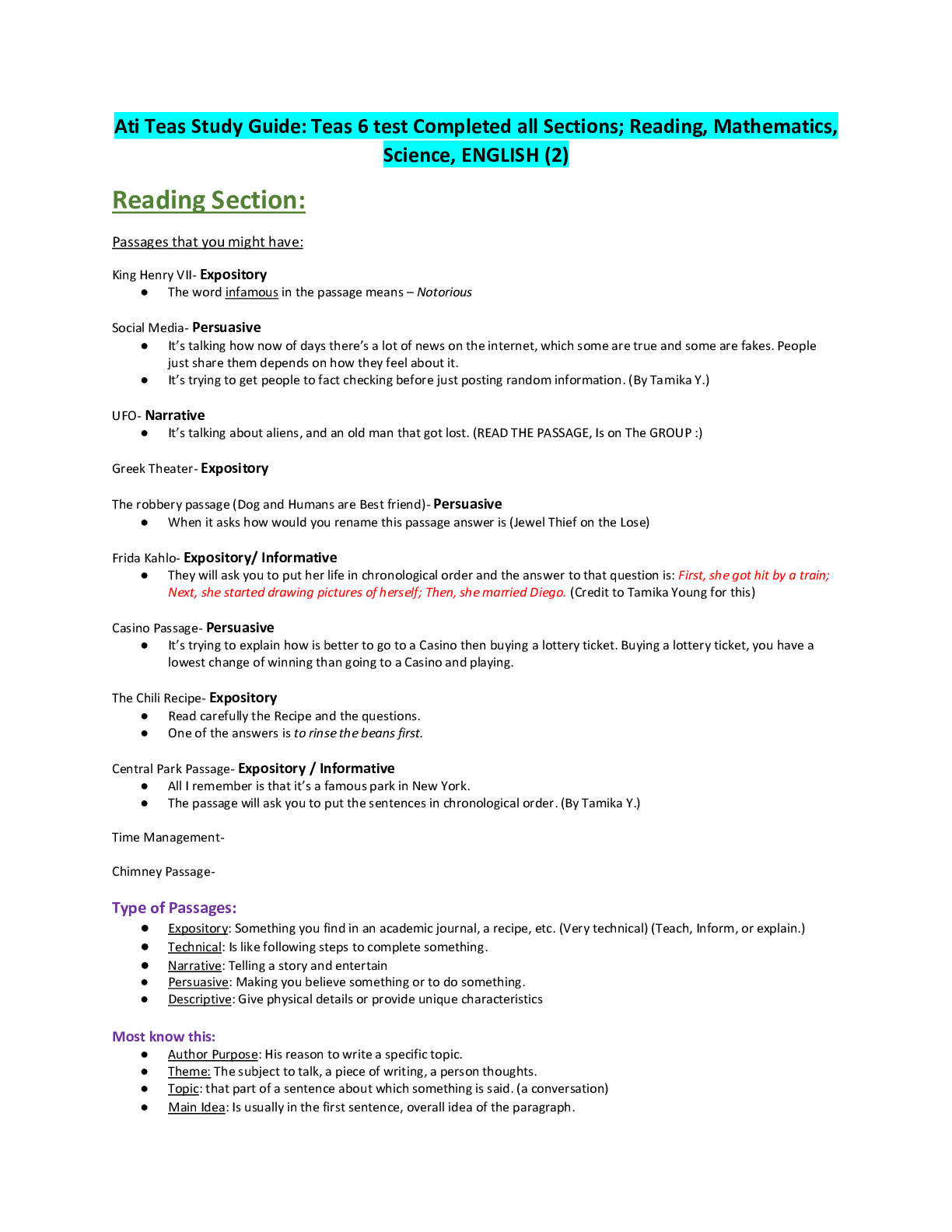
Ati Teas Study Guide: Reading Section: Passages that you might have: King Henry VII- Expository ● The word infamous in the passage means – Notorious Social Media- Persuasive ● It’s ... talking how now of days there’s a lot of news on the internet, which some are true and some are fakes. People just share them depends on how they feel about it. ● It’s trying to get people to fact checking before just posting random information. (By Tamika Y.) UFO- Narrative ● It’s talking about aliens, and an old man that got lost. (READ THE PASSAGE, Is on The GROUP :) Greek Theater- Expository The robbery passage (Dog and Humans are Best friend)- Persuasive ● When it asks how would you rename this passage answer is (Jewel Thief on the Lose) Frida Kahlo- Expository/ Informative ● They will ask you to put her life in chronological order and the answer to that question is: First, she got hit by a train; Next, she started drawing pictures of herself; Then, she married Diego. (Credit to Tamika Young for this) Casino Passage- Persuasive ● It’s trying to explain how is better to go to a Casino then buying a lottery ticket. Buying a lottery ticket, you have a lowest change of winning than going to a Casino and playing. The Chili Recipe- Expository ● Read carefully the Recipe and the questions. ● One of the answers is to rinse the beans first. Central Park Passage- Expository / Informative ● All I remember is that it’s a famous park in New York. ● The passage will ask you to put the sentences in chronological order. (By Tamika Y.) Time Management- Chimney Passage- Type of Passages: ● Expository: Something you find in an academic journal, a recipe, etc. (Very technical) (Teach, Inform, or explain.) ● Technical: Is like following steps to complete something. ● Narrative: Telling a story and entertain ● Persuasive: Making you believe something or to do something. ● Descriptive: Give physical details or provide unique characteristics Most know this: ● Author Purpose: His reason to write a specific topic. ● Theme: The subject to talk, a piece of writing, a person thoughts. ● Topic: that part of a sentence about which something is said. (a conversation) ● Main Idea: Is usually in the first sentence, overall idea of the paragraph. ● Fact: Something that it can be prove is true. ● Opinion: A view or judgment. ● Bia: Against something or someone. ● Compare: two or more ● Inform: Give facts ● Entertain: Fiction ● Express: Feelings ● Stereotypes: A characteristics ascribed to groups of people involving gender, race, origin, etc. ● Cause and Effect: The author describes a situation and then its effects. ● Compare and Contrast: The author explores the similarities and differences between two or more things. ● Chronological: The author list events in the order in which they happened. ● Mood: Influences a reader emotional state in the piece. ● Tone: Describes the author’s attitude toward the topic. To Respond to Questions, you Should know this: ● Almanac: A book that gives you important dates such tidal waves, astronomical events, etc. ● Thesaurus: A dictionary that has definitions, synonyms and antonyms. ● Bibliography: A list of books, magazines, articles, etc. ● Biography: Story of someone written by someone else. ● Autobiography: Story of someone written by the same person. ● Atlas: A book of maps or charts. ● Appendix: A section or table at the end of the book. ● Index: Reference in alphabetical order to where everything is in the book. ● Glossary: Alphabetical list of terms of words with definition. The word Disseminate is in one the Passages and they ask you what does it means: Answer will be (Spread of disperse) ● Metaphor: A figure of speech containing an implied comparison, in which a word or phrase ordinarily and primarily used of one thing is applied to another. Example: Noah Has a heart of a lion ● Simile: A comparison of two different things using the words LIKE or AS. Example: On her first day of school, Jane was as cool as a cucumber. ● Forum: Online message board. ● Rhetorical: Used for effect not meaning. ● Memorandum: A written informal note usually used for business purposes. ● Sequential: Following SET of Orders. (First, Second, Third, Next, While, Last, Before, After) ● Anecdote: A short story that illustrates a concept but isn’t the main idea. [Show More]
Last updated: 3 years ago
Preview 1 out of 13 pages
Buy this document to get the full access instantly
Instant Download Access after purchase
Buy NowInstant download
We Accept:
Can't find what you want? Try our AI powered Search
Connected school, study & course
About the document
Uploaded On
Dec 18, 2020
Number of pages
13
Written in
All
This document has been written for:
Uploaded
Dec 18, 2020
Downloads
0
Views
201
Scholarfriends.com Online Platform by Browsegrades Inc. 651N South Broad St, Middletown DE. United States.
We're available through e-mail, Twitter, Facebook, and live chat.
FAQ
Questions? Leave a message!
Copyright © Scholarfriends · High quality services·