PMHNP Certification Exam Review 2022 (Verified)
100% CORRECT
Tarasoff Principle - - -1976 - duty to warn victims of potential harm from client
Deontological Theory - - -Ethical theory that states an action is judged a
...
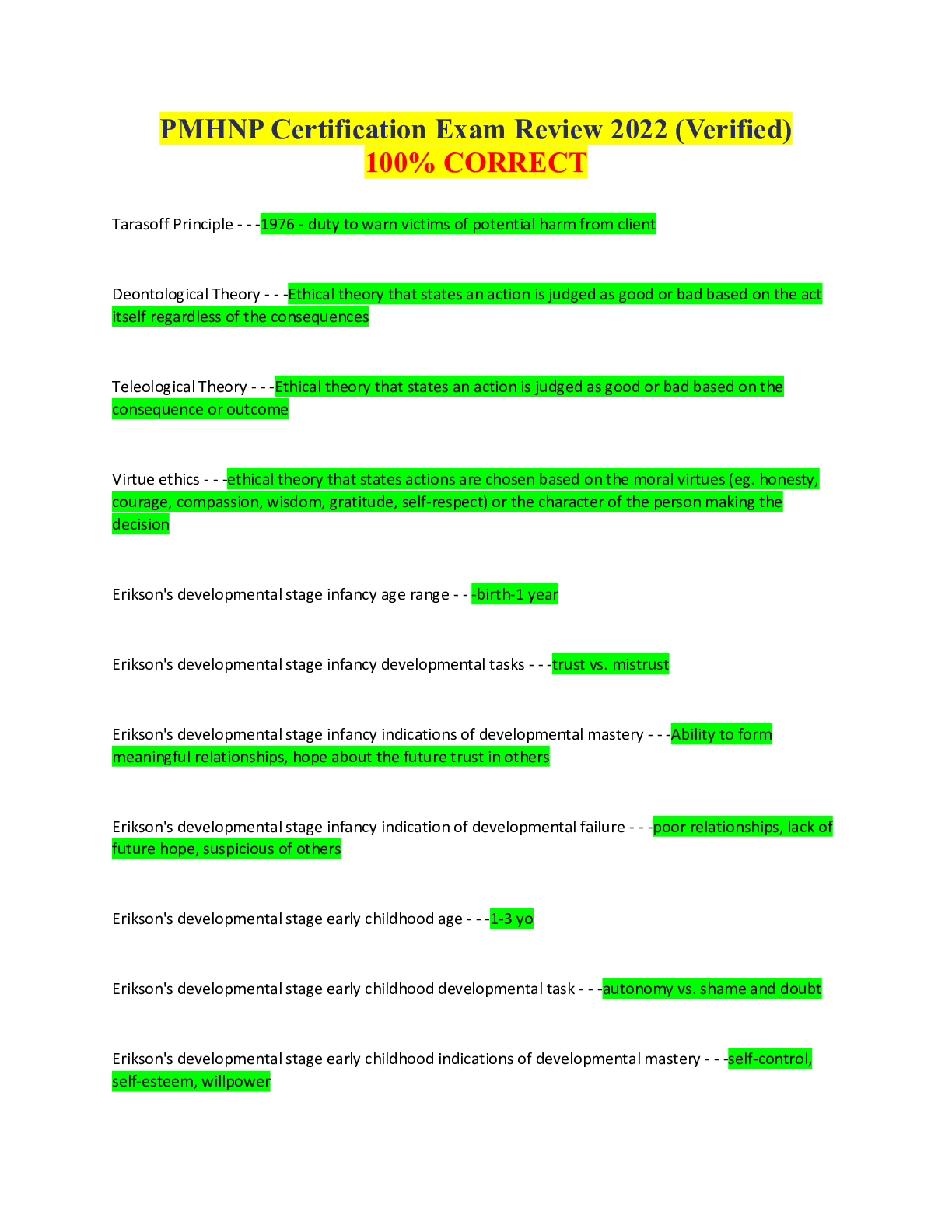
PMHNP Certification Exam Review 2022 (Verified)
100% CORRECT
Tarasoff Principle - - -1976 - duty to warn victims of potential harm from client
Deontological Theory - - -Ethical theory that states an action is judged as good or bad based on the act
itself regardless of the consequences
Teleological Theory - - -Ethical theory that states an action is judged as good or bad based on the
consequence or outcome
Virtue ethics - - -ethical theory that states actions are chosen based on the moral virtues (eg. honesty,
courage, compassion, wisdom, gratitude, self-respect) or the character of the person making the
decision
Erikson's developmental stage infancy age range - - -birth-1 year
Erikson's developmental stage infancy developmental tasks - - -trust vs. mistrust
Erikson's developmental stage infancy indications of developmental mastery - - -Ability to form
meaningful relationships, hope about the future trust in others
Erikson's developmental stage infancy indication of developmental failure - - -poor relationships, lack of
future hope, suspicious of others
Erikson's developmental stage early childhood age - - -1-3 yo
Erikson's developmental stage early childhood developmental task - - -autonomy vs. shame and doubt
Erikson's developmental stage early childhood indications of developmental mastery - - -self-control,
self-esteem, willpowerErikson's developmental stage early childhood indications of developmental failure - - -poor self-control,
low self esteem, self-doubt, lack of independence
Erikson's developmental stage late childhood age - - -3-6yo
Erikson's developmental stage late childhood developmental task - - -initiative vs guilt
Erikson's developmental stage late childhood indications of developmental mastery - - -self-directed
behavior, goal formation, sense of purpose
Erikson's developmental stage late childhood indications of developmental failure - - -lack of selfinitiated behavior, lack of goal orientation
Erikson's developmental stage school-age ages - - -6-12yo
Erikson's developmental stage school-age developmental task - - -industry vs. inferiority
Erikson's developmental stage school-age indications of developmental mastery - - -ability to work;
sense of competency and achievement
Erikson's developmental stage school-age indications of developmental failure - - -sense of inferiority,
difficulty with working, learning
Erikson's developmental stage adolescence ages - - -12-20yo
Erikson's developmental stage adolescence developmental task - - -identity vs role confusion
Erikson's developmental stage adolescence indications of developmental mastery - - -personal sense of
identityErikson's developmental stage adolescence indications of developmental failure - - -identity confusion,
poor self-identification in group settings
Erikson's developmental stage early adulthood ages - - -20-35 years
Erikson's developmental stage early adulthood developmental task - - -intimacy vs isolation
Erikson's developmental stage early adulthood indications of developmental mastery - - -committed
relationships, capacity to love
Erikson's developmental stage early adulthood indications of developmental failure - - -emotional
isolation, egocentrism
Erikson's developmental stage middle adulthood ages - - -35-65 yo
Erikson's developmental stage middle adulthood developmental task - - -generativity vs. self-absorption
or stagnation
Erikson's developmental stage middle adulthood indications of developmental mastery - - -ability to give
time and talents to others, ability to care for others
Erikson's developmental stage middle adulthood indications of developmental failure - - -selfabsorption, inability to row and change as a person, inability to care for others
Erikson's developmental stage late adulthood age - - ->65yo
Erikson's developmental stage late adulthood developmental task - - -integrity vs despair
Erikson's developmental stage late adulthood indications of developmental mastery - - -fulfilment and
comfort with life, willingness to face death, insight and balanced perspective on life's eventsErikson's developmental stage late adulthood indications of developmental failure - - -bitterness, sense
of dissatisfaction with life, despair over impending death
Psychodynamic (Psychoanalytic) Theory - - --Sigmund Freud
-all bx is purposeful and meaningful
-principle of psychic determinism
-most mental activity is unconscious
-conscious behaviors and choices are affected by unconscious mental content
-childhood experiences shape adult personality
-instincts, urges, or fantasies function as drives that motivate thoughts, feelings, and bx
-Id, Ego, Superego
-conflict is experienced consciously as anxiety
Principle of psychic determinism - - -Even apparently meaningless, random, or accidental behavior is
actually motivated by underlying unconscious mental content
Intellectual disability typical age onset - - -infancy- usually evident at birth
ADHD typical age onset - - -early childhood (per DSM by age 12)
Schizophrenia typical age onset - - -18-25 for men
25-35 for women
Major Depression typical age onset - - -late adolescence to young adulthood
dementia typical age onset - - -most common after age 85
Freud's Id - - --contains primary drives or instincts
-drives are largely unconscious-operates on the pleasure principle
-"I want"
pleasure principle - - -the id seeks immediate satisfaction
freud's ego - - --rational mind, logical and abstract thinking
-"I think, I evaluate"
Freud's superego - - --sense of conscience or right vs wrong
-develops around age 6
-"I should or ought"
Freud's psychosexual stage of development oral stage age - - -0-18 months
Freud's psychosexual stage of development oral stage primary means of discharging drives and
achieving gratification - - -sucking, chewing, feeding, crying
Freud's psychosexual stage of development oral stage psych disorder linked to failure of stage - - -
schizophrenia, substance abuse, paranoia
Freud's psychosexual stage of development anal stage age - - -18 months-3 years
Freud's psychosexual stage of development anal stage primary means of discharging drives and
achieving gratification - - -sphincter control, activities of expulsion and retention
Freud's psychosexual stage of development anal stage psych disorder linked to failure of stage - - -
depressive disorder
Freud's psychosexual stage of development phallic stage age - - -3-6 yearsFreud's psychosexual stage of development phallic stage primary means of discharging drives and
achieving gratification - - -exhibitionism, masturbation with focus on Oedipal conflict, castration anxiety,
and female fear of lost maternal love
Freud's psychosexual stage of development phallic stage psychiatric disorder linked to failure of stage - -
-sexual identity disorders
Freud's psychosexual stage of development latency stage age - - -6years-puberty
Freud's psychosexual stage of development latency stage primary means of discharging drives and
achieving gratification - - -peer relationships, learning, motor-skills development, socialization
Freud's psychosexual stage of development latency stage psych disorder linked to failure of stage - - -
inability to form social relationships
Freud's psychosexual stage of development genital stage age - - -puberty forward
Freud's psychosexual stage of development genital stage primary means of discharging drives and
achieving gratification - - -integration and synthesis of behaviors from early stages, primary genitalbased sexuality
Freud's psychosexual stage of development genital stage psych disorder linked to failure of sage - - -
sexual perversion disorders
Cognitive Theory - - --Piaget
- four stages of development
Piaget developmental stage sensorimotor age - - -birth-2 years
Piaget developmental stage sensorimotor - - -the critical achievement of this stage is object permanence
Piaget developmental stage preoperational age - - -2-7 yearsPiaget developmental stage preoperational - - -more extensive use of language and symbolism
magical thinking
Piaget developmental stage concrete operations age - - -7-12 years
Piaget developmental stage concrete operations - - -child begins to use logic
develops concepts of reversibility and conservation
Piaget developmental stage formal operations age - - -12 years-adult
Piaget developmental stage formal operations - - -ability to think abstractly
thinking operates in a formal, logical manner
interpersonal theory - - --Harry Stack Sullivan
-self-system
-when the person's need for satisfaction and security is interfered with by the self system, mental illness
occurs
-humans experience anxiety and bx is directed toward relieving the anxiety, which then results in
interpersonal security
self system - - -interpersonal theory
total components of personality traits
two drives for behavior in interpersonal theory - - --the drive for satisfaction
-the drive for security
Freud's defense mechanisms - - --denial
-projection-regression
-repression
-reaction formation
-rationalization
-undoing
-intellectualization
-suppression
-sublimation
-altruism
Hierarchy of needs - - --Maslow
-survival
-safety and security needs
-love and belonging
-self-esteem
-self-actualizaiton
Sullivan's stage of interpersonal development infancy age - - -birth-18 months
Sullivan's stage of interpersonal development infancy developmental task - - -oral gratification, anxiety
occurs for the first time
Sullivan's stage of interpersonal development childhood age - - -18 months- 6 years
Sullivan's stage of interpersonal development childhood developmental task - - -delayed gratification
Sullivan's stage of interpersonal development juvenile age - - -6-9 years
Sullivan's stage of interpersonal development juvenile developmental task - - -forming peer relationshipsSullivan's stage of interpersonal development preadolescence age - - -9-12 years
Sullivan's stage of interpersonal development preadolescence developmental task - - -same-sex
relationships
Sullivan's stage of interpersonal development early adolescence age - - -12-14 years
Sullivan's stage of interpersonal development early adolescence developmental task - - -opposite- sex
relationships
Sullivan's stage of interpersonal development late adolescence age - - -14-21 years
Sullivan's stage of interpersonal development late adolescence developmental taks - - -self-identity
developed
Health Belief Model - - -Marshall Becker
explains that healthy people do not always take advantage of screening or preventative programs
because of certain variables:
-perception of susceptibility
-seriousness of illness
-perceived benefits of tx
-perceived barriers to change
-expectations of efficacy
transtheoretical model of change - - -states that change such as in health bx occurs in 6 predictable
stages
-precontemplation
-contemplation
-preparation-action
-maintenance
motivational interviewing - - -miller and rollnick
-focused, goal-directive therapy
-motivation is elicited from the client
-nonconfrontational, nonadversarial
self-efficacy and social learning theory - - --albert bandura
-behavior is the result of cognitive and environmental factors
theory of cultural care - - --madeline Leininger
-regardless of the culture, care is the unifying focus and the essence of nursing
theory of self-care - - -Dorothy orem
-self care
therapeutic nurse-client relationship theory or interpersonal theory - - -Hildegard Peplau
-first significant psych nursing theory
-sees nursing as an interpersonal process in which all interventions occur within the context of the
nurse-client relationship
phases of the nurse-client relationship - - --orientation
-working phase (identification, exploration)
-termination phase (resolution)
caring theory - - -jean Watson
caring is an essential component of nursingt test - - -assesses whether the means of two groups are statistically different from each other
analysis of variance (ANOVA) - - -tests the difference among three or more groups
pearson's r correlation - - -tests the relationship between two variables
probability - - -likelihood of an event occurring
lies between 0 and 1
an impossible event has probability of 0
a certain event has a probability of 1
P value - - -aka level of significance describes the probability of a particular result occurring by change
alone
if P=0.1, there is a 1% probability of obtaining a result by chance alone
Donabedian model - - -structure, process, outcome
process of quality improvement PDSA cycle - - -Plan
Do
Study
Act
monoamines - - --biogenic amines
-dopamine
-norepinephrine
-epinephrine
-serotonin
dopamine - - --catecholamine-produced in the substantia nigra and ventral tegmental area
-precursor is tyrosine
-removed from synaptic cleft by monoamine oxidase (MAO) enzyme action
-D1-like and D2-like receptors
four dopaminergic pathways - - --mesocortical
-mesolimbic
-nigrostriatal
-tuberoinfundibular
norepinephrine - - --catecholamine
-produced in the locus ceruleus of the pons
-precursor is tyrosine
-major neurotransmitter implicated in mood, anxiety, and concentration disorders
-Alpha 1 and 2 receptors
epinephrine - - --catecholamine
-produced by the adrenal glands
-referred to as the adrenergic system
serotonin - - --known as an indole
-produced in the raphe nuclei of the brainstem
-precursor is tryptophan
-major neurotransmitter implicated in mood and anxiety disorders
-5HT1a, 5HT1d, 5HT2, 5HT2a, 5HT3, 5HT4 receptors
amino acids - - -glutamate, aspartate, gamma-aminobutyric acid (GABA), glycine
glutamate - - --universal excitatory neurotransmitter-major neurotransmitter involved in process of kindling (implicated in sz dx and bipolar dx)
-imbalance implicated in mood dx and schizophrenia
-AMPA and MNDA receptors
aspartate - - -another excitatory neurotransmitter
-works with glutamate
GABA - - -universal inhibitory neurotransmitter
-site of action of benzos, alcohol, barbiturates, and other CNS depressants
-GABAa and GABAb receptors
glycine - - --another inhibitory neurotransmitter
-works with GABA
cholinergics - - -acetylcholine
acetylcholine - - -synthesized by the basal nucleus of Meynert
-precursors are acetylcoenzyme A and choline
-nicotinic and muscarinic receptors
neuropeptides - - --nonopioid type (substance P, somatostatin)
-opioid type (endorphins, enkephalines, dynorphins)
-modulate pain
-Decreased amount of neuropeptides is thought to cause substance abuse
- opioid type receptors: mu, kappa, epsilon, delta, sigma
dopamine general function - - -thinking
decision making
reward-seeking behaviorfine muscle action
integrated cognition
dopamine symptoms of deficit - - -mild: pour impulse control, poor spatiality, lack of abstractive thought
-severe: Parkinson's disease, endocrine alterations, movement disorders
-substance abuse, anhedonia
Dopamine symptoms of excess - - --mild: improved creativity, improved ability for abstract thinking,
improved executive functioning, improved spatiality
-severe: disorganized thinking, loose association, tics, stereotypic bx
-schizophrenia, psychosis
norepinephrine general function - - -alertness
focused attention
orientation
primes fight or flight
learning
memory
norepinephrine symptoms of deficit - - --dullness, low energy, depressive affect
-depression
norepinephrine symptoms of excess - - --anxiety, hyper alertness, increase startle, paranoia, decreased
appetite
-anxiety
serotonin general function - - -regulation of sleep
pain perception
mood statestemperature
regulation of aggression
libido
precursor for melatonin
serotonin symptoms of deficit - - -irritability, hostility, depression, sleep dysregulation, loss of appetite,
loss of libido
OCD, anxiety disorders, schizophrenia
serotonin symptoms of excess - - -sedation, increased aggression, hallucinations (rare)
acetylcholine general function - - -attention, memory, thirst, mood regulation, REM sleep, sexual
behavior, muscle tone
acetylcholine symptoms of deficit - - -lack of inhibition, decreased memory, euphoria, antisocial action,
speech decrease, dry mouth, blurred vision, constipation
alzheimers dx
acetylcholine symptoms of excess - - -overinhibition, anxiety, depression, somatic complaints, selfconsciousness, drooling, EPS
parkinsonian symptoms
GABA general function - - -reduces arousal, reduces aggression, reduces anxiety, reduces excitation
GABA symptoms of deficit - - -irritability, hostility, tension and worry, anxiety, seizure activity
anxiety disorders
GABA symptoms of excess - - -reduced cellular excitability
sedation
impaired memoryglutamate general function - - -memory, sustained automatic functions
glutamate symptoms of deficit - - -poor memory, low energy, distractible
learning difficulty, negative symptoms of schizophrenia
glutamate symptoms of excess - - -kindling, seizures, anxiety or panic
bipolar affective disorder, psychosis from ischemic neurotoxicity or excessive pruning
peptides opioid type general function - - -modulate emotions, reward center function, consolidation of
memory, modulate reactions to stress
peptides opioid type symptoms of deficit - - -hypersensitivity to pain and stress
decreased pleasure sensation
dysphoria
substance abuse
peptides opioid type symptoms of excess - - -insensitivity to pain
catatonic-like movement disturbance
auditory hallucinations
decreased memory
structural imaging - - -provides evidence of size and shape of anatomical structure
-computed tomography CT
-Magnetic resonance imaging MRI
computed tomography CT - - -provides a three-dimensional view of the brain structures
-differentiates structures based on density
provides suggestive evidence of brain-based problems but not specific testing for psychiatric disorders-advantage: widely available, relatively inexpensive
-disadvantage: lack of sensitivity, cannot differentiate white matter from gray mater; cannot view
structures close to the bone tissue; underestimation of brain atrophy, inability to image sagittal and
coronal views
magnetic resonance imaging (MRI) - - -provides a series of 2D images that represent the brain
-advantages: can view brain structures close to the skull and can separate white matter from gray
matter; readily available; resolution of brain tissue superior to CT scanning
-disadvantages: expensive, many contras to use, claustrophobia
Functional imaging - - -measures function of areas of the brain and bases the resulting assessment on
blood flow
-may use radioactive pharmaceuticals to cross blood-brain barrier
-mainly used for research
-EEG and evoked potentials testing
-magnetoencephalography MEG
-single photon emission computed tomography SPECT
-positron emission tomography PET
EEG and evoked potentials testing - - -least expensive test
convey info on electrical functioning of CNS
Magnetoencephalography MEG - - -similar to EEG
detects different electrical activities
used in complementary fashion with EEG testing
single photon emission computed tomography (SPECT) - - -information of cerebral blood flow
limited available
expensivepositron emission tomography PET - - -images of brain when positron-emitting radionuclei interact with
an electron
expensive
combined structural and functional testing - - -examine structure in conjunction with function
mainly for research
functional MRI fMRI
3D, event realted functional MRI 3fEMRI
Fluorine magnetic spectroscopy
Dopamine D2 receptor binding
genetic testing FDA required in people of Asian descent - - -presence of HLA-B*1502 allel
inherited variant of HLA-B gene
prior to prescribing carbamazepine d/t risk of steven Johnson syndrome and toxic epidermal necrolysis
TEN
normal BMI - - -20-25
overweight BMI - - -26-29
obese BMI - - -30-35
what to watch for if on psychtropics such as carbamazepine (Tegretol) or clozapine - - -elevated temp
agranulocytosis
steven Johnson syndrome med risk - - -carbamazepine or lamotrigine
blurry vision side effect in psychotropics - - -anticholinergic side effect
Seroquel may cause cataractswhat can both lithium and anorexia nervosa cause - - -peripheral edema
Free thyroxine T4 normal levels - - -0.8-2.8ng/dL
interfering factors of Free T4 - - -values can be increased during tx with heparin, aspirin, and propranolol
values can be decreased during tx with furosemide (Lasix) or Methadone
TSH values can be increased during therapy with what - - -lithium
systemic effects of hypothyroidism - - -decreased T4 and increased TSH
mimics symptoms of unipolar mood dx
systemic effects of hyperthyroidism - - -increased T4 and decreased TSH
may mimic symptoms of bipolar affective disorders
interfering factors of calcium levels - - -values can be increased by excessive ingestion of milk or during
tx with lithium, thiazide diuretics, alkaline antacids, or vitamin D
-values can be decreased during tx with anticonvulsants, aspirin, calcitonin, corticosteroids, heparin,
laxatives, diuretics, albuterol, and oral contraceptives
magnesium is a cause of neuromuscular what - - -excitability
interfering factors of magnesium levels - - -values can be increased by drugs such as antacids, laxatives
containing mg, salicylates, and lithium
interfering factors of ALT levels - - -values can be increased with Tylenol, allopurinol, aspirin, ampicillin,
carbamazepine, cephalosporins, codeine, digitalis, indomethacin, heparin, isoniazid, methotrexate,
methyldopa, oral contraceptives, phenothiazines, propranolol, tetracycline, and verapamilGGT is used to evaluate and monitor clients with what - - -known or suspected alcohol abuse
levels rise even after ingestion of small amounts of alcohol
primary preventions - - -aimed at decreasing the incidence (number of new cases) of mental disorders
helping people avoid stressors or cope with them more adaptively
secondary prevention - - -aimed at decreasing the prevalence (number of existing cases) of mental
disorders
early case finding
screening
prompt and effective tx
tertiary prevention - - -aimed at decreasing the disability and severity of mental disorder
rehabilitative services
avoidance or postponement of complications
drug steady state - - -drugs usually are administered once every half-life to achieve this
it takes approx. 5 half lives to achieve a steady state and 5 half lives to completely eliminate a drug
enzyme inducers can - - -decrease the serum level of other drugs that are substrates of that enzyme
possibly causing subtherapeutic drug levels
CP450 inhibitors - - -bupropion
clomipramine
cimetidine
clarithromycin
fluoroquinolones
grapefruitketoconazole
nefazodone
SSRIs
CP450 inducers - - -carbamazepine
hypericum/ st johns wort
phenytoin
phenobarbital
tobacco
enzyme inhibitors can - - -increase the serum level of other drugs that are substrates of that enzyme
possibly causing toxic levels
agonist effect - - -Drug binds to receptors and activates a biological response
inverse agonist effect - - -Drug causes the opposite effect of agonist; binds to same receptor
partial agonist effect - - -drug does not fully activate the receptors
antagonist effect - - -Drug binds to the receptor but does not activate a biological response
schedule 1 drugs - - -nonmedicinal substances
high abuse potential
used for research only
not available by prescription
heroin and marijuana
typical antipsychotics - - -haloperidol (Haldol), haloperidol deconate (Haldol deconate)
loxapine (loxitane)thioridazine (mallaril)
thiothixene (navane)
fluphenazine (prolixin), fluphenazine deconate (prolixin doconate)
mesoridazine (serentil)
trifluoperazine (stelazine)
chlorpromazine (thorazine)
perphenazine (trilafon)
second generation antipsychotics - - -clozapine (Clozaril)
ziprasidone (Geodon)
risperidone (Risperdal)
quetiapine (Seroquel)
olanzapine (Zyprexa)
aripiprazole (abilify)
paliperidone (Invega)
iloperidone (fanapt)
asenapine (saphris)
lurasidone (luatuda)
mood stabilizers - - -valproic acid (depakene)
divalproex sodium (Depakote)
lithium carbonate (eskalith, lithobid, lithonate, lithotabs)
lamotrigine (lamictal)
carbamazepine (tegretol)
carbamazepine ER (equetro)
oxcarbazepine (Trileptal; off label)
Tricyclics - - -clomipramine (anafranil)
amoxapine (asendin)amitriptyline (Elavil)
desipramine (norpramin)
nortripyline (pamelor)
doxepin (sinequan)
trimipramine (surmontil)
imipramine e(tofranil)
protriptyline (vivactil)
Serotonin selective reuptake inhibitors SSRIs - - -citalopram (celexa)
fluvoxamine (Luvox)
paroxetine (paxil)
paroxetine mesylate (pexeva)
fluoxetine Prozac)
sertraline (Zoloft)
escitalopram (Lexapro)
Monoamine oxidase inhibitors MAOIs - - -phenelzine (nardil)
tranylcyprmie sulfate (parnate)
selegiline transdermal (EMSAM)
SNRIs and other agents - - -trazodone (Desyrel)
venlafaxine (Effexor)
desvenlafaxine (Pristiq)
mirtazapine (Remeron)
nefazodone (serzone)
bupropion (Wellbutrin, Forfivo, Aplenzin)
duloxetine (Cymbalta)
vilazodone (viibryd)
vortioxetine (brintellix)levomilnacipran (Fetzima)
Benzodiazepines BNZs - - -lorazepam (Ativan)
clonazepam (klonopin)
chlordiazepoxide (Librium)
oxazepam (serax)
clorazepate (tranxene)
alprazolam (xanex)
anxiolytics - - -buspirone (buspar)
other agents to tx anxiety dx - - -propranolol (Inderal)
atenolol (Tenormin)
stimulants - - -amphetamine/destroamphetamine (Adderall)
dexmethylphenidate (focalin)
dextroamphetamine (Dexedrine)
methylphenidate (Ritalin)
lisdexamfetamine dimesylate (Vyvanse)
other ADHD and ADD agents - - -guanfacine (intuniv)
clonidine (kapvay)
atomoxetine (Strattera)
antidepressants such as desipramine (norpramin), venlafaxine (Effexor), and bupropion (Wellbutrin) are
also used
schedule II drugs - - -medicinal drugs in current use
high potential for abuse and dependency
written script onlyno telephone orders
no refills on script
morphine sulfate, codeine, fentanyl, methadone, hydromorphone (dilaudid), oxycodone (oxycontin,
Percocet), hydrocodone (Vicodin etc), amphetamine salts, methylphenidate
schedule III drugs - - -medicinal drugs with less abuse than II
telephone orders if followed by written script
prescription must renew Q6months
refills limited to 5
appetite suppressants, butalbital, testosterone, buprenorphine/naloxone
schedule IV drugs - - -medicinal drugs with less abuse than III
dextropropoxyphene (Darvon), pentazocine (talwin), benzos, modafinil (Provigil), phenobarbital,
zolpidem (ambien), eszopiclone (Lunesta), temazepam (Restoril), armodafinil (nuvigil)
schedule V drugs - - -lowest abuse potential
handled similar to noncontrolled drugs
buprenorphine (buprenex), cheratussin (robitussin) with codeine, promethazine (Phenergan) with
codeine, diphenoxylate/atropine (Lomotil)
pregnancy category A - - -Controlled studies show no risk
pregnancy category B - - -no evidence of risk to humans
pregnancy category C - - -risk cannot be ruled out
pregnancy category D - - -Positive evidence of isk
Pregnancy category X - - -absolutely contraindicatedteratogenic risks of benzos - - -floppy baby syndrome
cleft palate
teratogenic risks of carbamazepine (tegretol) - - -neural tube defects
teratogenic risks of lithium (Eskalith) - - -Epstein anomaly
teratogenic risks of divalproex sodium (Depakote) - - -neural tube defects
specifically spina bifida
atrial septal defect
cleft palate
possible long term developmental deficits
med that can induce depression - - -beta blockers
steroids
interferon
isotretinoin (Accutane)
some retroviral drugs
antineoplastic drugs
benzos
progesterone
meds that can induce mania - - -steroids
disulfiram (Antabuse)
isoniazid (INH)
antidepressants in persons with BP
meds that can cause false positives for amphetamines - - -stimulants
WellbutrinProzac
trazodone
ranitidine
nefazodone (serzone)
nasal decongestants
pseudoephedrine
meds that can cause false positives for alcohol - - -valium
meds that can cause false positives for benzos - - -zoloft
meds that can cause false positives for cocaine - - -amoxicillin
most antibiotics
NSAIDS
meds that can cause false positives for heroin or morphine - - -quinolones
rifampin
codeine
poppy seeds
meds that can cause false positives for methadone or PCP - - -OTC cough meds (Nyquil)
dextromethorphan
psychoanalytic therapy - - -Freud
promotes change by development of greater insight and awareness of maladaptive defenses
Cognitive therapy - - -Aaron Beck
goal is to change clients irrational beliefs, faulty conceptions, and negative cognitive distortionsbehavioral therapy - - -Arnold Lazarus
focus on changing maladaptive bx by participating in active bx techniques such as exposure, relaxation,
problem solving, and role playing
Dialectical behavior therapy - - -Marsha Linehan
focuses on emotional regulation, tolerance for distress, self management skills, interpersonal
effectiveness, mindfulness, with an emphasis on treating therapy-interfering bx
goals of DBT - - -decrease suicidal bx
decreased therapy interfering bx
decrease emotional reactivity
decrease self invalidation
decrease crisis-generating bx
decrease passivity
increase realistic decision making
increase accurate communication of emotions and competencies
existential therpay - - -viktor frankl
goal to live authentically and to focus on the present and on personal responsibility
humanistic therpay - - -carl rogers
person-centered therapy
self directed growth and self actualization
people are born with capacity to direct themselves toward self actualization
interpersonal therapy - - -Gerald klerman and myrna Weissman
evidence based therapy focus on interpersonal issues creating distress
time limited, active, focus on the present and on interpersonal distresseye movement desensitization and reprocessing EMDR - - -Francine shapiro
behavioral and exposure therapy
PTSD
goal to achieve adaptive resolution
3 phases of EMDR - - -desensitization phase
installation phase
body scan
group phases - - -pregroup phase
forming phase
storming phase
norming phase
performing phase
adjourning phase
family systems therapy - - -Murray Brown
focus on chronic anxiety within families
tx goal to increase familys awareness of each members function within the family and to incrase levels
of self determination
structural family therapy - - -Salvador minuchin
main tx goal to produce structural change in the family organization to more effectively manage
problems
changing transactional patterns and family structure
experiential therapy - - -virginia satir
focus on being authentic, freedom of choice, human validation, and experiencing the moment
tx goals to develop authentic, nurturing communication and increased self worth of each family memberoverall goal is growth rather than symptom reduction alone
does not focus on particular techniques
strategic therapy - - -jay haley
tx goal to help family embers behave in ways that will not perpetuate the problem bx
interventions are problem focused
solution focused therapy - - -steve deshaer bill ohanlon and insoo berg
focus to rework for the present situations that have worked previously
tx goal is effective resolution of problems through cognitive problem solving and use of personal
resources and strengths
omega 3 fatty acid supplements - - -used for ADHD, dyslexia, cognitive impairment, dementia, CVD,
asthma, lupus, and rheumatoid arthritis
interacts with warfarin
Sam-e supplement - - -used for depression, osteoarthritis, and liver dx
may cause hypomania, hyperactive muscle movements, and possible serotonin syndrome
tryptophan supplement - - -used for depression, obesity, insomnia, headaches, and fibromyalgia
increased risk of serotonin syndrome with use of SSRIs, MAOIs, and st johns wort
vitamin E supplement - - -used in enhancing immune system and protecting cells from effects of free
radicals
used for neurological dx, diabetes, and PMS
interacts with warfarin, antiplatelet drugs, and statins increasing risk of rhabdomyolysis
melatonin supplement - - -used for insomnia, jet lag, shift work, and cancer
interacts with aspirin, NSAIDS, beta blockers, corticosteroids, valerian, kava kava, and alcohol
can inhibit ovulation in large dosesfish oil supplement - - -used for bipolar disorder, hypertension, lowering triglycerides, and decreasing
blood clotting
interacts with warfarin, aspirin, NSAIDs, garlic, and ginkgo
may alter glucose regulation
black cohosh herbal uses - - -menopausal symptoms
PMS
dysmenorrhea
belladonna herbal use - - -anxiety
catnip herbal use - - -sedation
chamomile herbal use - - -sedation
anxiety
ginkgo herbal use - - -delirium, dementia, sexual dysfunction caused by SSRIs
Ginseng herbal use - - -depression
fatigue
valerian herbal use - - -sedation
MDD object loss theory - - --early psychological developmental issues lay the foundation for depressive
responses later in life
-the accomplishment of the first stage of development in which the child is able to form relationships is
normal
-during the second stage of development, the child experiences traumatic separation from significant
objects of attachment (usually a maternal object)MDD aggression turned inward theory - - --Freud
-assumes that early psychological developmental issues lay he foundation for depressive responses later
in life
-the accomplishment of the first stage of development in which the child is able to form relationships is
normal
-during the second stage of development, the child experiences the loss of the significant mothering
person
MDD cognitive theory - - --Beck
-represents cognitive diathesis- stress model in which developmental experiences sensitize a person to
response to stressful life events in a depressed manner
-assumes that people with a tendency to be depressed think about the world differently than
nondepressed people and that depressed people are more negative and believe that bad tings are going
to happen to them because of their own personal shortcomings and inadequacies
MDD learned helplessness-hoplessness theory - - -Seligman
-modified aspect of cognitive theory
-a person becomes depressed due to perceptions of lack of control over life events and experiences
-these perceptions are learned over time, especially as the person perceives others seeing him or her as
inadequate
MDD genetic predisposition theory - - -having a depressed parent is the single strongest predictor of
depression
MDD endocrine dysfunction theory - - -HPA axis
result of abnormal stress response related to HPA dysregulation
MDD abnormalities of neurotransmitter function theory - - -dysregulation of dopamine, serotonin, and
norepinephrine
MDD structural brain changes - - -hypovolemic hippocampushypovolemic prefrontal cortex-limbic striatal regions
MDD chronobiological theory - - -desynchronization of circadian rhythms produces the symptoms
constellation collectively called MDD
DSM MDD diagnostic criteria - - --anhedonia or depressed mood or both
-depressed mood most of the day, nearly every day, as indicated by subjective reports or observations
of others (irritability in kids)
-marked anhedonia in all or almost all ADLs
-at least 3 or more significant symptoms present during the same 2 week period that represent a change
in previous functioning
-weight loss/gain of more than 5% of body weight
-hypersomnia or insomnia nearly every day
-psychomotor agitation or retardation
-fatigue or loss of energy
-self-deprecating comments or thoughts
-feelings of worthlessness or excessive or inappropriate guilt nearly every day
-decreased concentration and memory
-symptoms that begin within 2 months of significant loss and do not persist beyond 2 months is
bereavement not MDD
SSRIs act on - - -increasing serotonin levels
TCAs act on - - -elevating serotonin and norepinephrine levels
MAOIs act on - - -elevating serotonin and norepinephrine levels
SNRIs act on - - -inhibiting dual reuptake of norepinephrine and serotonin
citalopram (celexa) - - --SSRI-tablet
-20-40mg/day
-SE: sedation, sexual dysfunction, agitation, yawning, GI disturbances, wt gain
-preg C
-lact L2
-proglonged QTc interval in doses above 40mg (20mg in older adults) and in those susceptible to
prolonged QTc
escitalopram (Lexapro) - - --SSRI
-tablet
-10-20mg/day
-SE: somnolence, headache, sexual dysfunction, GI disturbances
-prego C
-Lact L2
fluoxetine (Prozac) - - --SSRI
-capsule, tablet, or liquid
-20-80mg/day
-SE: insomnia, headache, GI disturbances, sexual dysfunction
-Long half-life
-Prego C
-Lact L2
-discontinuation syndrome unlikely
fluvoxamine (Luvox) - - --SSRI
-tablet
-100-300mg/day
-SE: sedation, sexual dysfunction, agitation, GI disturbances
-Doses above 150mg should generally be given BID-Prego C
-Lact L2
Paroxetine (Paxil CR, Pexeva) - - --SSRI
-tablet or liquid
-20-60mg/day
-SE: headache, GI disturbances, somnolence, sexual dysfunction
-Prego D
-Lact L2
-Discontinuation syndrome very common
Sertraline (Zoloft) - - --SSRI
-tablet
-50-200mg/day
-SE: sexual dysfunction, GI disturbances, somnolence, headache
-Prego C
-Lact L2
Vilazodone (Viibryd) - - --Serotonin partial agonist reuptake inhibitor SPARI
-tablet
-20-40mg
-SE: diarrhea, nausea, dry mouth, lower risk of sexual side effects
-Prego C
-Lact unknown, is excreted in breast milk
Amitriptyline (Elavil) - - --TCA
-tablet or IM
-50-300mg/day
-also used for chronic pain (particularly neuropathic pain), insomnia-Prego C
-Lact L2
clomipramine (Anafranil) - - --TCA
-Capsule
-100-250mg/day
-approved for OCD
-250mg/day maximum d/t increased seizure risk
-Prego C
-Lact L2
Desipramine (Norpramine) - - --TCA
-tablet or capsule
-100-300mg/day
-also used for ADHD (off label for pediatric clients and for ADHD)
-Prego C
-Lact L2
Doxepin (Sinequan) - - --TCA
-Capsule or liquid
-100-300mg/day
-also used for insomnia
-Prego C
-Lact L5 AVOID
imipramine (Tofranil) - - --TCA
-Tablet, capsule, or IM
-100-300mg/day
-also used for enuresis and separation anxiety-Prego D
-Lact L2
Nortriptyline (Pamelor) - - --TCA
-capsule or liquid
-50-150mg/day
-also used for enuresis and ADHD
-Prego D
-Lact L2
Protriptyline (Vivactil) - - --TCA
-tablet
-15-60mg/day
-Prego C
-Lact inadequate data
Trimipramine (Surmontil) - - --TCA
-Capsule
-100-300mg/day
-Prego C
-Lact inadequate data
norepinephrine dopamine reuptake inhibitors NDRIs act on - - -reuptake of norepinephrine and
dopamine
Serotonin agonist and reuptake inhibitors SARIs act on - - -agonist of serotonin 5HT2 receptors and
elevate serotonin levels
Isocarboxazid (Marplan) - - --MAOI-Tablet
-20-60mg/day
-also used for panic disorder, phobic disorders, selective mutism
-CAUTION: high-tyramine diet; sympathomimetic agents
-divided dosing BID and QID
-Prego C
-Lact inadequate info
Phenelzine (Nardil) - - --MAOI
-Tablet
-45-90mg/day
-also used for panic disorder, phobic disorders, selective mutism
-CAUTION: high-tyramine diet; sympathomimetic agents
-divided dosing BID and QID
-Prego C
-Lact inadequate info
Tranylcypromine (Parnate) - - --MAOI
-tablet
-30-60mg/day
-also used for panic disorder, phobic disorders, selective mutism
-CAUTION: high-tyramine diet; sympathomimetic agents
-divided dosing BID and QID
-Prego C
-Lact inadequate info
Selegiline (EMSAM) - - --MAOI
-Transdermal patch
-6-12mg-no dietary restrictions with 6mg dosage
-may need higher dose to see antidepressant effect
-Prego C
-Lact L4 AVOID
first line tx for first episode major depression with mild to mod symptoms - - -SSRIs
second line drugs for treating MDD - - -TCAs
TCA side effects - - --anticholinergic
-antiadrenergic
-antihistaminergic
-EKG changes and cardiac dyshrythmias possible
-unsafe in many co-occurring disorder such as cardiac disease
-significant discontinuation syndrome
anticholinergic side effects - - -dry m
[Show More]