WGU C213 Questions and Answers with
Complete Solutions
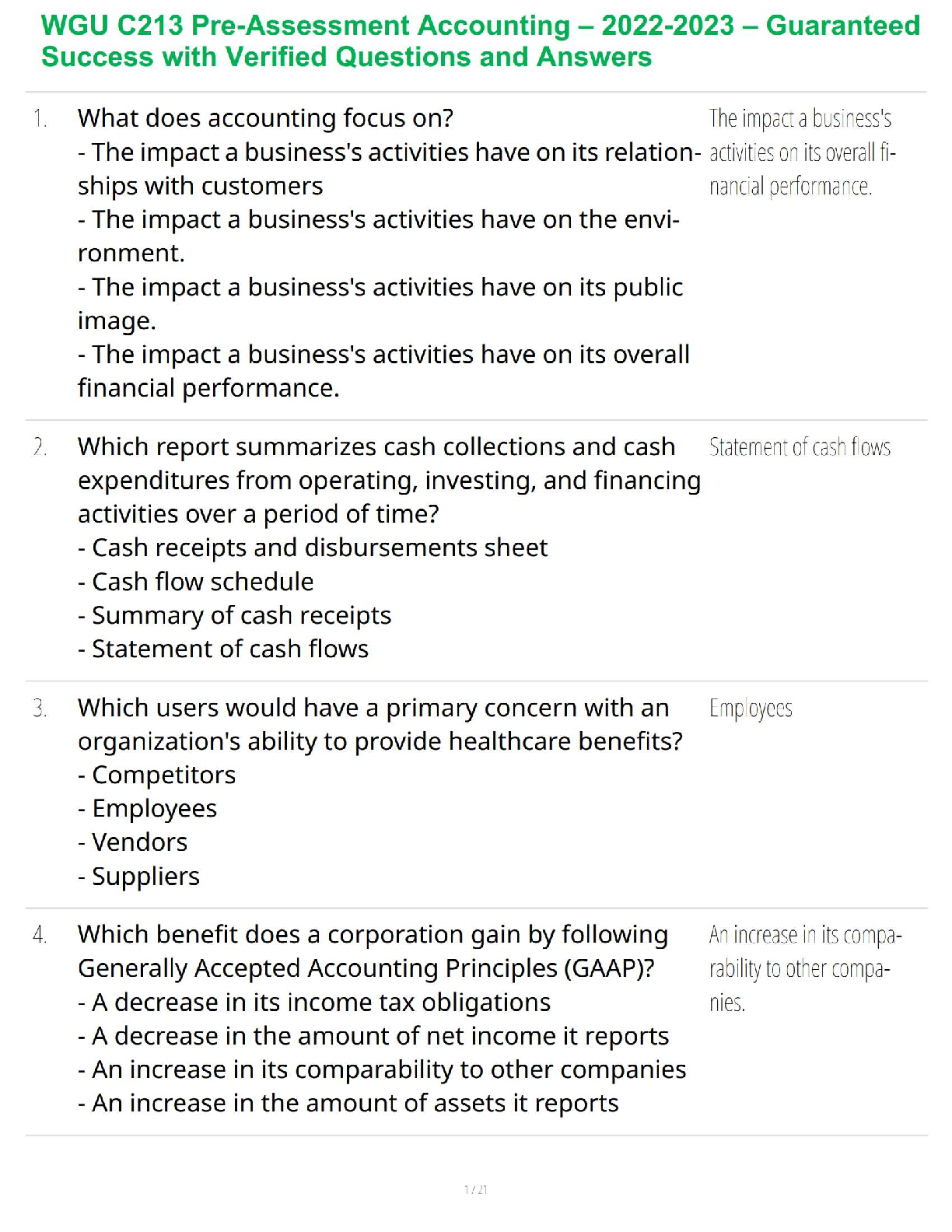
Purpose of Accounting ✔✔1. Recording of the day-to-day financial activities
2. Used to evaluate the company's financial status.
Bookkeeping ✔✔Systematic quantita
...
WGU C213 Questions and Answers with
Complete Solutions
Purpose of Accounting ✔✔1. Recording of the day-to-day financial activities
2. Used to evaluate the company's financial status.
Bookkeeping ✔✔Systematic quantitative record of an activity.
Accounting System ✔✔1. Handle routine bookkeeping tasks.
2. Evaluate the performance and financial status of the business.
Accounting Information ✔✔Used to make decisions about the future
Financial Accounting ✔✔Used by external users.
Managerial Accounting ✔✔Accounting systems designed for internal users.
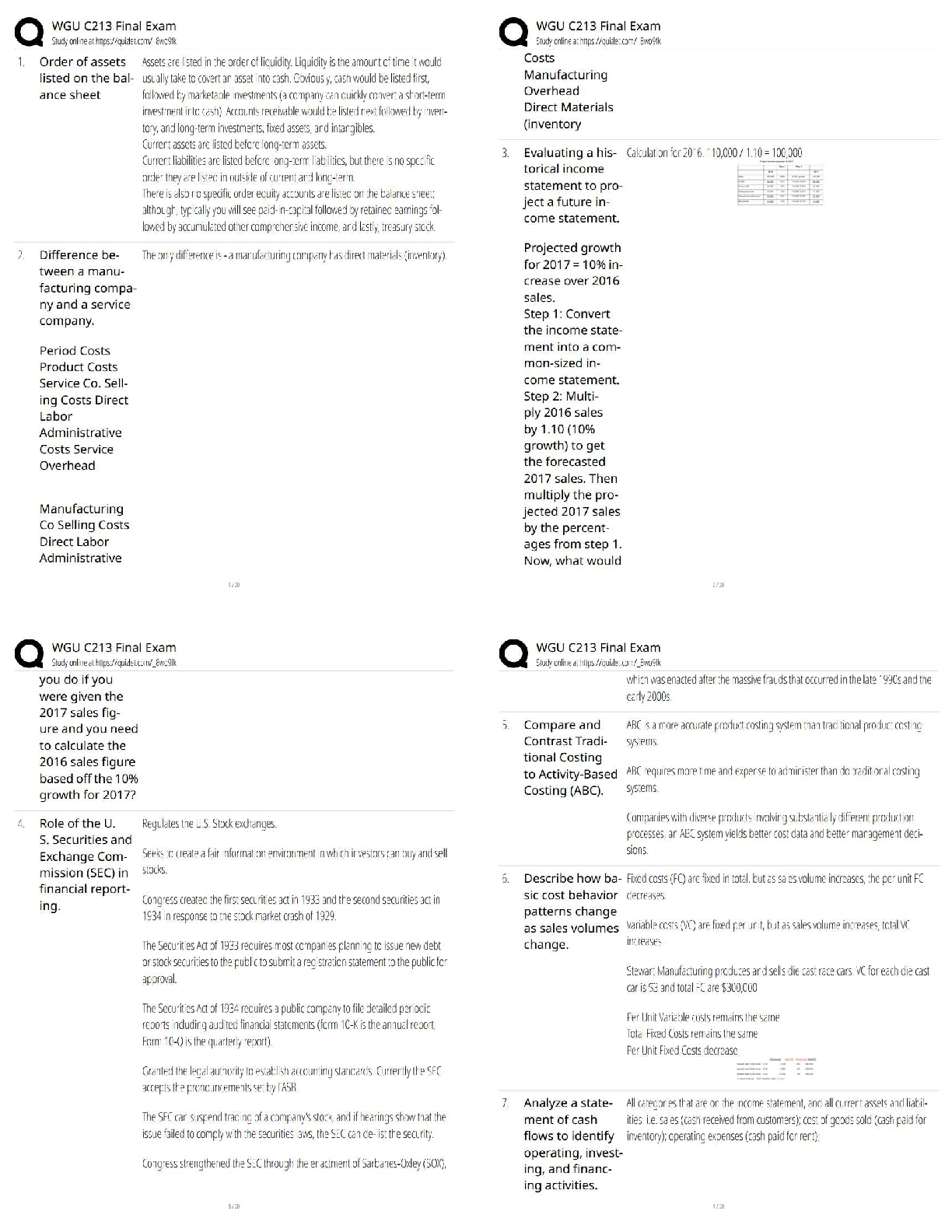
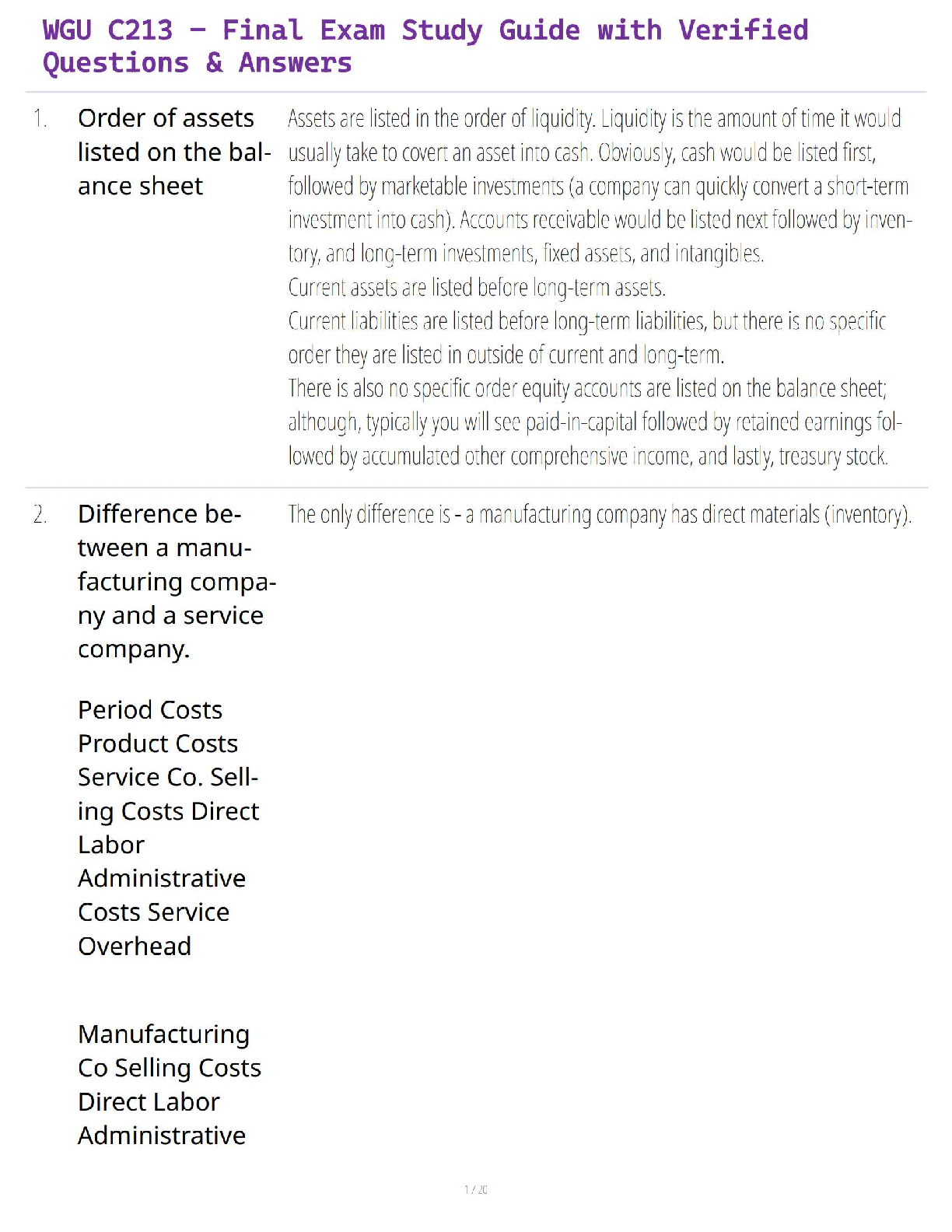
Balance Sheet ✔✔Reports a company's assets, liabilities, and owner's equity.
Income Statement ✔✔1. Reports the amount of net income earned by a company during a period.
2. Reports gains and losses from activities outside a companies normal operations.
Single-step Income Statement ✔✔Groups the revenues and expenses, and reports the overall
difference as net income.
Multi-step Income Statement ✔✔Emphasizes the presentation of gross profit and operating
income.
Net Income ✔✔The excess of a company's revenues over its expenses. Revenues, Expenses,
Gains, Losses
Statement of Cash Flows ✔✔Reports cash collected and paid out by a company. Operating,
Investing, Financing
Financial Accounting Standards Board ✔✔Not Government, Private body established by the US
business community, financial analysts, and practicing accountants, Has no legal power.
Securities and Exchange Commission ✔✔Regulates US stock exchanges
Role of SEC ✔✔Makes sure investors are provided with reliable information, Adds credibility,
Requires certain reports, 10-Q & 10-K, from companies.
Public Company Accounting Oversight Board ✔✔Inspects the audit practices, Has statutory
authority to investigate questionable audit practices, Can impose sanctions
Trends of Accounting ✔✔Information technology, integration of worldwide business, Increased
scrutiny
Constraints on Auditors (Sarbanes-Oxley) ✔✔1. Auditors are prohibited from providing nonaudit
services to audit clients.
2. Audit partners must rotate every five years.
3. Auditors must report to the audit committee of the board of directors.
Constraints on Management (Sarbanes-Oxley) ✔✔1. The CEO and the CFO must personally
certify the reliability of the financial statements
2. Companies must have a code of ethics
3. Loans to company executives are prohibited
4. Audit committees must be strengthened
Assets ✔✔Probable future economic benefits obtained or controlled by a company as a result of
past transactions or events.
Liabilities ✔✔1. Probable future sacrifices of economic benefits arising from present obligations
of a company to transfer assets.
2. Or provide services in the future as a result of past transaction or events.
Owners' Equity ✔✔The residual interest in the assets of a company that remains after deducting
its liabilities.
Revenues ✔✔The amount of assets generated in the normal course of business.
Expenses ✔✔Are the amount of assets consumed in doing business.
Revenue Recognition ✔✔The accounting process used to determine when revenue should be
reported in the income statement.
Operating Activities ✔✔Those activities that comprise the day-to-day operations of a business.
Investing Activities ✔✔The purchase and sale of long-term assets such as land and equipment.
Financing Activities ✔✔Those activities through which cash is obtained from, or repaid to,
creditors and investors.
Relevant Information ✔✔Information that is provided on a timely basis and can be used to assess
the past and to project the future for decision making.
Reliable Information ✔✔Information that represents what it is supposed to represent.
Comparability ✔✔Allows a company's financial statements to be analyzed in light of the
company's own performance in prior years or other companies' performance.
Conservatism ✔✔The practice of recognizing all losses but not recognizing gains until they are
certain.
Articulation ✔✔The idea that the three primary financial statements are interrelated.
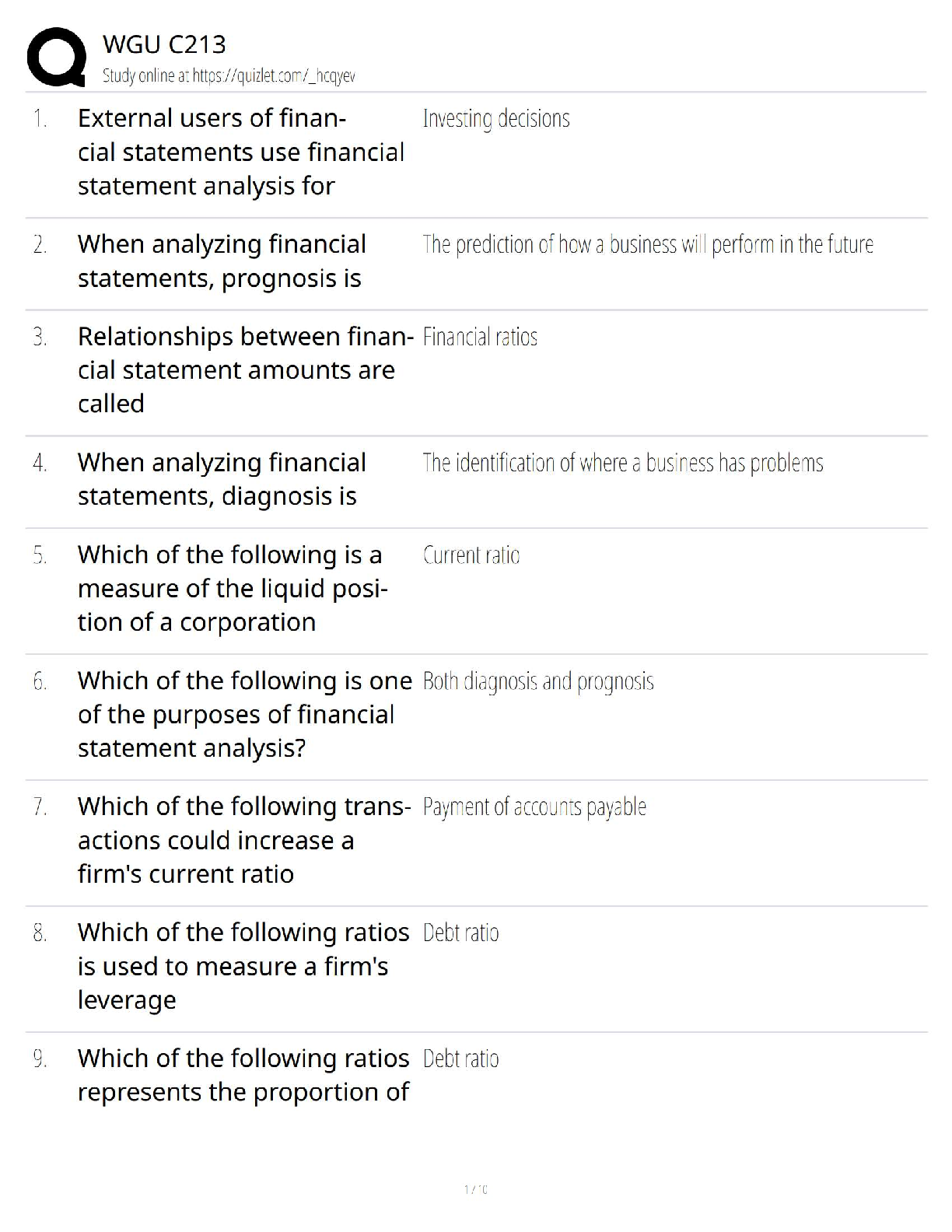
Purpose of Financial Statement Analysis ✔✔1. Can be used to diagnose existing problems
2. To forecast how a company will perform in the future
Debt Ratio ✔✔Percentage of company funding that is borrowed
Current Ratio ✔✔Indication of a company's ability to pay its short-term debts.
Return on Sales ✔✔Pennies in profit on each dollar of sales.
Asset Turnover ✔✔Measure of efficiency; number of sales dollars generated by each dollar of
assets.
Return on Equity ✔✔Pennies in profit for each dollar invested by stockholders.
Price-earnings Ratio ✔✔Number of dollars an investor must pay to "buy" the future rights to each
dollar of current earnings.
Common-size Financial Statements ✔✔1. Allows comparison of financial statements across years
and between companies.
2. Are prepared by dividing all financial statement numbers by sales for the year.
[Show More]
.png)
.png)

.png)
.png)