USMLE Step 2 OB/GYN Exam Questions
1426 Questions with 100% Correct Answers – COMPLETE SOLUTION
Q001. what is the genital system developed from? - ✔✔A001. mesoderm
Q002. what portion of the embryo gives rise to the re
...
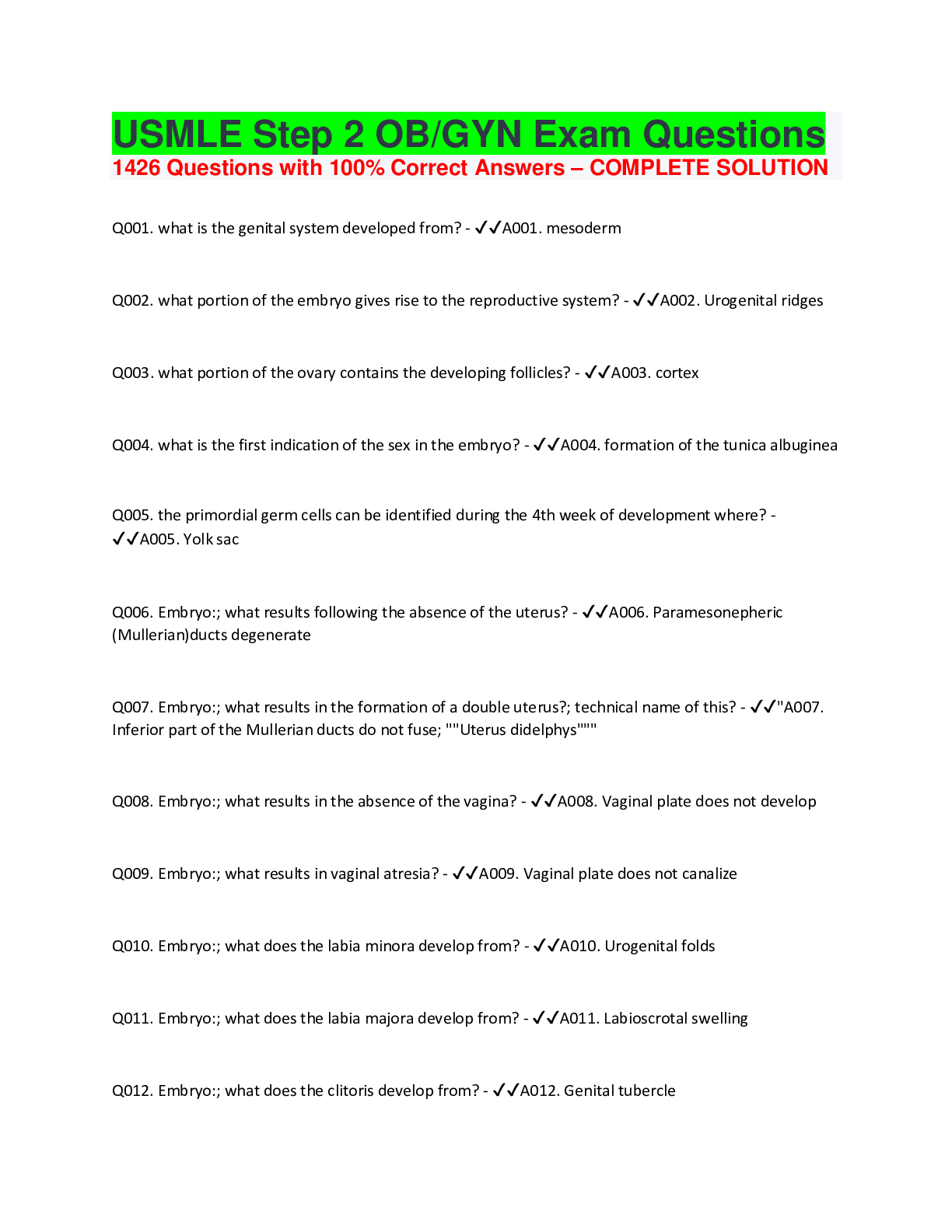
USMLE Step 2 OB/GYN Exam Questions
1426 Questions with 100% Correct Answers – COMPLETE SOLUTION
Q001. what is the genital system developed from? - ✔✔A001. mesoderm
Q002. what portion of the embryo gives rise to the reproductive system? - ✔✔A002. Urogenital ridges
Q003. what portion of the ovary contains the developing follicles? - ✔✔A003. cortex
Q004. what is the first indication of the sex in the embryo? - ✔✔A004. formation of the tunica albuginea
Q005. the primordial germ cells can be identified during the 4th week of development where? -
✔✔A005. Yolk sac
Q006. Embryo:; what results following the absence of the uterus? - ✔✔A006. Paramesonepheric
(Mullerian)ducts degenerate
Q007. Embryo:; what results in the formation of a double uterus?; technical name of this? - ✔✔"A007.
Inferior part of the Mullerian ducts do not fuse; ""Uterus didelphys"""
Q008. Embryo:; what results in the absence of the vagina? - ✔✔A008. Vaginal plate does not develop
Q009. Embryo:; what results in vaginal atresia? - ✔✔A009. Vaginal plate does not canalize
Q010. Embryo:; what does the labia minora develop from? - ✔✔A010. Urogenital folds
Q011. Embryo:; what does the labia majora develop from? - ✔✔A011. Labioscrotal swelling
Q012. Embryo:; what does the clitoris develop from? - ✔✔A012. Genital tubercleQ013. Embryo:; what does the fallopian tube develop from? - ✔✔A013. Mullerian ducts
Q014. Embryo:; what (2) structures does the vagina originate from? - ✔✔A014. Urogenital sinus;
Mullerian ducts
Q015. what are the innominate bones composed of?; (3) - ✔✔A015. Ileum,; Ischium,; Pubis
Q016. what separates the false pelvis from the true pelvis? - ✔✔A016. Linea terminalis
Q017. which pelvis does the fetus pass during labor? - ✔✔A017. True pelvis
Q018. what plane separates the false pelvis from the true pelvis? - ✔✔A018. Pelvic Inlet
Q019. at what plane does the arrest of fetal descent occur? - ✔✔A019. Plane of Least diameter
Q020. what is the value of the obstetric conjugate? - ✔✔A020. 10.0 - 11.0
Q021. what is the value of the transverse diameter of the pelvic inlet? - ✔✔A021. 13.5
Q022. what is the value of the Bispinous diameter of the pelvic midplane? - ✔✔A022. 10
Q023. what is the transverse diameter of the Greatest Diameter? - ✔✔A023. 12.5
Q024. what is the most common pelvic type? - ✔✔A024. Gynecoid
Q025. what is found in the labia majora but not the labia minora? - ✔✔A025. Hair folliclesQ026. Name type of epithelium:; Bartholin ducts - ✔✔A026. Transitional
Q027. Name type of epithelium:; Skene duct - ✔✔A027. Transitional
Q028. Name type of epithelium:; Urethra - ✔✔A028. Transitional
Q029. Name type of epithelium:; Endocervical canal - ✔✔A029. Columnar
Q030. what is the name of the part of the uterus where the fallopian tubes enter? - ✔✔A030. Cornu
Q031. what are the (2) main anatomic divisions of the uterus? - ✔✔A031. Corpus,; Cervix
Q032. what (2) arteries supply the uterus? - ✔✔A032. Uterine artery,; Ovarian artery
Q033. where do the uterine veins enter the venous system? - ✔✔A033. Internal iliac veins
Q034. what portion of the fallopian tube boarders the ovary? - ✔✔A034. Infundibulum
Q035. what ligament supports the ovary? - ✔✔A035. Broad ligament
Q036. before puberty, what is the ratio of the body of the uterus and the cervix length? - ✔✔A036.
0.0423611111111111
Q037. what is the portion of the broad ligament b/t the ovaries and fallopian tube? - ✔✔A037.
Mesosalpinx
Q038. what ligaments prevent uterine prolaspe? - ✔✔A038. Uterosacral ligaments
Q039. when do Oogonia stop developing? - ✔✔A039. just before birthQ040. how are trisomy pregnancies detected? - ✔✔A040. Chorionic villus sampling
Q041. Genetics Dx:; microcephaly, distinctive facial features - ✔✔A041. Cri-du-chat
Q042. what occurs with failure of testicular development in a XY zygote? - ✔✔A042. patient develops as
a female with uterus, tubes, vagina, and vulva (no ovaries)
Q043. what is the most common cause of mental retardation? - ✔✔A043. Fragile X syndrome
Q044. what amount of folic acid should be taken by a pregnant woman who already has a child with a
neural tube defect? - ✔✔A044. 4 mg
Q045. when is the developing brain most susceptable to teratogens? - ✔✔A045. 3 - 16 weeks
Q046. when is the developing neural tube most susceptable to teratogens? - ✔✔A046. 2 - 4 weeks
Q047. when is the developing heart most susceptible to teratogens? - ✔✔A047. 3 - 6 weeks
Q048. Cause of Teratogenic effect:; intrauterine growth retardation, fetal hypotension, pulmonary
hypoplasia - ✔✔A048. ACEi
Q049. Cause of Teratogenic effect:; skeletal defects, cleft palate - ✔✔A049. Antiepileptics
Q050. Cause of Teratogenic effect:; CNS and ear defects, cleft lip/palate, cardiac and great velles
defects; (2) - ✔✔A050. Cyclophosphamide; Accutane
Q051. Cause of Teratogenic effect:; nasal hypoplasia, vertebral abnormalities, CNS malformations -
✔✔A051. WarfarinQ052. Cause of Teratogenic effect:; limb reduction, VSD, GI atresia - ✔✔A052. Thalidomide
Q053. Cause of Teratogenic effect:; vaginal and cervical cancer, genital tract abnormalities - ✔✔A053.
DES; (Diethylstilbestrol)
Q054. Cause of Teratogenic effect:; staining of primary teeth - ✔✔A054. Tetracycline
Q055. what mouth problem increases with pregnancy? - ✔✔A055. Gingival Disease
Q056. how does glucose cross the placenta? - ✔✔A056. faciliated diffusion
Q057. how do amino acids cross the placenta? - ✔✔A057. active transport
Q058. how does pregnancy effect appetite?; gastric motility? cause - ✔✔A058. apetite Increases;
motility Decreases;
caused by increased progesterone
Q059. how does pregnancy affect GB emptying? - ✔✔A059. emptying is delayed
Q060. how does pregnancy affect liver enzymes? - ✔✔A060. Increase
"Q061. when does ""morning sickness"" begin?" - ✔✔A061. 4 - 8 weeks
Q062. what causes Ptyalism? - ✔✔A062. inability for patient to swallow normal amounts of saliva
Q063. 2 occult heart problem that can be exacerbated by pregnancy - ✔✔A063.
#1 mitral valve stenosis: A-fib, SOB, dry cough
(see hx of travel & rheumatic disease)
#2 mitral valve prolapse: ejection murmur w/ a clickQ064. how many additional calories is allowed daily with pregnancy? - ✔✔A064. 300
Q065. transit time in the stomach and small intestines increases by what percent in the second and third
trimesters? - ✔✔A065. 15 - 30%
Q066. during pregnancy how does the tone of the gastroesophageal sphinctor change? - ✔✔A066. it
Decreases; (GERD increases)
Q067. Definition:; pregnancy-related vascular swelling of the gums - ✔✔A067. Epulis
Q068. what pulmonary measurement is decreased throughout pregnancy? - ✔✔A068. Carbon dioxide
pressure
Q069. what pulmonary measurement is decreased in late pregnancy? - ✔✔A069. Functional Reserve
Capacity; (FRC)
Q070. what is the maternal acid-base balance in pregnancy? - ✔✔A070. mild Respiratory Alkalosis
because minute resp has changed
Q071. the Tidal volume in pregnancy increases by what percent? - ✔✔A071. 30 - 40%
Q072. in a normal singleton pregnancy what is the percent increase of maternal blood volume? -
✔✔A072. 0.45
Q073. in what position is maternal BP the highest? - ✔✔A073. Seated
Q074. what is the BP change in the lateral recumbent position of the inferior arm of a pregnant mother?
- ✔✔A074. BP in inferior arm is higher then superior armQ075. pregnancy-assoc systolic ejection murmurs are heard best where? - ✔✔A075. over left upper
sternal boarder
Q076. compensation for the occlusion of the inferior vena cava by the pregnant uterus is accomplished
by shunting blood through what? - ✔✔A076. Paravertebral collateral circulation
Q077. what causes inferior vena cava syndrome? - ✔✔A077. compression by the gravid uterine corpus
Q078. what causes the decrease in peripheral vascular resistance during pregnancy? - ✔✔A078.
increased Progesterone
Q079. plasma volume begins to increase at the sixth week of pregnancy and reaches its maximum at
what time? - ✔✔A079. 30 - 34 weeks
Q080. what hematologic parameter is decreased in pregnancy? - ✔✔A080. Hematocrit
Q081. what lab value related to iron is increased in pregnancy? - ✔✔A081. Total Iron-binding capacity
Q082. what CV risk increases with pregnancy? - ✔✔A082. thromboembolism
Q083. what does lack of maternal iron ingestion during pregnancy result in? - ✔✔A083. Maternal
Anemia
Q084. what renal functions increase during pregnancy?; (3) - ✔✔A084. GFR,; Renal Plasma Flow,; Renin
Q085. during pregnancy, what happens to the ureter?? - ✔✔A085. Dilation of the ureter more right than
left: (can be mistaken as hydronephrosis)
acog: uterus & ovarian vein sits on it
first aid: high level of progesteroneQ086. what (3) urinary labs decrease in pregnancy? - ✔✔A086. Creatinine,; Uric Acid,; Blood Urea
Nitrogen
Q087. Definition:; change in facial pigmentation during preganacy - ✔✔A087. Chloasma
Q088. what causes blurred vision during pregnancy? - ✔✔A088. swelling of the lens
Q089. what percent of total CO is channeled to the uterus during pregnancy? - ✔✔A089. 0.2
Q090. what is the main metabolic change that occurs with pregnancy? - ✔✔A090. Hyperglycemia
"Q091. what causes the ""hemorrhoids"" that develop late in pregnancy?" - ✔✔A091. elevated pelvic
venous pressure
Q092. what is the thyroid change in pregnancy? - ✔✔A092. none...Euthyroid
Q093. what is Diastasis recti? - ✔✔A093. Midline separation of the rectus muscles
Q094. how does the CO2 gradient b/t fetus and mother change in the later half of pregnancy? -
✔✔A094. Increases
Q095. how much does the BUN fall in the first trimester? - ✔✔A095. 0.25
Q096. what is the urinary protein loss in pregnancy? - ✔✔A096. 100 - 300 mg/24 hrs
Q097. how long after the delivery will the hair loss assoc with pregnancy return? - ✔✔A097. 6 - 12
months
Q098. when does breast enlargement occur with pregnancy? - ✔✔A098. first trimesterQ099. the vision changes in pregnancy assoc. with increased thickness of the cornea regresses within
what time? - ✔✔A099. 6 - 8 weeks postpartum
Q100. why is supplemental vitamin K given to newborns? - ✔✔A100. b/c of their fetal liver immaturity in
the immediate newborn
Q101. what is the change in serum bicarb levels during pregnancy? - ✔✔A101. significantly lower
Q102. the umbilical blood flow represents about what percent of the combined output of both fetal
ventricles? - ✔✔A102. 0.4
Q103. the fetal kidney forms urine at what rate? - ✔✔A103. 400 - 1200 mL/day
Q104. in the later half of pregnancy, umbilical blood flow is what? - ✔✔A104. 300 mL/mg/minute
Q105. what is the normal constant fetal heart rate? - ✔✔A105. 120 - 180 bmp
Q106. maternal diastolic BP and Mean Arterial volume nadir when? - ✔✔A106. 16 - 20 weeks
Q107. an increase in breast volume of what percent is common in pregnancy? - ✔✔A107. 25 - 50%
Q108. Definition:; the patient's initial perception of fetal movement; at how many weeks gestation is it
normally felt? - ✔✔A108. Quickening; felt at 20 weeks
Q109. Definition:; congestion and a bluish color of the vagina - ✔✔A109. Chadwick sign
Q110. Definition:; a softening of the cervix on physical exam - ✔✔A110. Hegar signQ111. when are fetal heart tones in a normal pregnancy hear by simple auscultation? - ✔✔A111. 18 - 20
weeks
Q112. commonly used electronic Doppler devices will detect fetal heart tones at how many weeks? -
✔✔A112. 12 weeks gestation
Q113. home urine preg tests become positive approx how many weeks following the first day of the last
menstrural period? - ✔✔A113. 4 weeks
Q114. how high should progesterone be for a viable uterine pregnancy? - ✔✔A114. > 25 ng/mL
Q115. intrauterine pregnancy is detectable by transvaginal US when the beta-HCG is greater then what?
- ✔✔A115. 1000 - 2000 mIU/mL
Q116. in what percent of pregnant women is rubella titer positive? - ✔✔A116. 0.85
Q117. specific screening for treponema is required following what positive test? - ✔✔A117. Rapid
Plasma reagin
Q118. when can maternal alpha-fetoprotein testing be done? - ✔✔A118. 15 - 18 weeks
Q119. in a normal singleton pregnancy, from approx 16 - 18 weeks gestation until 36 weeks, the fundal
height in cm is equal to what? - ✔✔A119. the number of weeks gestational age
Q120. what is the prescribed recommendation for weight gain during pregnancy? - ✔✔A120. normally:
25 - 35
underweight BMI <20: 30-40 lbs
normal wt BMI 20-25: 25-35 lbs
overweight BMI 25-30: 15-25 lbs
obese BMI >30: 10-20 lbsQ121. Definition:; when the patient reports a change in the shape of her abdomen and that the baby has
gotten less heavy - ✔✔A121. Lightening
"Q122. what is the direct result of ""lightening""?" - ✔✔A122. decreased fundal height
Q123. a breech presentation occurs in what percent of deliveries? - ✔✔A123. 0.035
Q124. estimation of gestional age by US is least accurate at what time during pregnancy? - ✔✔A124. 36
- 38 weeks
Q125. what is the normal fetal heart rate at term? - ✔✔A125. 120 - 160 bpm
Q126. a reactive nonstress test is characterized by a fetal heart rate increase of how many beats per
minute? - ✔✔A126. 15
Q127. what is an abnormal contraction stress test? - ✔✔A127. fetal heart rate decreases in response to
uterine contraction
Q128. what is the number of contractions in a ten minute window that must occur for a contraction
stress test to be measurable? - ✔✔A128. 3
Q129. a biophysical profile in which there is one or more episodes of fetal breathing in 30 min, 3 or
more descrete movements in 30 min, opening/closing of the fetal hand, a nonreactive nonstress test
and no pockets of amnioticfluid greater then 1 cm would have a total score of what? - ✔✔A129. 6
Q130. exclusive of the fetal HR reactivity, what is the biophysical profile considered most important? -
✔✔A130. qualitative amniotic fluid volume
Q131. repetative decelerations following each contraction when three contractions occur in a 10-min
window is an indication of what? - ✔✔A131. nonreassuring fetal statusQ132. tests of fetal lung maturity are generally used when delivery of a fetus is contemplated at a
gestational age of less then how many weeks? - ✔✔A132. 36
Q133. at how many weeks does phospholipid production increase resulting in a positive phosphatidylglycerol test? - ✔✔A133. 32 - 33 weeks
Q134. during a normal pregnancy, the patient should be encouraged to engage in non-weight-bearing
activity at what interval? - ✔✔A134. three times a week
Q135. in pregnancy, psyllium hydrophilic mucilloid is used to manage what? - ✔✔A135. constipation
Q136. because of the position of the fetus, round ligament pain is more pronounced where? - ✔✔A136.
on the right side
Q137. which Pregnancy Risk Factor indicates that human controlled studies do not exist? - ✔✔A137. PRF
B
Q138. which Pregnancy Risk Factor means that the drug should only be given if the benefits outweigh
the risks? - ✔✔A138. PRF C
Q139. which Pregnancy Risk Factor means that there is evidence that the fetus is at risk? - ✔✔A139. PRF
D
Q140. which Pregnancy Risk Factor indicates that animal and human studies demonstrate fetal
abnormalities, such that the risk outweighs any possible benefit? - ✔✔A140. PRF X
Q141. Definition:; progressive effacement and dilation of the cervix, resulting from rhythmic
contractions of the uterine musculature - ✔✔A141. Labor
Q142. Definition:; Uterine contractions without cervical dilation - ✔✔A142. False Labor; (Braxton-Hicks
contractions)"Q143. what is ""bloody show"" associated with at term?" - ✔✔A143. extrusion of endocervical gland
mucous
Q144. lower abdominal and groin pain are usually assoc with what type of labor? - ✔✔A144. False labor
Q145. Definition:; the descent of the fetal head into the pelvis and the changing contour of the
abdomen late in pregnancy - ✔✔A145. Lightening
"Q146. what is the definition od ""fetal lie""?" - ✔✔A146. relationship of the long axis of the fetus with
the maternal long axis
"Q147. what is the ""Presentation"" determined by?" - ✔✔A147. portion of the fetus lowest in the birth
canal
"Q148. what is ""Position"" defined as?" - ✔✔A148. relationship of the fetal presenting part of the right
and left side of the pelvis
Q149. the descent of the presenting part is identified by which Leopold maneuver? - ✔✔A149. Third
maneuver
Q150. the location of the small parts is determined by which Leopold maneuver? - ✔✔A150. Second
maneuver
Q151. determining what occupies the fundus is accomplished by what Leopold maneuver? - ✔✔A151.
First maneuver
Q152. identifying the cephalic prominence is accomplished by what Leopold maneuver? - ✔✔A152.
Fourth maneuver
"Q153. what is the most common ""fetal lie"" found during early labor?" - ✔✔A153. Longitudinal"Q154. what is the most common ""fetal presentation"" found in early labor?" - ✔✔A154. Vertex
Q155. Definition:; the turning of the fetal head toward the sacrum - ✔✔A155. Anterior Asynclitism
Q156. what is the station of a patient in labor with the vertex at the level of the ischial spines? -
✔✔A156. Zero
Q157. At Zero station, where is the biparietal diameter of the fetal head in relation to the pelvic inlet? -
✔✔A157. Passed below the pelvic inlet
Q158. the clinical significance of the fetal head presenting at zero station is that the biparietal diameter
of the fetal head has negotiated what? - ✔✔A158. Pelvic inlet
Q159. what is cervical effacement? - ✔✔A159. the degree of cervical thinning
Q160. how is the First Stage of Labor described? - ✔✔A160. Onset of labor to full cervical dilation
Q161. how is the Second Stage of Labor described? - ✔✔A161. Complete dilation of the cervix to
delivery of the infant
Q162. how is the Third Stage of Labor described? - ✔✔A162. Delivery of the infant to delivery of the
placenta
Q163. how is the Fourth Stage of Labor described? - ✔✔A163. period extending up to two hours after
delivery of the placenta
Q164. the Active Phase of the first stage of labor is defined to begin when the cervix is how dilated? -
✔✔A164. 4 cm
Q165. what describes the cardinal movement of labor that allows the smaller diameter of the fetal head
to present to the maternal pelvis? - ✔✔A165. FlexionQ166. what describes the movement of the fetal head as it reaches the introitus? - ✔✔A166. Extension
of the fetal head
"Q167. what describes the movement of the fetal head to ""face forward"" relative to the shoulders?" -
✔✔A167. External rotation
Q168. Definition:; movement of the presenting part through the birth canal - ✔✔A168. Descent
Q169. Times in Nulliparas:; 1) Latent phase of stage 1; 2) Active phase of stage 1; 3) Second stage of
labor - ✔✔A169. Nulliparas:; Latent phase of stage 1: 6.5 hours; Active phase of stage 1: 4.5 hours;
Second stage of labor: 1 hour
Q170. Times in Multiparas:; 1) Latent phase of stage 1; 2) Active phase of stage 1; 3) Second stage of
labor - ✔✔A170. Multiparas:; Latent phase of stage 1: 5 hours; Active phase of stage 1: 2.5 hours;
Second stage of labor: 0.5 hours
Q171. during the active phase of labor, if electronic monitoring is not used, the fetal heart rate should
be auscultated how often? - ✔✔A171. every 15 min
Q172. during the second stage of labor, if electronic monitoring is not used, the fetal heart rate should
be auscultated how often? - ✔✔A172. each uterine contraction
Q173. an external tocodynamometer provides information about what? - ✔✔A173. Contraction
frequency
Q174. the sensory nerves form the lower birth canal and the perineum enter the spinal cord where? -
✔✔A174. S2 - S4
Q175. What is an epidural best used for specifically compared to a spinal and pudendal? - ✔✔A175.
Epidural:; Active phase of labor and delivery; Spinal:; short-term for vaginal and abdominal delivery;
perineal anesthesia for vaginal deliveryQ176. what is the major cause of maternal mortality from OB anesthesia? - ✔✔A176. Aspiration of
vomitus
Q177. what is the MC result of compression of the fetal head during delivery? - ✔✔A177. Molding
Q178. what is the usual postpartum blood loss in a vaginal delivery? - ✔✔A178. 500 mL
Q179. what is the First-degree vaginal laceration at birth? - ✔✔A179. involves the vaginal mucosa and
perineal skin
Q180. what is the Second-degree vaginal laceration at birth? - ✔✔A180. involves the underlying fascia
or muscle but not rectal sphinctor or rectal mucosa
Q181. what is the Third-degree vaginal laceration at birth? - ✔✔A181. extends through rectal sphinctor
but not into the rectum
Q182. what is the Fourth-degree vaginal laceration at birth? - ✔✔A182. extends into the rectal mucosa
Q183. during the delivery of the fetal head the likelihood of laceration or extension of episiotomy is
decreased by what maneuver? - ✔✔A183. Ritgen maneuver
Q184. how many minutes should one wait for the spontaneous extrusion of the placenta? - ✔✔A184. 30
minutes
Q185. IUGR - What is it - ✔✔A185. Wt. < 10th percentile; suspect if > 4 between fundal ht. (cm)
and GA (weeks); asymmetric - 80%, placenta mediated: HTN, poor nutrition, maternal smoking;
symmetric - fetal problem: cytogenetic, infection, anomalies
Q186. IUGR - Dx - ✔✔A186. Serial exams,; US every 3-4 weeks; NST, CST, BPP; DopplerQ187. IUGR - Tx - ✔✔A187. Steroids; consider early delivery - esp. asymmetric; continuous FHR
monitoring during labor; C-section if decelerations persist
Q188. Oligohydramnios - What is it - ✔✔A188. Excess loss of fluid - ROM (amniotic leak); decreased in
fetal urine produced; fetal urinary tract abnorm; obstructive uropathy; chronic uteroplacental
insufficiency; maternal HTN; severe toxemia; AFI < 5 on US
Q189. Oligohydramnios - Complications - ✔✔A189. Pulmonary hypoplasia; club foot; flattened facies;
IUGR; fetal distress; fetal hypoxia - (umbilical cord compression)
Q190. Oligohydramnios - Tx - ✔✔A190. Rule out inaccurate gestational dates; Tx underlying cause,; if
possible, amnioinfusion - NaCl
Q191. Polyhydramnios - What is it - ✔✔"A191. Excess of fluid; AFI > 20 on US; Maternal DM; ""baby
can't swallow"": esoph atresia, TEF, duodenal atresia; anencephaly; multiple gestations; twin-twin
transfusion syn"
Q192. Polyhydramnios - Dx/Tx; complications? - ✔✔A192. US for fetal anomalies; glucose test; Rh
screening; Tx depends on cause
cause preterm labor, cord prolapse, fetal malpresentation
Q193. What is ABO incompatibility; what does it cause in newborns? - ✔✔A193. Type O mom with type
A & B baby;
newborn will mild hemolytic disease; asymptomatic or mild anemia that resolves
Q194. Rh Isoimmunization - What is it - ✔✔A194. Ag protein on RBC; AD; maternal anti-Rh IgG ab =>
erythroblastosis fetalis; 2nd pregnancy - fast production by memory plasma cells
Q195. Rh Isoimmunization - History/PE; What do you ask on History - ✔✔A195. Ask about - prior
delivery of Rh+ child, ectopic pregnancy, abortion, blood transfusions, amniocentesis, abdom trauma
Q196. Rh Isoimmunization - Evaluation - ✔✔A196. Maternal - on 1st visit, check ABO & Rh;if Rh- then check dad's Rh,; if dad Rh+ then, check mom's titer at 26-28 weeks; if pos., test serially for
high titers (> 1:16), fetal - amniocentesis or US-guided umbilical bld sample, blood type, Coombs'
titer, bilirubin level, HCT, reticulocytes;
postnatally - fetal cord blood, Rh,HCT
Q197. Rh Isoimmunization - Tx? What is the KB test? - ✔✔A197. Prevention - .
1. at 28 weeks, if mom Rh- and dad Rh+ or status unknown, give RhoGAM (IgG anti-D);
2. at pospartum, if baby Rh+, give RhoG too;
3. give RhoGAM to Rh- moms if have had abortion, ectopic pregnancy, amniocentesis, vaginal bleeding,
placenta previa, placental abruption,
*Kleiheur-Betke KB test: check what post-partum dose of RhoG is needed to prevent sensitization (titer
higer than 1:16)
Q198. Rh Isoimmunization: reading if mom is sensitized; tx - Complications - ✔✔A198. sensitized Rhmoms with titers > 1:16
monitor closely, serial US, amniocentesis in severe cases - enhance lung maturity, intrauterine blood
transfusion, init preterm delivery
complication: Fetal hypoxia = lactic acidosis = heart failure = hydrops fetalis & death; kernicterus;
prematurity
Q199. Gestational Trophoblastic Dis - What is it - ✔✔A199. Prolif of trophoblastic tissue, range of
diseases, benign or malignant; risk factors: age < 20 or > 40, def. in folate or B-carotene;
hydatidiform mole - 80%, benign, may progress to malignant; complete, sperm fertilize empty ovum,
46XX; paternal derived incomplete/partial fertilized by 2 sperm, 69XXY; has fetal tissue;
choriocarcinoma; placental site trophoblastic tumor
Q200. Gestational Trophoblastic Dis- History/PE - ✔✔A200. History - 1st trimester uterine bleeding;
hyperemesis gravidarum; preeclampsia-eclampsia <24 weeks; excessive uterine enlargement;
hyperthyroidism; PE - no fetal heartbeat, enlarged ovaries with b/l theca-lutein cysts, expulsion of
grapelike cluster, blood in cervical os
Q201. Gestational Trophoblastic Dis- Dx - ✔✔"A201. High B-hCG (> 100,000 mlU/mL); ""snowstorm""
on pelvic US; no fetus; CXR - may have lung mets"Q202. Gestational Trophoblastic Dis- Tx - ✔✔A202. D&C; monitor B-hCG; no pregnancy for 1 yr; if
malignant - methotrexate, dactinomycin; residual uterine disease - hysterectomy
Q203. Gestational Trophoblastic Dis- Complications - ✔✔A203. Malignant GTD; pulmonary or CNS mets;
trophoblastic PE, acute respiratory insufficiency
Q204. Placenta Abruptio - What is it - ✔✔A204. Premature separation of normally implanted placenta;
any degree of separation; MCC of late-trimester bleeding; MCC of painful late-trimester bleeding
Q205. Placenta Abruptio - Risk factors - ✔✔A205. HTN; abdominal/pelvic trauma; tobacco; coke;
previous abruption; premature membrane rupture; rapid decompression of; overdistended uterus
Q206. 36 year old G2P1 35 weeks vaginal bleeding & constant back pain, contractions q 1-2 mins, cervix
closed; FHR 160 minimal variablilty, dx? - ✔✔A206. Abruptio placenta
*abd or back pn*, FHR abnormality, (dark red) vaginal bleeding
Q207. Placenta Abruptio - Dx - ✔✔A207. Mainly clinical (US sensitivity 50%); check for retroplacental
clot
Q208. Placenta Abruptio - Tx - ✔✔A208. Mild - admit, stabilize, IV, fetal monitoring, type and cross
blood, bed rest; moderate to severe - immediate delivery; if both stable: amniotomy, vaginal delivery; if
distress: C-section
Q209. (uw) 36 year old G1P0 38 weeks sudden vag bleeding + severe abd pn. Urinalysis 3+ protein.
Greatest risk of developing:
a. DIC
b. intra-abd hemorrhage
c. retained placenta
d. septic shock
e. umbilical cord prolpase - ✔✔A209.a. DIC
abruptio placenta complications:
1. Hemorrhagic shock
2. DIC > ATN
3. fetal hypoxia; 4. couvelaire uterus
Q210. Placenta Previa - What is it - ✔✔A210. Abnorm implant of placenta:; total - covers internal os;
partial - partially covers; marginal - at edge of os; low-lying - near os without reaching it
Q211. Placenta Previa - Risk factors - ✔✔A211. Prior C-sections; multiparity; advanced maternal age;
multiple gestation; prior placenta previa
Q212. Placenta Previa - Sxs - ✔✔A212. Usually first occurs in late preg; painless, bright red bleeding;
may be heavy; usually no fetal distress
Q213. Placenta Previa - Dx - ✔✔A213. US
Q214. Placenta Previa - Management - ✔✔A214. No vaginal exam; premature fetus - stabilize; tocolytics
(MgSO4); serial US; detect fetal lung maturity - by amnio and augment; Delivery indicated if - persistent
labor, life-threatening bleeding, fetal distress, fetal lung maturity, 36 weeks GA; deliver by C-section;
vaginal - lower edge of placenta > 2cm from internal os
Q215. Placenta Previa - Complications - ✔✔A215. Increased risk of pl. accreta; vasa previa; preterm
delivery; PROM; IUGR; congenital anomalies
Q216. PROM - What is it - ✔✔A216. ROM before onset of labor; > 37 weeks gestation; may be due to
- vaginal or cervical infections; abnorm membrane physiology; cervical incompetence
Q217. PPROM (preterm PROM) - What is it; Risk factors - ✔✔A217. ROM < 37 weeks gestation risk
factors:; low socioeconomic status; young maternal age; smoking; STDsQ218. Prolonged ROM - What is it - ✔✔A218. ROM > 24 hours prior to labor
Q219. PROM - History/PE - ✔✔A219. Gush of clear or blood-tinged vaginal fluid; may have uterine
contractions
Q220. PROM - Evaluation - ✔✔A220. Sterile speculum exam - amniotic fluid (in vaginal vault);
meconium; vernix caseosa; positive nitrazine paper test; positive fern test; US - assess fluid volume;
cultures; smears; no digital vaginal exam; check for chorioamnionitis - fetal heart tracing; maternal
temp; WBC count; uterine tenderness
Q221. PROM - Tx - ✔✔A221. Balance risk of infection vs. fetal immaturity (pre or post week 34)
if no sign of infection -
1. if no contractions, then tocolytics: B agonists, MgSO4, Ca2+ ch blocker, NSAID (indomethacin also
close PDA)
2. prophylactic Antibiotics
3. lung development: corticosteroids;
if signs of infection or fetal distress -
Antibiotics, induce labor
Q222. PROM - Complications - ✔✔A222. Increased risk of; preterm L&D; chorioamnionitis;
placental abruptio; cord prolapse
Q223. Preterm Labor - What is it; Risk factors - ✔✔A223. Onset of labor bet. 20-37 weeks; primary cause
of neonatal M&M; risk factors - multiple gestation, infection, PROM, uterine anomalies, previous
preterm L or D, polyhydramnios, placental abruptio, poor maternal nutrition, low socioeconomic status;
Most patients have no identifiable risk factors
Q224. Preterm Labor - History/PE - ✔✔A224. May have menstrual-like cramps; onset of low back pain;
pelvic pressure; new vaginal discharge or bleedingQ225. Preterm Labor - Dx - ✔✔A225. Regular contractions >3, 30 sec. each, over 30 min. concurrent
cervical change; sterile speculum exam; US; UA/UC; cultures for - chlamydia, gonorrhea, GBS
Q226. Preterm Labor - Tx - ✔✔A226. Hydration; bed rest; tocolytics; steroids; GBS prophylaxis - PCN or
ampicillin
Q227. Preterm Labor - Complications - ✔✔A227. RDS; IVH; PDA; NEC; ROP; BPD; death
Q228. Fetal Malpresentation - What is it; Risk factors - ✔✔A228. Any presentation not vertex (Normal is
vertex); MC malpresentation - breech Risk factors; prematurity; prior breech delivery; uterine
anomalies; poly- or oligohydramnios; multiple gestations; PPROM; hydrocephalus; anencephaly;
placenta previa
Q229. Fetal Malpresentation - What are the subtypes - ✔✔A229. Frank - thighs flexed and knees extend;
footling - 1 or both legs extended below the butt; complete - thighs and knees flexed
Q230. Fetal Malpresentation - Dx - ✔✔A230. Leopold maneuver
Q231. Fetal Malpresentation - Tx - ✔✔A231. Follow external version - risks of placental abruptio, cord
compression; prepare for emergency C-sect; elective C-section; breech vaginal delivery only if delivery
imminent
Q232. Postpartum Hemorrhage - What is it; MCC; MC Risk Factor - ✔✔A232. > 500 mL for vaginal
delivery, > 1000 mL for C-section; MCC - bleeding at placental implantation site; MC risk factor -
uterine atony due to overdistention
Q233. Postpartum Hemorrhage - Dx - ✔✔"A233. Palpation of soft, enlarged, ""boggy"" uterus; explore
for lacerations and retained placental tissues"
Q234. Postpartum Hemorrhage - Tx - ✔✔A234. Bimanual uterine massage; oxytocin infusion;
methergine - if not HTN; prostin (PGF2a) - if no asthmaQ235. Mastitis - What is it - ✔✔A235. Cellulitis of perigland tissue; caused by - nipple trauma from
breastfeeding & staph from baby's nostrils => nipple ducts
Q236. 36 year old right breast pain x 2 ds, fever, muscle ache, fatigue; use breast pump, fever 38.8
(101.9), beast erythema, tender, upper outer quadrant, no fluctuance, right axillary lymphadenopathy,
NBS?
a. continue breast feeding, abx
b. continue breast feeding, mammography
c. stop breast feeding, abx
d. stop breast feed, mammograph - ✔✔A236. a. continue breast feeding & abx; pt has mastitis
Inflammatory breast cancer has skin thickening & dimpling
Q237. Mastitis -Tx - ✔✔A237. Continue breastfeeding!; po Antibiotics - dicloxacillin or cephalexin
PCN, erythro; incise and drain abscess (if present)
Q238. 32 year old G1P1 left breast pain & swelling, breast-feeding, hx of fibrocystic breast disease, patch
of erythema from areola to lateral edge of breast, 3 cm, fluctuance; NBS? - ✔✔A238. Needle aspiration
& abx; incision & drainage only if no response to aspiration
Q239. Sheehan's Syndrome - What is it - ✔✔A239. Postpartum pituitary necrosis; pituitary ischemia
& necrosis => ant. pituitary insuff. due to massive obstetric blood loss & hypovol shock;
decreased prolactin
Q240. Sheehan's Syndrome - History - ✔✔A240. No lactation; menstrual disorder; fatigue; loss of pubic
& axillary hair
Q241. Postpartum Fever- What is it - ✔✔A241. Genital tract infection; temp >= 38 C at least 2 of 1st
10 postpartum days; not including 1st 24 hrs.
Q242. Postpartum Fever- Risk Factors - ✔✔A242. MC - endometrial infection; C-section; emergent Csection; PROM; prolonged labor; multiple intrapartum vag exams; intrauterine manipulationsQ243. Postpartum Fever- Causes (7 W's) - ✔✔A243. Wind - atelectasis, pneumonia; water - UTI; wound -
incision, episiotomy; walk - DVT, PE; wonder drug; womb - endomyometritis; weaning - breast
engorgement, abscess, mastitis
Q244. Postpartum Fever- Dx - ✔✔A244. UA/UC; BC; pelvic exam - rule out hematoma; rule out lochial
block
Q245. Postpartum Fever- Tx - ✔✔A245. Admit; broad-spectrum IV Antibiotics - clindamycin, gentamicin
until afebrile for 48 hrs. if complicated - add ampicillin; if 3 drugs not effective after 48 hrs. - consider
other Dxs
Q246. Breastfeeding - What inhibits prolactin release; what hormonal & physiological change allows for
breast-feeding? - ✔✔A246. prolactin release inhibited by: Hi levels of progesterone & estrogen during
pregnancy (also cause breast hypertrophy)
after placenta is delivered, levels of progesterone and estrogen drop; sucking also stimulates rel. of
prolactin & oxytocin
Q247. Breastfeeding - tx for breast engorgement after rapid cessation of breast feeding - ✔✔A247.
NSAIDs (bromocriptine not recommended d/t side effect incl. HTN, SZ)
Q248. Breastfeeding - What gives passive immunity; what gives active immunity - ✔✔A248. Colostrum
has hi IgA; IgA - passive immunity; hi leukocyte levels - active
Q249. Breastfeeding - Contraindications - ✔✔A249. HIV infection; active hepatitis; meds - tetracycline,
chloramphenicol, warfarin
Q250. Hyperemesis Gravidarum - What is it; Risk factors - ✔✔A250. Persistent vomiting => wt. loss
> 5% (or poor wt. gain); dev. of dehydration and ketoacidosis; persists past 16-18 weeks - rare, can
damage liver risk factors; nulliparity; molar pregnancy (increased B-hCG); multiple gestations
Q251. (uw) Hyperemesis Gravidarum - Dx - ✔✔A251. *ketonuria* seperate it from pregnancy vomiting
Serum electrolytes
hypoK-hypoCl metab alkalosisBUN/Cr
Q252. Hyperemesis Gravidarum - Tx - ✔✔A252. IV hydration; correct electrolyte def, Mg, P; antiemetics;
fluids => freq. small meals as tolerated
Qa. 252a. (uw) Hyperemesis gravidarum complication w/ confusion, incoherence, falling, low mcv -
✔✔Thiamine deficiency causing Wernicke Encephalitis
Q253. Gestational DM - What is it; Risk factors - ✔✔A253. 3-5% of all pregnancies; usu due to of late
pregnancy - usu Dx 24-28 weeks; hypergly in 1st trimester - usu means preexisting, may be due to
insulin-antag hormones from placenta risk factors; > 25 y/o; obesity; personal or family History; prior
macrosomia; congen deformed infants
Q254. Gestational DM - History/PE - ✔✔A254. Typically asymp; edema; polyhydramnios; LGA - warning
sign
Q255. Gestational DM - Dx - ✔✔A255. UA tests done 24-28 weeks; 2 abnorm glu tests to include -
fasting >= 126 mg/dL, random >= 200 or abnorm GTT; 1 hr (50g) GTT >140 suggestive, confirm
with 3 hr (100g) GTT - any 2 of following:; fasting >= 95; 1 hr >= 180; 2 hr >= 155; 3 hr >= 140
Q257. Gestational DM - Complications - ✔✔A257. > 50% develop glu intolerance and/or DM Type 2
Q258. Pregestational DM & Pregnancy- What is it - ✔✔A258. HbA1C > 10% has ↑ risk of -
congen malformations; ↑ mat./fetal morbidity during L&D
Q259. Pregestational DM & Pregnancy- Management of Mom - ✔✔A259. Prenatal care; nutrition
counseling; Renal eval; ophthalmologic eval; CV eval; Strict glucose control - Type 1 get insulin to
maintain; Fasting morning: ≤ 60-90 mg/dL; Prelunch: 60-105; Two-hour postprandial: < 120
Q260. Pregestational DM & Pregnancy- Management of Fetus - ✔✔A260. 16-20 weeks - US; AFP;
20-22 weeks - echo; 3rd trimester - close surveillance, NST, CST, BPP; admit at 32-36 weeks if DM poorly
controlled, fetus is of concernQ261. Pregestational DM & Pregnancy- Management of Delivery and; Postpartum - ✔✔A261.
Maintain 80-100 during labor consider early delivery if:; poor maternal glu control; preeclampsia;
macrosomia; fetal lung maturity; C-section if macrosomia; monitor glucose postpartum
Q262. Pregestational DM & Pregnancy- Maternal Complications - ✔✔A262. DKA; HHNK;
preeclampsia/eclampsia; cephalopelvic disproportion (macrosomia) and need for C- section; preterm
labor; infection; polyhydramnios; postpartum hemorrhage; maternal mortality
Q263. Pregestational DM & Pregnancy- Fetal Complications - ✔✔A263. Macrosomia; cardiac
defects; renal defects; neural tube defects; hypocalcemia; polycythemia; hyperbilirubinemia; IUGR;
hypoglycemia from hyperinsulinemia; RDS; birth injury; perinatal mortality
Q264. Gestational & Chronic HTN - What is it - ✔✔A264. Both increased risk of preeclampsia
& eclampsia, M&M; Chronic - high before pregnant or before 20 weeks gestation; gestational -
after 20 weeks, usually after 37 weeks remits by 6 weeks postpartum; MC in multifetal
Q265. Gestational & Chronic HTN - Dx - ✔✔A265. Monitor BP routinely; if severe for 1st time -
check for other causes
Q266. Gestational & Chronic HTN - Tx - ✔✔A266. Methyldopa; B-blocker; hydralazine; no ACEI or
diuretics
Q267. Preeclampsia - What is it; Risk factors - ✔✔A267. New-onset HTN; proteinuria; nondependent
(hands & face) edema; > 20 weeks gestation Risk factors:; nulliparity; Black; extremes of age;
multiple gestations; molar pregnancy; renal dis. (from SLE or DM1); family History; chronic HTN
Q268. Mild Preeclampsia - History/PE - ✔✔A268. Often asymp; BP > 140/90 on 2 occasions, > 6
hrs. apart; proteinuria; nondependent edema
Q269. Mild Preeclampsia - Dx - ✔✔A269. UA; 24-hour urine protein; CBC; electrolytes; BUN/Cr; uric
acid; measure fetal age; amniocentesis - lung maturity; LFTs; PT/PTT; fibrinogen and FSP; urine tox
screen; US; NST/CST/BPP - as neededQ270. Mild Preeclampsia - Tx - ✔✔A270. Only cure - delivery; induce - IV oxytocin, prostaglandins or
amniotomy based on mom and fetus; if far from term - bed rest, expectant management
Q271. Severe Preeclampsia - History/PE - ✔✔A271. Based on Sxs, organ damage, fetal growth
restriction; BP > 160/110 on 2 occasions, > 6 hrs. apart; proteinuria; HELLP syndrome;
RUQ/epigastric pain; oliguria; pulmonary edema/cyanosis; cerebral changes; visual changes; hyperactive
reflexes; oligohydramnios or IUGR
Q272. Severe Preeclampsia - Dx - ✔✔A272. UA; 24-hour urine protein; CBC; electrolytes; BUN/Cr; uric
acid; measure fetal age; amniocentesis - lung maturity; LFTs; PT/PTT; fibrinogen and FSP; urine tox
screen; US; NST/CST/BPP - as needed
Q273. Severe Preeclampsia - Tx - ✔✔A273. Only cure - delivery; control BP - Hydralazine, labetalol,
MgSO4 - prevent Seizures, postpartum - MGSO4 - 1st 24 hrs. monitor for Mg2+ toxicity: loss of DTRs,
respiratory paralysis, coma, Tx with IV Ca2+ gluconate
Q274. Preeclampsia - Complications - ✔✔A274. Prematurity; fetal distress; stillbirth; placental
abruption; seizure; DIC; cerebral hemorrhage; serous retinal detachment; fetal/maternal death
Q275. Eclampsia - What is it - ✔✔A275. Seizures in patients with preeclampsia; antepartum, intra or
post; if post - MC within 48 hrs.
Q276. Eclampsia - History/PE - ✔✔A276. MC Sxs before attack - headache; visual changes;
RUQ/epigastric pain; Seizures severe if not controlled; with anticonvulsant therapy
Q277. Eclampsia - Dx - ✔✔A277. UA; 24-hour urine protein; CBC; electrolytes; BUN/Cr; uric acid;
measure fetal age; amniocentesis - lung maturity; LFTs; PT/PTT; fibrinogen and FSP; urine tox screen; US;
NST/CST/BPP - as needed
Q278. Eclampsia - Tx - ✔✔A278. Monitor ABCs, O2; control seizures - MgSO4, consider IV diazepam;
control BP - Hydralazine, labetalol; limit fluids: foley catheter- monitor I/Os; monitor Mg2+ level, Mg2+
toxicity; monitor fetal status; postpartum - MgSO4 - 1st 24 hrs; monitor for Mg2+ toxicity: loss of DTRs,
respiratory paralysis, coma, Tx with IV Ca2+ gluconateQ279. Eclampsia - Complications - ✔✔A279. Cerebral hemorrhage; aspiration pneumonia; hypoxic
encephalopathy; thromboembolic events; fetal/maternal death
Q280. Alcohol - Teratogenic Effect - ✔✔A280. Fetal alcohol syndrome; microcephaly; midfacial
hypoplasia; MR; IUGR; cardiac defects
Q281. Cocaine - Teratogenic Effect - ✔✔A281. Bowel atresia; IUGR; microcephaly
Q282. Streptomycin - Teratogenic Effect - ✔✔A282. CN8 damage; ototoxicity
Q283. Tetracycline - Teratogenic Effect - ✔✔A283. Tooth discoloration; bone growth inhib; small limbs;
syndactyly
Q284. Sulfonamides - Teratogenic Effect - ✔✔A284. Kernicterus
Q285. Quinolones - Teratogenic Effect - ✔✔A285. Cartilage damage
Q286. Isotretinoin - Teratogenic Effect - ✔✔A286. Heart and great vessel defects; craniofacial
dysmorphism; deafness
Q287. Iodide - Teratogenic Effect - ✔✔A287. Congenital goiter; hypothyroidism; MR
Q288. Methotrexate - Teratogenic Effect - ✔✔A288. CNS malformations; craniofacial dysmorphism;
IUGR
Q289. DES (Diethylstilbestrol) - Teratogenic Effect - ✔✔A289. Clear cell adenocarcinoma of
vagina/cervix; genital tract abnorm; cervical incompetence
Q290. Thalidomide - Teratogenic Effect - ✔✔A290. Limb reduction (phocomelia); ear and nasal
anomalies; cardiac and lung defects; pyloric stenosis; duodenal stenosis; GI atresiaQ291. Coumadin - Teratogenic Effect - ✔✔A291. Stippling of bone epiphyses; IUGR; nasal hypoplasia;
MR
Q292. ACEIs - Teratogenic Effect - ✔✔A292. Oligohydramnios; fetal renal damage
Q293. Lithium - Teratogenic Effect - ✔✔A293. Ebstein's anomaly; other cardiac diseases
Q294. Carbamazepine - Teratogenic Effect - ✔✔A294. Fingernail hypoplasia; IUGR; microcephaly; neural
tube defects
Q295. Phenytoin - Teratogenic Effect - ✔✔A295. *cleft palate*, Nail hypoplasia; IUGR; MR; midface
hypoplasia; microcephaly
Q296. Valproic Acid - Teratogenic Effect - ✔✔A296. Neural tube defects; craniofacial defects; skeletal
defects
Q297. HELLP Syndrome - What is it - ✔✔A297. Variant of pre-eclampsia; Hemolytic anemia; Elevated
Liver enzymes; Low Platelet count (systemic inflammation and platelet consumption)
Q298. Physio Changes in Pregnancy - CV - ✔✔A298. Increased HR x increased SV = increased CO; CO
lowest - supine; CO highest - lt. lateral position; sys vascular resistance - decreased; normal - systolic
murmur, S3; abnorm - new diastolic murmur; CVP unchanged; FVP increases; BP - decreased in 1st
trimester, diastolic more than systolic, nadir at 24 weeks, increased thereafter, but never to baseline;
uterus displaces heart up & Left => looks like cardiomeg on CXR
Q299. Physio Changes in Pregnancy - Cervix - ✔✔"A299. Softens and cyanosis ~ 4 weeks; ""bloody
show"" - at or near labor; cervical mucus looks granular on slide"
Q300. Physio Changes in Pregnancy - Endocrine - ✔✔A300. Increased thyroid blood flow => thyroid
increased in size; increased - TBG; increased bound T3 & T4, and total; unchanged - free T4;
increased - total & free cortisol; adrenal gland unchanged in size; HPL - maintains fetal glucoselevels => prolonged postprandial hyperglycemia, fasting hyperinsulinemia,; fasting
Hypertriglyceridemia, exaggerated starvation ketosis
Q301. Physio Changes in Pregnancy - GI - ✔✔A301. N/V resolves by 14-16 weeks; increased acid reflux;
aspiration; constipation; predisposed to gallstones
Q302. Physio Changes in Pregnancy - Hematology - ✔✔"A302. ""physiologic anemia"" - increased
plasma vol (50%) & RBC mass (30%) => decreased H&H => normal pregnancy Hb is 10-
12; WBC increased; ESR increased; platelets unchanged; hypercoagulable state; increased factors 7, 9,
10 & C; MC nonobstetric cause of postpartum death - thromboembolic disease"
Q303. Physio Changes in Pregnancy - Musculoskeletal - ✔✔A303. Increased motility - sacroiliac,
sacrococcygeal, pubic joints
Q304. Physio Changes in Pregnancy - Pulmonary - ✔✔"A304. TV - increased; RR unchanged; TV x RR = VE
(min. ventilation) so, VE increased; decreased - RV (IRV, ERV, TLC); increased - alveolar & arterial
PO2; decreased - alveolar & arterial PCO2; so, resp. alkalosis => increased renal loss of bicarb
=> alkaline urine; ""dyspnea of pregnancy"" - from increased VE and decreased PCO2"
Q305. Physio Changes in Pregnancy - Renal - ✔✔A305. Increased renal blood flow => kidneys
increased in size (until 3 mos. postpartum); ureters - diameter increased, right > left (due to
progesterone); dilation of collecting system, can be mistaken for hydronephrosis; increased - GFR (by
50%), renal plasma flow, Cr clearance, aldosterone, all leads to - decreased BUN, Cr, uric acid; urine
glucose increased because reabsorb threshhold decreased
Q306. Physio Changes in Pregnancy - Skin - ✔✔A306. striae - abdomen, breast, thighs; spider angiomas;
palmar erythema; hyperpigmentation - linea nigra - midline, chloasma - face, perineum; diastasis recti
Q307. Physio Changes in Pregnancy - Uterus - ✔✔A307. 12 weeks, uterus - contracts anterior abdo wall,
displaces intestines, felt above symphysis pubis; Braxton Hicks - irreg painless contractions throughout
pregnancy => freq., rhythmic in 3rd trimester (false labor)
Q308. Physio Changes in Pregnancy - Vagina - ✔✔A308. Thick, acidic secretions; Chadwick's signQ309. Prenatal Care and Nutrition - Estimated Delivery Date; What is the best way to determine
Gestational Age? - ✔✔A309. Nagele's rule - EDD; 1st day of LMP + 9 mos.+7 days; GA determined by -
uterine size; heart tones (10 weeks); quickening (17-18 weeks); *1st trimester US - crown rump (5-12
weeks)*; biparietal diameter + head circumference + femur length (20-30weeks)
Q310. Prenatal Care and Nutrition - Weight Gain - ✔✔A310. gain 25-35 lbs. obese to gain less; thin
women to gain more; need 2,000-2,500 kcal/day; need additional - 300 kcal/day during pregnancy; 500
kcal/day in breastfeeding
Q311. Prenatal Care and Nutrition - Nutrition - ✔✔A311. Prenatal vitamins; 1 mg/day of folate; 30-60
mg/day of elemental iron
Q312. Prenatal Labs - Initial Visit - ✔✔A312. CBC; UA/UC; pap smear; blood type, Rh; Ab screen; rubella
Ab titer; HBV surface Ag test; syphilis screen - RPR, VDRL; cervical gonorrhea and; chlamydia cultures;
PPD; glucose testing; sickle prep; HIV
Q313. Prenatal Labs - 15-19 weeks - ✔✔A313. Maternal serum AFP (MSAFP) or triple screen - MSAFP,
estriol, B-hCG; offer amniocentesis if >35 y/o
Q314. Prenatal Labs - 18-20 weeks - ✔✔A314. US - GA (if needed); fetal anatomy; amniotic fluid volume;
placental location
Q315. Prenatal Labs - 26-28 weeks - ✔✔A315. Glucose loading test (GLT); HCT
[Show More]