CCS Exam prep - exam 1 2022
105 Study Questions with 100% Correct
Answers – COMPLETE SOLUTION
This patient was admitted for chemotherapy due to a primary hepatocellular carcinoma of the
transplanted liver. What codes
...
CCS Exam prep - exam 1 2022
105 Study Questions with 100% Correct
Answers – COMPLETE SOLUTION
This patient was admitted for chemotherapy due to a primary hepatocellular carcinoma of the
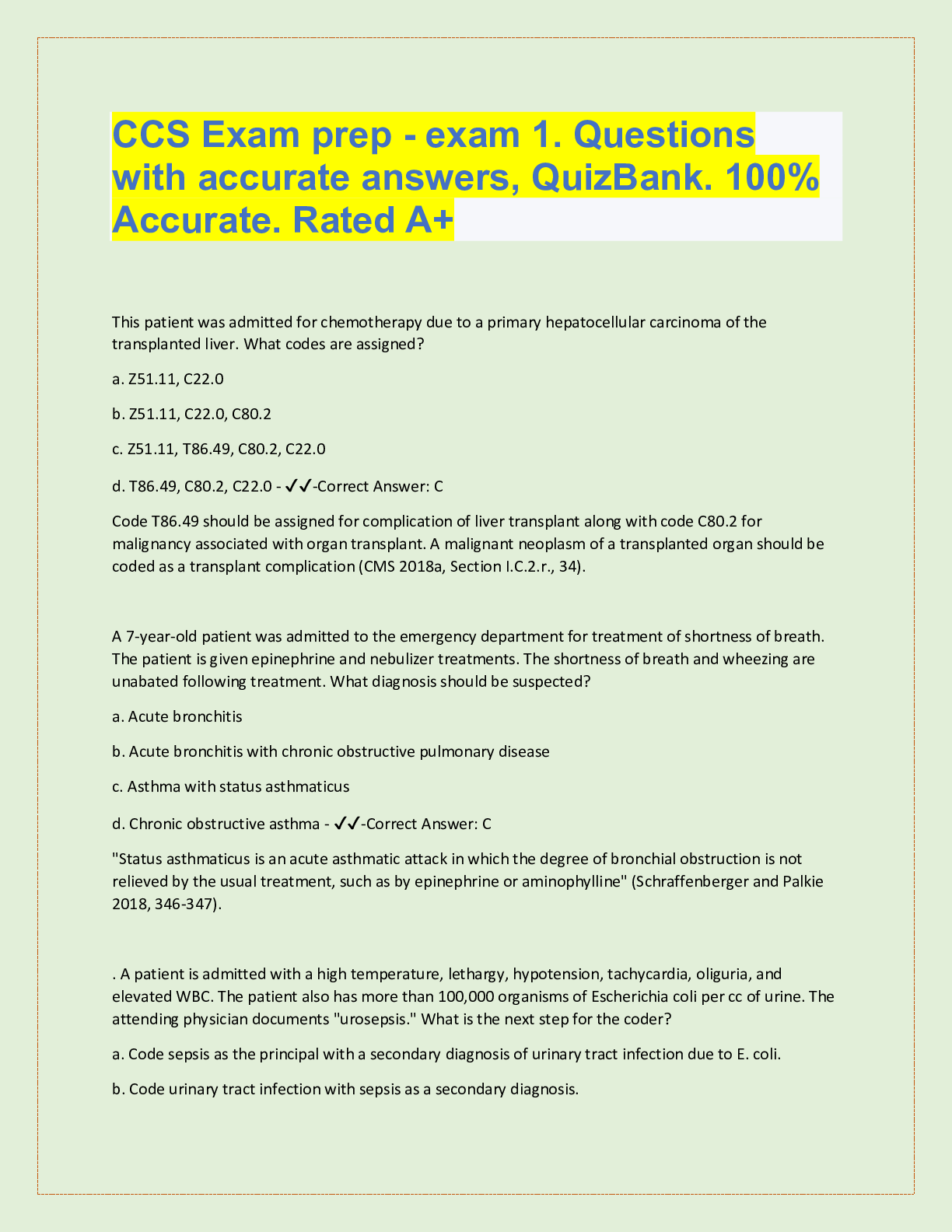
transplanted liver. What codes are assigned?
a. Z51.11, C22.0
b. Z51.11, C22.0, C80.2
c. Z51.11, T86.49, C80.2, C22.0
d. T86.49, C80.2, C22.0 - ✔✔Correct Answer: C
Code T86.49 should be assigned for complication of liver transplant along with code C80.2 for
malignancy associated with organ transplant. A malignant neoplasm of a transplanted organ should be
coded as a transplant complication (CMS 2018a, Section I.C.2.r., 34).
A 7-year-old patient was admitted to the emergency department for treatment of shortness of breath.
The patient is given epinephrine and nebulizer treatments. The shortness of breath and wheezing are
unabated following treatment. What diagnosis should be suspected?
a. Acute bronchitis
b. Acute bronchitis with chronic obstructive pulmonary disease
c. Asthma with status asthmaticus
d. Chronic obstructive asthma - ✔✔Correct Answer: C
"Status asthmaticus is an acute asthmatic attack in which the degree of bronchial obstruction is not
relieved by the usual treatment, such as by epinephrine or aminophylline" (Schraffenberger and Palkie
2018, 346-347).
. A patient is admitted with a high temperature, lethargy, hypotension, tachycardia, oliguria, and
elevated WBC. The patient also has more than 100,000 organisms of Escherichia coli per cc of urine. The
attending physician documents "urosepsis." What is the next step for the coder?
a. Code sepsis as the principal with a secondary diagnosis of urinary tract infection due to E. coli.
b. Code urinary tract infection with sepsis as a secondary diagnosis.c. Query the physician to determine if the patient is being treated for sepsis, highlighting the clinical
signs and symptoms.
d. Ask the physician whether the patient had septic shock so that this may be used as the principal
diagnosis. - ✔✔Correct Answer: C
The term urosepsis is a nonspecific term. It has no default code in the Alphabetic Index. Should
providers use this term, they must be queried for clarification (CMS 2018a, Section I.C.1.d., 22).
During a coronary artery bypass surgery, the patient underwent saphenous bypass grafts; from the aorta
to the left anterior descending branch of the left main coronary artery, and the left posterior descending
of the left main coronary artery. The patient also underwent a repositioning of the mammary artery to
the right coronary artery. Choose the best description for this procedure.
a. Three aortocoronary grafts
b. Two aortocoronary grafts and one mammary-coronary graft
c. Two aortocoronary grafts and two saphenous bypass grafts
d. Three aortocoronary grafts and one mammary-coronary graft - ✔✔Correct Answer: B
It is rare for only one coronary artery to be bypassed, and it is also fairly common to perform both an
internal mammary-coronary artery bypass and an aortocoronary bypass at the same operative episode
(Schraffenberger and Palkie 2018, 324-326).
According to CPT, an endoscopy that is undertaken to the level of the midtransverse colon would be
coded as a:
a. Proctosigmoidoscopy
b. Sigmoidoscopy
c. Colonoscopy
d. Proctoscopy - ✔✔orrect Answer: C
A colonoscopy is an examination of the entire colon, from the rectum to the cecum that may include the
terminal ileum. In general, a colonoscopy examines the colon to a level of 60 cm or higher (Smith 2018,
135-136).
Infusion of Herceptin, a monoclonal antibody used for treatment of breast cancer in patients carrying a
certain mutation of the HER2 gene, is classified as:
a. Chemotherapy
b. Radiotherapyc. Molecular Targets
d. Immunotherapy - ✔✔Correct Answer: C
Targeted cancer therapies are drugs or other substances that block the growth and spread of cancer by
interfering with specific molecules involved in tumor growth and progression. Herceptin is a type of
targeted cancer therapy also referred to as a monoclonal antibody (National Cancer Institute 2018).
A patient has findings suggestive of chronic obstructive pulmonary disease (COPD) on chest x-ray. The
attending physician mentions the x-ray finding in one progress note but no medication, treatment, or
further evaluation is provided. The coder should:
a. Query the attending physician regarding the x-ray finding
b. Code the condition because the documentation reflects it
c. Question the radiologist regarding whether to code this condition
d. Use a code from abnormal findings to reflect the condition - ✔✔Correct Answer: A
Query the attending physician regarding the clinical significance of the findings and request that
appropriate documentation be provided. This is an example of a circumstance where the chronic
condition must be verified. All secondary conditions must meet the UHDDS definitions; it is not clear if
COPD does (CMS 2018a, Section III, 105-106).
If a patient undergoes an inpatient procedure and the final summary diagnosis is different from the
diagnosis on the pathology report, the coder should:
a. Code only from the discharge diagnoses
b. Code the diagnosis reflected on the pathology report
c. Code the most severe symptom
d. Query the attending physician as to the final diagnosis - ✔✔Correct Answer: D
Coding strictly from the pathology report is not appropriate as the coder is assigning a diagnosis without
the attending physician's corroboration. It is therefore appropriate to query the physician (CMS 2018a,
Section III, 105-106).
A 56-year-old woman is admitted to an acute-care facility from a skilled nursing facility. The patient has
multiple sclerosis and hypertension. During the course of hospitalization, a decubitus ulcer is found and
debrided at the bedside by a physician. There is no typed operative report and no pathology report. The
coder should:a. Use an excisional debridement code as these charts are rarely reviewed to verify the excisional
debridement
b. Code with a nonexcisional debridement procedure code
c. Query the healthcare provider who performed the procedure to determine if the debridement was
excisional
d. Eliminate the procedure code all together - ✔✔Correct Answer: C
Excisional debridement can be performed in the operating room, the emergency department, or at the
bedside. Coders are encouraged to work with the physician and other healthcare providers to ensure
that the documentation in the health record is very specific regarding the type of debridement
performed. If there is any question as to whether the debridement is excisional or nonexcisional, the
provider should be queried for clarification (Schraffenberger and Palkie 2018, 402).
A 23-year-old female is admitted for shock following treatment of a miscarriage. The pathology report
from the previous admission reveals that the patient had no decidua or products of conception in the
tissue removed. This encounter would be coded as:
a. O03.81, Spontaneous abortion complicated by shock
b. O08.9, Complication following abortion and ectopic and molar pregnancies
c. R57.9, Shock NOS
d. T81.10XA, Postoperative shock - ✔✔Correct Answer: B
When a patient is readmitted because a complication has developed following discharge for a treated
miscarriage, a code from category O08 is assigned as the principal diagnosis. Code O08.9 is used because
the miscarriage (spontaneous abortion) was dealt with in a prior episode of care (Leon-Chisen 2018,
347-348).
Most hospitals require a medical record is completed within:
a. 5 days
b. 10 days
c. 7 days
d. 30 days - ✔✔Correct Answer: D
The Medicare Conditions of Participation and the Joint Commission require that the medical record is
completed no later than 30 days following discharge of the patient (Brickner 2016, 84).
To correct an entry in the medical record, the provider should:a. Draw a single line through the error, add a note explaining the error, initial and date, add the correct
information in chronological order
b. Draw a double line through the error, initial and date, add the reason for the correction
c. Draw a single line through the error, and add the correct information in chronological order
d. Draw several lines through the error, obliterate the documentation as much as possible, initial and
date, add the correct information in chronological order - ✔✔Correct Answer: A
If an error is corrected, the healthcare provider who made the error should draw a single line through
the error, add a note explaining the error, initial and date it, and add the correct information in
chronological order (Sayles 2016, 65). Further, AHIMA principles for health record documentation
specify the prior statement as the proper method for correcting an error in the paper-based records in
order to maintain a legally sound record. This process is based on the ASTM and HL7 standards for error
correction (AHIMA e-HIM Work Group on Maintaining the Legal EHR, 2005).
After a patient is discharged from the hospital, the medical record must be reviewed for:
a. Inclusion of all incident reports
b. Certain basic reports (for example, history and physical, discharge summary, etc.)
c. Voided prescription pads
d. Personal case notes from all mental health providers - ✔✔Correct Answer: B
In order to determine if a medical record is complete, it must be reviewed for certain basic reports
including the presence of a history and physical, signed progress notes, and a discharge summary if
applicable (Reynolds and Sharp 2016, 123-125). The incident report should never be filed in the medical
record (Carter and Palmer 2016, 522); voided prescription pads are not used during a patient
hospitalization; personal case notes from mental health providers are kept separate from the official
record. While there are a number of documents required for the hospital medical record to be
complete, the ones described in option b present the best answer (Rinehart-Thompson 2017c, 189).
A patient is discharged with a diagnosis of acute pulmonary edema due to congestive heart failure.
What condition(s) should be coded?
a. Acute pulmonary edema
b. Congestive heart failure
c. Acute pulmonary edema and congestive heart failure
d. Unable to determine based on the information provided - ✔✔Correct Answer: B
When a patient has pulmonary edema that is due to congestive heart failure, only the congestive heart
failure should be coded (Leon-Chisen 2018, 394-395).A 65-year-old patient is admitted with pain and loosening of a left total hip prosthesis. The acetabular
component has loosened and become painful. The patient was admitted for open removal and
replacement of the acetabular component of the left hip prosthesis. What is the appropriate code(s) for
the admission?
T84.031A Mechanical loosening of internal left hip prosthetic joint, initial encounter
T84.031D Mechanical loosening of internal left hip prosthetic joint, subsequent encounter
T84.030A Mechanical loosening of internal right hip prosthetic joint, initial encounter
T84.50XA Infection and inflammatory reaction due to unspecified internal joint prosthesis, initial
encounter
Z96.642 Presence of left artificial hip joint
0SP90JZ Removal of synthetic substitute from right hip joint, open approach
0SPB0JZ Removal of synthetic substitute from left hip joint, open approach
0SUA0BZ Supplement right hip joint, acetabular surface with resurfacing device, open approach
0SUR0BZ Supplement right hip joint, femoral surface with resurfacing device, open approach
0SRA0JZ Replacement of right hip joint, acetabular surface with synthetic substitute, open approach
0SRE0JZ Replacement of left hip joint, acetabular surface with synthetic substitute, open approach
a. T84.031A, 0SPB0JZ, 0SRE0JZ
b. T84.50XA, 0SUR0BZ
c. T84.031D, Z96.642, 0SP90JZ
d. T84.50XA, Z96.642 0SUR0BZ, 0SUA0BZ - ✔✔Correct Answer: A
Common reasons for revision joint replacement surgery include mechanical loosening of the prosthesis,
dislocation of the prosthetic joint, fracture of the bone around the implant. In addition to the
complication code, an additional code can be assigned to identify the previous joint replacement.
Revision of the acetabular component involves removal and exchange of the entire acetabular
component, including both the metal shell and the polyethylene, ceramic, or metal modular bearing
surface (Leon-Chisen 2018, 302-303).
A maternity patient is admitted in labor at 43 weeks. She has a normal delivery with vacuum extraction
to facilitate the baby's delivery. Which of the following would be the principal diagnosis?O80 Encounter for full-term uncomplicated delivery
O48.0 Post-term pregnancy
O48.1 Prolonged pregnancy
O66.5 Attempted application of vacuum extractor and forceps
a. O48.0
b. O48.1
c. O80
d. O66.5 - ✔✔Correct Answer: B
When an admission involves delivery, the principal diagnosis should identify the main circumstance or
complication of the delivery. The code for normal delivery cannot be used because there is a
complication of pregnancy because the pregnancy is prolonged (CMS 2018a, Section I.C.15.b., 59).
With regard to the implementation of ICD-10-CM, all of the following are correct except:
a. ICD-10-CM was developed by NCHS
b. ICD-10-CM and ICD-10-PCS was fully implemented on October 1, 2016
c. ICD-10 is already being used in the United States for death certificate coding
d. The process of adoption of ICD-10-CM is specified in HIPAA - ✔✔Correct Answer: B
Full compliance is expected for claims received for encounters and discharges occurring on or after
10/1/2015 (Leon-Chisen 2018, 6).
A 75-year-old female was admitted for acute myocardial infarction and underwent a diagnostic cardiac
catheterization. Following the catheterization, the patient developed a thrombophlebitis documented as
due to the catheter in the common femoral artery. The thrombophlebitis would be coded as:
a. T81.718A, Complication of other artery following a procedure, not elsewhere classified, initial
encounter
b. I97.51, Accidental puncture and laceration of a circulatory system organ or structure during a
circulatory system procedure
c. I72.4, Aneurysm of artery of lower extremity
d. I97.52, Accidental puncture and laceration of a circulatory system organ or structure during other
procedure - ✔✔Correct Answer: A
Thrombophlebitis occurred in the artery where the catheterization was performed and the cause of the
thrombophlebitis is documented as due to the catheterization. Thrombophlebitis resulting from aprocedure is listed as T81.72. When the tabular is reviewed, this code relates to a vein. The exercise
states that the artery is the location of the thrombophlebitis. Therefore a code from the T81.718
category is used (CMS 2018a, Section I.B.16, 18).
A patient was admitted to the emergency department with chest pain and was diagnosed with aborted
myocardial infarction with acute myocardial ischemia. There was no prior cardiac surgery. The cardiac
enzymes were normal. The appropriate coding of the diagnosis for this case is:
a. I21.3, ST elevation (STEMI) myocardial infarction of unspecified site
b. I25.10, Atherosclerotic heart disease of native coronary artery without angina pectoris
c. I24.8, Other forms of acute ischemic heart disease
d. I24.0, Acute coronary thrombosis not resulting in myocardial infarction - ✔✔Correct Answer: D
Acute ischemic heart disease or acute myocardial ischemia in a patient does not always indicate an
infarction. It is often possible to prevent infarction by means of surgery or the use of thrombolytic
agents if the patient is treated promptly. Using the main term, ischemia, then the subterms of
myocardium and acute, the alphabetic index reflects that I24.0 is the correct code for an acute
myocardial ischemia without myocardial infarction (Leon-Chisen 2018, 391).
A patient has nausea and vomiting with abdominal pain due to acute cholecystitis. The physician
documents the following on the discharge summary: acute cholecystitis, nausea, vomiting, and
abdominal pain. The correct diagnosis code(s) are:
a. Acute cholecystitis, nausea, vomiting, and abdominal pain
b. Acute cholecystitis, nausea, vomiting
c. Acute cholecystitis, nausea
d. Acute cholecystitis - ✔✔Correct Answer: D
Nausea, vomiting, and abdominal pain are symptoms of acute cholecystitis. Signs and symptoms that
are associated routinely with a disease process should not be assigned as additional codes, unless
otherwise instructed by the classification (CMS 2018a, Section I.B.5., 14).
A patient is admitted because of congestive heart failure (CHF). During the treatment of the CHF, the
patient was also found to have elevated liver function tests. The physician worked up the elevated liver
function tests but was not able to determine a diagnosis. The following diagnoses should be assigned:
a. Congestive heart failure with liver disease
b. Abnormal liver function tests
c. Congestive heart failure and abnormal liver function testsd. Congestive heart failure - ✔✔Correct Answer: C
If the findings are outside the normal range and the attending provider has ordered other tests to
evaluate the condition or prescribed treatment, it is appropriate to ask the provider whether the
abnormal findings should be added. Abnormal findings from laboratory, x-ray, pathologic, and other
diagnostic results are not usually coded and reported unless the physician indicates their clinical
significance (CMS 2018a, Section III, 105-106).
A patient is admitted with hypotension due to dobutamine taken and prescribed correctly. How should
this be coded?
a. I95.1, Orthostatic hypotension T44.5X5A, Adverse effect of predominantly beta-adrenoreceptor
agonists, initial encounter
b. I95.2, Hypotension due to drugs T44.5X5A, Adverse effect of predominantly beta-adrenoreceptor
agonists, initial encounter
c. I95.89, Other hypotension T44.995A, Adverse effect of predominantly beta-adrenoreceptor agonists,
initial encounter
d. I95.81, Postprocedural hypotension T44.995A, Adverse effect of predominantly beta-adrenoreceptor
agonists, initial encounter - ✔✔Correct Answer: B
This is an adverse effect of a drug as the dobutamine was prescribed correctly and the patient took it
correctly. Hypotension, should be assigned to describe the condition related to the adverse effect. A "T"
code should be assigned to indicate that it is an adverse effect of the drug (CMS 2018a, Section I.C.19.e.,
76).
A patient is readmitted two weeks after a laminectomy for spinal stenosis with a headache and
documentation that the headache is due to a tear in the dura accidently that occurred during the prior
laminectomy surgery. The patient is taken to the operating room for repair of the dura. The diagnosis
code(s) assigned for this admission would be:
a. M48.061, Spinal stenosis, lumbar region, without neurogenic claudication
b. G97.41, Accidental puncture or laceration of dura during a procedure
c. G97.1, Other reaction to spinal and lumbar puncture
d. S34.109A, Unspecified injury to unspecified level of lumbar spinal cord, initial encounter - ✔✔Correct
Answer: B
A tear in the dura that occurs during spinal surgery is not unusual and is typically repaired
intraoperatively when identified. Primary closure of the dural tear is usually accomplished. Dural tears
that are not discovered during surgery can result in leakage of cerebrospinal fluid (CSF), leading to CSF
headache, caudal displacement of the brain, subdural hematoma, spinal meningitis, pseudomeningocele
and/or a dural cutaneous fistula (CMS 2018a, Section I.B.16, 18).A patient is admitted to the hospital with shortness of breath and congestive heart failure and
subsequently develops respiratory failure. The patient undergoes intubation with ventilator
management. The correct sequencing of the diagnoses in this case would be:
a. Congestive heart failure and respiratory failure
b. Respiratory failure
c. Respiratory failure and congestive heart failure
d. Shortness of breath, congestive heart failure, and respiratory failure - ✔✔Correct Answer: A
Respiratory failure may be listed as a secondary diagnosis if it occurs after admission, or if it is present
on admission, but does not meet the definition of principal diagnosis (CMS 2018a, Section I.C.10.b., 49).
If a patient is admitted with pneumococcal pneumonia and severe pneumococcal sepsis, the coder
should:
a. Assign a code for only the sepsis and pneumonia
b. Assign a code for the sepsis, pneumonia, and severe sepsis
c. Assign only a code for pneumococcal pneumonia
d. Review the chart to determine if septic shock could be used first - ✔✔Correct Answer: B
A patient with pneumococcal sepsis and pneumococcal pneumonia also has severe sepsis. Careful
review of the ICD-10-CM Official Guidelines for Coding and Reporting provides information related to
the coding and sequencing of sepsis, severe sepsis, and localized infection, such as pneumonia (CMS
2018a, Section I.C.1.d., 21).
A patient was admitted with end stage renal disease (ESRD) following kidney transplant. The patient also
had angina and chronic obstructive pulmonary disease. The diagnoses would be sequenced as:
a. Kidney failure; status post kidney transplant; chronic obstructive pulmonary disease; angina
b. End-stage renal disease; status post kidney transplant; chronic obstructive pulmonary disease; angina
c. Chronic kidney disease, stage 5; status post kidney transplant; chronic obstructive pulmonary disease;
angina
d. Acute kidney failure; status post kidney transplant; chronic obstructive pulmonary disease; angina -
✔✔Correct Answer: B
Patients who have undergone kidney transplant may still have some form of CKD, because the kidney
transplant may not fully restore kidney function. Therefore, the presence of CKD alone does not
constitute a transplant complication (CMS 2018a, Section I.C.14.a., 56).A patient is admitted to the hospital due to a fracture of the right hip and is scheduled for an open
reduction with internal fixation. The patient developed cardiac arrhythmia which results in an inability to
do the planned surgery. Assign a code for the principal diagnosis.
a. Status post fracture
b. Cardiac arrhythmia
c. Right hip fracture
d. Admission for possible fracture - ✔✔Correct Answer: C
The condition after study that occasioned the admission should be sequenced first even if the plan of
treatment was not carried out due to unforeseen circumstances (CMS 2018a, Section II.F., 103).
Which of the following is not part of a facility coding compliance plan?
a. Regular internal audits
b. Audits performed by objective external reviewers
c. Coding audits performed by payers
d. Sharing and discussing results with coding staff - ✔✔Correct Answer: C
Reviewing the results of payers' audits is valuable, but payers are an external entity. As far as a facility
coding compliance plan, incorporating internal and external auditing into the coding compliance plan
has proven to be the best strategy. Internal auditing enables managers to see firsthand where their
units' strengths and weaknesses lie. External auditing provides an unbiased view of a department's
performance. Together, internal and external audits help coding managers build effective education
plans for their units (Casto and Forrestal 2015, 44-45).
A 30-year-old woman with a 6-year history of anorexia nervosa was seen in her physician's office
because of significant weight loss over the past three months going from 82 pounds down to 53 pounds.
She was admitted to the hospital to increase body weight and to be given nutrition counseling because
of her severe malnutrition. How should this be coded?
a. F50.00, Anorexia nervosa, unspecified
b. F50.00, Anorexia nervosa, unspecified E43, Unspecified severe protein-calorie malnutrition
c. F50.01, Anorexia nervosa, restricting type
d. E43, Unspecified severe protein-calorie malnutrition - ✔✔Correct Answer: BCode E43 should be assigned as an additional diagnosis for the severe malnutrition. For some anorexic
patients, the weight loss is so severe that it leads to malnutrition. Code E43 further describes the
severity of the patient's condition (Leon-Chisen 2018, 548).
If a 55-year-old patient with AIDS admitted with traumatic comminuted fracture femur shaft, right leg,
initial encounter. The coder should:
a. Assign a code for only the AIDS
b. Assign a code for the AIDS and the fracture
c. Assign only a code for fracture
d. Review the chart to determine the cause of the injury - ✔✔Correct Answer: B
If a patient with HIV disease is admitted for an unrelated condition (such as a traumatic injury), the code
for the unrelated condition (for example, the nature of injury code) should be the principal diagnosis.
Other diagnoses would be B20 followed by additional diagnosis codes for all reported HIV-related
conditions (CMS 2018a, Section I.C.1.a.1., 19).
The patient is seen in the pain clinic for chronic neoplasm-related pain that was known to be caused by
the metastatic bone carcinoma of the vertebra that has spread from carcinoma of the left main
bronchus of the lung. How should this be coded?
a. C34.02, Malignant neoplasm of left main bronchus
b. G89.3, Neoplasm related pain (acute) (chronic)
c. G89.3, Neoplasm related pain (acute) (chronic); C79.51, Secondary malignant neoplasm of bone;
C34.02, Malignant neoplasm of left main bronchus
d. G89.3, Neoplasm related pain (acute) (chronic); C79.51, Secondary malignant neoplasm of bone -
✔✔Correct Answer: C
Code G89.3 is assigned to pain documented as being related, associated or due to cancer, primary or
secondary malignancy, or tumor. This code is assigned regardless of whether the pain is acute or chronic
(CMS 2018a, Section I.C.6.b.5., 41).
A 45-year-old man with known AIDS is admitted to the hospital for treatment of Pneumocystis carinii
pneumonia. What is the principal diagnosis code?
a. B20
b. J18.9
c. B59d. Any of the above - ✔✔Correct Answer: A
AIDS stands for acquired immunodeficiency syndrome, frequently referred to as human
immunodeficiency virus (HIV). Whenever an HIV-positive patient is admitted with an HIV-related
condition, the principal diagnosis is B20, followed by additional ICD-10-CM codes for all reported HIVrelated conditions (CMS 2018a, Section I.C.1.a.2., 19).
2. A patient is prescribed Diazepam and reports taking more than the prescribed amount. The patient is
admitted to the hospital for complete work up. The final diagnosis is documented as Diazepam use and
abuse. How should this be coded?
a. F13.180
b. F13.188
c. F13.10
d. F13.11 - ✔✔Correct Answer: C
Diazepam is a sedative. When use and abuse are documented, assign only the code for abuse (CMS
2018a, Section I.C.5.b.2., 37).
A female patient with terminal carcinoma of the breast, metastatic to the liver, brain, and intrahepatic
and extrahepatic bile ducts, was admitted with dehydration. Patient rehydrated with IVs and discharged,
with no treatment given to the cancer. What are the codes assigned?
a. E86.0, C50.919, C78.7, C79.31, C78.89
b. E86.9, C50.919, C78.7, C79.31,
c. E86.0, C50.919, C79.31, C78.89
d. E86.9, C50.919, C78.7, C79.31, C78.89 - ✔✔Correct Answer: A
When an encounter is for management of a complication associated with a neoplasm, such as
dehydration, and the treatment is only for the complication, the complication is coded first followed by
the appropriate code(s) for the neoplasm. Because the focus of the admission and treatment was for the
dehydration, it meets principal diagnosis reporting (CMS 2018a, Section I.C.3., 29).
A child has second- and third-degree burns of the left lower leg and second- and third-degree burns of
the lower back with a total of 16 percent total body surface area (TBSA), 9 percent third-degree. What is
the correct code assignment?
a. T24.301A, T21.34XA, T31.10
b. T24.302D, T21.34XD, T31.10c. T24.302A, T21.34XA, T31.10
d. T24.301D, T21.34XD, T31.10 - ✔✔Correct Answer: C
T24.302A, T21.34XA, T31.10, Burns classified to the same site but with different degrees are coded to
the highest degree of burn (CMS 2018a, Section I.C.19.d.2, 75). An additional code for the extent of the
body surface involved may also be assigned (CMS 2018a, Section I.C.19.d.6, 75).
The "code, if applicable, any causal condition first" note in the ICD-10-CM tabular lists indicates that this
code may be assigned when the causal condition is unknown or not applicable. When the causal
condition is known, the code for that condition may be reported as which type of diagnosis?
a. Comorbidity
b. Manifestation
c. Principal
d. Qualified - ✔✔Correct Answer: C
"Code, if applicable, any causal condition first" notes indicate that this code may be assigned as a
principal diagnosis when the causal condition is unknown or not applicable. If a causal condition is
known, then the code for that condition should be sequenced as the principal or first-listed diagnosis
(CMS 2018a, Section I.B.7, 15).
5-year-old patient admitted with Insulin dependent diabetes. The type of diabetes is not specified in the
medical record. How should this be coded?
a. E11.9, Z79.4
b. E11.8
c. E11.8, Z79.4
d. Z79.4, E11.8 - ✔✔Correct Answer: A
If the type of diabetes mellitus is not documented in the medical record the default is E11.-, Type 2
diabetes mellitus. Code Z79.4, Long term (current) use of insulin, should also be assigned for patients
who take insulin (CMS 2018a, Section I.C.4.a.2, 34).
A 65-year-old man is admitted due to an acute myocardial infarction. The patient also has coronary
artery disease. How should this be coded?
a. CAD, AMI
b. AMIc. AMI, CAD
d. Query the physician for the principal diagnosis - ✔✔Correct Answer: C
If a patient with coronary artery disease is admitted due to an acute myocardial infarction (AMI), the
AMI should be sequenced before the coronary artery disease (CMS 2018a, Section I.C.9.b, 44).
A patient is admitted to the hospital during the postpartum period as a result of developing a
thromboembolism or pulmonary blood clot leading to respiratory failure. What is the principal
diagnosis?
a. O88.23
b. J96.00
c. O88.03
d. O88.22 - ✔✔Correct Answer: A
The obstetric code is sequenced first because chapter 15 (obstetric) codes have sequencing priority over
codes from other ICD-10-CM chapters (CMS 2018a, Section I.C.15.a.1, 56).
Patient admitted with hemorrhage due to placenta previa with twin pregnancy. This patient had two
prior (cesarean section) deliveries. Emergency C-section was performed due to the hemorrhage. The
appropriate principal diagnosis would be:
a. Prior cesarean sections
b. Placenta previa without hemorrhage
c. Twin gestation
d. Placenta previa with hemorrhage - ✔✔Correct Answer: D
The principal diagnosis should be the condition established after study that was responsible for the
patient's admission. If the patient was admitted with a condition that resulted in the performance of a
cesarean procedure, that condition should be sequenced as the principal diagnosis. If the reason for the
admission or encounter was unrelated to the condition resulting in the cesarean delivery, the condition
related to the reason for the admission or encounter should be selected as the principal diagnosis, even
if a cesarean was performed (CMS 2018a, Section I.C.15.b., 58).
A 70-year-old patient was admitted with pneumonia. The history and physical documented that the
patient has a history of diabetes, hypertension, and migraine headache about 10 years ago without
recurrence. The patient was administered IV antibiotics, metformin, and Altace during the
hospitalization. Which conditions would be reported at the time of discharge?a. Pneumonia, diabetes, hypertension, and migraine headaches
b. Pneumonia, diabetes, hypertension, and history of migraine headaches
c. Pneumonia, diabetes, and hypertension
d. Pneumonia - ✔✔Correct Answer: C
Pneumonia, diabetes, hypertension should be coded. The migraine headaches are a past condition and
would not be coded as per the reporting guidelines for the UHDDS for "other conditions" (CMS 2018a,
Section III, 105-106).
A diabetic patient was admitted for a treatment of a pressure ulcer. The patient also has a history of
diabetic neuropathy and retinopathy. The patient is blind and additional nursing care and extended time
with the patient was required. Which conditions should be coded at discharge?
a. Pressure ulcer, history of neurologic condition, history of retinal condition, diabetes
b. Pressure ulcer, diabetic neuropathy and diabetic retinopathy, and blindness
c. Pressure ulcer, diabetic neuropathy
d. Pressure ulcer, diabetic retinopathy, and blindness - ✔✔Correct Answer: B
Pressure ulcer, diabetic neuropathy and diabetic retinopathy, and blindness should be coded. Diabetes
and related conditions are chronic conditions that ordinarily should be coded and the patient required
nursing care because of her blindness (CMS 2018a, Section I.C.4.a., 34).
A patient has an inpatient discharge with principal diagnosis of either peptic ulcer or cholecystitis
documented on the history and physical. Both are equally treated and well documented. A coder
should:
a. Code based on the circumstances of admission and if both are equally treated, code either as principal
b. Use a code from the Abnormal findings category
c. Code to the most severe symptom
d. Code shoulder pain, peptic ulcer, cholecystitis - ✔✔Correct Answer: A
In those rare instances when two or more contrasting or comparative diagnoses are documented as
"either/or" (or similar terminology), they are coded as if the diagnoses were confirmed and the
diagnoses are sequenced according to the circumstances of the admission. If no further determination
can be made as to which diagnosis should be principal, either diagnosis may be sequenced first (CMS
2018a, Section II.D, 103).A 75-year-old woman is admitted to the hospital after tripping and falling at home. She underwent an
open reduction with internal fixation of the femur. Which of the following would be important to
capture in addition to diagnostic codes?
a. External cause codes for Cause of Injury and Place of Occurrence
b. External cause codes for Cause of Injury, Place of Occurrence, Activity, and Status
c. External cause codes for Cause of Injury, Place of Occurrence, and Activity
d. External cause codes for Cause of Injury only - ✔✔Correct Answer: B
External cause of injury codes are used to provide information about how an injury occurred, the intent
(intentional or unintentional), where the injury occurred, and the status of the person at the time the
injury occurred. In the case of a person who seeks care for an injury or other health condition that
resulted from an activity, or when an activity contributed to the injury or health condition, activity codes
are used to describe the activity (CMS 2018a, Section I.20., 81).
In CPT, unlisted codes are reported only if:
a. There is not a current CPT category I code available
b. There is not a current CPT category III code available
c. There is not a current CPT category II code available
d. There is not a HCPCS Level II code or a current CPT level III code - ✔✔Correct Answer: D
Before any unlisted code is assigned, the coding professional should review HCPCS Level II (national)
codes to confirm that CMS has not developed a specific code for the procedure or service in question.
CPT Category III codes, which are developed specifically for reporting new technology, should also be
reviewed. CPT guidelines support the use of a Category III code instead of a Category I unlisted code
(Smith 2018, 24).
A virtual screening colonoscopy would be coded as:
45378 Colonoscopy, flexible; diagnostic, including collection of specimen(s) by brushing or washing,
when performed (separate procedure)
45391 Colonoscopy, flexible; with endoscopic ultrasound examination limited to the rectum, sigmoid,
descending, transverse, or ascending colon and cecum, and adjacent structures
74263 Computed tomographic (CT) colonography, screening including image postprocessing
76376 3D rendering with interpretation and reporting of computed tomography, magnetic resonance
imaging, ultrasound, or other tomographic modality with image post-processing under concurrent
supervision; not requiring image postprocessing on an independent workstationa. 74263
b. 45391
c. 45378
d. 76376 - ✔✔Correct Answer: A
CT colonography uses CT scanning to obtain an interior view of the colon (the large intestine) that is
otherwise only seen with a more invasive procedure where an endoscope is inserted into the rectum.
Computed tomographic (CT) colonography, screening, including image postprocessing (AMA CPT
Professional Edition 2018, 458).
A patient underwent an excision of a malignant lesion of the chest that measured 1.0 cm and there was
a 0.2-cm margin on both sides. Based on the 2018 CPT codes, which code would be used for the
procedure?
a. 11401, Excision, benign lesion including margins, except skin tag (unless listed elsewhere), trunk, arms
or legs; excised diameter 0.6 to 1.0 cm
b. 11601, Excision, malignant lesion including margins, trunk, arms, or legs; excised diameter 0.6 to 1.0
cm
c. 11602, Excision, malignant lesion including margins, trunk, arms, or legs; excised diameter 1.1 to 2.0
cm
d. 11402, Excision, benign lesion including margins, except skin tag (unless listed elsewhere), trunk, arms
or legs; excised diameter 1.1 to 2.0 cm - ✔✔Correct Answer: C
11602: Excision, malignant lesion including margins, trunk, arms, or legs; excised diameter 1.1 to 2.0 cm.
The size of the lesion plus the margins are included in coding the excision. Excised diameter: 1.0 cm + 0.2
cm + 0.2 cm = 1.4 cm (Smith 2018, 69-70).
[Show More]