Spinors, B2 SYMMETRY AND RELATIVITY, physical, Oxford University
Document Content and Description Below
Spinors, B2 SYMMETRY AND RELATIVITY, physical, Oxford University
Introducing spinors
Spinors are mathematical entities somewhat like tensors, that allow a more general treatment
of the notion of invariance under rotat
...
[Show More]
Last updated: 4 years ago
Preview 1 out of 32 pages
Instant download

Buy this Document to get the Full Access Instantly
Provided by Students Who Aced it
We Verify Document Content to Gurantee Accuracy
Reviews( 0 )
Document information
Connected school, study & course
About the document
Uploaded On
Sep 04, 2022
Number of pages
32
Written in
All

Additional information
This document has been written for:
Uploaded
Sep 04, 2022
Downloads
0
Views
399
Topic Tags
Recommended For You
Get more on Summary »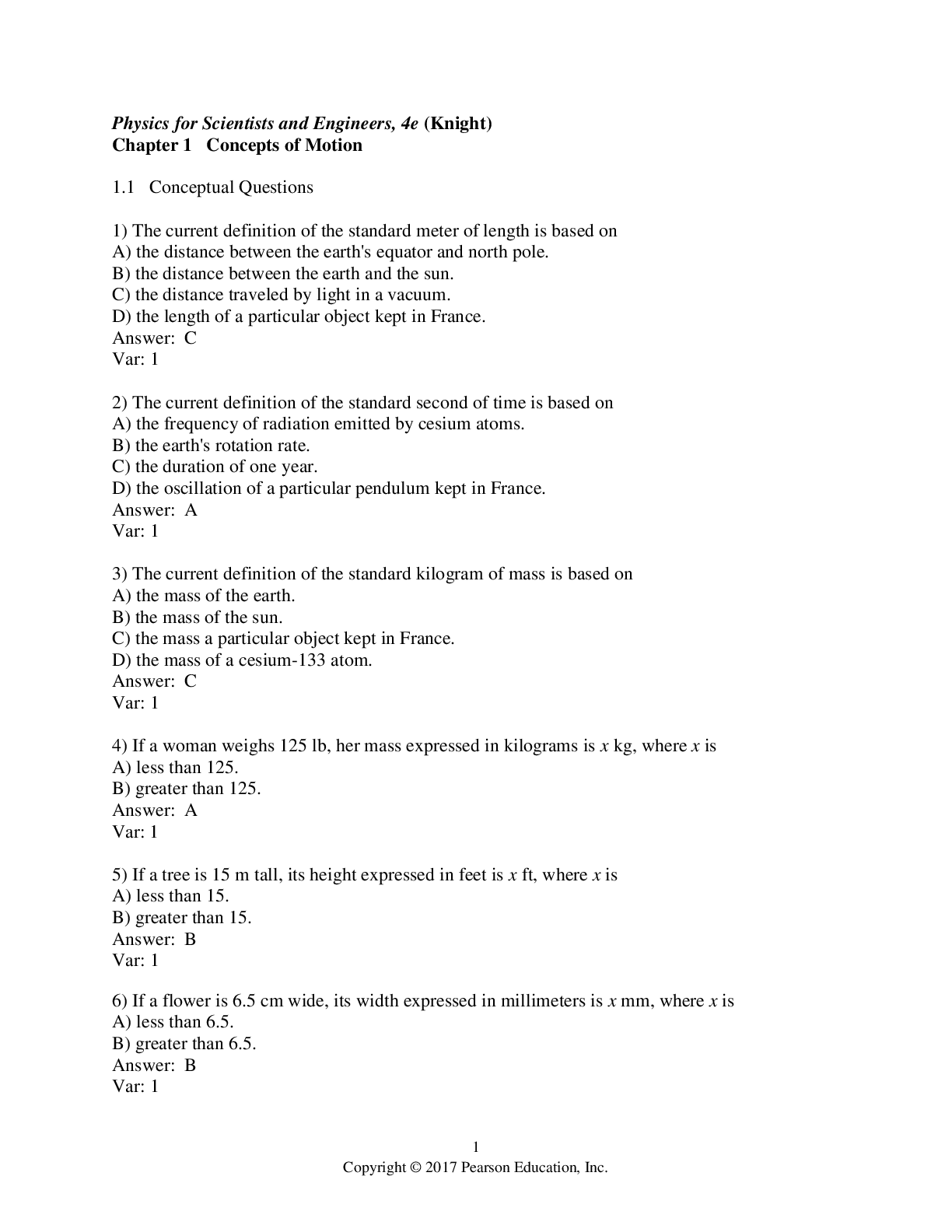
$22
713 Pages
Test Bank for Physics for Scientists and Engineers A Strategic...

$25
100 Pages
Plasma Physics, 2e by Richard Fitzpatrick (Solutions Manual)

$25
37 Pages
College Physics, 3e Roger Freedman, Todd Ruskell, Philip Keste...

$25
79 Pages
A Concise Introduction to Thermodynamics for Physicists, 1e by...



$15
36 Pages
Summary NSG 405 EXAM 1 Completed Study Guide > latest (Spring...
$10
18 Pages
Summary Rasmussen College, Minneapolis - PN 3 PN3 Exam 3 Study...

$5
20 Pages
Summary Med surg ATI (study guide; latest Fall 2020, A+ help

$8
31 Pages
BIOS242 / BIOS 242 Final Study Guide Chapter 1 -9 : Fundamen...
More related documents below


