Chapter 21: Peripheral Vascular System and Lymphatic
System Questions And Answers 2022-2023
what does the vascular system consist of? - Answer- -vessels for transporting fluid
such as blood or lymph
-any disease in
...
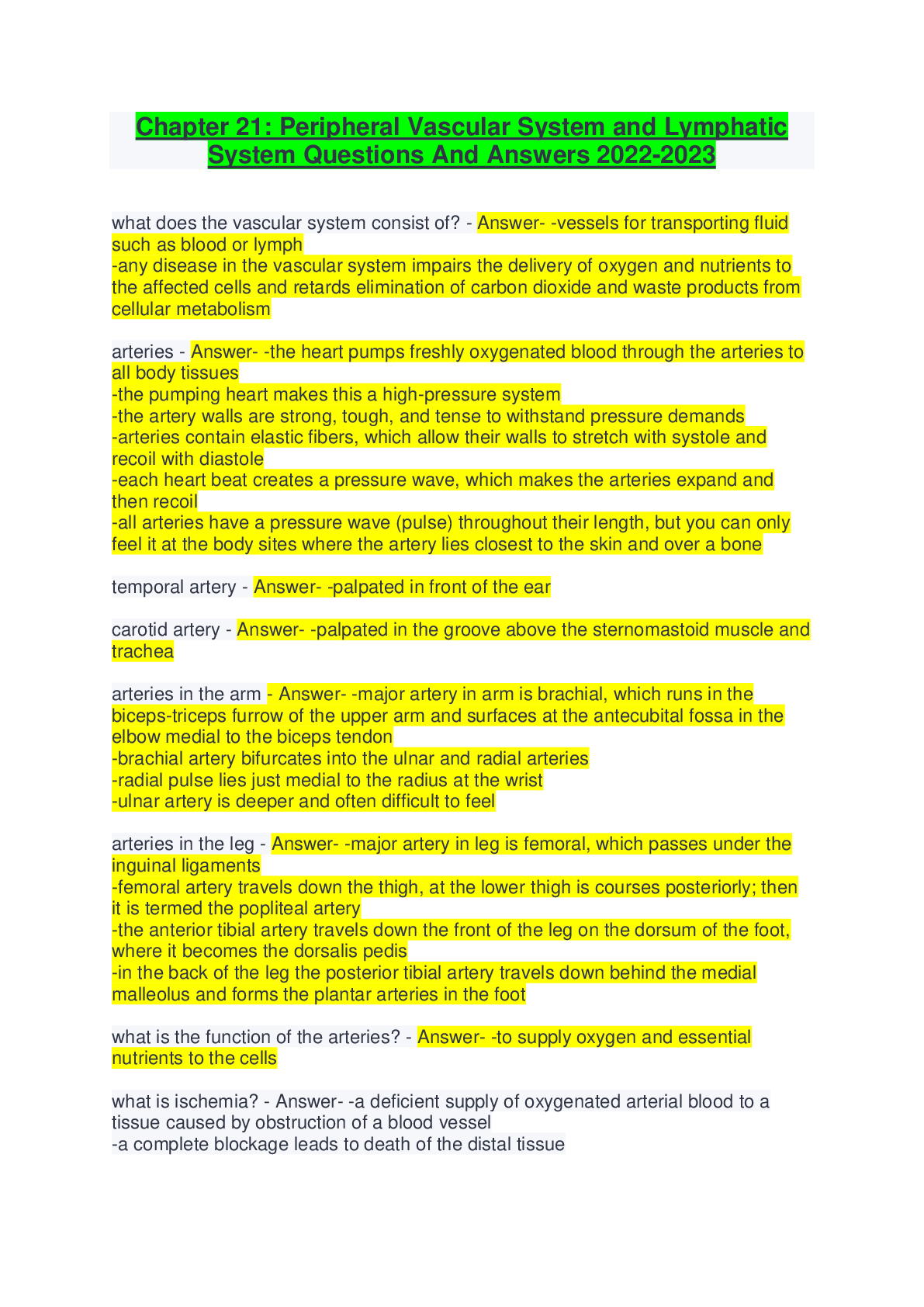
Chapter 21: Peripheral Vascular System and Lymphatic
System Questions And Answers 2022-2023
what does the vascular system consist of? - Answer- -vessels for transporting fluid
such as blood or lymph
-any disease in the vascular system impairs the delivery of oxygen and nutrients to
the affected cells and retards elimination of carbon dioxide and waste products from
cellular metabolism
arteries - Answer- -the heart pumps freshly oxygenated blood through the arteries to
all body tissues
-the pumping heart makes this a high-pressure system
-the artery walls are strong, tough, and tense to withstand pressure demands
-arteries contain elastic fibers, which allow their walls to stretch with systole and
recoil with diastole
-each heart beat creates a pressure wave, which makes the arteries expand and
then recoil
-all arteries have a pressure wave (pulse) throughout their length, but you can only
feel it at the body sites where the artery lies closest to the skin and over a bone
temporal artery - Answer- -palpated in front of the ear
carotid artery - Answer- -palpated in the groove above the sternomastoid muscle and
trachea
arteries in the arm - Answer- -major artery in arm is brachial, which runs in the
biceps-triceps furrow of the upper arm and surfaces at the antecubital fossa in the
elbow medial to the biceps tendon
-brachial artery bifurcates into the ulnar and radial arteries
-radial pulse lies just medial to the radius at the wrist
-ulnar artery is deeper and often difficult to feel
arteries in the leg - Answer- -major artery in leg is femoral, which passes under the
inguinal ligaments
-femoral artery travels down the thigh, at the lower thigh is courses posteriorly; then
it is termed the popliteal artery
-the anterior tibial artery travels down the front of the leg on the dorsum of the foot,
where it becomes the dorsalis pedis
-in the back of the leg the posterior tibial artery travels down behind the medial
malleolus and forms the plantar arteries in the foot
what is the function of the arteries? - Answer- -to supply oxygen and essential
nutrients to the cells
what is ischemia? - Answer- -a deficient supply of oxygenated arterial blood to a
tissue caused by obstruction of a blood vessel
-a complete blockage leads to death of the distal tissue
-a partial blockage creates an insufficient supply, and the ischemia may be apparent
only at exercise when oxygen needs increase
what is peripheral artery disease (PAD)? - Answer- -affects non-coronary arteries
and usually refers to arteries supplying the limbs
-it is usually caused by atherosclerosis (deposit of plaque from high cholesterol) and
less commonly by embolism, hypercoagulable states, or arterial dissection
veins - Answer- -the course of the veins is parallel to the arteries, but the direction of
flow is opposite
-the veins absorb carbon dioxide and waste products from the periphery and carry
them back to the heart
-the body has more veins, and they lie closer to the skin surface
-walls of veins are thinner
veins in the arm - Answer- -each arm has two sets of veins: superficial and deep
-the superficial veins in the subq tissue are responsible for most of the venous return
veins in the leg - Answer- -3 types of veins: deep veins, superficial veins, and
perforators
-deep veins: run alongside the deep arteries and conduct most of the venous return
from the legs, these are the femoral and popliteal veins, as long as these veins
remain intact, the superficial veins can be excised without harming the circulation
-superficial veins: great and small saphenous veins, the great saphenous, inside the
leg, starts at the medical side of the dorsum of the foot. the small saphenous, outside
the leg, starts on the lateral side of the dorsum of the foot and ascends behind the
lateral malleolus
-perforators: are connecting veins that join the two sets, they also have one way
valves that route blood from the superficial into the deep and prevent reflux to the
superficial veins
venous flow - Answer- -veins drain deoxygenated blood and its waste products from
tissues and return it to heart
-veins are a low pressure system
what is the mechanism of venous blood flow - Answer- (1) the contracting skeletal
muscles milk the blood proximally, back toward the heart
(2) the pressure gradient caused by breathing, in which inspiration makes the
thoracic pressure decrease and the abdominal pressure increase
(3) the intraluminal valves, which ensure unidirectional flow, each valve is a paired
semilunar pocket that opens toward the heart and closes tightly when filled to
prevent backflow of blood
-in the legs this mechanism is called the calf pump or peripheral heart
what does efficient venous return depend on? - Answer- -contracting skeletal
muscles
-competent valves in the veins
-patent (clear) lumen
who is at risk for venous disease? - Answer- -people who undergo prolonged
standing, sitting, or bedrest because they do not benefit from the the milking action
that walking accomplishes
-hypercoagulable states and vein wall trauma are other factors
varicose veins - Answer- -some people have a genetic predisposition
-venous pooling also occurs in obese people and women following multiple
pregnancies
lymphatics - Answer- -form a completely separate vessel system that retrieves
excess fluid and plasma proteins from the interstitial spaces and returns it to the
bloodstream
-fluid moves according to a pressure gradient (filtration)
what is hydrostatic pressure caused by? - Answer- -at the arterial end, the
hydrostatic pressure is caused by the pumping action of the heart and pushes
somewhat more fluid out of the capillaries than the venules can absorb
what are the functions of the lymphatic system? - Answer- (1) conserve fluid and
plasma proteins that leak out of capillaries
(2) form a major part of the immune system that defends the body against disease
(3) absorb lipids from the small intestine
what are lymph nodes?
what do they do? - Answer- -small, oval clumps of lymphatic tissue located at
intervals along the vessels
-most nodes are arranged in groups, both deep and superficial
-they filter the fluid before it is returned to the bloodstream and filter out
microorganisms that could be harmful to the body
cervical nodes - Answer- -drain the head and neck
axillary nodes - Answer- -drain the breast and upper arm
epitrochlear node - Answer- -in antecubital foss and drains the hand and lower arm
inguinal nodes - Answer- -in the groin and drain most of the lymph of the lower
extremity, the external genitalia, and the anterior abdominal wall
spleen - Answer- -located in left upper quandrant of abdomen
four functions
(1) destroy old red blood cells
(2) produce antibodies
(3) store red blood cells
(4) filter microorganisms from the blood
tonsils - Answer- -located at the entrance to the respiratory and gastrointestinal
tracts and respond to local inflammation
thymus - Answer- -flat, pink-gray gland located in the superior mediastinum behind
the sternum and in front of the aorta
-important in developing T lympocytes
the aging adult - Answer- -arteriosclerosis (vessels become more rigid)
-PAD
-aging produces a progressive enlargement of the intramuscular calf veins
-prolonged bed rest, immobilization, and heart failure increase the risk for deep vein
thrombosis (DVT) and subsequent pulmonary embolism
subjective data - Answer- -leg pain or cramps
-skin changes on arms or legs
-swelling in arms or legs
-lymph node enlargement
-medications
-smoking history
leg pain or cramps - Answer- -where, describe the pain (burning, aching, cramping,
stabbing), gradually or suddenly, aggravated by activity, what relieves it, change in
sexual function, history of vascular problems
-with PAD blood flow cannot back muscle demand during exercise; therefore people
feel muscle fatigue or pain when walking (claudication), but only 10% of those with
PAD have this symptom
-claudication distance is the number of blocks walked or stairs climbed to produce
pain
-night leg pain is common in aging adults, may indicate ischemic rest pain of PAD,
severe night muscle cramping, or restless leg syndrome
what are the risk factors for PAD? - Answer- -diabetes, smoking, age, cardiac
disease
skin changes on arms or legs - Answer- -swelling, when did it start, what time of day
is it worse, does it go down, what brings it on, what relieves it
-edema is bilateral when the cause is generalized (heart failure) or unilateral when it
is the result of a local obstruction or inflammation
lymph node enlargement - Answer- -swollen glands, where, how long, any recent
change, hard or soft, pain
-englarged lymph nodes occur with infection, malignancies, and immunologic
diseases
medications - Answer- -what are you taking (oral contraceptives, hormone
replacement)
-these may cause hypercoagulable state (can cause DVT)
-low dose aspirin or clopidogrel is used to prevent blood clots in selected people
smoking history - Answer- -cigarettes, how many packs per day, what age did you
start, how many years
-tobacco constricts arteries, increases coagubility, injures endothelium and promotes
inflammation
-smoking is the strongest risk factor for PAD
Inspect and palpate the arms:
What is the normal nailbed angle? - Answer- The normal nail-bed angle is 160
degrees.
Profile Sign - Answer- view the finger from the side to detect early clubbing
Capillary Refill - Answer- What is it?
-Index of peripheral perfusion and cardiac output
How do you do it?
-Depress and blanch the nailbeds
-Release and note the time for color return
What is suppose to happen?
-Usually the vessels refill within a fraction of a second
-Consider it normal if the color returns in less than 1-2 seconds......
[Show More]

.png)

.png)

.png)




.png)