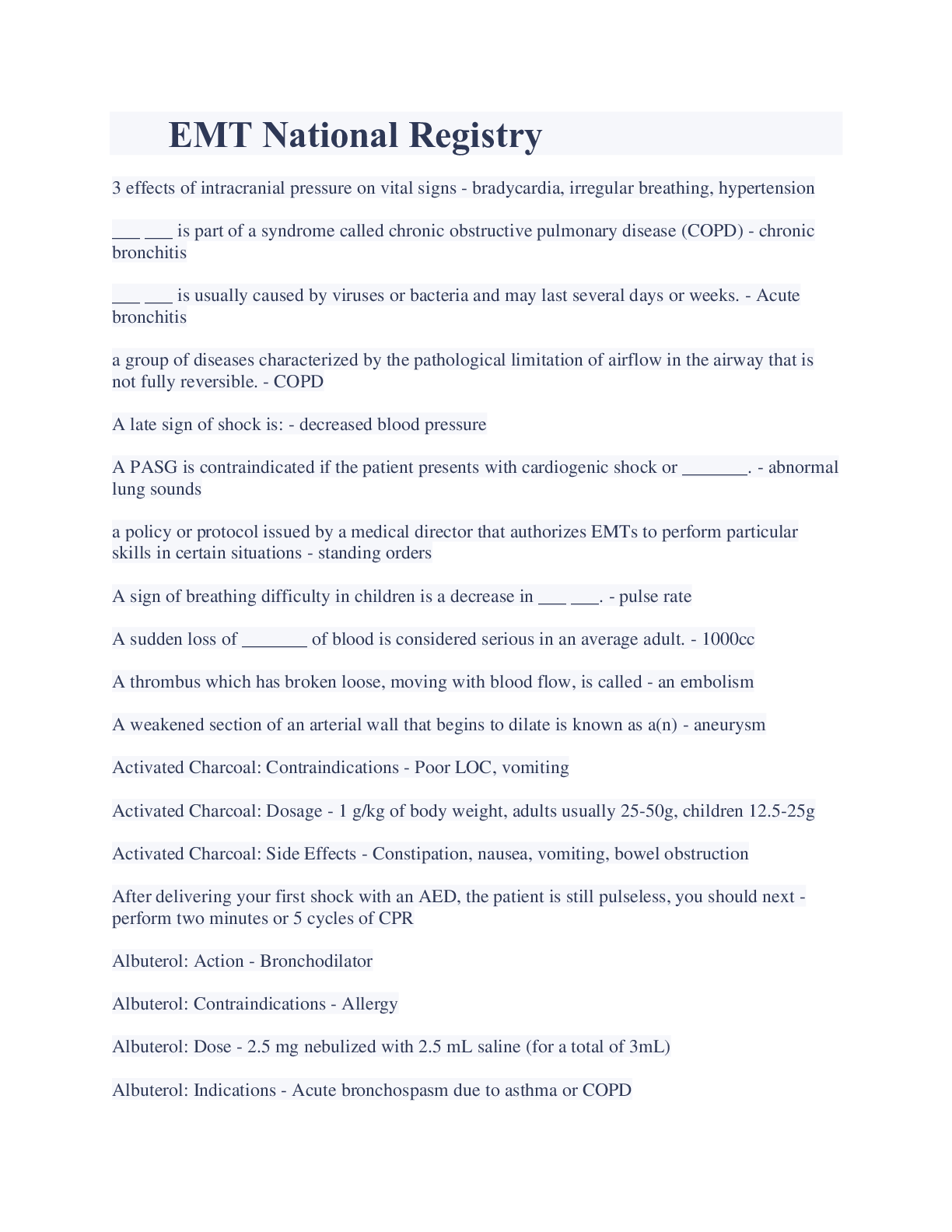
3 effects of intracranial pressure on vital signs - ANSWER bradycardia, irregular breathing, hypertension
___ ___ is part of a syndrome called chronic obstructive pulmonary disease (COPD) - ANSWER chronic bronchitis
...
3 effects of intracranial pressure on vital signs - ANSWER bradycardia, irregular breathing, hypertension
___ ___ is part of a syndrome called chronic obstructive pulmonary disease (COPD) - ANSWER chronic bronchitis
___ ___ is usually caused by viruses or bacteria and may last several days or weeks. - ANSWER Acute bronchitis
a group of diseases characterized by the pathological limitation of airflow in the airway that is not fully reversible. - ANSWER COPD
A late sign of shock is: - ANSWER decreased blood pressure
A PASG is contraindicated if the patient presents with cardiogenic shock or _______. - ANSWER abnormal lung sounds
a policy or protocol issued by a medical director that authorizes EMTs to perform particular skills in certain situations - ANSWER standing orders
A sign of breathing difficulty in children is a decrease in ___ ___. - ANSWER pulse rate
A sudden loss of _______ of blood is considered serious in an average adult. - ANSWER 1000cc
A thrombus which has broken loose, moving with blood flow, is called - ANSWER an embolism
A weakened section of an arterial wall that begins to dilate is known as a(n) - ANSWER aneurysm
Activated Charcoal: Contraindications - ANSWER Poor LOC, vomiting
Activated Charcoal: Dosage - ANSWER 1 g/kg of body weight, adults usually 25-50g, children 12.5-25g
Activated Charcoal: Side Effects - ANSWER Constipation, nausea, vomiting, bowel obstruction
After delivering your first shock with an AED, the patient is still pulseless, you should next - ANSWER perform two minutes or 5 cycles of CPR
Albuterol: Action - ANSWER Bronchodilator
Albuterol: Contraindications - ANSWER Allergy
Albuterol: Dose - ANSWER 2.5 mg nebulized with 2.5 mL saline (for a total of 3mL)
Albuterol: Indications - ANSWER Acute bronchospasm due to asthma or COPD
Albuterol: Side effects - ANSWER Headache, tachycardia, hypertension
An example of a shockable rhythm - ANSWER pulseless ventricular tachycardia
An infant or child patient who exhibits wheezing, increased breathing effort on exhalation, or rapid breathing without stridor probably has: - ANSWER A lower-airway disease
an inflammation of the bronchi (medium-size airways) in the lungs - ANSWER bronchitis
ASA: Action - ANSWER Impedes blood clotting
ASA: Contraindications - ANSWER allergy, bleeding disorder, already taken 324mg
ASA: Dosage - ANSWER 324mg (81mg x 4)
Atrovent: Action - ANSWER Bronchodilator
Atrovent: Contraindications - ANSWER Allergy to drug, soybeans, peanuts, glaucoma
Atrovent: Dose - ANSWER 0.5 mg nebulized w/ 2.5 mL saline (3mL total)
Atrovent: Side Effects - ANSWER Dry mouth, headache, gastrointestinal distress
caused by loss of elasticity of the lung tissue, from destruction of structures supporting the alveoli, and destruction of capillaries feeding the alveoli. - ANSWER emphysema
Chaotic electrical activity originating from many sites in the heart is called: - ANSWER Ventricular fibrillation
DCAP-BTLS = - ANSWER deformities, contusions, abrasions, punctures, burns, tenderness, lacerations, swelling
Emphysema, chronic bronchitis, and many undetermined respiratory illnesses are classified as - ANSWER COPD
Epinephrine: Action - ANSWER vasoconstriction, bronchodilation
Epinephrine: Contraindications - ANSWER Glaucoma, shock other than anaphylactic, diabetes, cardiac problems, hypertension, pregnancy, meds include a beta blocker or MAOI
Epinephrine: Dosage - ANSWER Epi-Pen = 0.3mg, Epi-Pen Jr = 0.15mg (for <60 lbs)
Epinephrine: Indications - ANSWER Anaphylaxis
Epinephrine: Side Effects - ANSWER Headache, palpitations, hypertension, tachycardia
Flow rates for nasal cannula - ANSWER 1-6 L/min
Flow rates for NRB - ANSWER 12-15 L/min
Full dilation of the cervix occurs in the _______ stage of labor. - ANSWER first
Glucagon: Action - ANSWER increases blood glucose by stimulating liver to release stored glycogen
Glucagon: Contraindications - ANSWER allergy, hx of pheochromocytoma (tumor which secretes epinephrine)
Glucagon: Dosage - ANSWER 1.0 mg for >44lbs, 0.5 mg for <44lbs, repeat in 20 min if no response
Glucagon: Side Effects - ANSWER hypotension, nausea, vomiting, respiratory distress
Half of all cardiac arrest patients will initially have a _______ rhythm. - ANSWER Ventricular fibrillation
Hypoglycemia - ANSWER Blood sugar less than 60
If a cardiac arrest occurs within two hours of the onset of symptoms, it is called - ANSWER sudden death
If a patient is eight months pregnant, how much blood can she potentially lose before exhibiting signs of shock? - ANSWER 30-35%
If the patient is not defibrillated within _______ minutes of a cardiac arrest, there is almost no chance for survival. - ANSWER 8
In an adult, a systolic BP of __ or less is hypotensive - ANSWER 90mmHg
In patients > 1 y/o, the 1st pulse you check - ANSWER radial
In the condition called ____, there is not electrical stimulus to cause the heart muscle to contract. - ANSWER asystole
list of steps to be taken in different situations - ANSWER protocols
Lung sounds that resemble low-pitched snoring or rattling are called - ANSWER rhonchi
Normal breathing rate for adults - ANSWER 12-20
Normal breathing rate for children - ANSWER 15-30
Normal breathing rate for infants - ANSWER 25-50
Normal diastolic BP in adults - ANSWER 60 to 90
Normal pulse rate for an adult - ANSWER 60-100 bpm
Normal systolic BP in adults - ANSWER 90 to 150
Not all poisons are toxins. Toxins are poisons that are - ANSWER produced by living organisms
NTG: Action - ANSWER vasodilator, decreases blood return to heart
NTG: Contraindications - ANSWER systolic pressure <100mm/Hg, use of ED med within last 24 hrs, head injury
NTG: Dosage - ANSWER 0.4mg SL, repeat every 3-5 min for 15 min
NTG: Indications - ANSWER chest pain of cardiac origin, angina, acute CHF
NTG: Side Effects - ANSWER headache, hypotension, tachycardia
occurs when an object migrates from one part of the body and causes a blockage of a blood vessel in another part of the body - ANSWER embolism
Order of preference for artifical breathing techniques, best to worst - ANSWER Mouth to mask, 2-rescuer BVM, Flow-restricted O2 powered device, 1-rescuer BVM
orders from the on-duty MD given directly to an EMT-B - ANSWER on-line medical direction
Oximeter reading in a normal, healthy person - ANSWER 96-100
Pertinant characteristics of breathing - ANSWER rate, rhythm, quality, depth
Prior to delivery, if the mother is in the supine position, she may develop dizziness and a drop in blood pressure. This is called: - ANSWER supine hypotensive syndrome
Signs of internal bleeding include: - ANSWER Bruising, swelling, and pain over vital organs; painful, swollen, or deformed extremities
Small round purplish spots, called petechiae, are caused by: - ANSWER capillary bleeding
Splinting a closed, angulated fracture in the position in which it was found may cause a(n) _______ during transport. - ANSWER open fracture
standing orders issued by the medical director that allow EMTs to do things without speaking to the med director - ANSWER off-line medical direction
This increases in adults with breathing difficulty. - ANSWER Pulse rate
the amount of air breathed in during each respiration multiplied by breaths/minute - ANSWER minute volume
The butt or feet of a baby presents first - ANSWER Breech presentation
The condition of excessive fluid buildup in the lungs because of the inadequate pumping of the heart is called - ANSWER CHF
the formation of a clot or thrombus inside a blood vessel, obstructing the flow of blood through the circulatory system - ANSWER thrombosis
The normal headfirst delivery of a baby is called a: - ANSWER Cephalic presentation
The primary electrical disturbance that results in cardiac arrest is... - ANSWER Ventricular fibrillation
The required amount of suctioning that a suction unit must provide. - ANSWER 30 L/min, 300 mmHg
The spinal column is made up of _______ separate irregularly shaped bones called vertebrae - ANSWER 33
Type _ diabetes usually develops in adults and often is controlled by diet and oral medication. - ANSWER 2
Type _ diabetes usually develops in childhood, and requires at least daily doses of supplemental insulin. - ANSWER 1
Usually only _______ patients can develop hemorrhagic shock due to a closed head injury. - ANSWER infant
Ventilation rate for adults - ANSWER 12/min
Ventilation rate for children - ANSWER 20/min
Ventilation rate for infants - ANSWER 20/min
What is a very late sign of an ectopic pregnancy? - ANSWER Low BP
When gases enter the bloodstream as the result of a damaged lung, it is called a(n) - ANSWER arterial gas embolism
When pressure increases inside the skull because of swelling of brain tissue, blood flow is decreased. This results in... - ANSWER the brain being starved for oxygen and carbon dioxide increasing, causing more swelling.
The major artery of the arm - ANSWER brachial artery
APGAR - ANSWER Appearance, pulse, grimace, activity, respiratory effort
layers of skin, outside to inside - ANSWER epidermis, dermis, subcutaneous
Which body parts are considered to be 9% of total body surface area - ANSWER head, chest, abdomen, both arms, each leg
What part of the body can be used to estimate 1% surface area - ANSWER palm
[Show More]





.png)