Powers under the Articles of Confederation - ANSWER 1. Could exchange Ambassadors
2. Make treaties with foreign governments and Indian Tribes
3. Declare War
4. Borrow Money
5. Settle disputes among States
Weakness
...
Powers under the Articles of Confederation - ANSWER 1. Could exchange Ambassadors
2. Make treaties with foreign governments and Indian Tribes
3. Declare War
4. Borrow Money
5. Settle disputes among States
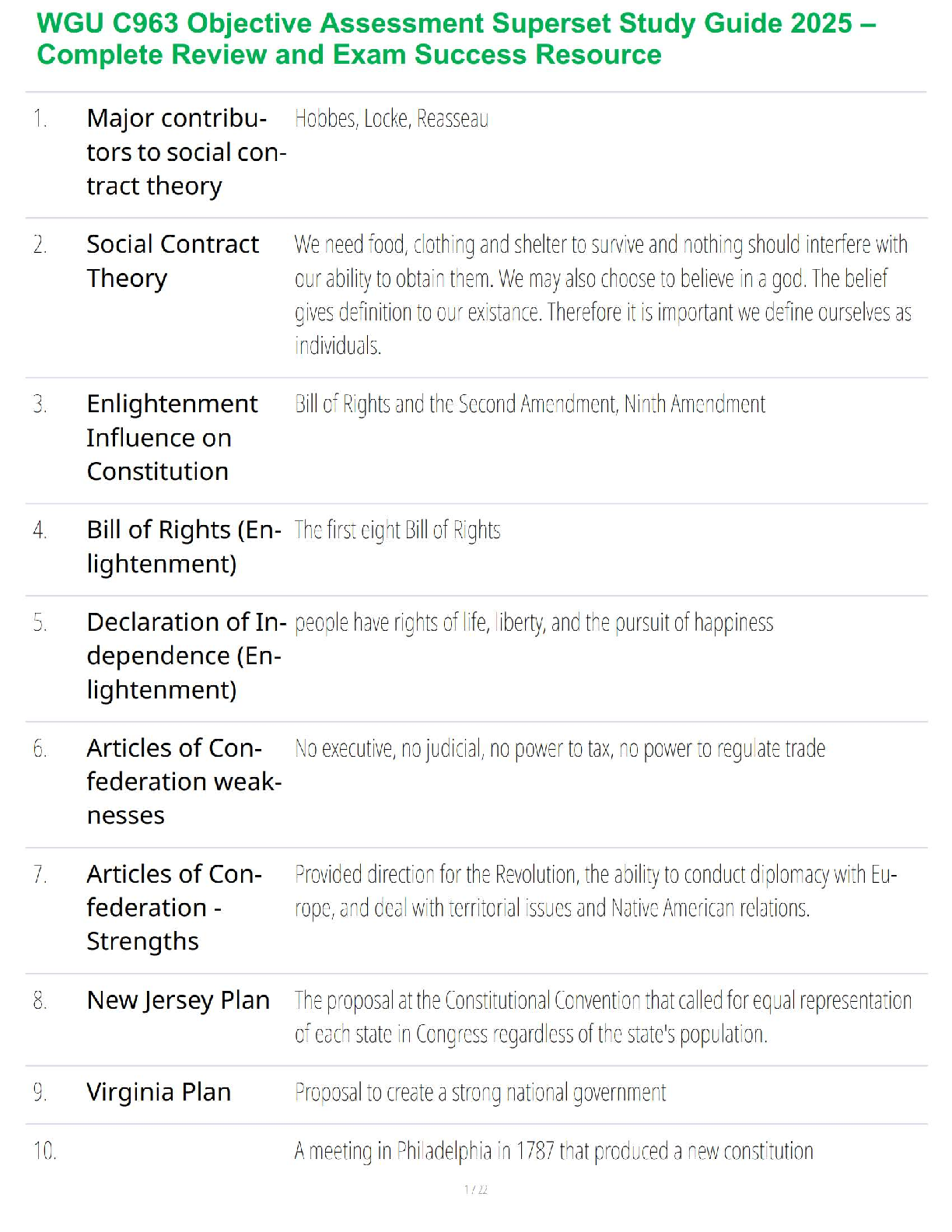
Weaknesses of the Articles of Confederation - ANSWER no power to tax,
President lacked power,
no money to buy ships
no money pay soldiers
no national judiciary
New Jersey Plan - ANSWER William Paterson
Three Branches of Government
The states had the power
Every state had one vote
one chamber legislature, unicameral
Supremacy clause "Law of the Land"
Virginia Plan - ANSWER James Madison
Three Branches of government
Two-chamber in a legislative
Bicameral legislature:
House: elected by the people
Senate: appointed by the legislature
Votes based on population
Could tax, regulate trade, veto down state laws, create an army
The Great Compromises - ANSWER 1. combined the two ideas from the Virginia Plan and the New Jersey plan.
2. The 3/5 slavery ruling
3. Slave owners could reclaim their slaves in states where they had fled.
4. Slaves could only be freed if they were born in the US and was over the age of 28
Articles of Confederation with a Congress - ANSWER 1. representation based on the population
2. the the weak national government and a strong states
Federalists - ANSWER supporters of the Constitution
Anti-Federalists - ANSWER people who opposed the Constitution
Federalist Paper #10 - ANSWER Written by James Madison to convince people to support the ratification of the constitution. Argued that factions were inevitable but were best controlled by a large republic that employed a Federalist structure. Argued that competition among factions would limit their negative impacts.
Federalist Paper # 51 - ANSWER •Written by James Madison
•Defines the relationship among the three branches of government as independent.
•To stay independent, no branch should have total power to choose members of the other branches
•By creating a bicameral legislature, it protects the people from legislative tyranny
•Explains that each branch of government should be selected in different ways
What was a major difference between the Articles of Confederation and the Constitution? - ANSWER The Articles of Confederation did not provide for a national judiciary.
Why did the framers design the government under the Articles of Confederation with a Congress? - ANSWER They wanted a government based on the representation of the population.
implied powers - ANSWER Powers not specifically mentioned in the constitution
Examples of implied powers - ANSWER Establishing a national bank, creating the IRS, establishing a military draft, raising the min wage
enumerated powers - ANSWER The powers explicitly given to Congress in the Constitution.
Examples of enumerated powers - ANSWER -declare war & raise army & navy
-create rules on how to become citizen
-regulate trade b/t states & countries
-coin $
-protect patents & copyrights
-create lower federal courts
-est. post offices
inherent powers - ANSWER is the power that congress and the president need in order to get the job done
Examples of inherent powers - ANSWER Regulating immigration, acquiring territory, granting diplomatic recognition to other states
concurrent powers - ANSWER Powers held jointly by the national and state governments.
[Show More]