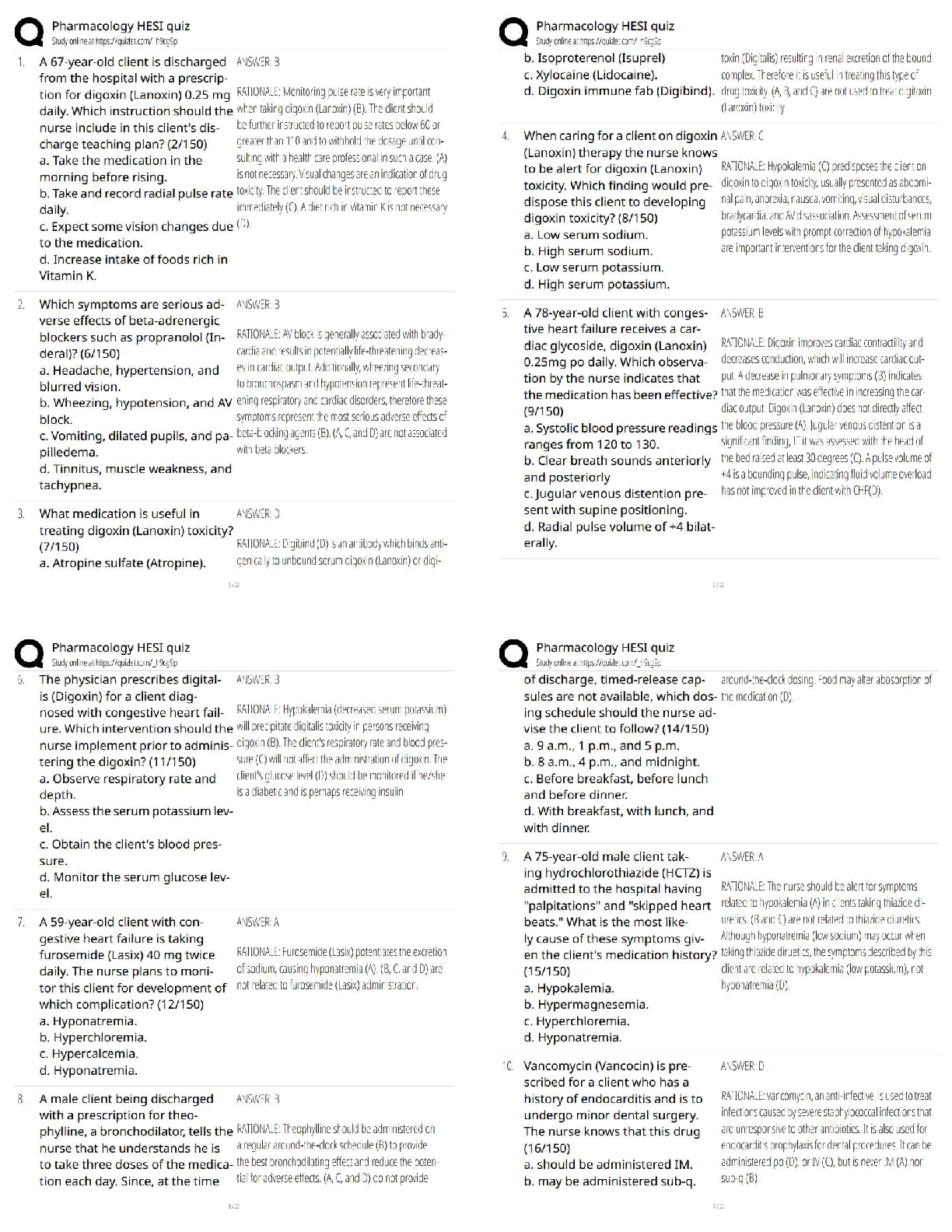
PN Pharmacology Review
General Directions:
Please choose the letter that best answers the question. There is only one correct answer to each question,
except for select all that apply. Mark the appropriate letter on y
...
PN Pharmacology Review
General Directions:
Please choose the letter that best answers the question. There is only one correct answer to each question,
except for select all that apply. Mark the appropriate letter on your answer sheet. Good luck!
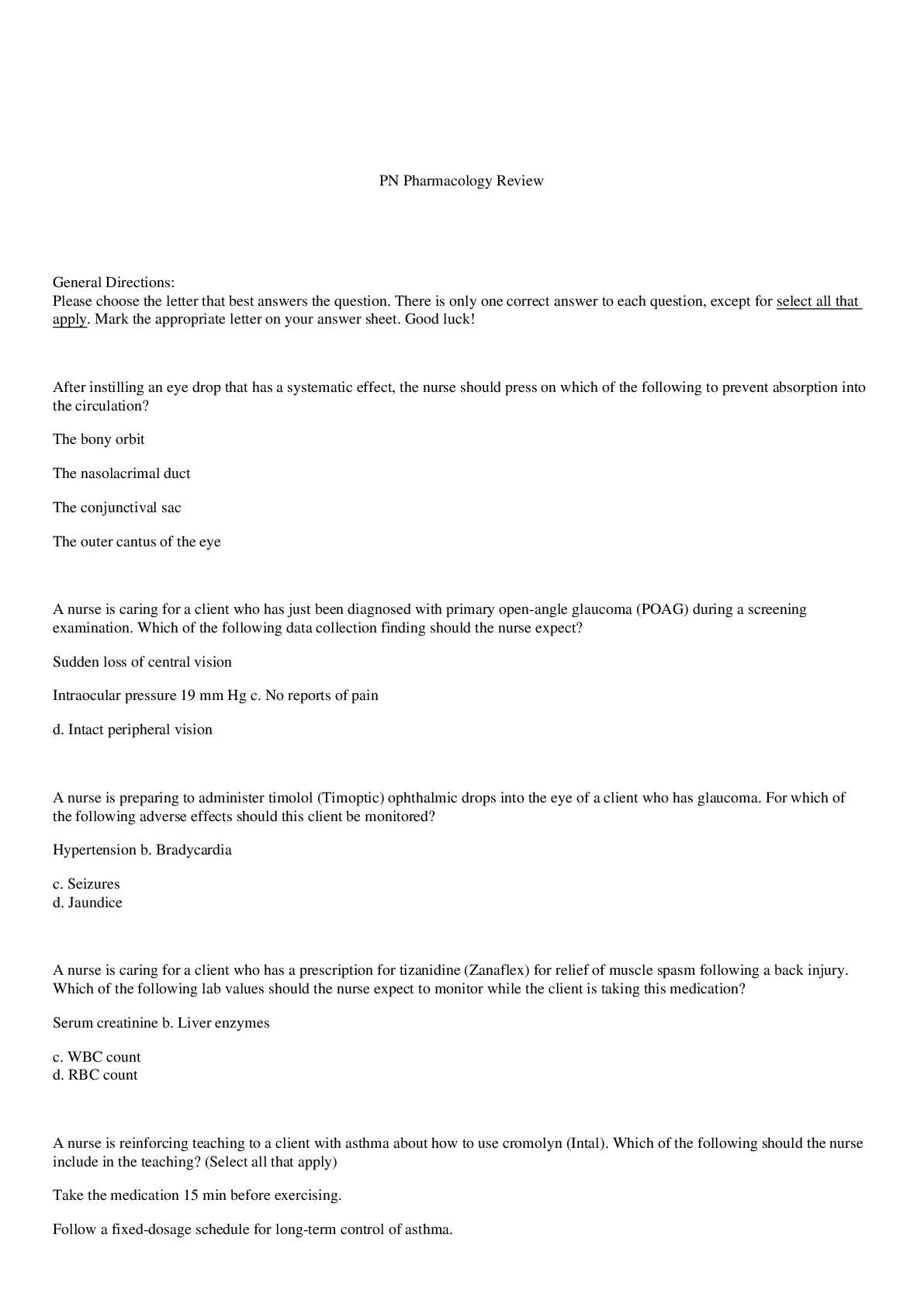
1. After instilling an eye drop that has a systematic effect, the nurse should press on which of the
following to prevent absorption into the circulation?
a. The bony orbit
b. The nasolacrimal duct
c. The conjunctival sac
d. The outer cantus of the eye
2. A nurse is caring for a client who has just been diagnosed with primary open-angle glaucoma
(POAG) during a screening examination. Which of the following data collection finding should the
nurse expect?
a. Sudden loss of central vision
b. Intraocular pressure 19 mm Hg
c. No reports of pain
d. Intact peripheral vision
3. A nurse is preparing to administer timolol (Timoptic) ophthalmic drops into the eye of a client who
has glaucoma. For which of the following adverse effects should this client be monitored?
a. Hypertension
b. Bradycardia
c. Seizures
d. Jaundice
4. A nurse is caring for a client who has a prescription for tizanidine (Zanaflex) for relief of muscle
spasm following a back injury. Which of the following lab values should the nurse expect to
monitor while the client is taking this medication?
a. Serum creatinine
b. Liver enzymes
c. WBC count
d. RBC count
5. A nurse is reinforcing teaching to a client with asthma about how to use cromolyn (Intal). Which of
the following should the nurse include in the teaching? (Select all that apply)
a. Take the medication 15 min before exercising.
b. Follow a fixed-dosage schedule for long-term control of asthma.
c. Expect to lose weight while taking the medication.
d. Observe for adverse effects such as tremors, restlessness, and palpitations.
1/15
e. Do not crush or chew tablets.
6. A nurse is reinforcing teaching for a client with a prescription for a beclomethasone (QVAR)
inhaler to be used for the long-term management of asthma. Which of the following dietary
supplements should the client be sure to consume in sufficient amounts to prevent a deficiency
while taking the QVAR inhaler?
a. Iron and Protein
b. Calcium and Vitamin D
c. Vitamin B¹² and folic acid
d. Vitamin E and K
7. A nurse is caring for a client who is prescribed oral prednisone (Deltasone) for the treatment of
chronic asthma. The nurse should plan to monitor the client for which of the following findings?
a. Weight loss
b. Infection
c. Hypoglycemia
d. Angina Pain
8. A nurse is caring for a client who states she has been taking phenylephrine (Neo-Synephrine) nasal
drops for the past 10 days for her upper respiratory symptoms. The nurse should plan to monitor
the client for which of the following findings?
a. Sedation
b. Nasal congestion
c. Productive cough
d. Constipation
9. A nurse is caring for a preschool-age child who may have taken an overdose of diphenhydramine
(Benadryl). To identify antihistamine toxicity, the nurse should plan to monitor the child for which
of the following?
a. Hallucinations
b. Bradycardia
c. Pinpoint pupils
d. Pallor
10. A nurse is reinforcing teaching for a client who has hypertension and is prescribed
hydrochlorothiazide (HydroDIURIL) twice daily. Which of the following instructions should the
nurse include in the client’s teaching?
a. “You should avoid foods high in potassium.”
b. “Take the second dose of the day by early afternoon.”
c. “Watch for ankle swelling that may appear late in the evening.”
d. “Limit your daily fluid intake to 1½ L.”
2/15
11. A client has a new prescription for spironolactone (Aldactone). Which of the following laboratory
values should the nurse recognize as a reason to withhold the morning dose of the medication and
notify the provider?
a. Serum sodium 138 mEq/L
b. Serum potassium 5.2 mEq/L
c. Serum creatinine 1.2 mEq/L
d. Serum chloride 106 mEq/L
12. A nurse is caring for a client who is prescribed daily doses of both digoxin (Lanoxin) and
furosemide (Lasix). The client’s potassium level is 3.2 mEq/L. For which of the following
medication interaction is the client at risk?
a. Toxic levels of furosemide
b. Toxic levels of digoxin
c. Sub-therapeutic levels of furosemide
d. Sub-therapeutic levels of digoxin
13. Propranolol (Inderal) is contraindicated for a client who has which of the following conditions?
a. Asthma
b. Diabetes
c. Angina
d. Dementia
14. A nurse is reinforcing teaching for a client who has a prescription for verapamil (Calan). Which of
the following statements by the clients indicates a need for further teaching?
a. “I should increase the amount of fiber in my diet since the medication causes constipation.”
b. “I should eliminate grapefruit juice from my diet while taking verapamil.”
c. “I should decrease the amount of calcium in my diet while taking the medication.”
d. I should take the medication with food if it causes an upset stomach.”
15. A nurse is caring for a client with prescription for nifedipine (Procardia) to treat angina pectoris.
The nurse should plan to monitor the client for which of the following findings?
a. Weight loss
b. Reflex tachycardia
c. Grand mal seizures
d. Urinary Retention
16. A nurse is caring for a client on a medical unit who takes regular doses of propranolol (Inderal)
for hypertension. Before administering the client’s morning dose of propanolol, which of the
following should the nurse plan to monitor? (Select all that apply)
a. Urinary output
b. Pulse rate
c. Temperature
d. Blood pressure
e. Deep tendon reflexes
3/15
17. A nurse is reinforcing teaching for a client who is prescribed digoxin (Lanoxin). Which of the
following should the nurse instruct the client to report to the provider? (Select all that apply.)
a. Fatigue
b. Constipation
c. Anorexia
d. Rash
e. Diplopia
18. A nurse is caring for a client who is prescribed isosorbide mononitrate (Imdur) for chronic stable
angina. The nurse should plan to monitor the client for which of the following findings?
a. Bradycardia
b. Fever
c. Hypertension
d. Headache
19. A nurse is obtaining a medication history from a client who is to start a new prescription for
warfarin (Coumadin). Which of the following over-the-counter medications should the nurse
instruct the client to avoid?
a. Ranitidine (Zantac)
b. Docusate sodium (Colace)
c. Acetaminophen
d. Aspirin
20. A nurse is caring for a client who has angina pectoris and is prescribed a nitroglycerin patch
(Nitro-Dur) once daily. Which of the following are true regarding the administration of
transdermal nitroglycerin? (Select all that apply)
a. Apply the patch at the same time each morning
b. Leave the patch in place for 24 hr before replacing.
c. Put patch on a hairless area of skin.
d. Rotate the sites of administration with each application.
e. Cut patches in half to allow for smaller doses of prescribed medication.
21. A nurse is reinforcing teaching to a client who is prescribed lovastatin (Mevacor). Which of the
following should be included in the teaching?
a. Take the medication with the evening meal.
b. Change position slowly when rising from a chair.
c. Maintain a steady intake of green leafy vegetables.
d. Consume no more than 1L of fluid/day.
22. A nurse is reinforcing teaching for a client who is to begin taking a new prescription for niacin
(Niacor). The nurse should instruct the client to expect which of the following?
a. Facial flushing
b. Frontal headache
c. Blurred vision
d. Dry mouth
4/15
23. A nurse is caring for a client who takes a daily dose of warfarin (Coumadin). The client begins
vomiting blood. Which of the following medications should the nurse prepare to give to reverse
the effects of warfarin?
a. Vitamin K
b. Atropine sulfate
c. Protamine sulfate
d. Calcium gluconate
24. A nurse is caring for a client who has been taking a daily dose of warfarin for the past two weeks
following an acute myocardial infarction. The client’s most recent INR is 1 to 2. If the client has
been taking the warfarin as prescribed, the nurse should expect which of the following changes to
the client’s prescription?
a. The warfarin will be continued at the same dose.
b. The warfarin will be discontinued.
c. The warfarin dosage will be increased.
d. The warfarin dosage will be decreased.
25. When caring for a client taking aspirin to reduce the risk for a myocardial infarction, the nurse
should monitor for which of the following adverse effects? (Select all that apply)
a. Petechiae
b. Hypertension
c. Tinnitus
d. Bruising
e. Black stools
26. Which of the following interventions should the nurse implement when preparing to administer
filgrastim (Neupogen) for the first time to a client who has undergone a bone marrow transplant?
a. Administer intramuscularly in a large muscle mass to prevent injury.
b. Give orally with a meal or snack to prevent severe gastrointestinal upset.
c. Shake vial gently to mix well before withdrawing dose.
d. Discard vial after removing one dose of the medication.
27. A nurse is caring for a client who has been receiving epoetin alfa (Epogen) three times a week for
several weeks. At a visit to the clinic, the client’s Hgb has increased from 7 g/dL to 8.5 g/dL in the
past week. Which of the following actions should the nurse expect to take regarding today’s dose
of epoetin alfa?
a. To increase today’s dose.
b. To administer the ordered dose.
c. To withhold today’s dose.
d. To discontinue the medication.
5/15
28. A nurse is monitoring a client who is receiving sargramostim (Leukine) following a bone marrow
transplant. For which of the following adverse reactions should the nurse monitor the client?
a. Constipation
b. Bone pain
c. Insomnia
d. Hair loss
29. A nurse is reinforcing teaching for a client who has peptic ulcer disease on how to properly selfadminister ranitidine (Zantac). Which of the following client statements indicates effective
teaching by the nurse?
a. “I should call my doctor if my stools look black and sticky.”
b. “I will take ranitidine regularly until my burning symptoms disappear.”
c. “I need to take ranitidine on my empty stomach.”
d. “I can take ibuprofen if I have minor aches and pains.”
30. A nurse is reinforcing teaching for a client who is newly diagnosed with peptic ulcer disease and
has prescription for several different medications. The nurse should recognize that which of the
following medications is used as a mucosal protectant to promote healing of the ulcer?
a. Bismuth (Pepto-Bismol)
b. Sucralfate (Carafate)
c. Ranitidine hydrochloride (Zantac)
d. Metronidazole (Flagyl)
31. A nurse is reinforcing teaching for a client who is beginning a prescription of conjugated
estrogens (Premarin) for symptoms of menopause. For which of the following should the nurse
plan to monitor the client?
a. Lower leg pain and swelling
b. Shortened stature
c. Vulvar and vaginal atrophy
d. Weight loss
32. A nurse is reinforcing teaching for a client who is about to begin a prescription for an oral
contraceptive. The nurse should tell the client that the oral contraceptives work by doing which of
the following? (Select all that apply.)
a. Thickening the cervical mucus to slow sperm passage
b. Inducing maturation of ovarian follicle
c. Increasing development of the corpus luteum
d. Altering the endometrial lining to prevent implantation
e. Inhibiting ovulation
6/15
33. A nurse is caring for a male client who has a new prescription for testosterone cypionate (DepoTestosterone) IM every 2 to 4 weeks for hypogonadism. The nurse should plan to monitor which
of the following laboratory values?
a. Serum creatinine
b. Cholesterol levels
c. BUN
d. Serum potassium
34. A nurse is reinforcing teaching for a client who takes sildenafil (Viagra) several times weekly and
has a new prescription for oral erythromycin (E-Mycin) to treat a respiratory tract infection. The
nurse should instruct the client about an increased risk for which of the following findings due to
an interaction between the two medications?
a. Priapism
b. Urinary frequency
c. Weight gain
d. Insomnia
35. A nurse is reinforcing teaching for a female client who has a new prescription for
hydroxychloroquine (Plaquenil) for rheumatoid arthritis. The nurse evaluates that the client
understand the teaching when she states, “While taking hydroxychloroquine I should
a. go to the dentist more frequently
b. call my doctor if I develop blurred vision.”
c. have a Pap test twice a year.”
d. let my doctor know if my urine becomes darker.”
36. A client who has osteoporosis is started on alendronate (Fosamax). The nurse should instruct the
client to do which of the following? (Select all that apply.)
A. Take the medication in the morning after arising and before eating.
B. Chew tablets to increase bioavailability.
C. Drink 8oz of water with each tablet
D. Take the medication with an antacid if heartburn occurs
E. Avoid lying down after taking the medication
37. A nurse is caring for a client who has been prescribed calcitonin-salmon to treat osteoporosis.
When evaluating the client’s therapy, the nurse should recognize that which of the following
serum calcium levels is within the expected range?
a. 8.6 mg/dl
b. 9.6 mg/dl
c. 10.6 mg/dl
d. 11.6 mg/dl
7/15
38. A nurse is caring for an older adult client who is taking large doses of aspirin four times daily for
severe rheumatoid arthritis pain. For which of the following should the nurse monitor the client?
a. Hepatotoxicity
b. Renal impairment
c. Reye’s syndrome
d. Ischemic stoke
39. A nurse is caring for a toddler who was just admitted for an acetaminophen overdose. Which of
the following medications should the nurse anticipate being administered to this client?
a. Acetylcysteine (Mucomyst)
b. Pegfilgrastim (Neulasta)
c. Misoprostol (Cytotec)
d. Naltrexone (Re Via)
40. A nurse is caring for postoperative client who is prescribed ketorolac (Toradol) for pain
management. The nurse should recognize that which of the following is true regarding the
administration of ketorolac?
a. Ketorolac is prescribed postoperatively to lower the dosage of opiods needed.
b. Client’s who take ketorolac avoid the adverse reactions of NSAIDS.
c. Ketorolac is available as a timed-release transdermal patch.
d. Client’s maybe prescribed ketorolac for long-term relief of chronic pain, such as arthritis
41. A nurse is monitoring a client who received regular doses of meperidine (Demerol) for postoperative pain for 36 hr. For which of the following should the nurse monitor the client?
a. Hypothremia
b. Bradycardia
c. Delirium
d. Watery diarrhea
42. A nurse is caring for a client who has been receiving morphine for postoperative pain for the past
few days. For which of the following should the nurse monitor the client? (Select all that apply)
a. Dilated pupils
b. Urinary retention
c. Orthostatic hypotension
d. Constipation
e. Nausea
8/15
43. A nurse is caring for a client with severe pain whose prescription for morphine IV bolus has been
changed to transdermal fentanyl (Duragesic). The nurse should understand which of the following
information when administering a fetanyl transdermal patch?
a. Apply a hot pack to the area containing the patch to enhance therapeutic effect.
b. Administer a short-term opioid for pain for the first 24 hr after patch application.
c. Have the client replace the patch daily.
d. Remove the patch for immediate relief of the respiratory depression and do not give any
further treatment.
44. A nurse is caring for a client who has back pain and has been prescribed nalbuphine (Nubain). The
nurse should know that agonist-antagonist opioids, such as nalbuphine, differ from pure opioid
agonists in that they
a. have a greater risk for abuse due to an increase in euphoria.
b. cause a higher incidence of respiratory depression.
c. may not be reversed with an opioid antagonist.
d. may cause abstinence syndrome in clients physically dependent to opioids.
45. A nurse is caring for a hospitalized client who has cancer and has a variety of prescribed adjuvant
medications which may be administered along with opioids for pain. When the client describes
having “burning pain shooting down my leg.” Which of the following adjuvants should the nurse
administer?
a. Etidronate (Didronel)
b. Gabapentin (Neurontin)
c. Methylphenidate (Ritalin)
d. Hydroxyzine (Vistaril)
46. A nurse is caring for a client who has cancer and is receiving opioids along with prednisone
(Deltasone) daily for pain control. While the client is taking prednisone, the nurtse should plan to
monitor the client for which of the following findings?
a. Hypoglycemia
b. GI Bleeding
c. Weight loss
d. Asthma
47. A nurse is caring for a client who has severe pain in his right foot. Which of the following
laboratory values tell the nurse that the client is having a flare-up of gout?
a. Increased serum creatinine
b. Decreased creatinine kinase
c. Decreased total protein
d. Increased uric acid
9/15
48. A nurse is caring for a client who has migraine headaches and is planning to ask her provider for
a prescription for ergotamine is contraindicated for clients who have which of the following
conditions?
a. Seizure disorders
b. Angle closure glaucoma
c. Coronary artery disease
d. Peptic ulcer disease
49. A nurse is reinforcing teaching to a client with migraine headaches who has a new prescription
for sumatriptan (Imitrex).The nurse should plan to monitor the client for which of the following?
a. Nausea and vomiting
b. Pressure in the chest
c. Fever and sore throat
d. Bleeding and bruising
50. Match the time of NPH insulin (Humulin N) onset:
a. Less than 15 min
b. 0.5 to 1 hr
c. 1 to 2 hr
d. 1 hr
51. A nurse is caring for a group of clients who need insulin injections. The nurse should recognize
that he can mix. Which of the following insulin in the same syringe with another insulin? (Select
all that apply)
a. Insulin detemir (Levemir)
b. Insulin lispro (Humalog)
c. Insulin glargine (Lantus)
d. Insulin aspart (Novolog)
52. A nurse is caring for a client who has type 2 diabetes mellitus and a prescription for
rosiglitazone (Avandia). For which of the following findings should the nurse monitor the
client?
a. Edema
b. Palpitations
c. Seizures
d. Urinary retention
53. A nurse is reinforcing teaching for a client newly diagnosed who has type 2 diabetes mellitus.
Which of the following should the nurse include the teaching? (Select all that apply)
a. Check blood glucose levels less frequently when feeling ill.
b. Take an extra dose of the oral hypoglycemic agent the next day if a dose is missed.
c. Carry a fast-acting glucose source at all times.
d. Eat a snack prior to planned exercise.
e. Inspect feet surfaces daily
10/15
54. A nurse is caring for a client who is taking levothyroxine (Synthroid). For which of the
following should the nurse monitor to identify levothyroxine toxicity?
a. Hair loss
b. Lethargy
c. Weight loss
d. Cold intolerance
55. A nurse is reinforcing teaching for a client with hyperthyroidism who has a new prescription for
propanolol (Inderal). The nurse should teach the client that propranolol should perform which of
the following actions?
a. Increase blood flow to the thyroid gland
b. Prevent thyroid hormone synthesis
c. Suppress tachycardia
d. Promote conversion of T4 to T3
56. A nurse is reinforcing teaching for a client who is prescribed strong iodide solution (Lugol’s
solution) prior to thyroid surgery. For which of the following adverse effects should the nurse
monitor the client?
a. Blurred vision
b. Metallic taste
c. Absence seizures
d. Frontal headache
57. A client taking hydrocortisone for adrenocortical insufficiency (Addison’s disease) is admitted
to the hospital for a total hip arthroplasty. Which is the following actions is the highest priority?
a. Administration of supplemental doses of hydrocortisone
b. Instruction on coughing and deep breathing
c. Insertion of an indwelling urinary catheter
d. Requesting a referral for physical therapy
58. A nurse is preparing to administer scheduled immunizations to a 2-month-old infant. Which of
the following instructions should the nurse give the parent before discharge?
a. Treat discomfort with liquid ibuprofen for the first 24 hr following the vaccinations.
b. Apply warm compresses to injection site comfort.
c. Call the provider if the injection site becomes slightly reddened.
d. Gently move the involved extremity to decrease discomfort.
59. A nurse is caring for a client who has a suspected bacterial infection in her urine. Which of the
following prescribed laboratory tests will identify which micro-organism is responsible for the
injection?
a. Gram stain
b. Culture
c. Sensitivity
d. Specific gravity
11/15
60. A nurse is caring for a client for urgent care clinic who has pneumonia. The client is prescribed
ampicillin (Pricipen). Two days later the client calls the clinic and reports to the nurse that she is
experiencing itchy rash. Which of the following actions should the nurse take first?
a. Collect data about previous allergic reactions.
b. Ask the client to prescribe her symptoms.
c. Tell the client not to take the next dose of antibiotic.
d. Have the client come to the clinic to see her provider.
61. A nurse is caring for a client who is receiving vancomycin (Vancocin) for a severe infection. For
which of the following should the nurse monitor the client in order to collect data about a
possible adverse reaction to vancomycin?
a. Visual acuity
b. Hearing ability
c. Presence of ataxia
d. Deep tendon reflexes
62. A nurse is reinforcing teaching for a client who has a urinary tract infection and a new
prescription for Primaxin. Which of the following adverse reaction should the nurse insstruct
the client to watch for?
a. Oral thrush
b. Chest pain
c. Rapid pulse
d. Peripheral neuropathy
63. A nurse is reinforcing teaching to a client prescribed tetracycline (Sumycin) to treat a
gastrointestinal infection. Which of the following statements by the client indicates a need for
further teaching?
a. “I will be sure to wear long sleeves when out in the sun.”
b. “I will take the medication with full glass of milk.”
c. “I will finish all the medicine even if I am feeling better.”
d. “I will take the medication first thing in the morning.’
64. A nurse is caring for a client who will receive gentamicin (Garamycin) intermittent IV bolus at
noon. The infusion will take 30 min. When should the nurse plan to have a peak level of
gentamicin drawn by the laboratory?
a. 12:30 pm
b. 1:00 pm
c. 2:30 pm
d. 3:00 pm
12/15
65. A nurse is caring for a client with prescription for erythromycin (E-Mycin) to treat a urethral
infection. The client also takes daily prescriptions for furosemide (Lasix) and warfarin
(Coumadin). For which of the following manifestations of a drug interaction should the nurse
monitor the client?
a. Bradycardia
b. Urinary retention
c. Bleeding
d. Hypernatremia
66. A nurse is caring for a client who receives amikacin (Amikin) by intermittent IV bolus for a
severe infection. Which of the following laboratory values should the nurse recognize as an
adverse effect of amikacin?
a. Elevated serum creatinine
b. Elevated triglycerides
c. Decrease serum potassium
d. Decrease hematocrit
67. A nurse is caring for a group of clients who each have urinary tract infections. The nurse should
know that trimethroprim-sulfamethoxazole is contraindicated in clients who have had a
hypersensitivity reaction to which of the following medications?
a. Digoxin (Lanoxin)
b. Chlorothiazide (Diuril)
c. Ranitidine (Zantac)
d. Rosiglitazone (Avandia)
68. A nurse is reinforcing teaching for a client with prescription for trimethoprim-sulfamethoxazole
(Bactrim). Which of the following precautions should the nurse reinforce to the client in order
to minimize an adverse effect of the medication?
a. Avoid prolonged sun exposure.
b. Slip water or suck hard candy frequently.
c. Stop taking the medication if ringing in the ears occurs.
d. Increase the amount of fiber and liquids in the diet.
69. A nurse is caring for a client who has diabetes mellitus and pulmonary tuberculosis. The client
has a new prescription for isoniazid (INH). Which of the following supplements should the
nurse expect to administer to prevent an adverse effect of isoniazid?
a. Ascorbic acid
b. Pyridoxine
c. Folic acid
d. Cyanocobalamin
13/15
70. A nurse is caring for a client who has a prescription for oral ketoconazole (Nizoral), which he
will be taking for several months to treat a systemic fungal infection. Which of the following
should the nurse to monitor?
a. BUN and serum creatinine levels
b. Hemoglobin and hematocrit levels
c. Liver function tests
d. Thyroid function tests
71. A nurse is monitoring a client with latent tuberculosis who has been taking twice-weekly
isoniazid (INH) for the past 3 months. For which of the following findings should the nurse
monitor the client?
a. Jaundice
b. Renal impairment
c. Hypotension
d. Palpitations
72. A nurse is reinforcing teaching to a client who has HIV-positive and has a new prescription for
efavirenz (Sustiva), an NNRTI medication. Which 0f the following adverse effects should the
nurse teach the client to watch for?
a. A rash, which may begin within two weeks
b. Orthostatic hypotension, which may occur following the first dose
c. Hair loss, which may start after 2 to 3 days
d. Ankle edema, which may occur after several months of therapy
73. A nurse is preparing to administer medication for a client who is receiving intermittent enteral
feedings through a gastrostomy tube. Which of the following actions should the nurse take?
a. Crush extended release tablets
b. Administer sublingual tables under the tongue
c. Flush with 10 mL of warm water when completed
d. Add medications to enteral feeding
74. A health care provider prescribes furosemide (Lasix) 40 mg PO now. The nurse should
recognize this as which types of order?
a. Single order
b. Stat order
c. Routine order
d. Standing order
75. A nurse is preparing to administer a client’s morning insulin dosage. Which of the following
actions should the nurse take first?
a. Review the client’s blood glucose level
b. Verify the client’s identity
c. Ask another nurse to check the amount of insulin drawn into the syringe.
d. Wash the injection site with soap and water
[Show More]