Detailed Answer Key
HW-3
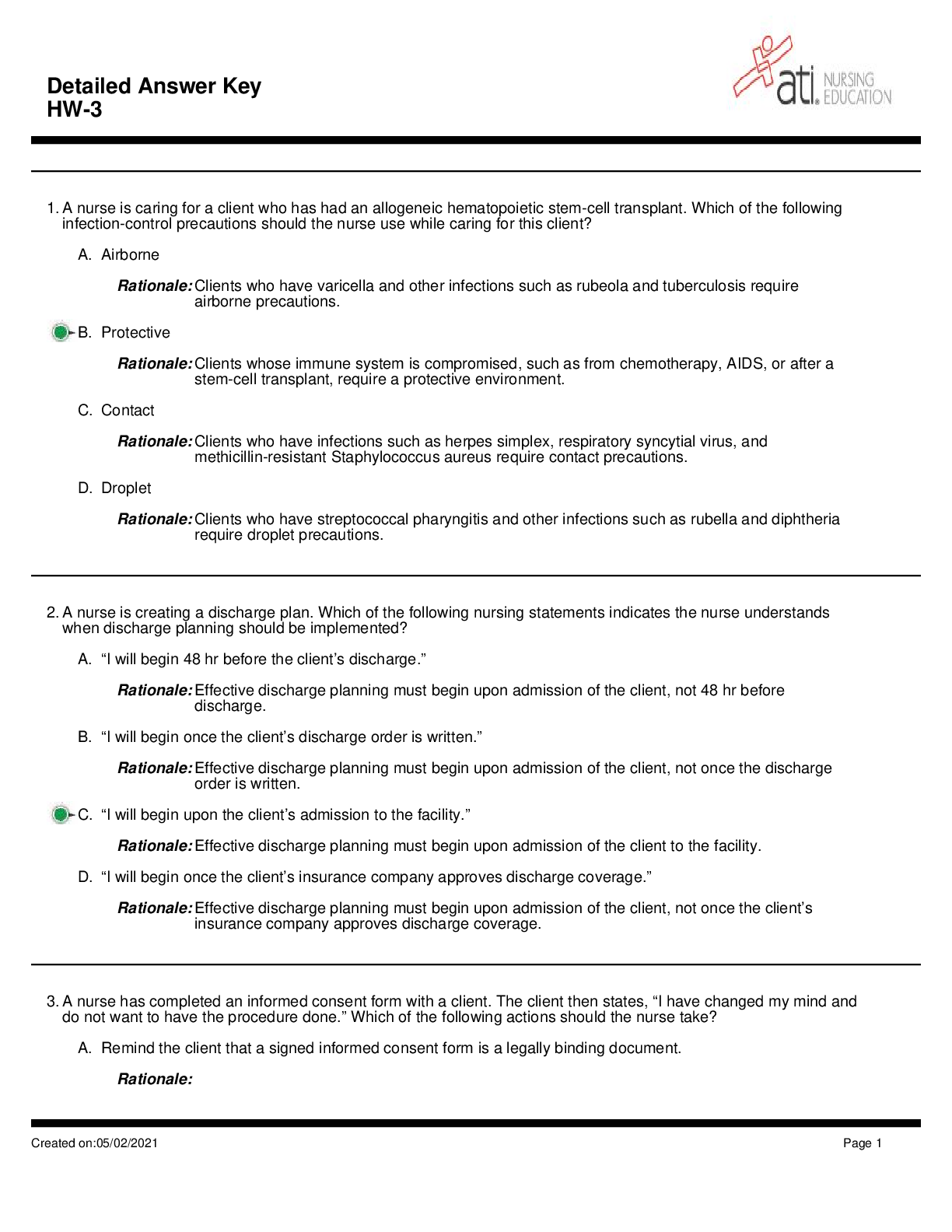
1.A nurse is caring for a client who has had an allogeneic hematopoietic stem-cell transplant. Which of the following
infection-control precautions should the nurse use while caring for this c
...
Detailed Answer Key
HW-3
1.A nurse is caring for a client who has had an allogeneic hematopoietic stem-cell transplant. Which of the following
infection-control precautions should the nurse use while caring for this client?
A. Airborne
Rationale: Clients who have varicella and other infections such as rubeola and tuberculosis require
airborne precautions.
B. Protective
Rationale: Clients whose immune system is compromised, such as from chemotherapy, AIDS, or after a
stem-cell transplant, require a protective environment.
C. Contact
Rationale: Clients who have infections such as herpes simplex, respiratory syncytial virus, and
methicillin-resistant Staphylococcus aureus require contact precautions.
D. Droplet
Rationale: Clients who have streptococcal pharyngitis and other infections such as rubella and diphtheria
require droplet precautions.
2.A nurse is creating a discharge plan. Which of the following nursing statements indicates the nurse understands
when discharge planning should be implemented?
A. “I will begin 48 hr before the client’s discharge.”
Rationale:Effective discharge planning must begin upon admission of the client, not 48 hr before
discharge.
B. “I will begin once the client’s discharge order is written.”
Rationale:Effective discharge planning must begin upon admission of the client, not once the discharge
order is written.
C. “I will begin upon the client’s admission to the facility.”
Rationale:Effective discharge planning must begin upon admission of the client to the facility.
D. “I will begin once the client’s insurance company approves discharge coverage.”
Rationale:Effective discharge planning must begin upon admission of the client, not once the client’s
insurance company approves discharge coverage.
3.A nurse has completed an informed consent form with a client. The client then states, “I have changed my mind and
do not want to have the procedure done.” Which of the following actions should the nurse take?
A. Remind the client that a signed informed consent form is a legally binding document.
Rationale:
Created on:05/02/2021 Page 1
Detailed Answer Key
HW-3
The client has the right to withdraw informed consent; therefore, informing the client the consent
is a legal document is not an appropriate response.
B. Notify the surgeon that the client wishes to withdraw informed consent for the procedure.
Rationale: The client has the right to withdraw informed consent; therefore, the surgeon who is the one to
obtain the informed consent should be notified of the request.
C. Inform the surgical team to cancel the client’s surgery.
Rationale: The client has the right to withdraw informed consent; however, the surgeon who is the one to
obtain the informed consent should be notified first to determine if the surgery will be cancelled.
D. Proceed with preparation of the patient for the surgical procedure.
Rationale: The client has the right to withdraw informed consent; therefore, proceeding with the preparation
for surgery is not an appropriate response.
4.A nurse in a community health clinic is caring for a client who has a new diagnosis of plantar warts. The nurse
should include which of the following in the teaching plan for this client?
A. Soak feet in an antiseptic solution daily.
Rationale:Plantar warts are a result of an infection with the human papillomavirus; therefore, antiseptic
solutions are ineffective as a means of treatment.
B. They may be painful with ambulation.
Rationale:Plantar warts are painful with ambulation.
C. They are related to excessive foot perspiration.
Rationale: Foot odors are a result of excessive perspiration of the feet. This is not a finding associated with
plantar warts.
D. A biopsy will be prescribed to rule out malignancy.
Rationale:Plantar warts are a result of an infection with the human papillomavirus and are benign growths
of the skin. A biopsy is not necessary unless obvious changes in the appearance of the wart are
present.
5.A nurse is assisting with transferring a client from the bed to a wheelchair. Which of the following actions should the
nurse take?
A. Place the wheelchair at a 90° angle to the bed.
Rationale: The nurse should place the wheelchair as close to the bed as possible to prevent the client from
falling.
B. Lock the wheels of the bed and the wheelchair.
Rationale:
Created on:05/02/2021 Page 2
Detailed Answer Key
HW-3
The nurse should keep the wheels of the bed and the wheelchair in the locked position to
prevent them from moving when transferring a client.
C. Acquire the help of several people to lift the client.
Rationale: There is no indication that the client is so weak that the staff must lift him. If the client requires
lifting, the nurse should use the appropriate lifting device to keep the client and the staff safe.
D. Elevate the bed to a position of comfort for the nurse.
Rationale: When assisting the client out of bed, the nurse should lower the bed to its lowest position.
6.A nurse is assisting a client during ambulation when the client begins to fall. Which of the following actions should
the nurse take?
A. Provide support by holding the client’s arm.
Rationale: This is not an appropriate action. Holding the client’s arm does not allow the nurse to easily
support the client, and can cause the shoulder joint to dislocate during a fall.
B. Lean the client toward the wall.
Rationale: This is not an appropriate action. Leaning the client to one side alters the center of gravity,
causing distorted balance and making the fall more difficult to control.
C. Lower the client to the floor.
Rationale: This is an appropriate action. The nurse should gently lower the client to the floor.
D. Assume a narrow base of support.
Rationale: This is not an appropriate action. The nurse should assume a wide base of support.
7.A nurse is documenting information in a computerized health record. Which of the following nursing actions
jeopardizes client confidentiality?
A. Logging out of the computer before leaving a terminal
Rationale:Legal guidelines for a nurse include logging out of the computer before leaving a terminal.
B. Sharing computer passwords with coworkers
Rationale: This action violates client confidentiality by allowing coworkers to access information which they
may not be authorized to view.
C. Using a computer terminal in a non-public area
Rationale:Legal guidelines for a nurse include using a computer terminal that is not accessible for public
viewing.
D. Preventing an unidentified health care worker from viewing a health record on the computer screen
Rationale:
Created on:05/02/2021 Page 3
Detailed Answer Key
HW-3
This action follows legal guidelines as not all health care personnel have access to client health
records.
8. A nurse is planning to discharge a client who has quadriplegia to his home. The nurse suggests that the family
might need respite care services. When a family member asks how respite care can help, which of the following
responses should the nurse provide?
A. “Respite care allows the primary caregiver time away from day-to-day care responsibilities.”
Rationale:A client who has quadriplegia requires support for many activities of daily living. Primary
caregivers need time to meet their own personal needs as well. Respite care allows primary
caregivers time away from their day-to-day care responsibilities for the client.
B. “Respite care provides holistic support and care for a client who is terminally ill.”
Rationale: Hospice care provides holistic support and care for clients who are terminally ill and their
families.
C. “Respite care helps relieve pain and promote comfort.”
Rationale:Palliative care or hospice care helps relieve pain and promote comfort.
D. “Respite care is a continuation of psychological support after a family member dies.”
Rationale: Hospice care continues psychological support after a family member dies.
7,A nurse in a long-term care facility is planning care for several clients. Which of the following activities should
the nurse delegate to the licensed practical nurse (LPN)?
[Show More]