1. The following are risk factors for hypertension in children and teens (choose all that apply):
being obese. being exposed to second-hand smoke.
2. In evaluating a 9-year-old child with a healthy BMI during a well vi
...
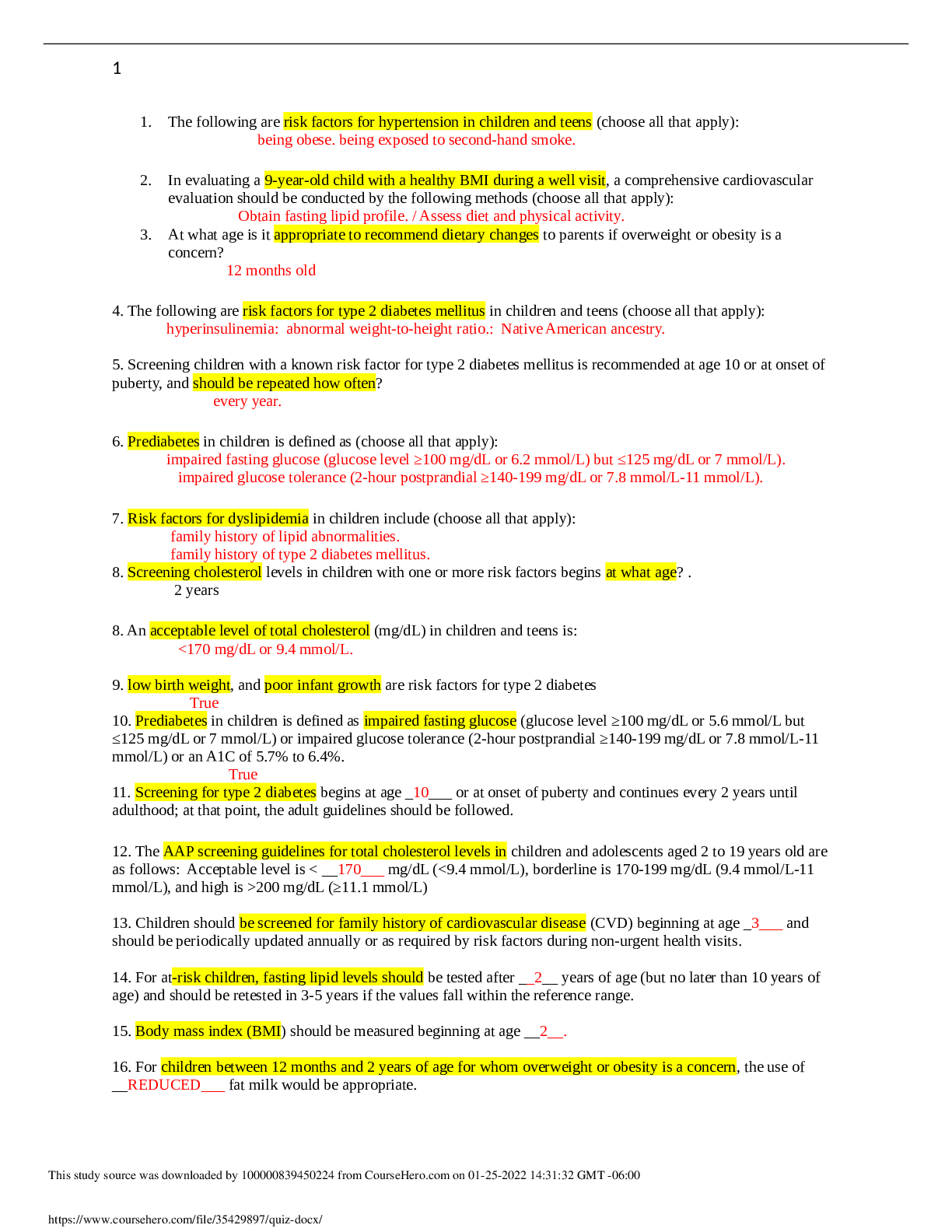
1. The following are risk factors for hypertension in children and teens (choose all that apply):
being obese. being exposed to second-hand smoke.
2. In evaluating a 9-year-old child with a healthy BMI during a well visit, a comprehensive cardiovascular
evaluation should be conducted by the following methods (choose all that apply):
Obtain fasting lipid profile. / Assess diet and physical activity.
3. At what age is it appropriate to recommend dietary changes to parents if overweight or obesity is a
concern?
12 months old
4. The following are risk factors for type 2 diabetes mellitus in children and teens (choose all that apply):
hyperinsulinemia: abnormal weight-to-height ratio.: Native American ancestry.
5. Screening children with a known risk factor for type 2 diabetes mellitus is recommended at age 10 or at onset of
puberty, and should be repeated how often?
every year.
6. Prediabetes in children is defined as (choose all that apply):
impaired fasting glucose (glucose level ≥100 mg/dL or 6.2 mmol/L) but ≤125 mg/dL or 7 mmol/L).
impaired glucose tolerance (2-hour postprandial ≥140-199 mg/dL or 7.8 mmol/L-11 mmol/L).
7. Risk factors for dyslipidemia in children include (choose all that apply):
family history of lipid abnormalities.
family history of type 2 diabetes mellitus.
8. Screening cholesterol levels in children with one or more risk factors begins at what age? .
2 years
8. An acceptable level of total cholesterol (mg/dL) in children and teens is:
<170 mg/dL or 9.4 mmol/L.
9. low birth weight, and poor infant growth are risk factors for type 2 diabetes
True
10. Prediabetes in children is defined as impaired fasting glucose (glucose level ≥100 mg/dL or 5.6 mmol/L but
≤125 mg/dL or 7 mmol/L) or impaired glucose tolerance (2-hour postprandial ≥140-199 mg/dL or 7.8 mmol/L-11
mmol/L) or an A1C of 5.7% to 6.4%.
True
11. Screening for type 2 diabetes begins at age _10 or at onset of puberty and continues every 2 years until
adulthood; at that point, the adult guidelines should be followed.
12. The AAP screening guidelines for total cholesterol levels in children and adolescents aged 2 to 19 years old are
as follows: Acceptable level is < 170 mg/dL (<9.4 mmol/L), borderline is 170-199 mg/dL (9.4 mmol/L-11
mmol/L), and high is >200 mg/dL (≥11.1 mmol/L)
13. Children should be screened for family history of cardiovascular disease (CVD) beginning at age _3 and
should be periodically updated annually or as required by risk factors during non-urgent health visits.
14. For at-risk children, fasting lipid levels should be tested after 2 years of age (but no later than 10 years of
age) and should be retested in 3-5 years if the values fall within the reference range.
15. Body mass index (BMI) should be measured beginning at age 2 .
16. For children between 12 months and 2 years of age for whom overweight or obesity is a concern, the use of
REDUCED fat milk would be appropriate.
2
This study source was downloaded by 100000817113117 from CourseHero.com on 09-14-2021 06:04:21 GMT -05:00
https://www.coursehero.com/file/35429897/quiz-docx/
17. Beginning at age _5 if BMI is ≥ 85th percentile, intensify dietary and activity changes to the parent.
18. Infection with Corynebacterium diphtheriae usually causes:
Pseudomembranous pharyngitis
19. The tetanus infection is caused by CLOSTRIDIUM TETANI , an anaerobic, gram-positive, sporeforming rod. This organism is found in soil and is particularly potent in manure.
20. Sources of lead that can contribute to plumbism include select traditional remedies such as azarcon and greta.
True
21. Patients with plumbism present with which kind of anemia?
Microcytic, hypochromic
22. Intervention for a child with a lead level of 5 to 44 mcg/dL usually includes all of the following except:
Chelation therapy
23. Ingested lead inactivates heme synthesis by inhibiting the insertion of iron into the protoporphyrin ring. This
leads to the development of what kind of anemia?
microcytic, hypochromic
24. Basophilic stippling is often noted on red blood cell morphology in lead poisoning.
25. Lead is significantly toxic to the solid organs, bones, and nervous system
26. Long-term complications of LEAD poisoning include behavior or attention problems, poor academic
performance, hearing problems, kidney damage, reduced IQ, and slowed body growth.
27. Unless deleading procedures have been performed, however, most homes built before 1957 contain lead-based
paint.
28. A diet low in calcium, iron, zinc, magnesium, and copper and high in fat, which is a typical diet for children
living in poverty , enhances oral lead absorption
29. In older homes, the point of greatest risk is the __window because their sills and the putty have high lead
concentration. Because toddlers (age 2 to 3) are the ideal height to reach them and are often drawn to open ones,
they are at greatest risk and summer is the riskiest season.
window
30. Symptoms of elevated LEAD levels include abdominal pain and cramping, aggressive behavior, anemia,
constipation, difficulty sleeping, headaches, irritability, loss of previous developmental skills in young children, low
appetite and energy, and reduced sensations. Very high levels can result in vomiting, staggering walk, muscle
weakness, seizures, or coma.
31. A measure of 5 mcg/dL is now used to identify children with elevated blood lead levels.
32. Most children with lead levels of 5-44 mcg/dL are treated with removal from the source, improved nutrition, and
IRON therapy.
33. Those with lead levels of 45-50 mcg/dL are treated with a CHELATION agent such as succimer, in
addition to the previously listed interventions.
34. For children with lead levels of greater than 51 mcg/dL, hospital admission with expert evaluation is likely the
most prudent course to avoid serious problems (including ENCEPHALOPATHY ) associated with markedly
elevated lead levels
35. Which of the following represents the best choice of clinical agents for a child who has had a history of
penicillin allergy who requires antimicrobial therapy?
Cefdinir
3
This study source was downloaded by 100000817113117 from CourseHero.com on 09-14-2021 06:04:21 GMT -05:00
https://www.coursehero.com/file/35429897/quiz-docx/
36. The clinical presentation of UTI in children can be without the classic symptoms such as frequency, dysuria, or
flank pain.
True
37. In younger children, UTI often manifests as IRRITABLITY_, LETHARGEY , and FEVER with
no obvious focal infectious source.
38. Older children with UTI often present with ABDOMINAL pain, unexplained fever, or both; as children
approach puberty, flank pain becomes more common
40. UTI should be considered in infants and young children 2 months to 2 years old with unexplained fever,
particularly in boys younger than 6 months and girls younger than 2 years who have a temperature greater than or
equal to 39°C (≥102.2°F).
[Show More]







![Preview of WEEK **5 [Chamberlain university]NR 602 IHUMAN Case Week #5 Deborah Arnaudin 54 Year Old](https://browseimages.nyc3.digitaloceanspaces.com/paper-images/2026/03/31/zbQKePwt2026-03-31-11-4669cc328fcad96.png)