Bio-319 Midterm Study guide
Chapters 1-6
*If you go through each item on this study guide and read about it on in your text, you should
have an excellent study guide for the Midterm Exam. *
Chapter 1
Define Phytoc
...
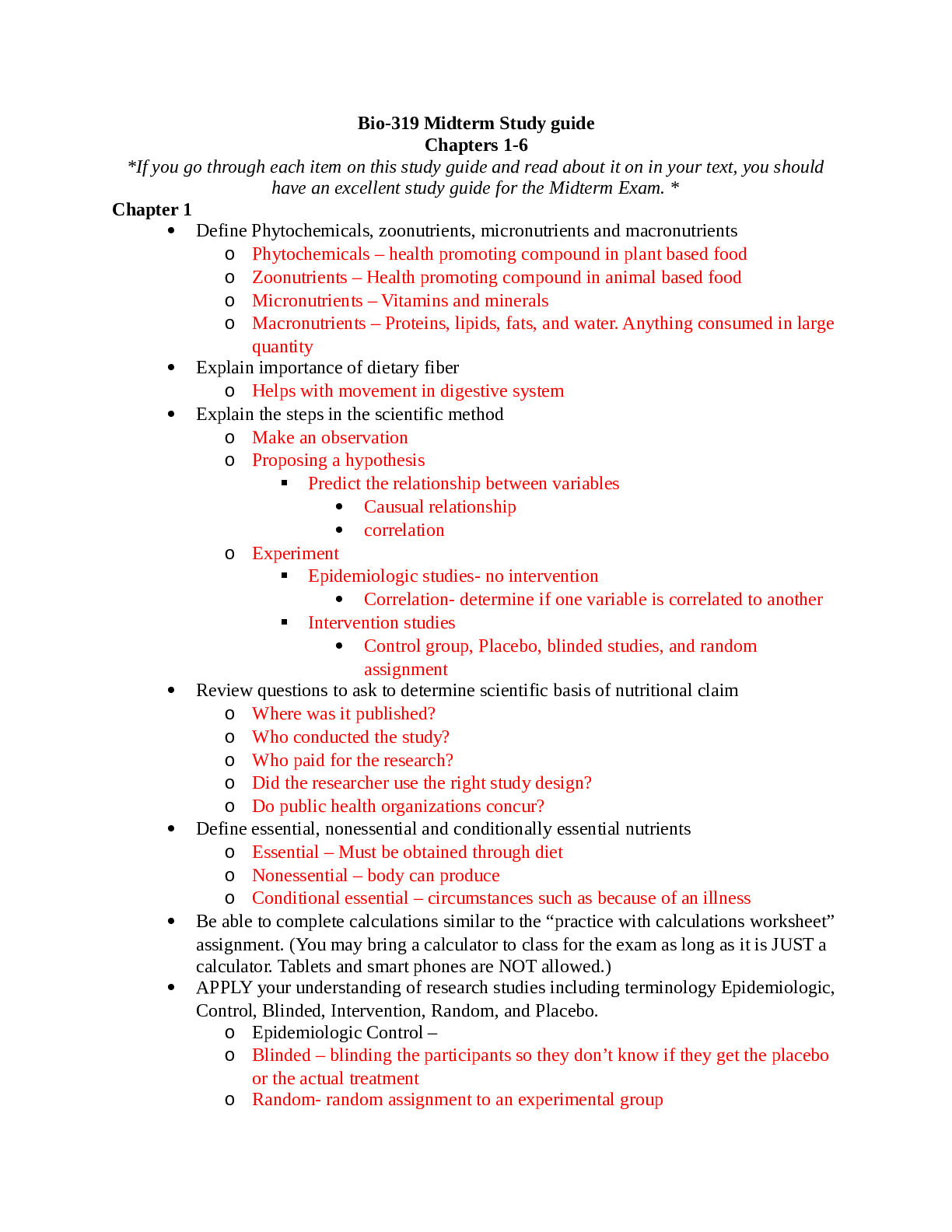
Bio-319 Midterm Study guide
Chapters 1-6
*If you go through each item on this study guide and read about it on in your text, you should
have an excellent study guide for the Midterm Exam. *
Chapter 1
Define Phytochemicals, zoonutrients, micronutrients and macronutrients
o Phytochemicals – health promoting compound in plant based food
o Zoonutrients – Health promoting compound in animal based food
o Micronutrients – Vitamins and minerals
o Macronutrients – Proteins, lipids, fats, and water. Anything consumed in large
quantity
Explain importance of dietary fiber
o Helps with movement in digestive system
Explain the steps in the scientific method
o Make an observation
o Proposing a hypothesis
Predict the relationship between variables
Causual relationship
correlation
o Experiment
Epidemiologic studies- no intervention
Correlation- determine if one variable is correlated to another
Intervention studies
Control group, Placebo, blinded studies, and random
assignment
Review questions to ask to determine scientific basis of nutritional claim
o Where was it published?
o Who conducted the study?
o Who paid for the research?
o Did the researcher use the right study design?
o Do public health organizations concur?
Define essential, nonessential and conditionally essential nutrients
o Essential – Must be obtained through diet
o Nonessential – body can produce
o Conditional essential – circumstances such as because of an illness
Be able to complete calculations similar to the “practice with calculations worksheet”
assignment. (You may bring a calculator to class for the exam as long as it is JUST a
calculator. Tablets and smart phones are NOT allowed.)
APPLY your understanding of research studies including terminology Epidemiologic,
Control, Blinded, Intervention, Random, and Placebo.
o Epidemiologic Control –
o Blinded – blinding the participants so they don’t know if they get the placebo
or the actual treatment
o Random- random assignment to an experimental group
( Control vs. treatment)
o Placebo – not the actual treatment … usually a fake treatment
Know current trends in Infant Mortality Rates and Life Expectancy in the United
States.
o Infant mortality rates have decreased and life expectancy has increased
DEFINE and APPLY characteristics of Chronic Degenerative Diseases.
o Chronic Degenerative Diseases: a non infectious disease that develops slowly,
persists over a long period of time, and tends to result in progressive
breakdown of tissues and loss of function
Leading cause of death
Risk factors
Tobacco use, physical activity, dietary habits
Causes
DNA, what is put in your body, what a person is exposed to ,
and physical activity
Chapter 2
Describe the tools for assessment of nutritional status
o ABCD methods of nutritional assessment
Anthropometric measurement
Physical dimensions and composition
Biochemical measurement
Lab analysis of biological samle
Clinical assessment
Medical history
Dietary assessment
Diet record or food record
Define Malnutrition, Overnutrition, and Undernutrition.
o Undernutrition
Inadequte intake of nutrient or energy
o Overnutrition
Nutritional toxicity
o Malnutrition
Nutritional status
Inadequate diet
Define Dietary Reference Intakes (DRI).
o a set of four dietary assessment stan-dards used to assess and plan dietary
intake. The four reference values that comprise the DRIs are:
Define Recommended Dietary Allowance (RDA).
o RDA: Recommended Dietary Allowances
Meets 97% healthy individuals needs
Not available for all nutrients
DEFINE and APPLY Primary and Secondary Malnutrition.
o Primary Malnutrition
A condition by which poor nutritional status is caused strictly by
inadequate diet.
o Secondary
A condition by which poor nutritional status is caused by factors other
than diet, such as illness.
Define nutrient density
o The ratio of amount of nutrients a food gives to its calories
APPLY recommendations (EAR, RDA, AI, and UL) to recommend corrective actions
when a client is outside of these limits.
KNOW the recommended AMDR percentages, and based on a specific EER, be able
to CALCULATE the appropriate amount of carbs, proteins, and fats of a person’s
diet.
o Carbohydrates
o 45 to 65 % total energy
o Proteins
o 10 to 35 %total energy
o Fats
o 20 to 35 %total energy
o Take the percentage and multiply it by the EER
Know the 2010 Dietary Guidelines for Americans and their suggestions for balancing
calories and managing weight.
o Balancing calories to manage weight
o Foods and food components to reduce
o Foods and nutrients increase
o Build healthy patterns
APPLY principles of best practices when tracking food intake with programs
associated with your text or the government MyPlate website.
Know the requirements found on a Nutrition Facts panel
o Food serving size
o Amount of iron
o Total calories
o Total carbs
o Sugar
o Protein
o Total fat
o Cholesterol
o sodium
Chapter 3
Define Digestion.
o The physical and chemical breakdown of food that allows the nutrients to be
absorbed
Identify the organs of the digestive system and the accessory organs of the digestive
system
o Organs
Mouth, Esophagus, Stomach, Small intestine, Large intestine
o Accessory organ
Salivary Glands, Liver, Pancreas, Gallbladder
Describe the functions of the accessory organs of the digestive system
o Salivary Glands: Aids in chemical digestion by releasing a mixture of water,
mucus, and enzymes
o Liver: produces bile which is important for lipid digestion
o Pancreas: releases pancreatic juice that neutralizes chime and contains
enzymes needed for carbohydrate, protein, and lipid digestion
o Gallbladder: stores and releases bile
Describe the molecular formula
o Represents the number and types of atoms present in a molecule
2+ atoms joined by a chemical bond
Understand the advantage of bacteria in the large intestine.
Compare and Contrast Simple and Facilitated Diffusion.
o Simple
Substance moves from higher concentration to a lower concentration
without the use of energy or assistance of a transport protein
o Facilitated
Substance moves from a higher concentration to a lower concentration
with the use of energy and assistance of a carrier molecule
Know the Definition and Cause and treatment of Gastroesophageal Reflux Disease
(GERD).
o A condition caused by chronic reflux of the stomach content into the
esophagus, irritating the lining
o Can be treated by changing lifestyle by avoiding large meals and certain types
of food
Define Nutrient Absorption and factors affecting bioavailability.
o Nutrient Absorption
o Bioavailability
The extent to which a nutrient is absorbed into the blood or lymphatic
system
For example vitamin C can enhance the absorption of certain
irons
Describe prebiotic and probiotic foods
[Show More]
.png)