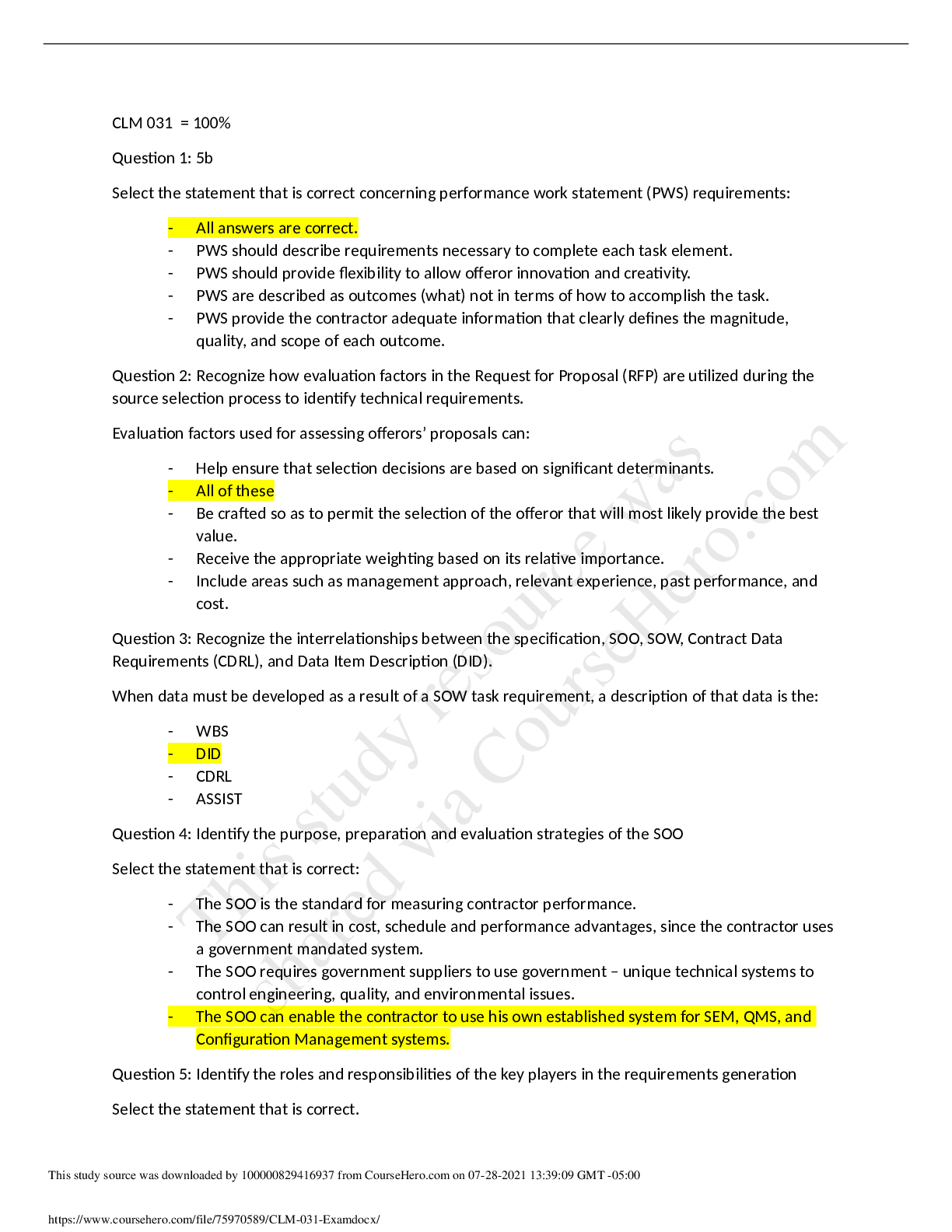
1. All of the following are true about the nursing code of ethics except:
Provides specific answers to many ethical dilemmas
2. The nurse is assigned to see a home-bound client on a daily basis to prepare the client’s
...
1. All of the following are true about the nursing code of ethics except:
Provides specific answers to many ethical dilemmas
2. The nurse is assigned to see a home-bound client on a daily basis to prepare the client’s medications.
The nurse fails to visit the client and does not request that another nurse visit the client. The client is
later admitted to the hospital after taking the wrong dosage of medication. Which ethical concept does
this situation reflect?
Abandonment
3. A client is held down by the nurse and forced to have a nasogastric tube placed. Which of the
following could this represent?
Battery
4. When applying the nursing process, which of the following should always be addressed first?
Assessment
5. How can most living organisms be classified in general systems theory?
Open systems
6. Which of the following are the steps to the nursing process? select all that apply
Planning
Implementation
Diagnosis
Evaluation
Assess
7. What type of tort may occur if a client is not allowed to leave the hospital after receiving emergency
care until the bill is paid?
False imprisonment
8. Which of the following is the bestsubstitute for self-determination if an individual is no longer
competent to make their own health care decisions?
Advance directive
9. Does clinical reasoning and judgment require various ways of thinking in the role of a nurse?
True
10. A client complains of hip pain and requests pain medication. For the nurse to apply the nursing
process, what would the nurse do next?
Assess the hip and ask the client about their pain
11. The client’s short term outcome was to walk in the hallway by the end of the day. The nurse reviews
the client outcome, determines that it was not met, and modifies the interventions. Which phase of the
nursing process is this?
Evaluation
12. Which of the following phases of the nursing process determines client problems, risks, and
strengths?
Diagnosis
13. What is another term that can be used for professional negligence?
Malpractice
14. An example of invasion of privacy would be:
Discussing Mrs. Green’s surgery in the hospital cafeteria
15. The client must have a treatment requiring an informed consent. Whose role is it to review the proposed
treatment and its associated risks with the client?
Physician
16. Team building, nurse retention, and patient satisfaction are all benefits of being sensitive to personality
types.
True
17. Why is it important for nurses to understand and use a nursing theory or model in practice?
Using models or theories of nursing aids practitioners in providing their care in an organized manner.
18. Which of the following theorists authored the Model of Goal Attainment?
Imogene King
19. A client suffered a ruptured appendix and had to have an open appendectomy. She is post-op day 1. She is
able to perform many of her activities of daily living independently, such as wash her face, brush her teeth, feed
herself, and reposition. However, she requires assistance to care for her indwelling urinary catheter, JacksonPratt drain, and change her dressing. Which of the following describes the level of care the nurse provides
according to Orem’s self-care model?
Partially compensated care
20. What are the primary ethical issues involved in genetic research?
Violations of confidentiality and informed consent
21. Which of the following would not be appropriate to chart?
The nurse thinks the patient is rude
22. Identify the four concepts that are common in most nursing theories.
Client, health, environment, nursing
23. You are teaching a group of senior citizens about the importance of getting their influenza and pneumonia
vaccines. What type of intervention are you providing based on Neuman’s Health Care Systems Model?
Primary
24. Upon what ethical principle do supporters of assisted suicide base their support for the practice?
Self-determination which includes the decision to end one’s life
25. Which of the following does not describe critical thinking in nursing?
Avoids the use of intuition and creativity
26. Which professional nursing organization wrote the Code of Ethics for Nurses?
American Nurses Association
27. This theorist states that even though you may be a novice now, with a solid educational base and many
patient care experiences over time, you will one day become an expert.
[Show More]
 (1).png)