EMT-B Final Exam Study Set Already
Scored A+
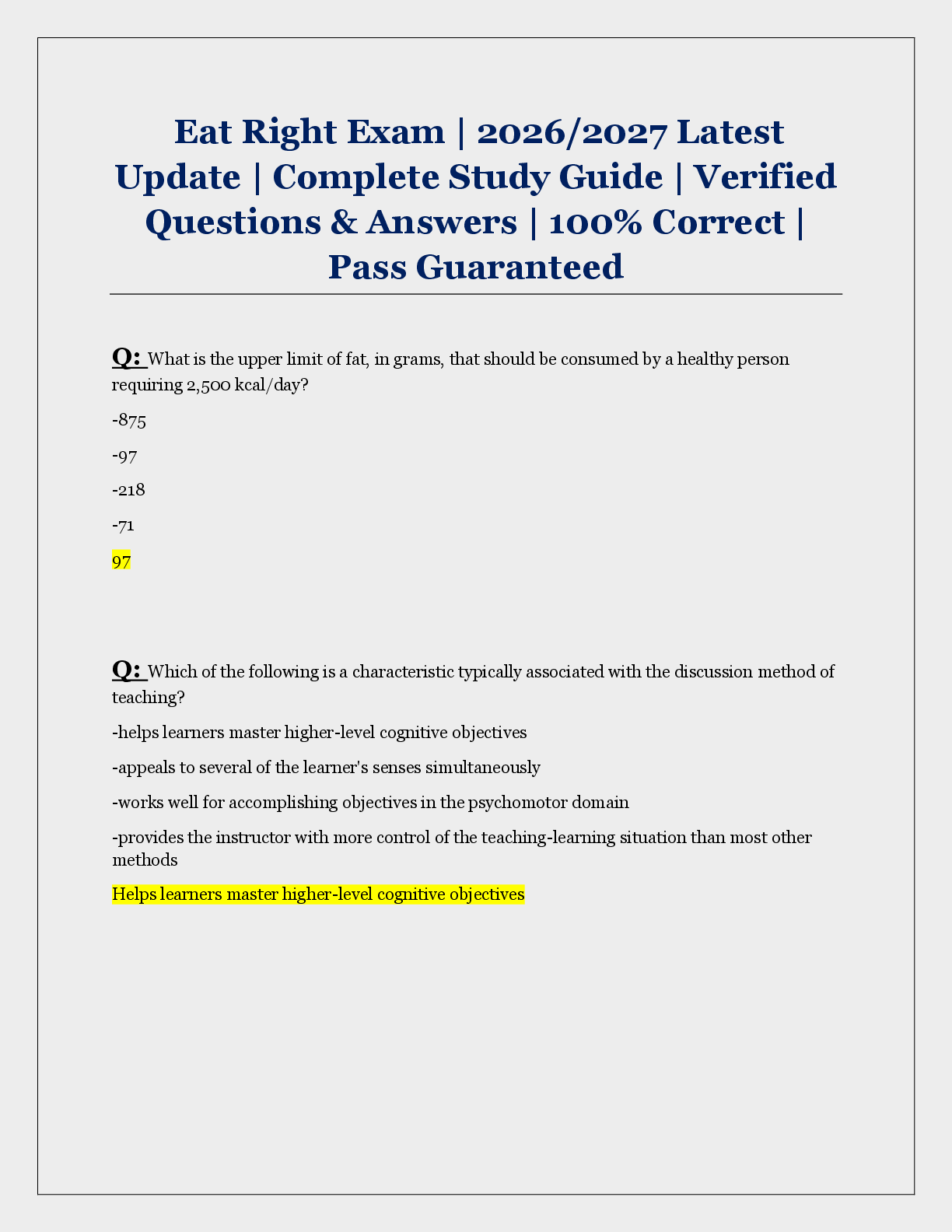
C. National Highway Transportation Safety Administration (NHTSA). Correct Answer-Most EMT training
programs are based on standards developed by the:
A. American Red Cross
...
EMT-B Final Exam Study Set Already
Scored A+
C. National Highway Transportation Safety Administration (NHTSA). Correct Answer-Most EMT training
programs are based on standards developed by the:
A. American Red Cross (ARC).
B. American Heart Association (AHA).
C. National Highway Transportation Safety Administration (NHTSA).
D. National Institutes of Health (NIH).
D. being pleasant, cooperative, and sincere, and a good listener. Correct Answer-An EMT can inspire
patient confidence and cooperation by:
A. transporting the patient from the scene to a hospital.
B. providing patient care without regard for her own personal safety.
C. telling the patient that everything will be all right.
D. being pleasant, cooperative, and sincere, and a good listener.
C. negligence. Correct Answer-If an on-duty EMT fails to provide the standard of care and if this failure
causes harm or injury to the patient, the EMT may be accused of:
A. assault.
B. abandonment.
C. negligence.
D. breach of promise.
D. informed Correct Answer-You are treating a conscious and mentally competent adult patient who
wants to refuse your care and transport to the hospital. This refusal must be _____ and documented.
A. implied
B. actual
C. involuntaryD. informed
B. implied Correct Answer-The EMT is authorized to treat and transport an unconscious patient because
of the legal consideration known as _____ consent.
A. applied
B. implied
C. triage
D. immunity
D. meaningless. Correct Answer-A child falls of a trampoline at an elementary school and twists her
ankle. Because the parents are not present, the child's consent is
A. not needed.
B. actual.
C. implied.
D. meaningless.
C. Good Samaritan laws Correct Answer-In some states, _____ help protect the off-duty EMT from
lawsuits when stopping at the scene of a collision to offer assistance.
A. professional associations
B. blanket insurance policies
C. Good Samaritan laws
D. abandonment laws
A. entering hazmat scenes with SCBA. Correct Answer-Each of the following is the responsiblity of an
EMT at a hazardous-materials (hazmat) incident except:
A. entering hazmat scenes with SCBA.
B. protecting yourself and others.
C. recognizing potential problems.
D. notifying the hazardous-materials response team.B. Standard Precautions. Correct Answer-The form of infection control that assumes that all body fluids
should be considered potentially infectious is:
A. infectious disease.
B. Standard Precautions.
C. immunity.
D. universal precautions.
D. the distance the patient needs to be carried. Correct Answer-When planning to lift a patient, all of the
following are important considerations for the EMT except:
A. the weight of the patient.
B. one's physical characteristics.
C. communicating with one's partner.
D. the distance the patient needs to be carried.
C. use the leg muscles to do the lift. Correct Answer-When lifting an injured patient, the EMT should:
A. keep the back loose and knees locked.
B. twist or attempt to make moves other than the lift.
C. use the leg muscles to do the lift.
D. try not to talk to her or his partner.
C. use a stair chair whenever possible. Correct Answer-You are treating a 45-year-old male who twisted
his ankle in the upstairs bathroom. To carry this patient on the stairs, you should:
A. keep the stretcher as level as possible.
B. use a long backboard at all times.
C. use a stair chair whenever possible.
D. do all of these.
C. keep arms straight when pulling. Correct Answer-Ways an EMT can avoid a potential back injury
include all of the following except:
A. push, rather than pull, a load.B. keep the back locked in while lifting.
C. keep arms straight when pulling.
D. push or pull from a kneeling position if the weight is below waist level.
D. the patient is unconscious. Correct Answer-An emergency move is required in each of the following
situations except when:
A. the scene is hazardous.
B. care of life-threatening conditions requires repositioning.
C. other patients who have life threats must be reached.
D. the patient is unconscious.
A. A spinal injury may be aggravated. Correct Answer-Which of the following is the greatest danger to
the patient in an emergency move?
A. A spinal injury may be aggravated.
B. Bleeding may increase after movement.
C. The airway may become obstructed.
D. There is no danger associated with an emergency move.
B. extremity lift. Correct Answer-A method of lifting and carrying a patient in which one EMT slips hands
under the patient's armpits and grasps the wrists while another EMT grasps the patient's knees is called
the:
A. direct ground lift.
B. extremity lift.
C. draw-sheet method.
D. direct carry method.
B. modified draw-sheet method. Correct Answer-Your patient is a medical patient with a suspected drug
overdose. He is lying supine on your stretcher, and you have been maintaining his airway. When moving
him from the ambulance stretcher to the hospital stretcher, you will probably use the:
A. crade carry.
B. modified draw-sheet method.C. direct ground lift.
D. extremity lift.
A. opposite sides Correct Answer-To load the wheeled ambulance stretcher into the ambulance, the two
EMTs should position themselves on _____ of the stretcher.
A. opposite sides
B. opposide ends
C. the same side
D. one end and one side
B. extremity lift. Correct Answer-You are treating a 28-year-old conscious diabetic who has an altered
level of consciousness. She is lying on the floor at the moment. To move her from the floor to a stair
chair, use the:
A. indirect carry.
B. extremity lift.
C. slide transfer.
D. chair lift.
A. do not protect the patient's neck and spine. Correct Answer-Drags are used only in emergencies
because they:
A. do not protect the patient's neck and spine.
B. require excessive energy from the EMT.
C. may injure the EMT's back.
D. provide full immobilization.
B. an even number of Correct Answer-To maintain balance when lifting a patient-carrying device, it is
best to use _____ rescuers to carry the device.
A. three
B. an even number of
C. an odd number ofD. bystanders and
B. make an urgent move. Correct Answer-You are treating the driver of a vehicle involved in a collision.
He is a 22-year-old male who requires immediate airway and bleeding control. You are unable to
provide this treatment in the vehicle. You should:
A. check the patient's vital signs.
B. make an urgent move.
C. remove the patient on a short backboard.
D. do all of these.
D. Piggyback Correct Answer-Your patient is an unconscious adult female stroke patient. Which carry is
considered very difficult to use with an unconscious person?
A. Cradle
B. Three-rescuer
C. Shoulder
D. Piggyback
C. firefighter's Correct Answer-The _____ carry must be performed in one unbroken sweep.
A. pack strap
B. front piggyback
C. firefighter's
D. four-rescue
C. flexible Correct Answer-A canvas or rubberized stretcher that can be used to move a patient through
a narrow hallway or restricted are is called a _____ stretcher.
A. basket
B. portable
C. flexible
D. wheeled-ambulanceB. clothes drag. Correct Answer-A patient with obvious spinal injuries is found on the floor of a burning
building. The EMT rates the situation hazardous but not yet dire. Alone and without special equipment,
the EMT should use the:
A. cradle carry.
B. clothes drag.
C. firefighter's carry.
D. pack-strap method.
C. wheeled ambulance Correct Answer-The patient-carrying device of choice for the 20-year-old male
who is dizzy by not injured is the _____ stretcher.
A. portable ambulance
B. wire basket
C. wheeled ambulance
D. slat
D. All of these are reasons to serve as an advocate. Correct Answer-If you are an EMT with a service that
does not provide the appropriate personal protective equipment, why should you serve as an advocate
for this equipment?
A. Your crew members could be injured unneccessarily.
B. You could be seriously injured.
C. An injured EMT is of little help to the patient.
D. All of these are reasons to serve as an advocate.
A. retreat to a safe area. Correct Answer-During an EMT call, a lethal threat is made by the 24-year-old
intoxicated male. The EMT should first:
A. retreat to a safe area.
B. radio for assistance.
C. reevaluate the situation.
D. remedy the situation.B. Eustress Correct Answer-Of the different types of stress, which is a positive form that helps the EMT
work under pressure and respond effectively?
A. Eumulative stress
B. Eustress
C. Distress
D. Critical incident stress
C. enter the neighborhood. Correct Answer-When responding to a violent situation, observation beings
when you:
A. enter the scene.
B. exit the ambulance.
C. enter the neighborhood.
D. arrive at the patient's side.
B. carry a portable radio. Correct Answer-To ensure crew safety, one member of the crew should
always:
A. remain in the ambulance.
B. carry a portable radio.
C. wear a bulletproof vest.
D. carry a canister of pepper gas.
B. quickly control the bleeding; then have the dog locked in another room. Correct Answer-While you
are treating a patient with a severely bleeding forearm, the patient's pet dog appears. The patient
states, "He won't hurt you. He's very friendly." Your best course of action would be to:
A. have your partner observe the dog closely while you treat the patient.
B. quickly control the bleeding; then have the dog locked in another room.
C. ignore the dog because the patient assures you it is friendly and will not harm you.
D. do all of these.
C. treat life-threatening problems and transport. Correct Answer-If a patient refuses care and then
becomes unconscious, it is best for the EMT to:A. refuse to treat or transport the patient.
B. ask a family member for permission to treat.
C. treat life-threatening problems and transport.
D. contact medical direction for advice.
B. the patient's expressed wishes may be followed. Correct Answer-An advantage of the advance
directive is that:
A. the patient is not involved in making a secision about her treatment.
B. the patient's expressed wishes may be followed.
C. no matter what the family says, CPR is not given.
D. it protects the EMT from charges of negligence.
C. not a reason to withhold medical care. Correct Answer-In most cases, the oral wishes of the patient's
family to withhold care are:
A. all that is needed to stop CPR from being initiated.
B. all that is needed to stop CPR once it is initiated.
C. not a reason to withhold medical care.
D. not sufficient unless they are given in writing.
D. do all of these. Correct Answer-Some EMTs participate in activities that attract legal actions, while
most EMTs are rarely involved in legal entanglements. You can prevent most lawsuits if you:
A. provide care within the scope of your practice.
B. properly document your care.
C. are courteous and respectful to all your patients.
D. do all of these.
D. health insurance costs. Correct Answer-The negligent EMT may be required to pay for all of the
following except the patient's:
A. lost wages.
B. medical expenses.C. pain and suffering
D. health insurance costs.
D. It regulates body temperature. Correct Answer-Which of the following is not a function of the
musculoskeletal system?
A. It gives the body shape.
B. It protects the internal organs.
C. It provides for body movement.
D. It regulates body temperature.
C. manubrium. Correct Answer-The superior portion of the sternum is called the:
A. xiphoid process.
B. sternal body.
C. manubrium.
D. clavicle.
B. medial malleolus. Correct Answer-A young girl fell while ice skating and injured the protrusion on the
inside of the ankle. The medical term for this location is the:
A. acromion.
B. medial malleolus.
C. lateral malleolus.
D. calcaneus.
B. automaticity Correct Answer-The heart muscle has property called _____. This means that the heart
has the ability to generate and conduct electrical impulses on its own.
A. contractibility
B. automaticity
C. involuntary contraction
D. conductibilityA. autonomic Correct Answer-A division of the peripheral nervous system that controls involuntary
motor functions is called the _____ nervous system.
A. autonomic
B. central
C. sensory
D. motor
B. the observer. Correct Answer-When in the anatomical position, a person is facing:
A. away from you.
B. the observer.
C. face down.
D. face up.
A. forward. Correct Answer-In the anatomical position, the person's palms will be facing:
A. forward.
B. backward.
C. upward.
D. downward.
D. plantar. Correct Answer-An anatomical term that is occasionally used to refer to the sole of the foot
is:
A. calcaneus.
B. ventral.
C. dorsal.
D. plantar.
C. zygomatic Correct Answer-The bones of the cheek are called the _____ bones.
A. orbit
B. maxillaeC. zygomatic
D. mandible
D. superior Correct Answer-The heart is _____ to the stomach.
A. distal
B. medial
C. proximal
D. superior
B. proximal; distal Correct Answer-When comparing body structure positions, the knees are said to be
_____ to the toes, and the toes are _____ to the knees.
A. inferior; superior
B. proximal; distal
C. distal; dorsal
D. anterior; posterior
C. supine Correct Answer-A patient found lying on her back is in the _____ position.
A. anatomical
B. prone
C. supine
D. lateral recumbent
C. four Correct Answer-To assist in describing the location of abdominal organs, we divide the abdomen
into _____ parts.
A. two
B. three
C. four
D. fiveA. thorax. Correct Answer-Your 18-year-old male patient has severe burns of the entire front (anterior)
surface of the torso. The torso of the body is composed of the abdomen, pelvis, and:
A. thorax.
B. upper arms and legs.
C. extremities.
D. head.
A. thoracic Correct Answer-The heart is located in the center of the _____ cavity.
A. thoracic
B. cranial
C. pelvic
D. cardiac
C. diaphragm. Correct Answer-The structure that divides the chest cavity from the abdominal cavity is
the:
A. meninges.
B. duodenum.
C. diaphragm.
D. spinal column.
C. patella. Correct Answer-The anatomical name for the kneecap is the:
A. ilium.
B. malleolus.
C. patella.
D. phalange.
C. top, back, and sides of the skull. Correct Answer-The cranium consists of the:
A. facial bones.
B. mandible and maxillae.C. top, back, and sides of the skull.
D. zygomatic bones.
A. acromion process. Correct Answer-The highest point in the shoulder is the:
A. acromion process.
B. humerus.
C. metatarsal.
D. clavicle.
C. Good Samaritan Correct Answer-At the scene of a collision, an off-duty EMT provides care to the
patient, acting in good faith and to the best of her abilities. In many states, this EMT is protected from
care-related lawsuits by _____ laws.
A. applied consent
B. total immunity
C. Good Samaritan
D. jeopardy
B. consider consent for care to be implied and begin care. Correct Answer-When confronted with an
unconscious minor without parents or a legal guardian present, the EMT should:
A. seek a physician's approval before beginning care.
B. consider consent for care to be implied and begin care.
C. ask the child for consent and begin care.
D. consider consent to be applied and begin care.
C. The EMT had a local duty. Correct Answer-The legal concept of negligence requires that three
circumstances must me demonstrated. Which of the following is not one of the three circumstances?
A. The EMT had a duty to act.
B. The EMT committed a breach of duty.
C. The EMT had a local duty.
D. The breach of duty caused harm.B. prone Correct Answer-A person lying on his stomach with his face down is in the _____ position.
A. supine
B. prone
C. coma
D. recovery
C. denial, anger, bargaining, depression, acceptance. Correct Answer-As an EMT, you have been
assigned to take a terminally ill patient back and forth to chemotherapy multiple times a week for the
next few weeks. You realize that the patient has been going through emotional stages in the following
order:
A. depression, bargaining, denial, acceptance, anger.
B. acceptance, rage, depression, acceptance, bargaining.
C. denial, anger, bargaining, depression, acceptance.
D. bargaining, acceptance, denial, anger, depression.
B. National Registry of Emergency Medical Technicians Correct Answer-In 1970, the _____ was founded
to establish professional standards for EMS personnel.
A. American Medical Association
B. National Registry of Emergency Medical Technicians
C. National Highway Traffic Safety Administration
D. U.S. Department of Transportation
D. ambulance. Correct Answer-Safe, reliable transportation is a critical component of an EMS system.
Most patients can be transported effectively by:
A. airplane.
B. helicopter.
C. rescue vehicle.
D. ambulance.B. EMT-Intermediate Correct Answer-An _____ is a national-level EMT who has been trained to start IVs,
perform advanced airway techniques, and administer some medicines beyond the EMT.
A. EMT-First Responder
B. EMT-Intermediate
C. EMT-Critical Care
D. EMT-Paramedic
B. quality improvement. Correct Answer-A continuous self-review with the purpose of identifying and
correcting aspects of the EMS system that require improvement is called:
A. standing orders.
B. quality improvement.
C. protocols.
D. medical direction.
B. Medical Director. Correct Answer-A physician who assumes the ultimate responsibility for the patientcare aspects of the EMS system is called the:
A. Designated Agent.
B. Medical Director.
C. Off-line Director.
D. Primary Care Physician.
A. patients who refuse care. Correct Answer-Situations that are higher risks of a lawsuit against an EMS
agency are:
A. patients who refuse care.
B. on-scene deaths.
C. cardiac arrest cases.
D. pedestrians struck by cars.
D. scope of practice. Correct Answer-The legal extent or limits of the EMT's job are formally defined by
the:A. patient.
B. DOT curriculum.
C. state.
D. scope of practice.
A. Decisiveness Correct Answer-Which is not generally considered a sign or symptom of stress?
A. Decisiveness
B. Guilt
C. Loss of interest in work
D. Difficulty sleeping
D. motor vehicle collisions. Correct Answer-All of the following are types of calls that have a high
potential for causing excessive stress except:
A. calls involving infants and children.
B. patients with severe injuries.
C. cases of abuse and neglect.
D. motor vehicle collisions.
B. increased consumption of fatty foods. Correct Answer-Lifestyle changes that can help the EMT deal
with stress include all of the following except:
A. exercise to burn off tension.
B. increased consumption of fatty foods.
C. decreased consumption of caffeine.
D. decreased consumption of alcohol.
A. requesting a change of shift or location. Correct Answer-Changes in your professional life to reduce
and prevent stress can include:
A. requesting a change of shift or location.
B. taking on another part-time position.
C. working additional overtime shifts.D. requesting a busier location.
D. protect the body from the environment, bacteria, and other organisms. Correct Answer-One of the
functions of the integumentary system is to:
A. regulate the diameter of the blood vessels in the circulation.
B. eliminate excess oxygen into the atmosphere.
C. allow environmental water to carefully enter the body.
D. protect the body from the environment, bacteria, and other organisms.
C. normal and to be expected. Correct Answer-Stress after a major EMS incident is:
A. unusual and expected.
B. a sign of weakness.
C. normal and to be expected.
D. part of the grieving process.
B. depression. Correct Answer-Retreating to a world of one's own after hearing one is going to die is a
result of the stage of grief called:
A. bargaining.
B. depression.
C. denial.
D. anxiety.
B. anaerobic metabolism. Correct Answer-When a patient's lower extremities are trapped under a farm
tractor, the blood supply is diminished to the cells in the legs. This injury can result in:
A. no lactic acids being produced.
B. anaerobic metabolism.
C. no carbon dioxide being produced.
D. none of these.C. bloodborne Correct Answer-A disease that is spread by exposure to an open wound or sore of an
infected individual is caused by a(n) _____ pathogen.
A. universal
B. airborne
C. bloodborne
D. infectious
D. hepatits. Correct Answer-An infection that causes inflammation of the liver is called:
A. meningitis.
B. tuberculosis.
C. typhoid.
D. hepatitis.
C. airborne. Correct Answer-A disease spread by inhaling or absorbing droplets from the air through the
eyes, nose, or mouth is considered:
A. bloodborne.
B. noncommunicable.
C. airborne.
D. viral.
D. hepatitis B virus. Correct Answer-The communicable disease that kills the most health workers every
year in the United States is:
A. tuberculosis.
B. HIV/AIDS.
C. meningitis.
D. hepatitis B virus.
B. productive cough has TB. Correct Answer-Always assume that any patient with a:
A. cold has a bloodborne disease.
B. productive cough has TB.C. fever has typhoid.
D. rash has measles.
D. It is an airborne pathogen. Correct Answer-Which of the following is not true about the human
immunodeficiency virus (HIV)?
A. It attacks the immune system.
B. It doesn't survive well outside the human body.
C. It can be introduced through puncture wounds.
D. It is an airborne pathogen.
C. 30 percent. Correct Answer-Your patient has hepatitis B. You are accidentally stuck with a needle that
has some of this patient's infected blood on it. Your chance of contracting the disease is about:
A. 10 percent.
B. 20 percent.
C. 30 percent.
D. 40 percent.
A. 0.5 percent. Correct Answer-Your patient has HIV. You are accidentally stuck with a needle that has
some infected blood on it. Your chance of contracting the disease is about:
A. 0.5 percent.
B. 5 percent.
C. 10 percent.
D. 15 percent.
C. HEPA or N-95 respirator. Correct Answer-If you think your patient has TB, you should wear the usual
personal protective equipment plus a:
A. surgeon's mask.
B. gown.
C. HEPA or N-95 respirator.
D. Tyvek suit.A. pocket mask with a one-way valve. Correct Answer-Instead of providing mouth-to-mouth ventilations
on the nonbreathing patient, the EMT, when acting alone, should use a(n):
A. pocket mask with a one-way valve.
B. one-way valve.
C. bag-valve mask.
D. endotracheal tube.
C. Hand washing after each patient contact Correct Answer-Which method of infection control reduces
exposure to yourself, your crew, and your next patient?
A. Wearing a HEPA or N-95 respirator
B. Taking universal precautions
C. Hand washing after each patient contact
D. None of these
B. the Ryan White CARE Act. Correct Answer-An act that establishes procedures through which
emergency response workers can find out if they have been exposed to life-threatening infectious
diseases is called:
A. OSHA 1910.1030.
B. the Ryan White CARE Act.
C. AIDS Protection Act.
D. OSHA 1910.120.
A. OSHA 1910.1030. Correct Answer-Each emergency response employer must develop a plan that
identifies and documents job classifications and tasks in which there is the possibility for expoure to
potentially infectious body fluids. This is required by:
A. OSHA 1910.1030.
B. the Ryan White CARE Act.
C. the AIDS Protection Act.
D. OSHA 1910.120.D. hepatitis B vaccination. Correct Answer-Every employer of EMTs must provide free of charge:
A. a yearly physical examination.
B. a life insurance policy.
C. universal health insurance.
D. hepatitis B vaccination.
D. all of these. Correct Answer-Engineering controls that prevent the spread of bloodborne diseases
include:
A. pocket masks.
B. needle containers.
C. disposable airway equipment.
D. all of these.
C. HEPA or N-95 respirator Correct Answer-Which of the following is not required by the OSHA
bloodborne pathogen standard?
A. Postexposure evaluation and follow-up
B. Personal protective equipment
C. HEPA or N-95 respirator
D. Housekeeping controls and labeling
B. Daycare centers Correct Answer-Which of the following is not considered a high-risk area for TB?
A. Correctional facilities
B. Daycare centers
C. Homeless shelters
D. Nursing homes
D. turn off your lights and siren. Correct Answer-As you near an emergency scene, you should:
A. sound your siren to broadcast your arrival.
B. go straight to the front door.C. secure the scene as quickly as possible.
D. turn off your lights and siren.
A. notify the police immediately. Correct Answer-If anyone at the scene is in possession of a weapon,
the EMT should:
A. notify the police immediately.
B. ask the person to give it to you.
C. ignore the person with the weapon.
D. advise the person to leave the scene.
A. respiratory failure. Correct Answer-The reduction of breathing to the point where oxygen intake is
not sufficient to support life is called:
A. respiratory failure.
B. anoxic metabolism.
C. respiratory arrest.
D. respiratory support.
C. blue or gray skin coloration. Correct Answer-Adequate signs of breathing include all of the following
except:
A. equal expansion of both sides of the chest.
B. air moving in and out of the nose.
C. blue or gray skin coloration.
D. present and equal breath sounds.
B. nasal flaring. Correct Answer-The widening of the nostrils of the nose with respirations is called:
A. hyperventilating.
B. nasal flaring.
C. nasal gurgling.
D. wheezing.B. cyanosis. Correct Answer-The condition in which a patient's skin or lips are blue or gray is called:
A. stridor.
B. cyanosis.
C. pallor.
D. anemia.
C. shortness of breath. Correct Answer-If a patient is unable to speak in full sentences, this could be a
sign of:
A. complete airway blockage.
B. snoring.
C. shortness of breath.
D. respiratory arrest.
B. inserting an endotracheal tube immediately. Correct Answer-The procedures by which lifethreatening respiratory problems are initially treated by the EMT include all of the following except:
A. opening and maintaining the airway.
B. inserting an endotracheal tube immediately.
C. providing supplemental oxygen to the breathing patient.
D. ensuring a clear airway with frequent suctioning.
A. the tongue. Correct Answer-You are assessing the airway of an unconscious male patient. You recall
that most airway problems are caused by:
A. the tongue.
B. asthma.
C. shock.
D. the epiglottis.
D. Jaw-thrust Correct Answer-You are treating a patient who fell down a flight of metal stairs. Which
maneuver is most appropriate for an unconscious patient found lying at the bottom of a stairwell?
A. Head-tilt, chin-liftB. Head-tilt, neck-lift
C. Jaw-pull lift
D. Jaw-thrust
B. one-rescuer bag-valve mask. Correct Answer-You are managing a 34-year-old male who you suspect
has had a narcotic overdose. His respirations are very slow and shallow, and you will need to assist
them. When choosing a means of ventilating a patient, your last choice would be:
A. flow-restricted, oxygen-powered ventilation device.
B. one-rescuer bag-valve mask.
C. two-rescuer bag-valve mask.
D. mouth-to-mask with high-flow supplemental oxygen.
C. rate of ventilation is too fast or too slow. Correct Answer-Artificial ventilation may be inadequate if
the:
A. chest rises with each ventilation.
B. heart rate returns to normal.
C. rate of ventilation is too fast or too slow.
D. skin becomes warm and dry.
A. 15/22 mm. Correct Answer-The standard respiratory fitting on a bag-valve mask that ensures a proper
fit with other respiratory equipment is:
A. 15/22 mm.
B. 10/14 mm.
C. 5/20 mm.
D. 20/26 mm.
D. a pop-off valve. Correct Answer-A bag-valve mask should have or be all of the following except:
A. a self-refilling shell.
B. a clear face mask.
C. easily cleared and sterilized.D. a pop-off valve.
C. 15 Correct Answer-The proper oxygen flow rate when ventilating a patient with a BVM is _____ liters
per minute.
A. 5
B. 10
C. 15
D. 20
B. sufficient to achieve visible chest rise. Correct Answer-According to the American Heart Association
guidelines, when ventilating a patient with a bag mask that has supplementary oxygen, the volume
administered should be:
A. 400 milliliters.
B. sufficient to achieve visible chest rise.
C. 800 milliliters.
D. as much as possible during the 1-second time frame.
C. clear any mucus or secretions obstructing the stoma. Correct Answer-The first step in providing
artificial ventilation of a stoma breather is to:
A. leave the head and neck in a neutral position.
B. ventilate at the appropriate rate for the patient's age.
C. clear any mucus or secretions obstructing the stoma.
D. establish a seal using a pediatric-sized mask.
A. an audible alarm when ventilation is activated. Correct Answer-A flow-restricted, oxygen-powered
ventilation device should have all of the following features except:
A. an audible alarm when ventilation is activated.
B. a trigger that enables the rescuer to use both hands.
C. a peak flow rate of up to 40 liters per minute.
D. a rugged design and construction.B. nasopharyngeal airway. Correct Answer-The two most common airway adjuncts for the EMT to use
are the oropharyngeal airway and the:
A. nasal cannula.
B. nasopharyngeal airway.
C. endotracheal tube.
D. Yankauer.
D. all unconscious patients with no gag reflex. Correct Answer-An oropharyngeal airway should be
inserted in:
A. all patients with inadequate breathing.
B. trauma patients with a gag reflex.
C. medical patients with a gag reflex.
D. all unconscious patients with no gag reflex.
C. never suction for longer than 15 seconds. Correct Answer-When suctioning a 19-year-old patient who
you suspect has bleeding into his throat, you should:
A. suction on the way in and the way out.
B. avoid using eyewear or a mask.
C. never suction for longer than 15 seconds.
D. hypoventilate prior to suctioning.
C. shock. Correct Answer-The emergency situation in which there is a failure of the cardiovascular
system to provide sufficient blood to all the vital tissues is called:
A. respiratory arrest.
B. respiratory failure.
C. shock.
D. cardiac arrest.
C. hypoxia. Correct Answer-An insufficiency in the supply of oxygen to the body's tissues is called:A. anoxia.
B. no-oxia.
C. hypoxia.
D. cyanosis.
A. 200 Correct Answer-Before the oxygen cylinder's pressure gauge reads a minimum of _____ psi, you
must switch to a fresh cylinder.
A. 200
B. 400
C. 800
D. 1,000
C. store reserve cylinders in a warm, humid room. Correct Answer-When handling oxygen cylinders, the
EMT should do all of the following except:
A. have the cylinders hydrostatically tested every 5 years.
B. ensure that valve seat inserts and gaskets are in good condition.
C. store reserve cylinders in a warm, humid room.
D. use medical-grade oxygen in all cylinders.
A. nonrebreather mask. Correct Answer-The best way to deliver high-concentration oxygen to a
breathing patient is to use a:
A. nonrebreather mask.
B. partial rebreather mask.
C. bag-valve mask.
D. nasal cannula.
B. 24; 44 Correct Answer-A nasal cannula provides between _____ percent and _____ percent oxygen
concentrations.
A. 10; 21
B. 24; 44C. 36; 58
D. 72; 96
B. leave them in unless they are loose. Correct Answer-You are assessing a 54-year-old woman who is
unconscious and has a noisy upper airway. If she has dentures, during airway procedures the EMT
should:
A. remove them right away.
B. leave them in unless they are loose.
C. remove the teeth one at a time.
D. hold them in place with a free hand.
A. the mouth and nose are smaller and more easily obstructed. Correct Answer-When managing the
airway of a child, an airway consideration you should remember is that:
A. the mouth and nose are smaller and more easily obstructed.
B. the chest wall is firmer in a child.
C. the trachea is wider and less easily obstructed.
D. all of these are airway considerations in a child.
A. respiratory arrest. Correct Answer-You are dealing with a patient who is in severe respiratory distress
from a life-threatening asthma attack. If breathing stops completely, the patient is in:
A. respiratory arrest.
B. ventilatory reduction.
C. artificial ventilation.
D. respiratory failure.
C. Flow-restricted, oxygen-powered ventilation device Correct Answer-Which ventilation device is
contraindicated in infants and children?
A. Bag-valve mask
B. Pediatric pocket mask
C. Flow-restricted, oxygen powered ventilation deviceD. Nonrebreather mask.
A. flowmeter. Correct Answer-A device that allows the control of oxygen in liters per minute is called a:
A. flowmeter.
B. G tank.
C. humidifier.
D. reservoir.
B. constant flow selector valve. Correct Answer-A type of flowmeter that has no gauge and allows for
the adjustment of flow in liters per minute and in stepped increments is called a:
A. Bourdon gauge flowmeter.
B. constant flow selector valve.
C. humidifier.
D. pressure compensated flowmeter.
A. Lack of humidity can dry out the patient's mucous membranes. Correct Answer-Why do some EMS
systems use humidified oxygen?
A. Lack of humidity can dry out the patient's mucous membranes.
B. It provides a reservoir for the oxygen.
C. It limits the risk of infection.
D. It is helpful when transporting patients short distances.
C. hypoxic drive. Correct Answer-A patient in the end stage of a respiratory disease may have switched
over to:
A. hyperventilation syndrome.
B. hyperbaric therapy.
C. hypoxic drive.
D. carbon dioxide drive.D. Chronic pulmonary disease Correct Answer-You are talking with a patient and he states that has has
had COPD for the past 10 years. What is COPD?
A. A type of shock
B. A type of ventilation
C. A mechanism of breathing
D. Chronic pulmonary disease
D. withdrawn; rigid Correct Answer-When using an air mattress, the patient is placed on the device and
the air is _____ by a pump. The mattress will then form a _____ and conforming surface around the
patient.
C. digestive Correct Answer-The body system that is responsible for the breakdown of food into
absorbable forms is called the _____ system.
A. urinary
B. nervous
C. digestive
D. integumentary
C. post-traumatic stress disorder. Correct Answer-A stress reaction that involves either physical or
psychological behavior manifested days or weeks after an incident is called a(n):
A. cumulative stress disorder.
B. burnout.
C. post-traumatic stress disorder.
D. acute stress reaction.
B. Health Insurance Portability and Accountability Act. Correct Answer-An agency privacy officer is
required by the:
A. Ryan White Law.
B. Health Insurance Portability and Accountability Act.
C. National Fire Protection Association Standards.
D. Privacy Control Act of 2002.D. 6,000 Correct Answer-When an adult patient is breathing at a respiratory rate of 12 times a minute,
you would expect that the minute volume would be approximately _____ mL per minute.
A. 3,000
B. 4,500
C. 5,000
D. 6,000
C. dehydration. Correct Answer-Your patient is a 45-year-old female who has been vomiting and has had
diarrhea for the past week. There is a danger that she may have a condition called:
A. extremity edema.
B. an excess of body fluid.
C. dehydration.
D. all of these.
A. Yes, he is probably very short of breath. Correct Answer-You question an elderly man sitting on a
bench in the park. He has a respiratory complaint, and he speaks in short, two or three word sentences.
Is this significant?
A. Yes, he is probably very short of breath.
B. No, elderly patients always talk slowly.
C. No, he is probably always like that.
D. Yes, he probably has a complete airway obstruction.
B. Because children in this age group are primarily nasal breathers. Correct Answer-Why can nasal
congestion be a major problem in the first few months of life?
A. Because the liver is so large in patients in this age group.
B. Because children in this age group are primarily nasal breathers.
C. Because it is an indication of life-threatening airway compromise.
D. Because children in this age group breathe with their diaphragm.B. sucking Correct Answer-When the mother strokes the infant's lips and the baby starts sucking, this is
a nervous system reflex known as the _____ reflex.
A. Moro
B. sucking
C. palmar
D. rooting
C. self-destructive behaviors. Correct Answer-The adolescent years are the beginning of:
A. better decision making skills.
B. nasal breathing.
C. self-destructive behaviors.
D. all of these.
D. Young adult Correct Answer-You are treating a patient who was involved in a serious accident. Based
on the leading causes of death, what age group is this patient most likely to be in?
A. Infant
B. School age
C. Adolescent
D. Young adult
D. Adolescent Correct Answer-Serious conflicts occur in families as the issues of control and
independence collide with children in which age group?
A. Toddler
B. Preschool
C. School age
D. Adolescent
B. 16. Correct Answer-Girls are usually finished growing by the age of:
A. 14.
B. 16.C. 18.
D. 20.
B. Yes, she is probably short of breath. Correct Answer-You are examining an elderly woman sitting on a
park bench. She is sitting forward with her elbows outward and speaking in short, choppy sentences. Is
this significant in her history?
A. No, she is probably always like that.
B. Yes, she is probably short of breath.
C. No, elderly patients like to sit forward like that.
D. Yes, she probably has a spine injury.
B. head-tilt, chin-lift Correct Answer-You have been called to a restaurant for a patient who collapsed at
the dinner table. According to a family members, she did not strike her head as she slid out of the chair
when she went unconscious. To open her airway, the EMT should use a _____ maneuver.
A. modified jaw-thrust
B. head-tilt, chin-lift
C. head-tilt, neck-lift
D. modified chin-lift
C. measured from the patient's nostril to the earlobe. Correct Answer-A nasopharyngeal airway should
be:
A. turned 180 degrees with the tip facing the roof of the mouth.
B. inserted with the bevel on the lateral side of the nostril.
C. measured from the patient's nostril to the earlobe.
D. inserted in the left nostril when possible.
C. inadequate breathing and is a precursor to respiratory arrest. Correct Answer-You are treating a
patient who initially had a chief complaint of severe difficulty breathing. You have concerns that this
may be leading to respiratory failure, which is:
A. cause by electrocution in young adults.
B. another term used to describe respiratory arrest.C. inadequate breathing and is a precursor to respiratory arrest.
D. the complete cessation of expiration.
D. air that can be felt at the nose or mouth on exhalation. Correct Answer-You are treating a patient
who initially had a chief complaint of severe difficulty breathing. You have concerns that this may be
leading to respiratory failure. The patient could have any of the following signs except:
A. absent or minimal chest movement.
B. noises such as wheezing, gurgling, stridor, or crowing.
C. diminished or absent breath sounds.
D. air that can be felt at the nose or mouth on exhalation.
B.12 to 20 per minute. Correct Answer-You are treating a patient who your partner states has a normal
breathing rate for an adult. The patient's breathing rate is most likely:
A. 6 to 10 per minute.
B. 12 to 20 per minute.
C. 15 to 30 per minute.
D. 25 to 50 per minute.
D. all of these are correct. Correct Answer-You are treating a patient who initially had a chief complaint
of severe difficulty breathing. You have concerns that this may be leading to respiratory failure. As you
assess and manage the patient, you decide she is either not breathing or her breathing is inadequate.
Thus, it will be necessary to provide:
A. artificial ventilation.
B. positive pressure ventilation.
C. assistance with a bag-valve mask device.
D. all of these are correct.
D. blood pressure. Correct Answer-During the primary assessment, all of the following are assessed
except:
A. airway.
B. mental status.C. circulation.
D. blood pressure.
B. Evaluating extremity mobility Correct Answer-Which is not a component of the primary assessment?
A. Determining patient priority
B. Evaluating extremity mobility
C. Forming a general impression
D. Assessing breathing
B. holding pieces of a toy in his or her hand. Correct Answer-When forming a general impression of a
child's condition, the environment can provide clues. An example would be a child:
A. complaining of nausea or vomiting.
B. holding pieces of a toy in his or her hand.
C. with a blood pressure of 120/80.
D. with a rapid heartbeat.
C. blood pressure. Correct Answer-When forming a general impression, the EMT takes into
consideration all of the following except the patient's:
A. position.
B. age and sex.
C. blood pressure.
D. sounds.
B. assessing mental status. Correct Answer-After forming a general impression, the next step of the
primary assessment is:
A. assessing breathing.
B. assessing mental status.
C. determining the priority of the patient.
D. assessing the airway.C. verbal. Correct Answer-The "V" in AVPU stands for:
A. virtual.
B. visible.
C. verbal.
D. vertex.
B. painful. Correct Answer-The "P" in AVPU stands for:
A. pulse.
B. painful.
C. paralysis.
D. parasthesia.
D. U. Correct Answer-The lowest and the most serious mental status is:
A. A.
B. V.
C. P.
D. U.
B. administer high-concentration oxygen. Correct Answer-If a patient's level of responsiveness is lower
than "Alert," you should:
A. apply a cervical collar.
B. administer a high-concentration oxygen.
C. place him or her in a recovery position.
D. bandage all bleeding wounds.
C. has an open airway. Correct Answer-If a patient is talking or crying, assume that the patient:
A. is in little pain.
B. has no life-threatening bleeding.
C. has an open airway.D. has an "A" mental status.
C. assist ventilations with a bag-valve mask. Correct Answer-If the patient is not alert and her breathing
rate is slower than 8 breaths per minute, the EMT should:
A. insert an oral airway.
B. place the patient in a prone position.
C. assist ventilations with a bag-valve mask.
D. apply the PASG.
B. poor circulation. Correct Answer-Pale and clammy skin indicates:
A. nervous system damage.
B. poor circulation.
C. extremely high temperature.
D. an airway problem.
A. high Correct Answer-A patient who gives a poor general impression should be considered a _____
priority.
A. high
B. low
C. delayed
D. stable
B. Nausea and vomiting Correct Answer-Which one of the following is not an example of a high-priority
condition?
A. Difficulty breathing
B. Nausea and vomiting
C. A severed artery
D. A mental status of "U"A. has a medical problem or a trauma problem. Correct Answer-The primary assessment takes different
forms, which depend on the age of the patient and whether he or she:
A. has a medical problem or a trauma problem.
B. is alert or conscious.
C. has a history of diabetes.
D. has a history of head injury.
C. capillary refill test. Correct Answer-When evaluating circulation in infants, the EMT should use the:
A. femoral pulse.
B. distal pulse check.
C. capillary refill test.
D. radial pulse.
B. shouting and flicking his feet. Correct Answer-The mental status of an unconscious infant is typically
checked by:
A. splashing cold water on him.
B. shouting a flicking his feet.
C. perorming a pin prick on the feet.
D. applying a sternal rub.
B. A fever with a rash Correct Answer-Which is not a high-priority condition?
A. Shock
B. A fever with a rash
C. A complicated childbirth
D. Severe pain anywhere
A. manual stabilization of the head for a trauma patient. Correct Answer-The difference between the
general impression steps for a medical patient and those for a trauma patient is:
A. manual stabilization of the head for a trauma patient.
B. no SAMPLE is taken for a trauma patient.C. the medical patient is treated faster.
D. the AVPU is not used for a medical patient.
C. a pertinent negative. Correct Answer-The EMT documents that the chest pain patient denies
shortness of breath. This is most appropriately termed:
A. an informative objective.
B. advisory information.
C. a pertinent negative.
D. run data information.
D. state one's personal opinion of the patient's condition. Correct Answer-When writing the narrative
section of a prehospital care report (PCR), the EMT should do all of the following except:
A. use medical terminology correctly.
B. avoid nonstandard abbreviations.
C. write legibly and use correct spelling.
D. state one's personal opinion of the patient's condition.
B. If it is not written down, you didn't do it. Correct Answer-Which statement best describes an
important concept of documentation?
A. Always fill out a continuation sheet.
B. If it is not written down, you didn't do it.
C. It should include plenty of medical terms.
D. Document everything you see.
A. document with a refusal-of-care form. Correct Answer-If the patient does not wish to go to the
hospital, the EMT should:
A. document with a refusal-of-care form.
B. take the patient to the hospital anyway.
C. end the assessment immediately.
D. call for another crew to subdue him.B. omission. Correct Answer-An important part of the assessment or care was not performed. This is
called:
A. submission.
B. omission.
C. inhibition.
D. commission.
C. falsification. Correct Answer-An EMT makes up a set of vitals for inclusion on the prehospital care
report (PCR). This is called:
A. assault.
B. libel.
C. falsification.
D. battery.
C. one that describes observable or measurable information. Correct Answer-An objective statement is:
A. one that is made from a particular point of view.
B. one that is made by the patient or a family member.
C. one that describes observable or measurable information.
D. one's own assessment of what is wrong with the patient.
A. objective information. Correct Answer-The EMT writes "The patient is alert and oriented" on the
prehospital care report (PCR). This is an example of:
A. objective information.
B. a statement beyond his or her training.
C. subjective information.
D. nonfactual information.
D. use quotes around the statement. Correct Answer-When you are documenting exactly what a patient
told you on the prehospital care report (PCR), you should:A. paraphrase for brevity.
B. summarize the key points.
C. use medical terminology.
D. use quotes around the statement.
A. not relevant. Correct Answer-Writing a statement such as "The patient's daughter was rude to us" on
a prehospital care report (PCR) is:
A. not relevant.
B. objective information.
C. run data information.
D. an example of what should be included in quotes.
A. ensure an open airway. Correct Answer-The next step in the primary assessment after establishing
unresponsiveness is to:
A. ensure an open airway.
B. check for adequate breathing.
C. check for circulation.
D. look for profuse bleeding.
A. an EMT's clinical judgement. Correct Answer-The term "sixth sense" is used to describe:
A. an EMT's clinical judgement.
B. the six steps in a primary assessment.
C. a patient's sensory functions.
D. the ability to hear.
B. Skin temperature Correct Answer-Which one of the following is a true vital sign?
A. Nausea
B. Skin temperature
C. Level of responsivenessD. Age
B. 60 to 100 Correct Answer-The normal pulse rate for an adult at rest is between _____ beats per
minute.
A. 50 to 70
B. 60 to 100
C. 65 to 95
D. 80 to 100
D. radial Correct Answer-During the determination of vital signs, the initial pulse rate for patients 1 year
of age and older is normally taken at the _____ pulse.
A. carotid
B. femoral
C. pedal
D. radial
D. thready. Correct Answer-When the force of the pulse is weak and thin, it is described as:
A. shallow.
B. full.
C. partial.
D. thready.
B. 12 to 20 Correct Answer-Normal at-rest respiration rates for adults vary from _____ breaths per
minute.
A. 5 to 10
B. 12 to 20
C. 15 to 30
D. 20 to 32D. crowing. Correct Answer-A noisy, harsh sound heard during inhalation that indicates a partial airway
obstruction is:
A. gurgling.
B. snorting.
C. stertorous respirations.
D. crowing.
C. heart contracts. Correct Answer-Systolic blood pressure indicates the arterial pressure created as the:
A. artery contracts.
B. artery relaxes.
C. heart contracts.
D. heart relaxes.
B. heart refills. Correct Answer-Diastolic blood pressure indicates the arterial pressure created as the:
A. heart contracts.
B. heart refills.
C. artery contracts.
D. artery relaxes.
B. auscultation. Correct Answer-The techniqur of measuring blood pressure with a sphygmomanometer
and a stethoscope is called:
A. palpation.
B. auscultation.
C. oscillation.
D. priaprism.
A. not as accurate as the auscultation method. Correct Answer-Determining blood pressure by palpation
is:
A. not as accurate as the auscultation method.
B. used when there is no noise around a patient.C. documented as the "palp/diastolic."
D. used whenever the patient is hypertensive.
A. signs. Correct Answer-Information that you can see, hear, feel, and smell is called:
A. signs.
B. sensations.
C. symptoms.
D. assessments.
B. patient's pertinent past history. Correct Answer-When the EMT asks the patient "Have you recently
had any surgery or injuries?" he is inquiring about the:
A. patient's medications.
B. patient's pertinent past history.
C. events leading up to the illness.
D. allergies that the patient may have.
A. patient's medications. Correct Answer-When the EMT asks the patient "Are you on birth control
pills?" she is inquiring about the:
A. patient's medications.
B. patient's pertinent past history.
C. events leading up to the illness.
D. allergies that the patient may have.
C. SAMPLE. Correct Answer-An acronym used to remember what questions to ask about the patient's
present problem and past history is:
A. AVPU.
B. DCAP-BTLS.
C. SAMPLE.
D. PEARL.D. avoid asking the patient's age. Correct Answer-When conducting a patient interview on an adult
patient, the EMT should do all of the following except:
A. position oneself close to the patient.
B. identify oneself and reassure the patient.
C. gently touch the patient's shoulder or rest a hand over the patient's hand.
D. avoid asking the patient's age.
C. 60 to 80 Correct Answer-Normal diastolic blood pressures range from _____ mmHg.
A. 50 to 80
B. 50 to 90
C. 60 to 80
D. 60 to 90
C. 136 Correct Answer-Using the formula presented in the text, a 36-year-old man would have an
estimated systolic blood pressure of _____ mmHg.
A. 116
B. 126
C. 136
D. 146
B. 116 Correct Answer-Using the formula presented in the text, a 26-year-old woman would have an
estimated systolic blood pressure of _____ mmHg.
A. 106
B. 116
C. 126
D. 136
A. It may give a false reading. Correct Answer-Why should the stethoscope not be placed under the cuff
and then inflated when evaluating the blood pressure?
A. It may give a false reading.B. It can dent the stethoscope.
C. The patient will not like the feeling.
D. It will prevent pumping the cuff to the proper pressure.
C. brachial Correct Answer-When taking a patient's blood pressure, the stethoscope is placed over the
_____ artery.
A. carotid
B. radial
C. brachial
D. femoral
C. mechanism of injury (MOI). Correct Answer-The best indication of potential injury is the:
A. type of accident.
B. type of injury.
C. mechanism of injury (MOI).
D. position of the patient.
[Show More]