When is termination in CBT - ANSWER Initial phase/1st session
When is Termination in IPT - ANSWER Middle phase.
What patient type is IPT for? - ANSWER Depression, anxiety, role transition, IP problems
What phase
...
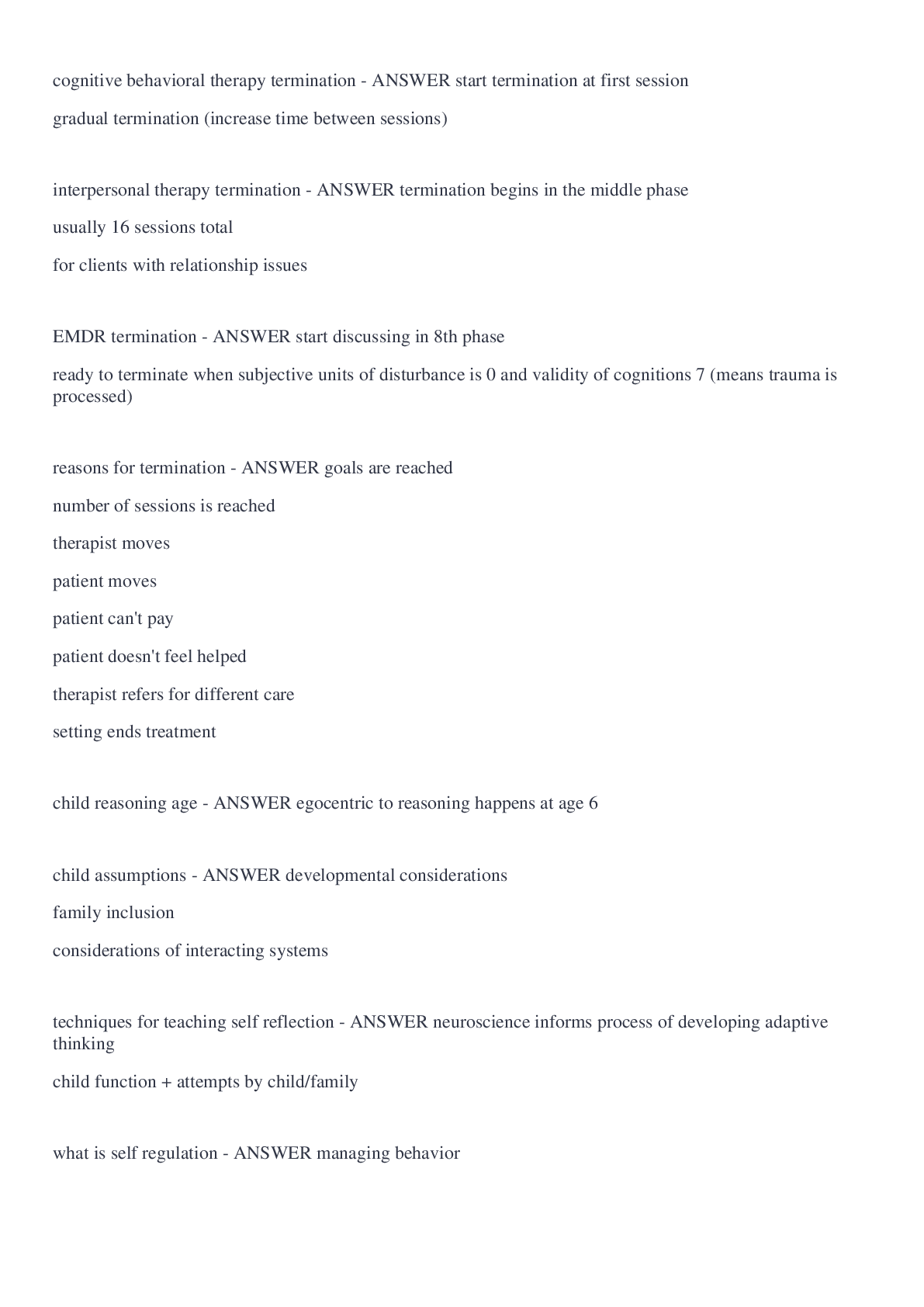
When is termination in CBT - ANSWER Initial phase/1st session
When is Termination in IPT - ANSWER Middle phase.
What patient type is IPT for? - ANSWER Depression, anxiety, role transition, IP problems
What phase is termination for EMDR - ANSWER Final stage/8th stage: when trauma is processed
What is SUD in EMDR and what value represents ready for termination? - ANSWER Subject Unit of Disturbance. SUD of 0.
What is VOC in EMDR and what value represents ready for termination? - ANSWER Validity of Cognition. VOC of 7.
When does reasoning and thinking of others begin in kids? - ANSWER Age 6
Reasons to terminate therapy: - ANSWER Completion; Noncompliance; Nonpayment; Relocation
Techniques for self-regulation in kids: - ANSWER Re-engage; Showing restraint; Integration of emotion with a memory
What kids to use self-regulation for? - ANSWER Aggressive; Socially withdrawn; Conflict
What Dx's is self-regulation good for? - ANSWER ADHD; PTSD; maltreatment; depression; anxiety
How to support the development of self-regulation in kids? - ANSWER Manage your own stress; Keep end goal in mind; Model self-regulation; Be supportive & encouraging
How to use Strength-based approach in kids? - ANSWER Praise for reinforcement
Why use TF-CBT in kids? - ANSWER Trauma; Trauma-focused CBT
S/S of ADHD in kids: - ANSWER Inattention; Impulsivity; Hyperactivity (IIH)
What part of the brain is affected in ADHD? - ANSWER Pre-frontal cortex
TX for ADHD? - ANSWER Meds and therapy. A combo is best.
Why use cognitive training in ADHD? - ANSWER Increases working memory
What is differentiation? - ANSWER SENSE OF SELF
DEGREE OF WHOLENESS
ABILITY TO SEPERATE ONES INTELLECTUAL AND EMOTIONAL FUNCTIONING
What is fusion? - ANSWER Dysfunctional; Blurring self with others; Single emotional system (over & underfunctioning) 2 undifferentiated people
Describe how Multi-gen Transmission Process works - ANSWER Passing on dysfunction patterns; "You're just like your father!"
What is a Triangle family - ANSWER Conflict b/t 2 and then they bring in the 3rd
What is Undifferentiated Ego Mass - ANSWER They're are stuck together; Can't function independently, a family system with members that are undifferentiated
Describe Bowen's Theory; Sibling position concept - ANSWER An eldest child would be compatible to marry a youngest child due to eldest are typically controlling and youngest are more dependent
What is Family Projection Process? - ANSWER Parental undifferentiation is transmitted to the child; Usually the child targeted is the most emotionally vulnerable and unprotected, regardless of birth order.
What is Emotional Cutoff? - ANSWER Decreasing or cutting contact with a person to decrease anxiety and conflict
How to promote self-statements? - ANSWER Use of "I" to separate self from family
An example of transforming dysfunctional generational patterns? - ANSWER Therapist: "I notice women in your family marry irresponsible men. Would you like to change this pattern?"
Purpose of transforming dysfunctional generation patterns? - ANSWER Decreases conflict and anxiety; de-triangulates the family; repairs cutoffs
Define boundaries: - ANSWER invisible lines of protection
What is an enmeshed family? - ANSWER Blurred boundaries and overly dependent on one another. Co-dependent.
Examples of an enmeshed family: - ANSWER Excessive involvement in kid's conflict; family overwrought over kid's grade; involving the kid in marital issues; parent reading the kid's text messages
What is a disengaged family? - ANSWER Rigid boundaries; immature; disconnected
Example of disengaged family: - ANSWER Little involvement in the kid's academic or psychological problems
What is a coalition in the family? - ANSWER 2 members are against a 3rd family member; 2 against 1
3 types of coalition families: - ANSWER Cross-gen: parent/child against another member
Schism: parent/child against a parent
Skewed: Spouse compensates for the other spouse
What is parentification? - ANSWER Role reversal; Kid acts as the parent
Example of boundary making in Enmeshed family: - ANSWER Kid & dad sit nest to each other & have inside jokes. Therapists asks mom to sit between them.
Example of boundary making in Disengaged family: - ANSWER Kid is asked to leave and parents must come up with ways to improve the kid's grades.
Example of unbalancing a family: - ANSWER Parents asked to discuss 15 y.o.'s curfew. Then, the disengaged parent is asked to speak to the kid.
Example of unbalancing a family: - ANSWER 7 & 9 y.o don't listen. Therapist asks them to leave in order to strengthen the parent system.
Example of Tracking in family therapy: - ANSWER Therapist catches onto communication trends in the family, such as "low blows". When therapist hears these; they then ask to use kind communication and help to do so.
Example of Reframing in therapy: - ANSWER A 12 y.o. is described as difficult. Then the family squabbles. The therapist reframes the problem to be a systems problem, not individual to the kid.
What is Reframing? - ANSWER Recasting the problem in a new light.
Example of Shaping Competence in therapy: - ANSWER "That was terrific! You were able to work together to be a united front!" Reinforcing new, desirable behaviors.
What is the "1st Order" of changes in Strategic Family Therapy Approach? - ANSWER Superficial behavior changes. Ex: Family makes the decision to stop shouting.
What is the "2nd Order" of changes in Strategic Family Therapy Approach? - ANSWER In-depth behavior changes that require fundamental revision of family structure.
Describe a Secure attachment style: - ANSWER Someone who thinks of themselves as loveable; they easily trust others; they are vulnerable.
Describe an Insecure attachment style: - ANSWER Someone who cannot express needs or feelings; They discount the need for attachment; They are distant.
Describe a vacillating attachment style: - ANSWER Traumatized people; Fluctuate between attachment and hostility.
Describe an Anxious attachment style": - ANSWER Reactive; Demands reassurance; Aggressive/Controlling; Blaming/Manipulating
What are RT and LRT? - ANSWER Reminiscence Therapy and Life Review Therapy are approaches that focus on reflecting on life, on the aging process, and on constructing a sense of self-continuity.
What is Reminiscence Therapy? - ANSWER Reconstructing life events from memories; Recalling forgotten experiences.
What are attributes of RT: - ANSWER "Flash Bulb" moments when chatting w/ someone about the past: "Oh yea! I remember that!"; usually happy memories; not a deep evaluation of life. Focuses on PAST, NOT CURRENT. Spontaneous.
What are benefits of RT: - ANSWER No time constraints; connects people; increases self-esteem and life satisfaction; decreases isolation; increases socialization.
Who are candidates for RT? - ANSWER Mild to moderate cognitive impairment.
What is LRT? - ANSWER Recalls past or recent event and experiences; Retrospective survey; 1 to 1 basis
Attributes of LRT: - ANSWER Both happy & sad times; Usually 4-6 weeks; Recall process is in chronological order; recall must contain evaluative/analytical component to prep for future.
What are positive benefits of LRT? - ANSWER Integrity; Increased self-esteem; Decreased depression; Increased life satisfaction; Peace. They feel better about their life, in general.
Who are candidates for LRT? - ANSWER Cognitively intact to mild impairment. Self-focused. Usually experiencing a life event trigger.
[Show More]











.png)