NHA CCMA Questions and Answers
Latest Updated With Complete Solutions
CC Correct Answer-Chief Complaint
Segment Correct Answer-Line between two wave forms
P-wave Correct Answer-Atrial Depolarization
How many 1mm box
...
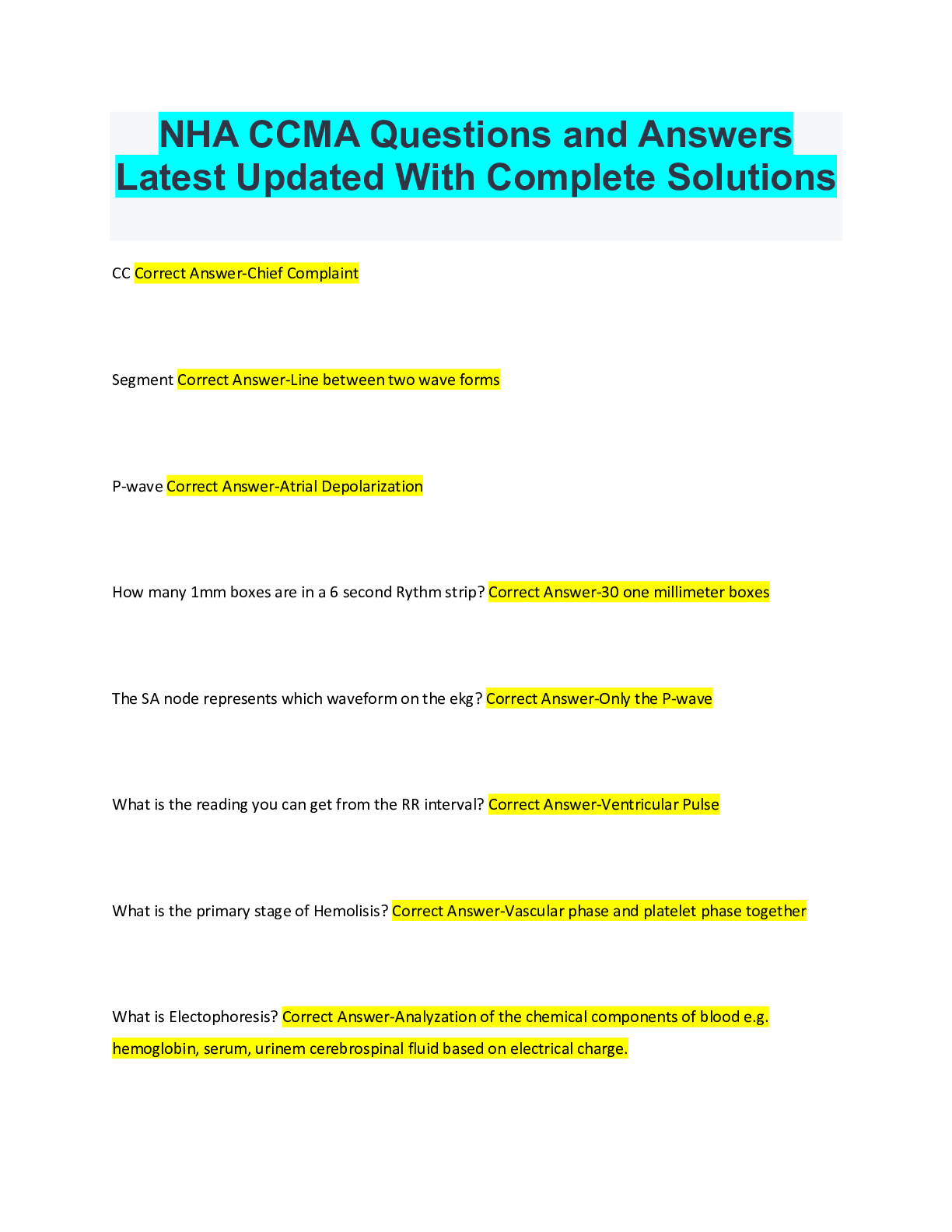
NHA CCMA Questions and Answers
Latest Updated With Complete Solutions
CC Correct Answer-Chief Complaint
Segment Correct Answer-Line between two wave forms
P-wave Correct Answer-Atrial Depolarization
How many 1mm boxes are in a 6 second Rythm strip? Correct Answer-30 one millimeter boxes
The SA node represents which waveform on the ekg? Correct Answer-Only the P-wave
What is the reading you can get from the RR interval? Correct Answer-Ventricular Pulse
What is the primary stage of Hemolisis? Correct Answer-Vascular phase and platelet phase together
What is Electophoresis? Correct Answer-Analyzation of the chemical components of blood e.g.
hemoglobin, serum, urinem cerebrospinal fluid based on electrical charge.Positive testing for occult blood in a stool sample turn which color? Correct Answer-Turns Blue on a
positive test for occult blood in feces.
The stages of Hemostasis: Correct Answer-1. Vascular 2. Platelet Phase 3. Coagulation Phase 4.
Fibronolysis
Blood Vessels Correct Answer-Aorta, arteries, arterioles, capillaries, venues, veins, superior and inferior
vena cavae.
Outer connective tissue layer of a blood vessel Correct Answer-Tunica adventitia
Inner endothelial tissue layer of a blood vessel Correct Answer-Tunica Intima
The inner smooth layer of a blood vessel Correct Answer-Tunica media
The standards of right and wrong in a medical setting Correct Answer-Code of Ethics
What do you find in capillaries? Correct Answer-A mixture of venous and arterial blood is found
The average adult has how many liters of blood? Correct Answer-5-6 litersWhat is the percentage of water in blood? Correct Answer-92%
Percentage of plasma in blood Correct Answer-55%
Percentage of Formed Elements in the blood Correct Answer-45%
99% of formed elements in blood Correct Answer-RBC's or Erythrocytes
Where you find Hemoglobin Correct Answer-RBC's
Where do all blood cells originate? Correct Answer-Bone Marrow
How many RBC's per microliter of blood Correct Answer-4.2-6.2 million
What is the second most numerous WBC? Correct Answer-Lymphocyte with 20-40%
Their numbers increase in intracellular infections and TB Correct Answer-MonocytesTheir numbers increase in bacterial infections and often are first on scene Correct Answer-Neutrophils
These WBC's play an important role in viral infection as well as in immunity. Correct AnswerLymphocytes
Number of leukocytes for average adult per micrometer Correct Answer-5000-10000
Leukopenia Correct Answer-Decrease in WBC's seen with viral infection and leukemia
Comprises 3-8% of wbc or leukocytes Correct Answer-Monocytes
Largest in size of the leukocytes Correct Answer-Monocytes
Carries Histamine Correct Answer-Basophil
Injury to a blood vessel that causes it to constrict, slowing the clot of blood Correct Answer-Cascular
phase of hemostasis
Preferred site for venipuncture Correct Answer-Antecubital fossaTest used to evaluate the intrinsic pathway and monitor heparin therapy Correct Answer-APTT also
know as PTT
Test used to evaluate the extrinsic pathway and also used to monitor warfarin therapy Correct AnswerPT
Fibrinolysis Correct Answer-Breakdown and removal of a clot
Converts the temorary platelet plug into a stable fibrin clot Correct Answer-Coagulation phase
2nd choice vein for venipuncture most often the only one palpatable in an obese pt Correct AnswerCephalic vein
Antiseptics used in Phlebodtomy Correct Answer-70% isopropyl alcohol pads most common, provolone
iodine for bc, s and chlorhexidine gluconate for patients that are allergic to betadine/ iodine
Length of needle commonly used in venipuncture Correct Answer-1 ince (up to 1.5")
Guage of needle that can cause hemolysis Correct Answer-Smaller than 23 guage
Average gauge of needle used for drawing blood Correct Answer-21-223 skills of the phlebotomist Correct Answer-social, clerical, technical
Analytical errors during collection of blood Correct Answer-extended tourniquet time, hemolysis, wrong
order of draw, failure to invert tubes, faulty technique under filling tubes
Analytical errors before collection of blood Correct Answer-Patient misidentification, improper time,
wrong tube, not fasting, exercise (cortisol levels), PT posture, poor coordination with other treatments,
improper side prep, medication interference
Analytical errors after blood collection Correct Answer-Failure to separate serum from cell (glycolisis),
improper use of serum separator (not inverting tubes or not spinning tubes) delays in processing,
exposure to light, improper storage conditions, dimming clots
Fistula Correct Answer-Permanent surgical connection between an artery and a vein, never used for
venipuncture
Edima Correct Answer-Accumulation of fluid in tissue
Thrombophlebitis Correct Answer-Inflammation of a vein with a clot formationExplanation of Hemoconcentration Correct Answer-The increase in proportion of formed elements to
plasma caused by leaving on the tourniquet for more than two minutes
Consequence of insufficient pressure applied after withdrawal of needle Correct Answer-Thrombus
additives in green top tube Correct Answer-heparin, sodium, litium, ammonium
Why is the green top tube never used for hematology Correct Answer-Green tops additive heparin
interferes with the Wright's stained blood test
Common tests for the lifht blue sodium citrate tube Correct Answer-Coagulation studies, PT (extrinsic,
warfarin) APTT, PTT (intrinsic, heparin) TT, BT, FDP
Common tests for the lavendar edta tube Correct Answer-CBC, differential or diff., ESR, sickle cell
screening
Common tests for this color tube are chemistry tests performed on plasuma such as Ammonia,
carboxyhemoglobin and STAT electrolytes Correct Answer-Green top tube (heparin) Tests
How long does it take for blood to clot by normal coagulation process in the red top tube? Correct
Answer-30-60 minsThe primary purpose is to provide reliable data about a patients health status by ensuring the accuracy
of a test while detecting and eliminating error Correct Answer-What is quality control
Common test for the red topped tube Correct Answer-Serum chemistry tests, serology tests, blood bank
(glass only)
Order of draw for cappilary specimens Correct Answer-lavender first, then tubes with other additives,
then tubes with out additives
Antiseptic not used on a dermal puncture site Correct Answer-Betadine (because it interferes with
several tests like bilirubin, uric acid, phosphorus and potassium
For which procedure would you warm the site for a minimum of 3-4 minutes to increase blood flow?
Correct Answer-dermal punctures (heel sticks)
Which are the preferred sites for dermal punctures Correct Answer-the distal segment of the third or
fourth finger of the non-dominant hand
heel sticks are performed on which patients? Correct Answer-infants less than 1 year old
Where on the foot is the dermal puncture made on patients less than a year old Correct Answer-the
medial and lateral areas of the plantar surface of the footdermal puncture is made in Correct Answer-the fleshy portion of the finger slightly to the side of the
center perpendicular to the lines of the fingerprints
What will occur if you puncture the heel too deep? more than 2 mm Correct Answer-osteomyalitis
What are the identification requirements for blood bank Correct Answer-Pt's full name and DOB,
hospital id # or ssn for outpatient, date and time of collection as well as the phlebotomist's initials
This section of the lab uses serum to analyze the presence Correct Answer-Serology (immunology)
Section
When checking for hormones in urine when do you collect the urine sample Correct Answer-first voiding
in the morning
Which urine specimen provides the clearest, most accurate results? Correct Answer-Clean catch
midstream specimen
Which urine sample requires aseptic technique? Correct Answer-Clean catch specimen
Examination of urine consists of Correct Answer-physical, chemical, microscopicPhysical examination of urine consists of Correct Answer-colume (adequate for testing, observing color
and appearance, odor, specific gravity
What amount of urine must you have to be sufficient for analysis? Correct Answer-25ml
What is the normal range of specific gravity of random collection Correct Answer-1.005-1.030
normal range of specific gravity of urine in adults with normal diet and fluid intake Correct Answer-
1.015-1.025
Microscopic examination of urine requires this amount Correct Answer-10-15ml
Urine Specific gravity Correct Answer-The ratio of weight of a given colume of urine to the weight of the
same volume of distilled water at a constant temperature
Glycosuria Correct Answer-presence of glucose in the urine
Symptoms of patients with diabetes mellitus Correct Answer-glycosuria, polyuria, and thirstA urine pH of what is considered neutral? Correct Answer-7.0 pH
the copper reaction test is used for what? Correct Answer-screening for glucose in urine
The presence of leukocytes in urine is an indicator for what? Correct Answer-bacteruria or UTI
Urine Screening for UCG or HCG Correct Answer-Pregnancy Test
HIPPA is for? Correct Answer-Patient Confidentiality
The four elements of Negligence Correct Answer-Duty, duty of care, derelict= breach of duty of care,
direct cause, damage
Tort Correct Answer-Wrongful act that results in injury to one person to another
Examples of Tort Correct Answer-Battery, invasion of privacy, defamation of character
Defamation of character by written statement is considered Correct Answer-libelConsists of injury to another person's reputation , name or character through spoken (slander) or
written (libel) Correct Answer-Defamation of character
unpriveleged touching Correct Answer-Battery
The release of medical records with out the patient's knowledge or permission Correct Answer-Invasion
of privacy
Good Samaritan Law Correct Answer-Rendering first aid within the scope of knowledge by a health care
worker with out fear of being sued for negligence
Hypothalamus Correct Answer-regulates and maintains body temperature
Functions necessary for life Correct Answer-heart function, blood pressure, respiration, temperature
Rectal Temperature range in celsius Correct Answer-37.0 -38.1 C
Oral temperature range in Fahrenheit Correct Answer-97.6-99.6 F
Axillary temperature range in celsius Correct Answer-35.9-37.0CTympanic temperature rang
[Show More]