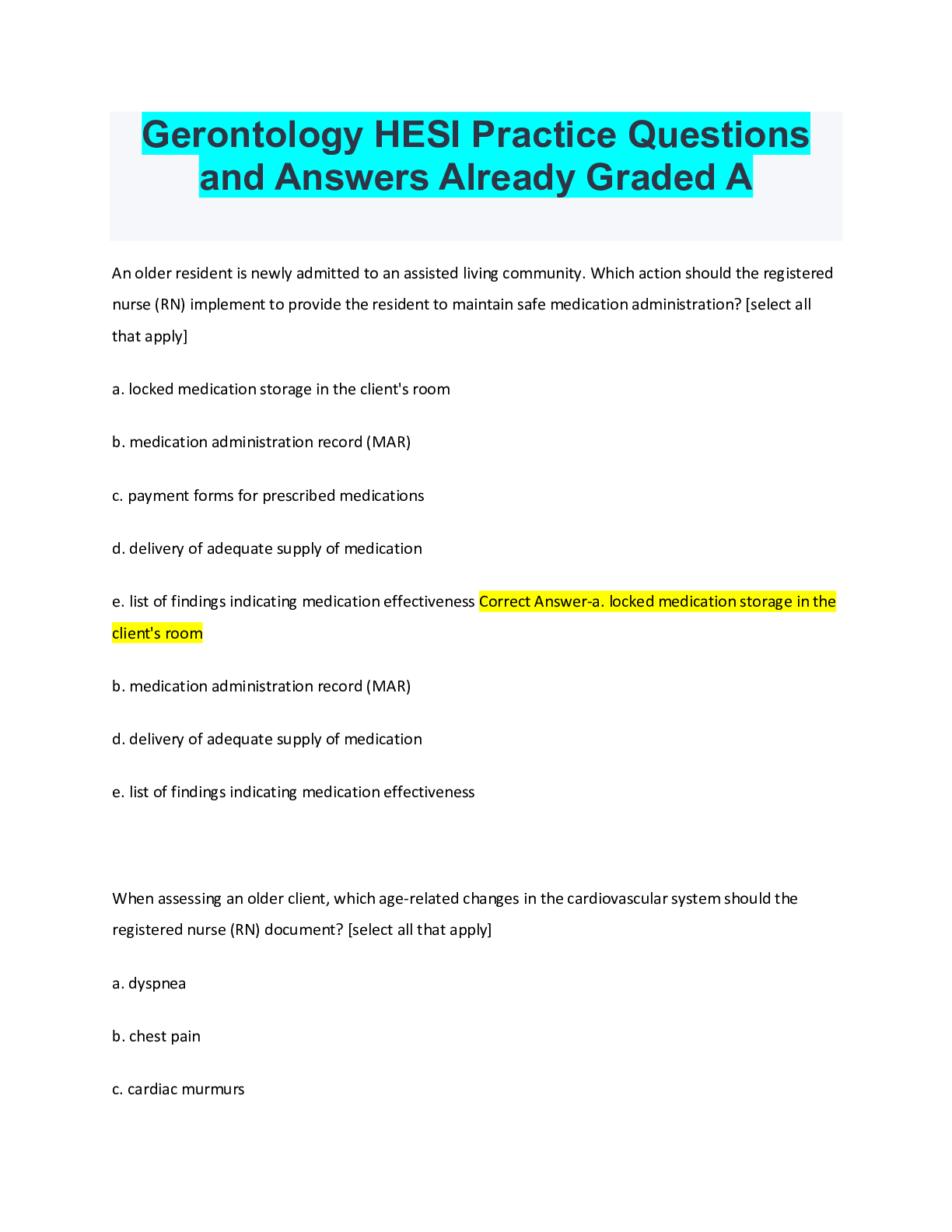
Gerontology HESI Practice Questions
and Answers Already Graded A
An older resident is newly admitted to an assisted living community. Which action should the registered
nurse (RN) implement to provide the resident to
...
Gerontology HESI Practice Questions
and Answers Already Graded A
An older resident is newly admitted to an assisted living community. Which action should the registered
nurse (RN) implement to provide the resident to maintain safe medication administration? [select all
that apply]
a. locked medication storage in the client's room
b. medication administration record (MAR)
c. payment forms for prescribed medications
d. delivery of adequate supply of medication
e. list of findings indicating medication effectiveness Correct Answer-a. locked medication storage in the
client's room
b. medication administration record (MAR)
d. delivery of adequate supply of medication
e. list of findings indicating medication effectiveness
When assessing an older client, which age-related changes in the cardiovascular system should the
registered nurse (RN) document? [select all that apply]
a. dyspnea
b. chest pain
c. cardiac murmursd. widening pulse pressure
e. irregular heart rate Correct Answer-c. cardiac murmurs
d. widening pulse pressure
An older client who recently moved into an assisted living community refuses to eat or join any
activities. When evaluating the client further, what should the registered nurse (RN) focus on during
next examination?
a. anxiety
b. depression
c. exhaustion
d. confusion Correct Answer-b. depression
Depression is a symptom that an older client is likely to experience with a sudden change in living
accommodations when a loss of personal identity can create low self-esteem.
The registered nurse (RN) is caring for an elderly client with functional incontinence who lives in an
assisted living community. The client is alert and mildly confused and can self ambulate. Which nursing
intervention should the RN implement?
a. offer assistance with toileting Q2 hours
b. use protective disposal undergarment instead of underwear
c. ask if the client has attempted to void Q2 hoursd. obtain a prescription for intermittent catheterization Correct Answer-a. offer assistance with toileting
Q2 hours
Toileting assistance maintains independence and self-esteem which are important for an older client
with incontinence. A toileting schedule also decreases the clients chances of accidents and
embarrassment.
The healthcare provider prescribes a new medication, atorvastatin (Lipitor), for an older client who
arrives at the clinic for an annual physical examination. What common side effect should the registered
nurse (RN) advise the client to observe for with this medication?
a. constipation
b. headaches
c. muscle weakness
d. nausea and vomiting Correct Answer-b. headaches
Headaches are the most common side effect of atorvastatin (Lipitor).
The registered nurse (RN) is re-enforcing discharge instructions with the family of an older client who
was recently admitted for an intestinal obstruction. Which statement indicates that the family
understands the instructions?
a. increase protein and carbohydrates in the daily diet
b. limit activity to bed rest for the first week and increase mobility incrementally each weekc. report abdominal distention, constipation, or any nausea and vomiting to the healthcare provider
d. drink liquids 2 hours after meals instead of during meals Correct Answer-c. report abdominal
distention, constipation, or any nausea and vomiting to the healthcare provider
These symptoms occur with intestinal obstruction and should be addressed immediately.
An older male client asks the registered nurse (RN) how he can reduce his incidents of hemorrhoidal
flare ups. What information should the RN offer the client about how to prevent rectal discomfort?
[select all that apply]
a. increase fiber and liquids in the diet to help prevent constipation and straining
b. change exercise program to reflect less cardio-exercise and more weight training
c. use a therapeutic cushion or frequent repositioning for periods of prolonged sitting
d. take frequent warm sitz baths and do not use abrasive paper that can traumatize tissues
e. establish bowel habits by scheduling daily time to defecate when the client is not rushed Correct
Answer-a. increase fiber and liquids in the diet to help prevent constipation and straining
c. use a therapeutic cushion or frequent repositioning for periods of prolonged sitting
d. take frequent warm sitz baths and do not use abrasive paper that can traumatize tissues
e. establish bowel habits by scheduling daily time to defecate when the client is not rushed
Fluids, comfort measures, and establishment of a regular bowel pattern help reduce incidents of
hemorrhoid inflammation.An older male client is seeking counseling about his recent sexual issues with his partner. What issue
should the registered nurse (RN) explore in this discussion?
a. certain medications may impact sexual function
b. normal aging affects sexual function in male clients
c. safe sex is not necessary with older sexually active elders
d. sexual interest usually declines with aging in male clients Correct Answer-a. certain medications may
impact sexual function
During the quarterly evaluations of the clients in the assisted living community, the registered nurse
(RN) assesses for findings of failure to thrive in the older population. Which findings should the RN
document and report as manifestations related to failure to thrive? [select all that apply]
a. unintentional weight loss
b. increased weakness
c. increased amounts of sleep
d. irritation and agitation
e. seeking constant attention from caregiver Correct Answer-a. unintentional weight loss
b. increased weakness
c. increased amounts of sleepSymptoms of failure to thrive in the older population include weight loss, weakness, and excessive sleep,
which should be documented and evaluated by a healthcare provider immediately.
The registered nurse (RN) is reinforcing discharge instructions to the family of an older client with failure
to thrive. What information should the RN include to promote nutritional intake for the client? [select all
that apply]
a. minimize stress level by providing the client with a quiet environment during meals
b. provide food variations that the client can manage without assistance
c. assist the client with eating meals in bed in a semi Fowler's position
d. encourage fluid intake before melas to decrease dehydration
e. offer any type of food to the client as long as calories are consumed Correct Answer-a. minimize
stress level by providing the client with a quiet environment during meals
b. provide food variations that the client can manage without assistance
A and B continue to promote independence and decreased stress for the client, which will increase the
opportunity for nutritional intake
An older woman asks the registered nurse (RN) how she can decrease her chances of getting cystitis.
What information should the RN provide?
a. void and empty the bladder completely every 2 to 3 hours
b. take warm sitz baths with bubble bath to cleanse the vulva
c. decrease fluid volume intake to reduce urgencyd. test urine pH daily using over-the-counter (OTC) dipsticks Correct Answer-a. void and empty the
bladder completely every 2 to 3 hours
An older male with Parkinson's disease (PD) is discharged home with levopoda-carbidopa (Sinemet) and
instructions to this wife for his care. Which statement best indicates to the registered nurse (RN) that
the wife understands her husband's needs?
a. "It is important to keep my husband in a chair or in bed as much as possible and prevent him from
falling."
b. "I will notify the healthcare provider if my husband has increasing involuntary movement of his
extremities."
c. "Since it is difficult for my husband to eat, we should stay in the house instead of going out to dine."
d. "I should expect that my husband be incontinent of bowel and bladder as his disease advances."
Correct Answer-b. "I will notify the healthcare provider if my husband has increasing involuntary
movement of his extremities."
The home health registered nurse (RN) visits an older women with heart failure (HF) who is on complete
bed rest. Which intervention is most important for the RN to suggest to the client to prevent
complications related to immobility?
a. get as much sleep as possible
b. perform leg exercises while in bed
c. increase protein intake to combat fatigue
d. invite friends to visit to decrease risk for depression Correct Answer-b. perform leg exercises while in
bedThis client is at risk for complications related to immobility. Active leg exercises should be performed
frequently to decrease the risk for thrombophlebitis.
An older male client is admitted to the hospital with left-sided heart failure (HF). Which finding should
the registered nurse (RN) document that is consistent with HF?
a. ascites
b. pitting edema
c. jugular distention
d. course and fine crackles Correct Answer-d. course and fine crackles
An older female client who has been taking hydrocodone/acetaminophen (Lortab) Q4 hours for chronic
back pain for the past 5 years tells the registered nurse (RN) that she cannot live without her pain pills.
When asked if she is addicted, the client states that she is not an addict because the healthcare provider
prescribed the pain pills. Which coping mechanism should the RN determine the client is using about her
addiction?
a. lack of knowledge about narcotic medications
b. rationalization to support narcotic use
c. transfer of blame to healthcare provider
d. justification of narcotic use due to chronic pain Correct Answer-b. rationalization to support narcotic
useThe client is using rationalization to maintain self-esteem when she is questioned by stating that she is
not addicted because she is taking medication prescribed by a healthcare provider.
An older male client with heart failure (HF) complains of chronic constipation and wants to retrain his
bowel. Which information should the registered nurse (RN) offer the client for establishing regular
bowel habits?
a. add whole grain foods and fibrous vegetables to diet
b. drink water and fluids up to 3,000 mL daily
c. use a stool softener or glycerin suppository PRN
d. plan daily exercise based on fatigue level Correct Answer-a. add whole grain foods and fibrous
vegetables to diet
Increasing daily fiber with increasing fluid intake are the best tools to use when retraining bowel habits.
The home health registered nurse (RN) is visiting an older client with chronic hypertension. What
evaluation is most important for the RN to complete with each visit?
a. effectiveness of medication
b. ability to ambulate
c. signs of dehydration
d. familial support Correct Answer-a. effectiveness of medicationAn older male client is admitted for emergency treatment of acute closed-angle glaucoma. The
registered nurse (RN) begins administering the prescribed biotic medications and glycerin (Glycol)
therapy. Which intervention is most important for the RN to maintain during the client's therapy?
a. maintain lighting control in the room during therapy
b. monitor intake and output Q2 hours for 24 hours
c. place an eye patch over the affected eye during sleep
d. administer the eye drops at the scheduled intervals Correct Answer-b. monitor intake and output Q2
hours for 24 hours
Monitoring I&O is most important during the administration of glycerin (Glycol) due to the rapid acting
osmotic diuretic effect of glycerin therapy.
The registered nurse (RN) is assigned the care of an older client who returns to the unit after surgery for
closed angle glaucoma. Which intervention in the plan of care should the RN bring to the attention of
the healthcare team?
a. assist with ambulating to the commode
b. monitor intake and output Q8 hours
c. administer morphine 4 mg IM Q2 hour PRN pain
d. place an eye patch on operative eye during sleep Correct Answer-c. administer morphine 4 mg IM Q2
hour PRN painMorphine side effects include nausea, vomiting, and constipation, causing straining on stool, all of which
can increase intraocular pressure and cause intraocular bleeding during the postoperative period.
The home health registered nurse (RN) is reinforcing instructions to the family about how to prevent
pressure ulcers for their older family member who is bedridden. Which measure should the RN discuss?
a. lift the client when turning instead of sliding
b. massage directly over reddened sites
c. change client's position ever 4 hours
d. place pillows under both the knees Correct Answer-a. lift the client when turning instead of sliding
Decreasing the chances of friction and shearing while moving the client.
The home health registered nurse (RN) is changing an older client's wet to dry dressing. Which
observation should the RN evaluate as a therapeutic response with the removal of the dry dressing?
a. debridement and removal of slough and eschar
b. drainage of purulent exudate from the wound
c. moist skin edges around the wound field
d. presence of capillary growth in the wound Correct Answer-a. debridement and removal of slough and
escharWet to dry dressings begin with a wet packing inside of the wound, and then a dry gauze is used to cover
the wet packing to wick drainage and bacteria away from the wound to promote healing.
The home health registered nurse (RN) is assessing an older client for a pressure ulcer. Which finding
should the RN observe the area for a Stage I pressure ulcer?
a. superficial skin breakdown and flaking
b. deep pink, red, or mottled skin
c. subcutaneous damage or necrosis
d. skin that blanches pink when pressed Correct Answer-b. deep pink, red, or mottled skin
Temporary blanching of the area can last for over a minute due to poor circulation. Deep pink, red, or
mottled skin is a finding consistent with a Stage 1 pressure ulcer.
A frail elderly woman visits the healthcare provider because she has been getting out of breath easily
when walking long distances. Which pulmonary function change should the registered nurse (RN) expect
to commonly occur with aging?
a. decreased residual volume
b. mild respiratory acidosis
c. reduced vital capacity
d. increased alveoli function Correct Answer-c. reduced vital capacityAn older female client arrives for an annual visit by the urologist due to a history of changes in serum
values related to renal function. What changes should the registered nurse (RN) expect for an older
client due to normal aging?
a. decrease in glomerular filtration rate (GFR)
b. hematuria during urinalysis
c. chronic bladder infections
d. urinary incontinence Correct Answer-a. decrease in glomerular filtration rate (GFR)
A frail elderly couple ask the registered nurse (RN) if they have to watch their salt intake because food
does not taste as good as it used to so they have to season most foods. What information should the RN
offer the couple?
a. boredom may influence how the taste of food is perceived, and different seasonings can stimulate
taste
b. with age, an increase in sodium intake is needed to compensate for a decrease in renal function
c. short-term memory loss and confusion may be the reason they want to over-season their food
d. taste buds often are dull due to atrophy so older clients should use other seasonings instead of salt
Correct Answer-d. taste buds often are dull due to atrophy so older clients should use other seasonings
instead of salt
An older client who is unconscious is admitted after experiencing a head injury from a fall. Glasgow
Coma Scale (GCS) is prescribed to evaluate the client. Which focused assessments should the registered
nurse (RN) use to determine the client's GCS score? [select all that apply]
a. verbal responseb. motor response
c. eye opening
d. pupillary reaction
e. hearing Correct Answer-a. verbal response
b. motor response
c. eye opening
The registered nurse (RN) is assigned to the care of an older client with venous stasis ulcers. A primary
goal in the client's plan of care is to decrease swelling in the extremities. What action should the RN take
to meet this goal?
a. elevate the legs on pillows
b. decrease fluid intake
c. decrease salt intake in diet
d. increase protein intake in diet Correct Answer-a. elevate the legs on pillows
After taking a 10-day course of an antibiotic that was ineffective, a frail, elderly client with chronic
obstructive pulmonary disease (COPD) is admitted with pneumonia. The client has a long history of
smoking and still smokes a pack of cigarettes a day. Which finding should the registered nurse (RN)
report to the healthcare provider?
a. barrel chest with increased chest diameter
b. crackles and pulse oximetry level of 88%c. low hemoglobin and hematocrit levels
d. arterial blood gases indicating respiratory acidosis Correct Answer-b. crackles and pulse oximetry level
of 88%
The home health registered nurse (RN) visits an older female client with an ideal conduit who has been
experiencing chronic urinary tract infections (UTI). Which intervention should the RN recommend to the
client to manage the frequency of UTIs?
a. force fluid intake to 1,000 mL daily
b. change appliance every 4 hours
c. attach a larger drainage bag while sleeping
d. allow bag to fill completely before emptying Correct Answer-c. attach a larger drainage bag while
sleeping
An older male client returns to the hospital after discharge 4 days ago for a transurethral resection of
the prostate (TURP). The registered nurse (RN) evaluates the function of the 3-way indwelling urinary
catheter and the continuous bladder irrigation system. Which finding should the RN report to the
healthcare provider?
a. irrigation bag of normal saline is hanging at the level of the client's head
b. the urinary output is greater than the amount of irrigation fluid instilled
c. the irrigation turbine is attached to the irrigation port on the 3-way catheter
d. the tubing that drains the urinary bladder has bright red urine with clots Correct Answer-d. the tubing
that drains the urinary bladder has bright red urine with clotsAn older client with chronic kidney disease (CKD) has an arteriovenous fistula (AV) in the left forearm for
hemodialysis. After palpating the AV fistula, which finding is an indication that the AV fistula is
functioning properly?
a. enlarged veins
b. redness around the site
c. decreased pulses below fistula
d. marked ecchymotic areas Correct Answer-a. enlarged vein
[Show More]


.png)

.png)

.png)
 Questions, Answers & Rationale, A+ Guide.png)