Gerontology HESI test Questions and
Answers Already Passed
The cleansing of the stomach with solution delivered through a nasogastric tube is known as what?
Gavage
Emesis
Lavage
Stomach pumping Correct Answer-Lavag
...
Gerontology HESI test Questions and
Answers Already Passed
The cleansing of the stomach with solution delivered through a nasogastric tube is known as what?
Gavage
Emesis
Lavage
Stomach pumping Correct Answer-Lavage
Gastric lavage is used to cleanse the stomach of a poison, overdose of medication, or other toxic
substance. It is delivered through a nasogastric tube
You are providing care to a patient who has recently begun dialysis. Her daughter, with whom she lives
and who prepares many of her meals, asks what types of foods she should incorporate into her diet and
which she should avoid. Which of the following is NOT a food that this patient should be advised to
avoid?
Avocado.
Lean red meat.
Dried fruit.Bananas. Correct Answer-Lean red meat
Dialysis patients are encouraged to eat lean meat, including red meat. High quality proteins produce less
waste and help the body heal and maintain regular processes. Dialysis patients should avoid foods high
in potassium, including avocado, banana, and dried fruit, and should eat other potassium-containing
foods in moderation.
Your 89-year-old patient presents with dyspepsia and nausea. After testing, you determine she is
positive for Peptic Ulcer Disease. Of the following, which would LEAST likely be a differential diagnosis
for Peptic Ulcer Disease?
Cholecystitis.
Migraines.
Gastric carcinoma.
Cardiovascular disease. Correct Answer-Migraines
Peptic Ulcer Disease is a gastrointestinal disorder. Other differential diagnoses of the condition are
pancreatitis and biliary tract disease.
There are a good many diseases affecting the elderly that are the result of smoking. Counseling
regarding smoking cessation is part of the GNP's job. The components of brief intervention for treating
tobacco use are:Counsel, Document, Caution, Describe, Demonstrate
Advise, Confer, Describe, Document, Prescribe
Advise, Counsel, Intervene, Prescribe, Follow-up
Ask, Advise, Assess, Assist, Arrange Correct Answer-Ask, Advise, Assess, Assist, Arrange
Ask about tobacco use, Advise to quit, Assess willingness to make an attempt to quit, Assist in this quit
attempt. Arrange a follow-up.
Mrs. Frasier, an 50-year-old patient, presents with a mosquito bite that she is concerned about. How do
you diagnose this?
Cyst.
Bulla.
Wheal.
Plaques. Correct Answer-Wheal
Cyst: encapsulated, fluid-filled mass that varies in size. Bulla: fluid-filled, elevated, circumscribed lesion
that's larger than 5mm. Wheal: circumscribed, reddening with transient elevation lesion that's 0.5 to
10mm diameter. Plaques: usually a grouping of papules; elevated and a variety of shapes; larger than
5mm.Which of the following groups should be tested for abdominal aortic aneurysm?
males aged 65-75 who have ever smoked
females aged 65-75 who have hypertension
males and females over 75
females over 75 Correct Answer-males aged 65-75 who have ever smoked
Abdominal aortic aneurysm (AAA) is more prevalent in males than in females. The American Heart
Association recommends screening males once between ages 65-75 if they have ever smoked since that
increases the risk of AAA.
With a giardia lamblia diagnosis, the NP would MOST likely prescribe what medication?
Metronidazole.
Erythromycin.
Ampicillin.
Trimethoprim-sulfamethoxazole. Correct Answer-Metronidazole.The preceding drugs are typically used in treating the following: - Campylobacter jejuni: Erythromycin -
Salmonella: Ampicillin - Shigella: Trimethoprim-sulfamethoxazole - Giardia lamblia: Metronidazole
A 65-year-old Caucasian male calls your office. He tells you he just came in from the woods and
discovered a tick on his upper right thigh. He reports self removal of the tick and now the area is slightly
red. What should you advise him to do?
He should come to the office for a ceftriaxone (Rocephin) injection.
He should be prescribed doxycycline.
He needs no treatment.
He needs a topical scrub to prevent Lyme Disease. Correct Answer-He needs no treatment.
To develop Lyme Disease from a tick bite, many factors must be present. The tick must belong to Ixodes
species and must have been attached for at least 48 hours before the disease can spread. There is no
need for prophylactic treatment in this case because the tick has not been present long enough.
As part of the treatment plan for your elderly patient, you recommend he see an Ophthalmologist. What
body part(s) will this doctor evaluate?
Brain / nerves.
Eyes.
Bones / Joints / Muscles.Ears / Throat. Correct Answer-Eyes
Neurologist - Brain / nerves Ophthalmologist - Eyes Orthopedist - Bones / Joints / Muscles
Otolaryngologist - Ears / Throat
As a GNP you understand that due to physiological changes of aging, some laboratory test results will
have age-related changes. Which of the following values would be the least likely to be affected?
red blood cell values
white blood cell counts
platelet range
hemoglobin values Correct Answer-platelet range
Due to the physiological changes of aging, red blood cell values tend to decrease, white blood cell
counts tend to decrease slightly, hemoglobin values slightly decrease, but platelet range does not vary.
The family of a patient with dementia has asked you to tell them more about this condition. You would
tell them all of the following except:
Dementia is the leading reason for institutionalization of older adults.
Some persons diagnosed with dementia have reversible pseudodementia.Irreversible dementia has a gradual onset and a progressive downward course.
50% of the older adult population suffer from some form of dementia. Correct Answer-50% of the older
adult population suffer from some form of dementia.
This statement is not true. It is estimated that between 10 and 20% of the older adult population suffer
from some form of dementia. There are 1.2 million cases in the United States in people over the age of
65.
What is true regarding deep vein thrombosis (DVT)?
Contrast venography is the most commonly used test to diagnose this.
Because the presentation of DVT varies, making the diagnosis from clinical presentation alone is
problematic.
Hypocoagulation state presents a considerable risk for DVT.
Therapy for patients with DVT is aimed at easing the pain. Correct Answer-Because the presentation of
DVT varies, making the diagnosis from clinical presentation alone is problematic.
Choice B is the right answer. Contrast venography has the greatest sensitivity and specificity for the
condition but due to the cost and nature of the test, ultrasound is more common as first-line diagnostic
technique (choice A). A hypercoagulation state presents a considerable risk for DVT (choice C). Therapy
for patients with DVT is aimed at minimizing the risk of pulmonary embolism and extension of peripheral
thrombus (choice D).It has been determined that an elderly patient is suffering from long term insomnia. Which of the
following is LESS likely to be considered a long term cause of the condition?
Nocturia.
Environmental changes.
Congestive heart failure.
Alcohol and substance abuse. Correct Answer-Environmental changes.
There are various causes of insomnia in the elderly. While some may be the cause of short term
insomnia and others long term insomnia, long term insomnia is more common in the elderly than short
term.
In terms of the elderly which of the following is NOT true of hypothyroidism?
Symptoms are often similar to normal aging changes making it difficult to detect in older adults.
Symptoms usually have an insidious onset.
It usually occurs before age 50.
There is a greater risk for developing myxedema coma, which is life-threatening. Correct Answer-It
usually occurs before age 50.Hypothyroidism usually occurs after age 50. It is often diagnosed as depression. You must use caution
against abruptly discontinuing medication.
When treating a patient with oral Vitamin B12, which drug interaction will result in decreased
absorption of vitamin B12?
aminoglycosides
colchicine
potassium supplements
all of the above Correct Answer-all of the above
In addition to the drugs listed in the first three choices, ascorbic acid may destroy the vitamin B12
supplement within one hour of ingestion. These drugs should not be taken concomitantly with oral
vitamin B12.
You are counseling a 72-year-old woman about nutrition. In the course of counseling you tell her that
older adults are at increased risk of Vitamin D deficiency. Which of the following is NOT a factor that
contributes to a Vitamin D deficiency?
too much exposure to sunlight
decreased exercise
diminished renal functiondecreased body mass Correct Answer-too much exposure to sunlight
In actuality lack of sun exposure decreases synthesis of Vitamin D.
An 88-year-old female patient comes into the clinic with her heart "racing and feeling funny." The ECG
confirms atrial fibrillation. The GNP understands that this condition is managed by all of the following
except:
treating the underlying disease
electrical cardioversion
heparin as the drug of choice with antithrombotic therapy
IV management with digoxin as first line therapy Correct Answer-heparin as the drug of choice with
antithrombotic therapy
The antithrombotic drug of choice for atrial fibrillation is warfarin (Coumadin).
A patient you diagnosed with hypothyroidism was started on levothyroixine. At what interval should the
GNP reassess her TSH?
1 to 2 weeks
2 to 4 weeks4 to 6 weeks
6 to 8 weeks Correct Answer-6 to 8 weeks
In the treatment of hypothyroidism, T4 replacement is needed in the form of levothyroixine (Synthroid
or Levoxyl). The initial dosages for an adult is 75 to 125 mcg. For an elderly person, the dose is 75% less
than the adult dosage. Because of the long half-life of levothyroxine, the effects of a dosage adjustment
or initiation would not cause a change in TSH for approximately five to six drug half-lives, or about 6 to 8
weeks.
A 67-year-old diabetic has been taking oral anti-hypoglycemics and is still having poor glycemic control.
You make the decision to start insulin therapy. He weighs 60 kg. What should you order as an initial
starting dose?
6 units short-acting insulin at breakfast, continue oral medication
6 units intermediate insulin at bedtime, stop oral medication
6 units long-acting before breakfast, stop oral medication
6 units long-acting insulin at bedtime, continue oral medication Correct Answer-6 units long-acting
insulin at bedtime, continue oral medication
The American Diabetic Association algorithm for initiation and adjustment of therapy (2006) suggests an
intermediate or long-acting insulin to be started at bedtime or morning as a once daily dose. The
starting dose is either 10 units or 0.2 units per kilogram. Oral medication should be continued except for
discontinuing sulfonylureas or meglitinides.A 65 year patient has sub-occipital and posterior cranial head pain following a fall. The GNP conducts a
musculoskeletal assessment by:
Palpating the acromioclavicular joint.
Assessing the gleno-humeral range of motion.
Palpating the cervical vertebrae.
Palpating anterior the thoracic muscles. Correct Answer-Palpating the cervical vertebrae.
The patient who is complaining of sub-occipital, posterior head pain should have the cervical vertebrae
assessed. Additionally, the GNP will palpate the posterior neck muscles and assess the neck for range of
motion.
A 67-year-old female is in the office with cataracts. She is asking what she needs to do about this. The
GNP understands that all of the following are management for this except:
Surgery may be necessary if the cataract markedly decreases visual acuity.
No drugs are available that will halt the progression of the aging process of the eye.
Vision correction with corrective lenses are available if the cataracts are in the early stages.
Ophthalmic steroids that decrease the severity are available by prescription from an ophthalmologist.
Correct Answer-Ophthalmic steroids that decrease the severity are available by prescription from an
ophthalmologist.No topical or oral medications exists that will cure or treat this condition. However, there are surgical
options.
You are providing patient education to a patient who has recently been diagnosed with shingles. Which
of the following is NOT true of the way this patient should care for his rash?
He should leave the rash uncovered to speed healing.
He should keep the rash covered.
He should keep the rash clean and dry.
He should use only nonadhesive bandages on the rash. Correct Answer-He should leave the rash
uncovered to speed healing.
Patients with herpes zoster - shingles - should keep their rashes clean, dry, and covered. The adhesive in
bandages can irritate the shingles, so only nonadhesive bandages should be used.
You are providing care for a patient who has been admitted to the hospital after a fall. Which of the
following is NOT appropriate when providing patient education for when the patient returns home?
The patient should resume regular activities as soon as possible.
The patient should avoid returning to full activity until he is fully recovered.The patient should take extra care of his feet.
The patient should engage in some type of regular exercise. Correct Answer-The patient should avoid
returning to full activity until he is fully recovered.
Patients who have suffered a fall should return to normal activity as soon as possible. Avoiding routine
activities may increase fear of falling and actually increase the risk of falling. Regular exercise and foot
care can also help reduce the risk of falls.
Which of the following is true when performing a functional assessment with a geriatric patient?
It may be necessary to allow more time for the assessment if the patient has impaired mobility.
It is not necessary to perform the assessment if the patient uses a wheelchair.
It may be necessary to bring in someone to assist the patient with the assessment.
It is only necessary when the patient returns for follow-up after treatment. Correct Answer-It may be
necessary to allow more time for the assessment if the patient has impaired mobility.
Functional assessments may take longer with geriatric patients due to impaired mobility. Allow for extra
time to conduct the functional assessment if you are working with a geriatric patient whose mobility is
limited.
You are managing a patient who has irritable bowel syndrome (IBS). Altering the gut pain threshold in
IBS is a possible therapeutic outcome with the use of:amitriptyline (Elavil)
loperamide (Immodium)
dicyclomine (Bentyl)
metrodionazole (Flagyl) Correct Answer-amitriptyline (Elavil)
Low dose tricyclic antidepressant or selective serotonin reuptake inhibitor use can be helpful in altering
the gut pain threshold, resulting in less abdominal pain. Imodium and Bentyl are prescribed to treat
diarrhea. Flagyl is not used in IBS, but is used to treat certain types of infectious colitis.
Which of the following is NOT a sign of depression in an older adult?
She neglects personal grooming.
She has difficulty concentrating.
She often becomes lost even in familiar places.
She worries about lapses in memory. Correct Answer-She often becomes lost even in familiar places.
Older adults who are depressed may have trouble concentrating or may have memory lapses. They
often express concern about these lapses. Depression may lead to neglect of personal grooming as well.
Depression does not lead to patients being disoriented or becoming easily lost. These symptoms are
more often associated with dementia.Change can be scary to anyone, but may be especially hard to deal with in the elderly population.
According to the Lewin Theory of Change, which of the following is the second step?
Freezing.
Resisting.
Unfreezing
Change. Correct Answer-Change.
The Lewin Theory of Change represents three steps with regard to change. These are: Unfreezing -
During this step, the individual realizes change is necessary and mentally prepares himself to do so.
Change - Self-explanatory. Freezing (or refreezing) - Once the change has taken place, the individual
regains a sense of stability or normalcy.
Which medication can cause urinary incontinence by relaxing the internal urethral sphincter and is used
to treat BPH for this reason?
librium, a benzodiazepine
furosemide, a diuretic
prazosin, an alpha-adrenergic antagonist
amitripylline, a tricyclic antidepressant Correct Answer-prazosin, an alpha-adrenergic antagonistThis is not a good medication to use with a woman who has continence issues. These medication s
potentially increase the risk of postural hypotension in the older adult, as well. Benzodiazepines cause
alteration in sensorium and can lead to functional urinary incontinence. Diuretics increase frequency of
voiding and volume of urine. Tricyclic antidepressants cause urinary retention, overflow incontinence,
and alteration in sensorium
A 65-year-old patient that has transferred into your care from another provider presents with a history
of migraine headaches. She is on Tylenol with codeine for treatment of these headaches but nothing for
abortive therapy. The GNP understands that a good agent to prescribe for her for abortive therapy is:
ketorolac (toradol) 100 mg IM
amitriptyline (Elavil) 100 mg PO
sumatriptan (Imitrex) 6 mg IM
ergotamine (Ergostat) 2 mg SL Correct Answer-ergotamine (Ergostat) 2 mg SL
Ergotamine sublinginal at 2 mg is the correct dose of abortive therapy for migraine headaches. Ketorolac
is give 30-60mg IM for pain, but does not help with abortive therapy. Sumatriptan is given
subcutaneously (SC) or PO, not IM and is a good medication for abortive migraine therapy. Amitriptyline
is not used in abortive therapy.
Of the following, which is the body system that is responsible for protecting the organs as well as
allowing the body to move?Nervous.
Skeletal.
Muscular.
Circulatory. Correct Answer-Skeletal
The human body is made up of 11 major body systems. These are Nervous, Skeletal, Muscular,
Circulatory, Respiratory, Digestive, Endocrine, Reproductive, Excretory, Integumentary, and Immune.
The Nervous System receives and sends messages to the body. The Skeletal System protects the body's
organs and helps with functions such as moving around. The Muscular System consists of bones and the
tissues that bring them together. It helps with functions such as walking. The Circulatory System includes
the heart and blood vessels and helps with the flow of blood throughout the body.
Ms. Villa asks the GNP the minimum number she can have for her LDL Cholesterol level to be considered
"high". What answer does she give her?
81 mg/dL.
113 mg/dL.
160 mg/dL.
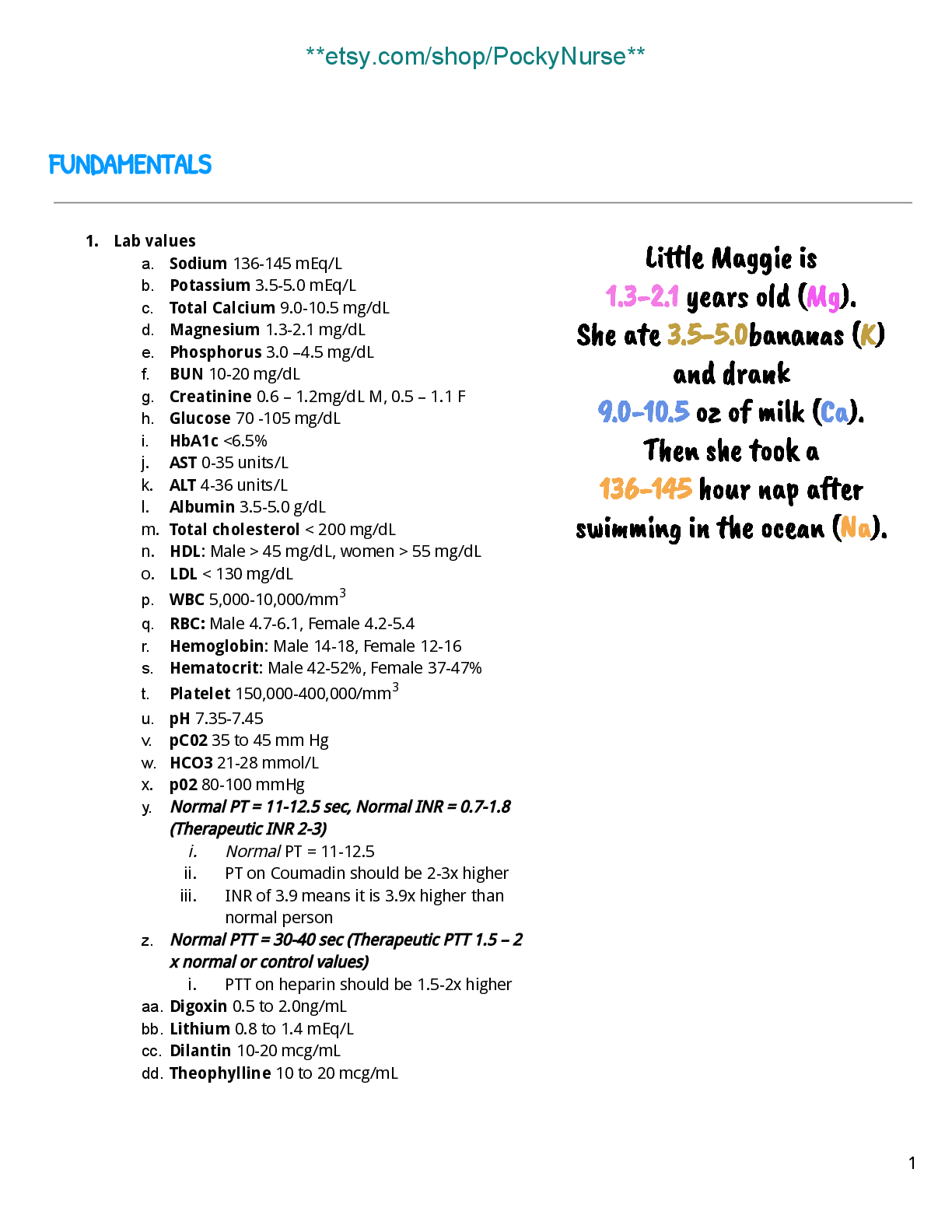
134 mg/dL. Correct Answer-160 mg/dL.The following LDL cholesterol guidelines are outlined by the American Heart Association: Less than 100
mg/dL = Optimal 100-129 mg/dL = Near or above optimal 130-159 mg/dL = Borderline high 160-189
mg/dL = High 190 mg/dL and above = Very high
Which of the following diseases can be described as the inability of the heart to pump out all the blood
returned to it from the veins resulting in the organs of the body not receiving an adequate supply of
blood?
artherosclerosis
hypertension
congestive heart failure
arteriosclerosis Correct Answer-congestive heart failure
Congestive heart failure is the inability of the heart to pump out all the blood returned to it from the
veins. As a result of vital organs not receiving an adequate supply of blood fluid backs up into the lungs
and body. Signs and symptoms include: congestion in the lungs, difficulty breathing, restlessness,
anxiety and edema of the legs, feet, hands, face, and buttocks.
A retired businessman, age 71, is in the office today with complaints of pain over the inner aspect of the
lower humerus of the arm. He reports that the pain is aggravated by wrist flexion and gripping. No
swelling is noted upon examination. He is an avid golfer and works around the house doing carpentry
work. What does the Geriatric Nurse Practitioner suspect is the cause of his ailment?medial epicondylitis
lateral epicondylitis
olecranon bursitis
elbow strain Correct Answer-medial epicondylitis
Choice A is the right answer. This is often called golfers' elbow because it results from repetitive activity
such as lifting, tooling, and sports that require a tight grip. The patient will complain of pan over the
medial epicondyle or inner aspect of the lower humerus. With lateral epicondylitis (choice B) the patient
has pain over the outer aspect of the lower humerus. Olecranon bursitis (choice C) results in pain and
swelling behind the elbow and a noticeable ball or sac hanging from the elbow. An elbow strain (choice
D) is not likely to cause aggravated pain with wrist flexion and decreased grip.
An adult male patient with iron deficiency anemia presents in the office and gastrointestinal (GI)
bleeding has been ruled out. The GNP determines that the next step is:
Prescribe ferrous sufate 300 mg PO tid and schedule patient to return in 1 month for a repeat CBC,
serum iron, and TIBC.
Administer iron dextran 50 mg IM weekly for 4 weeks.
Schedule the patient to return in 6 months for additional stool guaiac testing.
Refer patient to a hematologist. Correct Answer-Prescribe ferrous sufate 300 mg PO tid and schedule
patient to return in 1 month for a repeat CBC, serum iron, and TIBC.To replenish the depleted body iron stores, treatment with iron orally for at least 6 months is necessary
to correct the anemia. The patient should have hemoglobin/hematocrit, iron, and TIBC rechecked after
1 month of therapy. The patient should be referred to a hematologist if treatment shows no
improvement and referral to a GI specialist or repeat of stool guaiac is unnecessary because there is no
indication that the condition is related to bleeding.
When screening for alcohol abuse in the elderly, which test has been validated for this population?
CUT Screen
CAGE Screen
MINE Screen
LIST Screen Correct Answer-CAGE Screen
This is a screen for alcohol abuse that is validated in adults and the geriatric population.The C stands for
"have you ever felt like you should CUT down". The A stands for "does other's criticism of your drinking
ANNOY you". The G stands for "have you ever felt GUILTY about your drinking". The E stands for "have
you ever had an EYE opener".
You are assessing the pulse of an elderly patient. The reading is normal. Which of the following does
NOT fit the "normal" range.
50 beats per minute.72 beats per minute.
89 beats per minute.
65 beats per minute. Correct Answer-50 beats per minute
A normal pulse falls within the range of 60 to 100 beats per minute. It should be noted when a patient
has irregular rhythms. An electrocardiogram may also be necessary.
When providing care for an adult female patient who has a history of prescription benzodiazepine
dependence, you consider that:
The preferred method of treatment for this problem is rapid detoxification.
She is at significant risk for drug-induced hepatitis.
She is unlikely to have a problem with misuse of other drugs or alcohol.
She probably has an underlying untreated or under-treated mood disorder. Correct Answer-She
probably has an underlying untreated or under-treated mood disorder.
The misuse and overuse of various mood-altering products is referred to as substance abuse and it
affects 10-15% of primary care patients. Women have higher rates of misuse of prescription medications
and are more likely to have mood disorders, including anxiety and depression.Your patient, a 72 year old man, indicates that he is not urinating very often because is it painful and
difficult to do so. He reports a burning sensation when he urinates as well. This patient should be further
assessed for which of the following?
Enlarged prostate.
Bladder cancer.
Urinary tract infection.
STIs. Correct Answer-Urinary tract infection.
This patient's symptoms are consistent with urinary tract infection. Geriatric patients may be more
prone to UTIs. Further assess this patient for a UTI by ordering urinalysis on a clean catch specimen.
All but which of the following increase a geriatric patient's risk of abuse or mistreatment?
Taking multiple medications.
Impaired mobility.
Risk for fall.
Being male. Correct Answer-Being male.
Geriatric patients may be at risk for elder abuse or mistreatment. Several factors increase the risk,
especially those that contribute to overall frailty. Taking multiple medications, having decreased
[Show More]



.png)

.png)