NCC EFM Practice 2022/2023 Questions and Answers
Rated A+
Which of the following factors can have a negative effect on uterine blood flow?
a. Hypertension
b. Epidural
c. Hemorrhage
d. Diabetes
e. All of the above
...
NCC EFM Practice 2022/2023 Questions and Answers
Rated A+
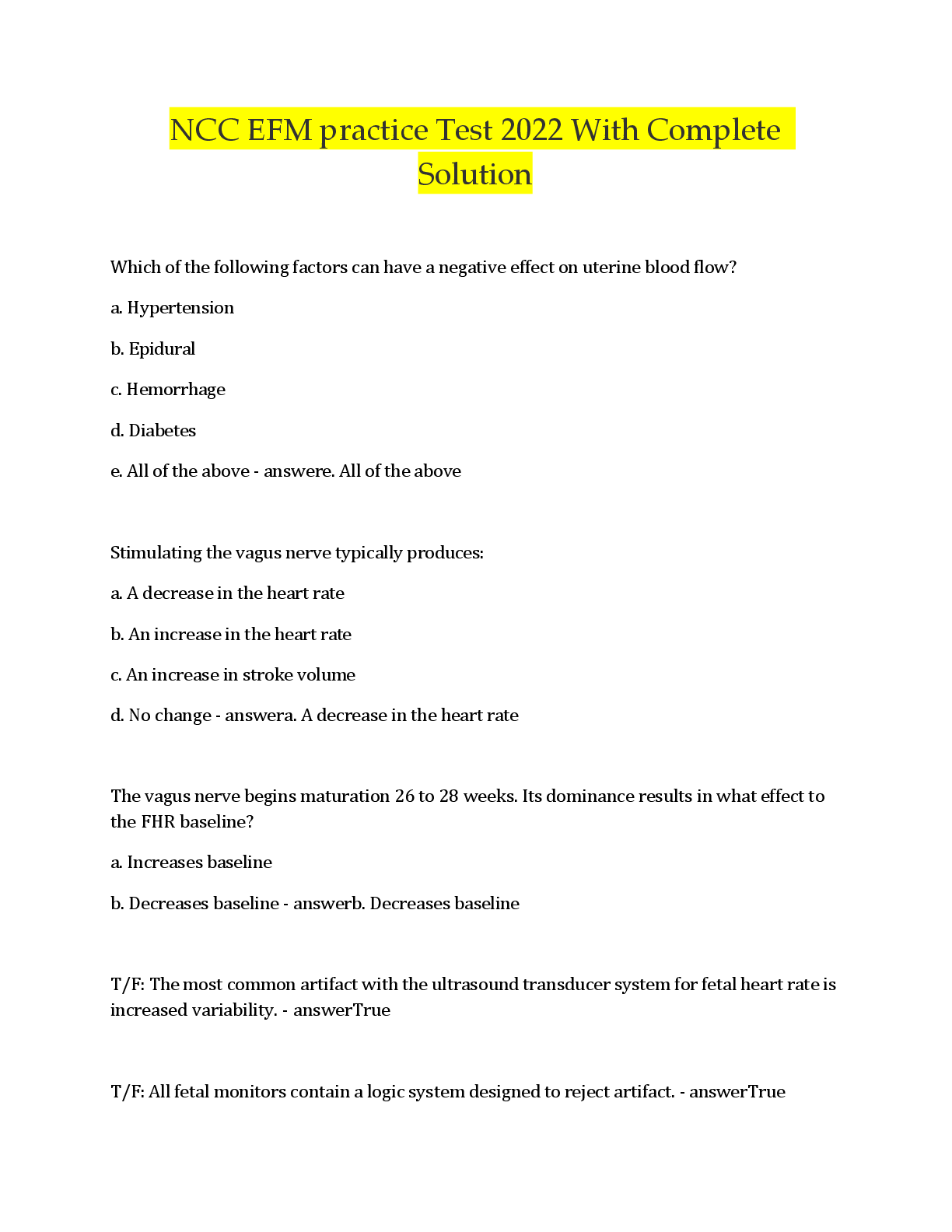
Which of the following factors can have a negative effect on uterine blood flow?
a. Hypertension
b. Epidural
c. Hemorrhage
d. Diabetes
e. All of the above Correct Answer-e. All of the above
Stimulating the vagus nerve typically produces:
a. A decrease in the heart rate
b. An increase in the heart rate
c. An increase in stroke volume
d. No change Correct Answer-a. A decrease in the heart rate
The vagus nerve begins maturation 26 to 28 weeks. Its dominance results in what effect to the FHR
baseline?
a. Increases baseline
b. Decreases baseline Correct Answer-b. Decreases baselineT/F: The most common artifact with the ultrasound transducer system for fetal heart rate is increased
variability. Correct Answer-True
T/F: All fetal monitors contain a logic system designed to reject artifact. Correct Answer-True
T/F: Fetal arrhythmias can be seen on both internal and external monitor tracings. Correct Answer-True
T/F: Variability and periodic changes can be detected with both internal and external monitoring.
Correct Answer-True
T/F: Variable decelerations are a vagal response. Correct Answer-True
T/F: Variable decelerations are the most frequently seen fetal heart rate deceleration pattern in labor.
Correct Answer-True
Etiology of a baseline FHR of 165bpm occurring for the last hour can be:
1. Maternal supine hypotension
2. Maternal fever
3. Maternal dehydration
4. Unknowna. 1 and 2
b. 1, 2 and 3
c. 2, 3 and 4 Correct Answer-c. 2, 3 and 4
The most prevalent risk factor associated with fetal death before the onset of labor is:
a. Low socioeconomic status
b. Fetal malpresentation
c. Uteroplacental insufficiency
d. Uterine anomalies Correct Answer-c. Uteroplacental insufficiency
Which of the following conditions is not an indication for antepartum fetal surveillance?
a. Gestational hypertension
b. Diabetes in pregnancy
c. Fetus in breech presentation
d. Decreased fetal movement Correct Answer-c. Fetus in breech presentation
Which of the following does not affect the degree of fetal activity?
a. Vibroacoustic stimulation
b. Smokingc. Fetal position
d. Gestational age Correct Answer-a. Vibroacoustic stimulation
T/F: Umbilical cord influences that can alter blood flow include true knots, hematomas, and number of
umbilical vessels. Correct Answer-True
T/F: Low amplitude contractions are not an early sign of preterm labor. Correct Answer-False
T/F: Corticosteroid administration may cause an increase in FHR accelerations. Correct Answer-False
T/F: Corticosteroid administration may cause an increase in FHR. Correct Answer-True
T/F: Contractions cause an increase in uterine venous pressure and a decrease in uterine artery
perfusion. Correct Answer-True
As a result of the intrinsic fetal response to oxygen deprivation, increased catecholamine levels cause
the peripheral blood flow to decrease while the blood flow to vital organs increases. These flow changes
along with increased catecholamine secretions have what effect on fetal blood pressure and fetal heart
rate?
A. Increase BP and increase HR
B. Increase BP and decrease HRC. Decrease BP and increase HR
D. Decrease BP and decrease HR Correct Answer-B. Increase BP and decrease HR
During a term antepartum NST (non-stress test), you notice several variable decelerations that decrease
at least 15 bpm and last at least 15 sec long. Which of the following is the least likely explanation?
A. True knot
B. Gestational diabetes
C. Umbilical cord entanglement
D. Oligohydramnios Correct Answer-B. Gestational diabetes
All of the following are likely causes of prolonged decelerations except:
A. Uterine tachysystole
B. Prolapsed cord
C. Maternal hypotension
D. Maternal fever Correct Answer-D. Maternal fever
All of the following could likely cause minimal variability in FHR except
A. Magnesium sulfate administration
B. Fetal sleep cycleC. Narcotic administration
D. Ephedrine administration Correct Answer-D. Ephedrine administration
When an IUPC has been placed, Montevideo units must be ___ or greater for adequate cervical change
to occur.
A. 100
B. 200
C. 300
D. 400 Correct Answer-B. 200
What would be a suspected pH in a fetus whose FHTs included recurrent late decelerations during
labor?
A. 7.10
B. 7.26
C. 7.32
D. 7.41 Correct Answer-A. 7.10
The nurse notes a pattern of decelerations on the fetal monitor that begins shortly after the contraction
and returns to baseline just before the contraction is over. The correct nursing response is to:
a. Give the woman oxygen by facemask at 8-10 L/minb. Position the woman on her opposite side
c. Increase the rate of the woman's intravenous fluid
d. Continue to observe and record the normal pattern Correct Answer-d. Continue to observe and
record the normal pattern
Determining the FHR baseline requires the nurse to approximate the mean FHR rounded to increments
of 5 bpm during a ___-minute window (excluding accelerations and decelerations).
A. 2
B. 5
C. 10
D. 20 Correct Answer-C. 10
Which of the following interventions would best stimulate an acceleration in the FHR?
A. Provide juice to patient
B. Perform vaginal exam
C. Turn patient on left side
D. Vibroacoustic stimulation Correct Answer-B. Perform vaginal exam
Scalp stimulationThe FHR is controlled by the
A. Sympathetic nervous system
B. Sinoatrial node
C. Atrioventricular node
D. Parasympathetic nervous system Correct Answer-B. Sinoatrial node
T/F: Fetal tachycardia is a normal compensatory response to transient fetal hypoxemia. Correct AnswerTrue
At how many weeks gestation should FHR variability be normal in manner?
A. 24 weeks
B. 28 weeks
C. 32 weeks
D. 36 weeks Correct Answer-B. 28 weeks
Reduced respiratory gas exchange from persistent decelerations may cause a rise in fetal PCO2, which
leads first to _______ _______, then _______ _______.
A. Respiratory alkalosis; metabolic acidosis
B. Respiratory acidosis; metabolic acidosis
C. Respiratory alkalosis; metabolic alkalosisD. Respiratory acidosis; metabolic acidosis Correct Answer-B. Respiratory acidosis; metabolic acidosis
Decreased intervillious exchange of oxygenated blood resulting in fetal hypoxia is typically present in
_______.
A. Variable decelerations
B. Late decelerations
C. Early decelerations
D. Accelerations Correct Answer-B. Late decelerations
Place the following interventions for a sinusoidal FHR in the correct order:
1. Prepare for cesarean delivery
2. Place patient in lateral position
3. Determine if pattern is related to narcotic analgesic administration
4. Provide oxygen via face mask
A. 4, 2, 3, 1
B. 3, 1, 2, 4
C. 4, 3, 2, 1
D. 3, 2, 4, 1 Correct Answer-D. 3, 2, 4, 1FHTs with accelerations, no decelerations, and minimal variability would be categorized as
A. Category I
B. Category II
C. Category III Correct Answer-B. Category II
FHTs with minimal variability, absent accelerations, and a 3-minute prolonged deceleration would be
categorized as
A. Category I
B. Category II
C. Category III Correct Answer-B. Category II
Which of the following is not a likely cause of a sinusoidal FHR pattern?
A. Chronic fetal bleeding
B. Fetal hypoxia or anemia
C. Triple screen positive for Trisomy 21
D. Fetal isoimmunization Correct Answer-C. Triple screen positive for Trisomy 21
Which of the following factors is not likely to cause uteroplacental insufficiency?
A. Late-term gestationB. Preeclampsia
C. Gestational diabetes
D. Polyhydramnios
E. Maternal smoking or drug use Correct Answer-D. Polyhydramnios
The normal FHR baseline
A. Decreases during labor
B. Fluctuates during labor
C. Increases during labor Correct Answer-B. Fluctuates during labor
Bradycardia in the second stage of labor following a previously normal tracing may be caused by fetal
A. Hypoxemia
B. Rotation
C. Vagal stimulation Correct Answer-C. Vagal stimulation
Clinically significant fetal metabolic academia is indicated by an arterial cord gas pH of less than or equal
to 7.10 and a base deficit of
A. 3
B. 6C. 12 Correct Answer-C. 12
Fetal bradycardia can result during
A. The sleep state
B. Umbilical vein compression
C. Vagal stimulation Correct Answer-C. Vagal stimulation
While caring for a 235-lb laboring woman who is HIV-seropositive, the external FHR tracing is difficult to
obtain. An appropriate nursing action would be to
A. Apply a fetal scalp electrode
B. Auscultate for presence of FHR variability
C. Notify the attending midwife or physician Correct Answer-C. Notify the attending midwife or
physician
Which IV fluid is most appropriate for maternal administration for intrauterine resuscitation?
A. Lactated Ringer's solution
B. D5L/R
C. Normal saline Correct Answer-C. Normal saline
An EFM tracing with absent variability and no decelerations would be classified asA. Category I
B. Category II (indeterminate)
C. Category III Correct Answer-B. Category II (indeterminate)
An EFM tracing with absent variability and intermittent late decelerations would be classified as
A. Category I
B. Category II
C. Category III Correct Answer-B. Category II
Maternal oxygen administration is appropriate in the context of
A. Recurrent variable decelerations/moderate variability
B. Intermittent late decelerations/minimal variability
C. Prolonged decelerations/moderate variability Correct Answer-B. Intermittent late
decelerations/minimal variability
In the context of hypoxemia, fetal blood flow is shifted to the
A. Brain
B. Liver
C. Lungs Correct Answer-A. BrainBaroreceptor-mediated decelerations are
A. Early
B. Late
C. Variable Correct Answer-C. Variable
An appropriate initial treatment for recurrent late decelerations with moderate variability during first
stage labor is
A. Amnioinfusion
B. Maternal repositioning
C. Oxygen at 10L per nonrebreather face mask Correct Answer-B. Maternal repositioning
Most fetal dysrhythmias are not life-threatening, except for _______, which may lead to fetal congestive
heart failure. Correct Answer-Supraventricular tachycardia
Medications, prematurity, fetal sleep, fetal dysrhythmia, anesthetic agents, or cardiac anomalies may
result in _______ variability. Correct Answer-Decreased
Stimulation of the _____ _____ _____ releases acetylcholine, resulting in decreased FHR. Correct
Answer-Parasympathetic nervous systemThe _____ _____ _____ maintains transmission of beat-to-beat variability. Correct AnswerParasympathetic nervous system
Stimulation of the _____ _____ _____ releases catecholamines, resulting in increased FHR. Correct
Answer-Sympathetic nervous system
Stimulation of _____ results in abrupt decreases in FHR, CO, and BP. Correct Answer-Baroreceptors
Baroreceptors influence _____ decelerations with moderate variability. Correct Answer-Variable
In comparing early and late decelerations, a distinguishing factor between the two is
A. Onset time to the nadir of the deceleration
B. The number of decelerations that occur
C. Timing in relation to contractions Correct Answer-C. Timing in relation to contractions
The underlying cause of early decelerations is decreased
A. Baroceptor response
B. Increased peripheral resistance
C. Vagal reflex Correct Answer-C. Vagal reflexGlucose is transferred across the placenta via _____ _____. Correct Answer-Facilitated diffusion
Oxygen, carbon dioxide, water, electrolytes, urea, uric acid, fatty acids, fat-soluble vitamins, narcotics
barbiturates, anesthetics, and antibiotics are transferred across the placenta via _____ _____. Correct
Answer-Simple (passive) diffusion
Amino acids, water-soluble vitamins, calcium, phosphorus, iron, and iodine are transferred across the
placenta via _____ _____. Correct Answer-Active transport
Well-oxygenated fetal blood enters the _____ ventricle, which supplies the heart and brain. Lessoxygenated blood enters the ______ ventricle, which supplies the rest of the body. Correct Answer-Left;
right
Fetal blood has a _______ affinity for oxygen compared with the mother's blood, which facilitates
adaptation to the low PO2 at which the placenta oxygenates the fetus.
A. Higher
B. Lower Correct Answer-A. Higher
The fetus has a _______ cardiac output and heart rate than the adult, resulting in rapid circulation.
A. Higher
B. Lower Correct Answer-A. HigherWhich statement best describes the relationship between maternal and fetal hemoglobin levels?
A. Fetal hemoglobin is higher than maternal hemoglobin
B. Maternal hemoglobin is higher than fetal hemoglobin
C. Maternal and fetal hemoglobin are the same Correct Answer-A. Fetal hemoglobin is higher than
maternal hemoglobin
A 36 week gestation patient is brought to triage by squad after an MVA on her back. She is not bleeding
and denies pain. She is not short of breath, but c/o dizziness and nausea since they put her on the
gurney. The most likely cause is
A. Abruptio placenta
B. Preterm labor
C. Supine hypotension Correct Answer-C. Supine hypotension
When the hydrogen ion content in the blood rises, the pH
A. Lowers
B. Neutralizes
C. Rises Correct Answer-A. Lowers
***A woman receives terbutaline for an external version. You may expect what on the fetal heart
tracing?
A. Decrease in variabilityB. Increase in baseline
C. No change Correct Answer-B. Increase in baseline
What affect does magnesium sulfate have on the fetal heart rate?
A. Decreases variability
B. Increases variability
C. No change Correct Answer-A. Decreases variability
Sinusoidal pattern can be documented when
A. Cycles are 4-6 beats per minute in frequency
B. The pattern lasts 20 minutes or longer
C. There is moderate or minimal variability Correct Answer-B. The pattern lasts 20 minutes or longer
Vagal stimulation would be manifested as what type of fetal heart rate pattern?
A. Acceleration
B. Early deceleration
C. Tachycardia Correct Answer-B. Early decelerationWhich fetal monitoring pattern is characteristic of cephalopelvic disproportion, especially when seen at
the onset of labor?
A. Early deceleration
B. Late deceleration
C. Variable deceleration Correct Answer-A. Early deceleration
A risk of amnioinfusion is
A. Prolonged labor
B. Uterine overdistension
C. Water intoxication Correct Answer-B. Uterine overdistension
A fetal heart rate pattern that can occur when there is a prolapsed cord is
A. Marked variability
B. Prolonged decelerations
C. Tachycardia Correct Answer-B. Prolonged decelerations
The patient is in early labor with pitocin at 8 mu/min, and FHR is Category I. In the next 15 minutes,
there are 18 uterine contractions. Recommended management is to
A. Address contraction frequency by reducing pitocin dose
B. Continue to increase pitocin as long as FHR is Category IC. Turn the patient on her side and initiate an IV fluid bolus Correct Answer-C. Turn the patient on her
side and initiate an IV fluid bolus
A woman at 38 weeks gestation is in labor. The labor has been uneventful, and the fetal heart tracings
have been normal. Spontaneous rupture of membranes occurs; fetal heart rate drops to 90 beats per
minute for four minutes and then resumes a normal pattern. The most likely etiology for this fetal heart
rate change is
A. Abnormal fetal presentation
B. Impaired placental circulation
C. Possible cord compression Correct Answer-C. Possible cord compression
A woman has 10 fetal movements in one hour. This is considered what kind of movement?
A. Decreased
B. Excessive
C. Normal Correct Answer-C. Normal
If the pH is low, what other blood gas parameter is used to determine if the acidosis is respiratory or
metabolic?
A. HCO3
B. PCO2
C. PO2 Correct Answer-B. PCO2The following cord blood gasses are consistent with: pH 7.10, pCO2 70, pO2 25, base excess -10
A. Metabolic acidosis
B. Mixed acidosis
C. Respiratory acidosis Correct Answer-C. Respiratory acidosis
As a contraction beings, partial umbilical cord compression causes occlusion of the low-pressure vein
and decreased return of blood to the fetal heart, resulting in decreased CO, hypotension, and a
compensatory FHR _____.
A. Acceleration
B. Early deceleration
C. Late deceleration
D. Variable deceleration Correct Answer-A. Acceleration
With complete umbilical cord occlusion, the two umbilical arteries also become occluded, resulting in
sudden fetal hypertension, stimulation of the baroreceptors, and a sudden _______ in FHR.
A. Increase
B. Decrease Correct Answer-B. Decrease
Central _______ are located in the medulla oblongata; peripheral _______ are found in the carotid
sinuses and aortic arch.A. Baroreceptors
B. Chemoreceptors Correct Answer-B. Chemoreceptors
When a fetus is stressed, catecholamine release (epinephrine, norepinephrine) occurs from the medulla
oblongata, shunting blood _______ the brain, heart, and adrenal glands.
A. Toward
B. Away from Correct Answer-A. Toward
T/F: A Doppler device used for intermittent auscultation of the fetal heart rate may be used to identify
rhythm irregularities, such as supraventricular tachycardia. Correct Answer-False
T/F: Use of a fetoscope for intermittent auscultation of the fetal heart rate may be used to detect
accelerations and decelerations from the baseline, and can clarify double-counting of half-counting of
baseline rate. Correct Answer-True
T/F: In the context of moderate variability, late decelerations are considered neurogenic in origin and
are typically amenable to intrauterine resuscitation techniques directed towards maximizing uterine
blood flow. Correct Answer-True
When coupling or tripling is apparent on the uterine activity tracing, this may be indicative of a
dysfunctional labor process and saturation (down regulation) of uterine oxytocin receptor sites in
response to excess exposure to oxytocin. Which of the following interventions would be most
appropriate?A. Normal response; continue to increase oxytocin titration
B. Turn patient on side
C. Decrease or discontinue oxytocin infusion Correct Answer-C. Decrease or discontinue oxytocin
infusion
The most common tachyarrhythmia in fetuses, supraventricular tachycardia, typically occurs at a rate of
_____ to _____ bpm with minimal or absent variability.
A. 160-200
B. 200-240
C. 240-260 Correct Answer-C. 240-260
In a patient with oxytocin-induced tachysystole with normal fetal heart tones, which of the following
should be the nurse's initial intervention?
A. Assist the patient to lateral position
B. Discontinue Pitocin
C. Administer IV fluid bolus Correct Answer-A. Assist the patient to lateral position
In a patient with oxytocin-induced tachysystole with indeterminate or abnormal fetal heart tones, which
of the following should be the nurse's initial intervention?
A. Assist the patient to lateral position
B. Discontinue PitocinC. Administer IV fluid bolus Correct Answer-B. Discontinue Pitocin
Fetal hypoxia and acidemia are demonstrated by pH < _____ and base excess < _____. Correct Answer-<
7.15; < -8
T/F: Uterine resting tone may appear higher (25 to 40 mmHg) during amnioinfusion. Correct AnswerTrue
_______ denotes an increase in hydrogen ions in the fetal blood.
A. Acidosis
B. Acidemia
C. Hypercapnia Correct Answer-B. Acidemia
_______ _______ occurs when there is low bicarbonate (base excess) in the presence of normal
pressure of carbon dioxide (PCO2) values.
A. Metabolic acidosis
B. Respiratory acidosis
C. Metabolic alkalosis Correct Answer-A. Metabolic acidosis
_______ _______ occurs when there is high PCO2 with normal bicarbonate levels.A. Metabolic acidosis
B. Respiratory acidosis
C. Metabolic alkalosis Correct Answer-B. Respiratory acidosis
_______ _______ occurs when the HCO3 concentration is lower than normal.
A. Base deficit
B. Base excess
C. Metabolic acidosis Correct Answer-A. Base deficit
_______ _______ occurs when the HCO3 concentration is higher than normal.
A. Base deficit
B. Base excess
C. Metabolic acidosis Correct Answer-B. Base excess
_______ is defined as the energy-consuming process of metabolism. Correct Answer-Anabolism
_______ is defined as the energy-releasing process of metabolism. Correct Answer-Catabolism
Normal oxygen saturation for the fetus in labor is ___% to ___%. Correct Answer-30% to 65%pH 7.05
PO2 21
PCO2 72
HCO3 24
Base excess -12
A. Metabolic acidosis
B. Respiratory acidosis
C. Mixed acidosis Correct Answer-B. Respiratory acidosis
pH 7.0
PO2 18
PCO2 54
HCO3 20
Base deficit 14
A. Metabolic acidosis
B. Respiratory acidosisC. Mixed acidosis Correct Answer-A. Metabolic acidosis
pH 7.02
PO2 17
PCO2 72
HCO3 19
Base deficit 16
A. Metabolic acidosis
B. Respiratory acidosis
C. Mixed acidosis Correct Answer-C. Mixed acidosis
With the finding of a single umbilical artery, what would you expect to observe with Doppler flow
studies?
A. Decreased blood perfusion from the fetus to the placenta
B. Decreased blood perfusion from the placenta to the fetus
C. Homeostatic dilation of the umbilical artery Correct Answer-A. Decreased blood perfusion from the
fetus to the placentaTwo umbilical arteries flow from the fetus to the placenta
A patient presents with a small amount of thick dark blood clots who denies pain and whose abdomen is
soft to the touch. Which component of oxygen transport to the fetus could potentially be compromised
by this bleeding?
A. Affinity
B. Saturation
C. Delivery Correct Answer-C. Delivery
[Show More]


.png)


.png)