PTCB exam 2020 Questions and
Answers Rated A
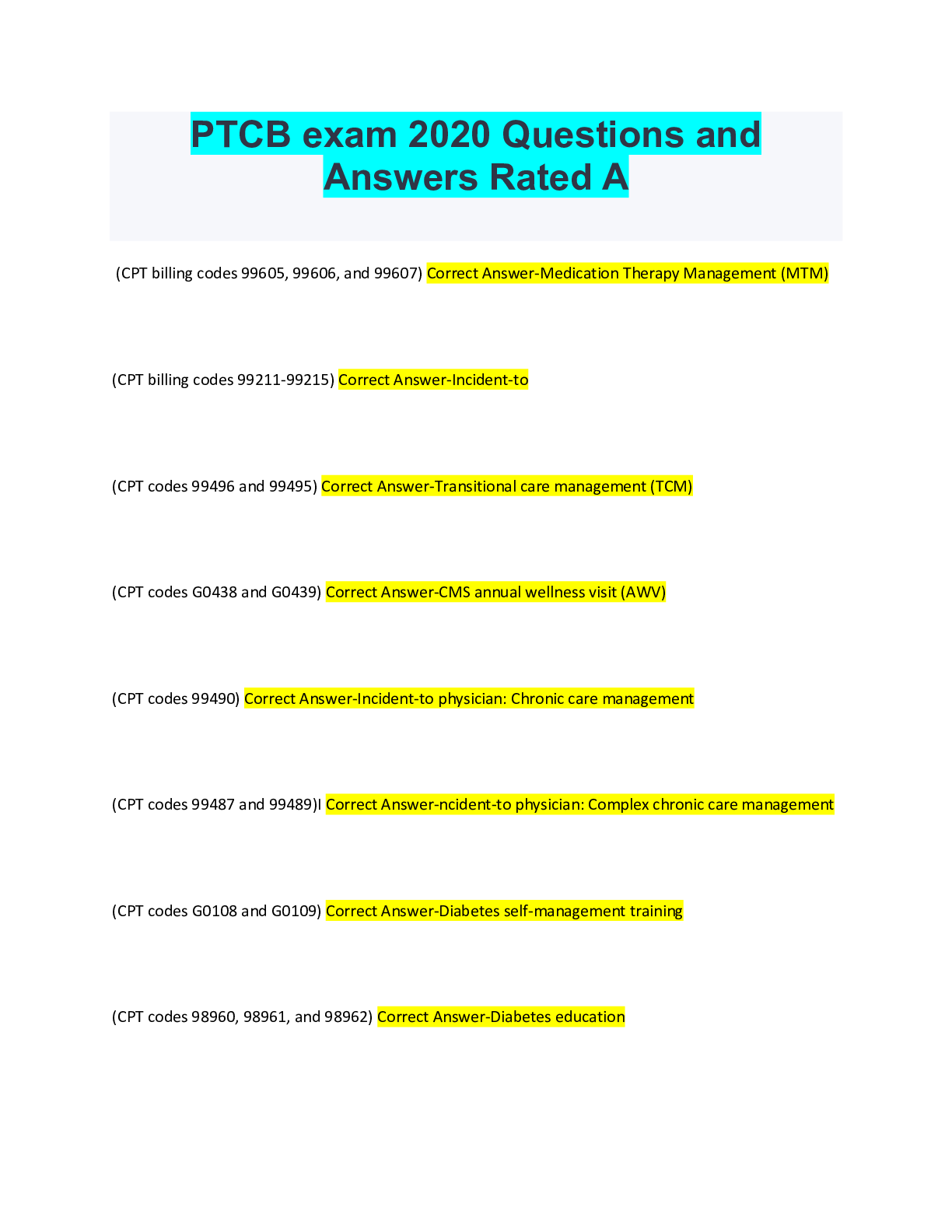
(CPT billing codes 99605, 99606, and 99607) Correct Answer-Medication Therapy Management (MTM)
(CPT billing codes 99211-99215) Correct Answer-Incident-to
(CPT codes 99496
...
PTCB exam 2020 Questions and
Answers Rated A
(CPT billing codes 99605, 99606, and 99607) Correct Answer-Medication Therapy Management (MTM)
(CPT billing codes 99211-99215) Correct Answer-Incident-to
(CPT codes 99496 and 99495) Correct Answer-Transitional care management (TCM)
(CPT codes G0438 and G0439) Correct Answer-CMS annual wellness visit (AWV)
(CPT codes 99490) Correct Answer-Incident-to physician: Chronic care management
(CPT codes 99487 and 99489)I Correct Answer-ncident-to physician: Complex chronic care management
(CPT codes G0108 and G0109) Correct Answer-Diabetes self-management training
(CPT codes 98960, 98961, and 98962) Correct Answer-Diabetes education(APC code 5012 with HCPCS code G0463) Correct Answer-Office visit in a hospital-based clinic (Hospital
outpatient)
(CPT codes 99211-99215) Correct Answer-The majority of options for pharmacist revenue generation
are through the Evaluation and Management (E&M)
Prior Authorization Correct Answer-the need to obtain permission from the insurance company before
seeking certain types of services
There are several kinds of medications that may require prior authorization: Correct Answer-1- A brand
name medication that is available as a generic
2- An expensive medication
3- A medication used for cosmetic reasons (such as those for hair growth and wrinkle treatment)
4- A medication prescribed at higher doses than normal
5- A medication that treats non-life threatening conditions
6- A medication not usually covered by the insurance company, but deemed medically necessary by the
physician
Steps for Prior Authorization: Correct Answer-Step 1: The pharmacy contacts the physician who
prescribed the medication to see if he or she obtained prior authorization from the insurance company
when the drug was prescribed.Step 2: If not, the physician will contact the insurance company and submit a formal authorization
request.
Step 3: The insurance provider may have the patient complete and sign forms.
Step 4: The insurance company will alert the pharmacy once they have approved the prescription or
denied the request.
PHARMACY CLAIM REJECTIONS AND FIXES Correct Answer-1- No PCN (Processor Control Number) on
the claim. To fix this error, you must find the PCN from the patient's insurance card or insurance
company and then edit the claim before resubmitting. You may need to contact the insurance company
to get more information on the problem.
2- No Group Number on the claim. To fix the problem, you must find the patient's group number on the
insurance card, fix the error, and resubmit the claim.
3- No NPI (National Provider Identifier) or invalid NPI on the claim. The pharmacist must have a contract
with the payer. Once the contract is negotiated, the payer will provide an NPI number. This number is
then inputted into the pharmacy software and included on all claims.
4-No Cardholder ID Number or invalid Cardholder ID number on the claim. To fix this, you must find the
correct Cardholder ID number and resubmit the claim.
5- Plan Limitations Exceeded. If the claim submitted needs prior approval before coverage because of
the medication expense, it may be rejected. Additionally, if the medication was already filled in the last
30 days or the quantity dispensed is over the allowed amount for the day supply, the claim may be
rejected. To fix these issues, you will need to contact the insurance company to obtain an override or
approval on the cost before resubmitting the claim.
6-Waiting Too Long to File the Claim. Most insurance companies allow 60 to 90 days from time of
service to file a claim. When claims are filed past that time, the claim may be rejected.
7-Incorrect Patient Information. Any error in patient information will trigger a claim rejection. Commonerrors include incorrect name, days supply, provider, date of birth, etc.
8-Coverage has expired. If the patient does not pay premiums or no longer works at employer-provided
insurance, the patient's coverage may not be current.
10-Coverage limits have been exceeded. The insurance plan may have a limit on the amount of coverage
they provide for each patient annually or for a lifetime. The claim may be rejected if the coverage limits
have been exceeded.
11-Refills. In some cases, the patient may be trying to get a prescription refilled when it either is not
refillable or within too short of a time frame. The insurance payer may reject this claim.
12-Invalid Amount. The prescription may be written for an invalid amount of the medication. Most
insurance companies cover only a 30-day supply of medication. Mail-order prescriptions may cover a 90-
day supply. The amount depends on the actual drug.
Coordination of Benefits (COB) Correct Answer-is the process in which two or more health insurers
cover the same person(s) but limit the total benefit payable for a claim to an amount not exceeding the
total cost of the claim. Coordination of Benefits applies to retail pharmacy claims, member-submitted
paper claims, and mail-order claims. Medicare, Medicaid, and private insurance companies have rules
for determining who pays for the prescription in the case where more than one insurance payer covers
the individual.
The Birthday Rule for Dependents of Parents who Live Together: Correct Answer-This rule determines
whether a plan is primary or secondary for a dependent child who is covered by both parents.If both
parents have the same birthday, then the plan that has been in effect the longest pays as primary.Birthday Rule for Dependents whose Parents are Divorced or Separated or are Not Living Together
(Whether or Not They Have Ever Been Married: Correct Answer-If the court decree states that one of
the parents is responsible for the child's healthcare
expenses/coverage and the plan covering that parent as actual knowledge of those terms, that plan is
primary.
If the responsible parent has no coverage for the child's healthcare expenses, but that parent's spouse
does, that parent's spouse's plan is the primary plan.
If a court decree states that both parents are responsible for the child's healthcare expenses/coverage,
the Birthday Rule determines the order of benefits.
If the court decree states that the parents have joint custody without specifying that one parent has
healthcare coverage responsibility, the Birthday Rule determines the ordre of benefits.
If there is no court decree allocating healthcare coverage responsibility for the child, the order of
benefits
for the child is as follows: a. the plan covering the custodial parent; b. the plan covering the custodial
parent's spouse; c. the plan covering non-custodial parent; and then, d. the plan covering the
noncustodial parent's spouse
hood suould be operated ? Correct Answer-24 hours in hospitals pharmacy and at least 30 min prior to
use in comunity pharmacy.
what reasonable working distance from the Hood? Correct Answer-work should be at least 6 inches into
the hood.sterile instruments should be held under ? Correct Answer-Class 100 (ISO 5)
The federal food and drug act (1906) Correct Answer-prohibited instersate commerce and adulterated
and misbranded drugs.
Fedral Food Drugs and Cosmetics Act ( FDCA1938) Correct Answer-Established the FDA (stated the drugs
cannot brought on the market untill proved to be safe), clarified the definition of misbranding and
adulteration.
Durham-Humphrey Amendment (1951) Correct Answer-It requires the drug prove to be safe and print
instructions clearly on the manufacture label. Created new legend drug what's known as prescription
drug. And created warning (Caution Federal law prohibits dispensing without prescription) Currently the
requirement has been changed in shorter warning (Rx only).
The Kefauver-Harris Amendment (1962) Correct Answer-This law requres for the first time a proof of the
effectiveness of the drug as well as its safety.
The food and administration modernization act (1997) Correct Answer-This act simplifies many FSA
regulations and procedures. It allows greater ease and speed with the FDA can approve a new drug and
granted access to investigational medication. It's also abbreviated the warning to Rx OnlyThe Drug Addiction Treatment Act (2000) Correct Answer-This act permitted physician who completed a
training course and who registers with the DEA to prescribe approved C-III, C-IV, C-V medication.
The Medicaire Modernization Act (2003) Correct Answer-Allow medicaire benificiaries to enroll in
medicaire advantage, or medicaire part D (coverage for prescription drug).
USP Chapter<797> Correct Answer-2004 & 2007, it outlines procedure and practices required for safe
and proper compounding for sterile preparations
USP Chapter <795> Correct Answer-Outlines the procedure of proper compounding of non-sterile
preparations.
The Combat Methamphetamine Epidemic Act (2005) (CMEA) Correct Answer-Regulates retail OTC sales
of ephedrine, pseudoephedrine, phenylpropanolamine product,
(3.6 grams per purchase per day),
(for mail order 7.5g for 30 days),
(for non-mail order 9g during 30 days period).
(required all non-liquid form including gel caps to be in 2-unit blister pack)
Medicaid Temper-Resistant Prescription Pad Law (2008) Correct Answer-Require the physician to write
prescriptions on temper-resistant pads.Affordable Care Act (2010) Correct Answer-Ensures American access to insurance coverage. Americans
may choose insurance through an open market exchange.
The Harrison Narcotic Act (1916) Correct Answer-To control illegal trafficking of narcotics. This law
employs taxation on legally sold narcotics to restrict trafficking.
The Drug Abuse Control Amendment (DACA) (1965) Correct Answer-Expands Harrison Act to include
barbiturates and stimulant drugs
The Bureau of Narcotics and Dangerous Drugs (1968) Correct Answer-The Harrison Act and DACA were
combined under newly formed Bureau of Narcotics and Dangerous Drugs. in 1973, the Bureau was
renamed to the DEA (Drug Enforcement Administration).
The Comprehension Drug Abuse Prevention and Control Act (1970) Correct Answer-Known as Controlled
Substances Act (CSA). Replaced the Harrison and DACA and established the concept of the DEA number
originated with the CSA.
The Poison Prevention Packaging Act (PPPA) (1970) Correct Answer-Requires locking cap on all
prescriptions dispensed from pharmacy with only 3 exceptions.
1) when patient asks for non-safety lid
2) when prescriber asks for non-safety lid
3) when the drug dispensed is an exempted drug (sublingual nitroglycerin).Also required all the prescriptions bottles to be child proof.
The OBRA Law (1990) (Omnibus Budget Reconcildation Act) Correct Answer-1) Retrospective Drug
Utilization Review (DUR)
2) Prospective Drug Utilization Review
3) Mandates councilling to medicaid patient (many states extend councelling to all patients)
JCAHO (Joint Commission on Accreditation of Healthcare Organizations) Correct Answer-Nongovernment organization conduct voluntary certification and inspection on 20,000+ healthcare
organizations including Hospital, Nursing Homes, long term care facilites, Ambulatory care providors,
and clinical laboratories
Patient Package Insert (Monographs) Correct Answer-1) Regulated by FDA
2) PPI (Monograph) must include
A) indication
B) Contradiction
C) Warning
D) Precaution
E) Dose and Route of administrationOccupational Safety and Health Administration (OSHA) (1970) Correct Answer-1) Ensures safe workplace
for employee by reducing hazards in workplace
2) Ensures job safety standard and requires reporting of any job related injuries or illness
3) Requires Material Safety data sheet (MSDS) for any hazardous material
Health Insurance Portability and Accountability Act (HIPAA) (1996) Correct Answer-1) Protect health
insurance coverage for workers and their family when they change job or lose their job. (Purpose of this
act to protect personal health information of patient)
2) Administration simplification - established electonic transaction and code set standards and required
health information privacy
---HIPPA Regulation---
A) Must Disclose protected health information (PHI) in two circumstances: First - when patient requests
access to their own record. Second - when HHS office for civil rights requests for information
B) May disclose PHI in instance which concerns patient treatment payment operation
C) Court Order
D) Criminal Investigation Evidence
MedWatch (1993) Correct Answer-This is the FDA reporting service for adverse effects that occur from
use of approved drugs. When we report any adverse event of drugs, we have to file form FDA 3500
Drug Recalls Correct Answer-Class 1: Serious adverse health consequences or death
Class 2: Health consequences are reversibleClass 3: Not likely to cause adverse health consequences (physically adulterated drug or mislabelling
drugs)
The New Drug Application Process (NDA Process) Correct Answer-Phase I - Trial involves small # of
volunteers to determine maximum tolerated dose of applicant drug (toxicity)
Phase II - Primarily concerned with (effectiveness)
Phase III - Last trial before NDA submitted to FDA. "Double Blind" method with thousands of individuals.
Phase IV - takes place after NDA submits to FDA. Allows manufactures to produce drugs
National Drug Code (NDC) Correct Answer-Each drug produced by a manufacturer is identified with a
specific NDC number. The NDC number is composed of three sets of numbers, which identifies the
manufacturer, drug, and pack size. The first 5 numbers represent the manufacturer. the second 4
numbers represent the drug. The last/third 2 numbers represent the packaging size.
00000-0000-00
DEA number formula Correct Answer-(1st + 3rd + 5th) + 2 (2nd + 4th + 6th) = last digit is last digit of DEA
#.
Usually the first letter is
A or B for physician, provider
F or P for manufacturer
M for mid-level provider
The 2nd letter represents the last name of the providerAG2705208
DEA Forms Correct Answer-222 - to order CII's
224 - to register with the DEA - check box to get 222 forms with registration
106 - to report theft or loss to the DEA
41 - to report drugs surrendered for disposal
104 - pharmacist surrender his/her license
Controlled Substances Act of 1970 Correct Answer-classifies controlled substances according to their
abuse potentials.
Schedule II = Prescription can be handwritten or computer generated but must be signed in ink by
physician (no allowable refill)
Schedule III-V = Prescription can be handwritten or computer generated must be signed by physician in
ink the office may telephone or fax prescription.
Paitent may receive up to 5 refills within 6 months.
Emergency Schedule II Prescription = An oral prescription can be issued under the following conditions:A) Pharmacist must make a good faith attempt to identify the physician
B) Limited to quantity to treat patient during period of emergency only.
C) Pharmacist must reduce order to writing
D) Physician must write prescription for this emergency quantity (pharmacy must receive it within 72
hours of oral order)
What color of the pharmaceutical waste container? Correct Answer-Black
What color of the chemotherapy waste container? Correct Answer-Yellow
What color of the non hazardous pharmaceutical waste container? Correct Answer-Green
What color of sharp objects container Correct Answer-Red
convert pint to mL Correct Answer-1 pint =473.17 mL
convert pint to oz Correct Answer-1 pint -16 OZ
oz to grams Correct Answer-1 oz = 28.4 gqt to mL Correct Answer-1 qt = 946 mL
qt to pt Correct Answer-1 qt = 2 pt
Calculating active ingredient Correct Answer-1w/v1000 = (g of active ingredient/mL of active ingredient)
Code 1 for insurance billing Correct Answer-Insured
Code 2 for insurance billing Correct Answer-Spouse
Code 3 for insurance billing Correct Answer-Dependent
rejection code 19 Correct Answer-Day supplied missing or not valid
Rejection code 11 Correct Answer-Relationship code invalid or missing
Rejection code 9 Correct Answer-When date of birth invalid or missingRejection code 04 Correct Answer-Processor Control Number (PCN)
Rejection code 06 Correct Answer-Group number is missing or invalid
Rejection code 40 Correct Answer-Pharmacy not contracted with this plan
Rejection code 01 Correct Answer-BIN number is missing or invalid
Rejection code 05 Correct Answer-invalid or missing service provider number
Capsules sizes Correct Answer-A size 0 =500 mg
size 1 = 400 mg
size 2 = 300 mg
size 3 200 mg
What type of balance must a pharmacy have? Correct Answer-Class A according to USP <795>
what the air velocity of laminar floww hood Correct Answer-90 linear feet/min (±20) , acc
[Show More]