PMP Exam 2021 Flashcards Questions
and Answers with Complete Solutions
Actual Cost Correct Answer-The realized cost incurred for the work performed on an activity during a
specific time period
Organizational Breakdow
...
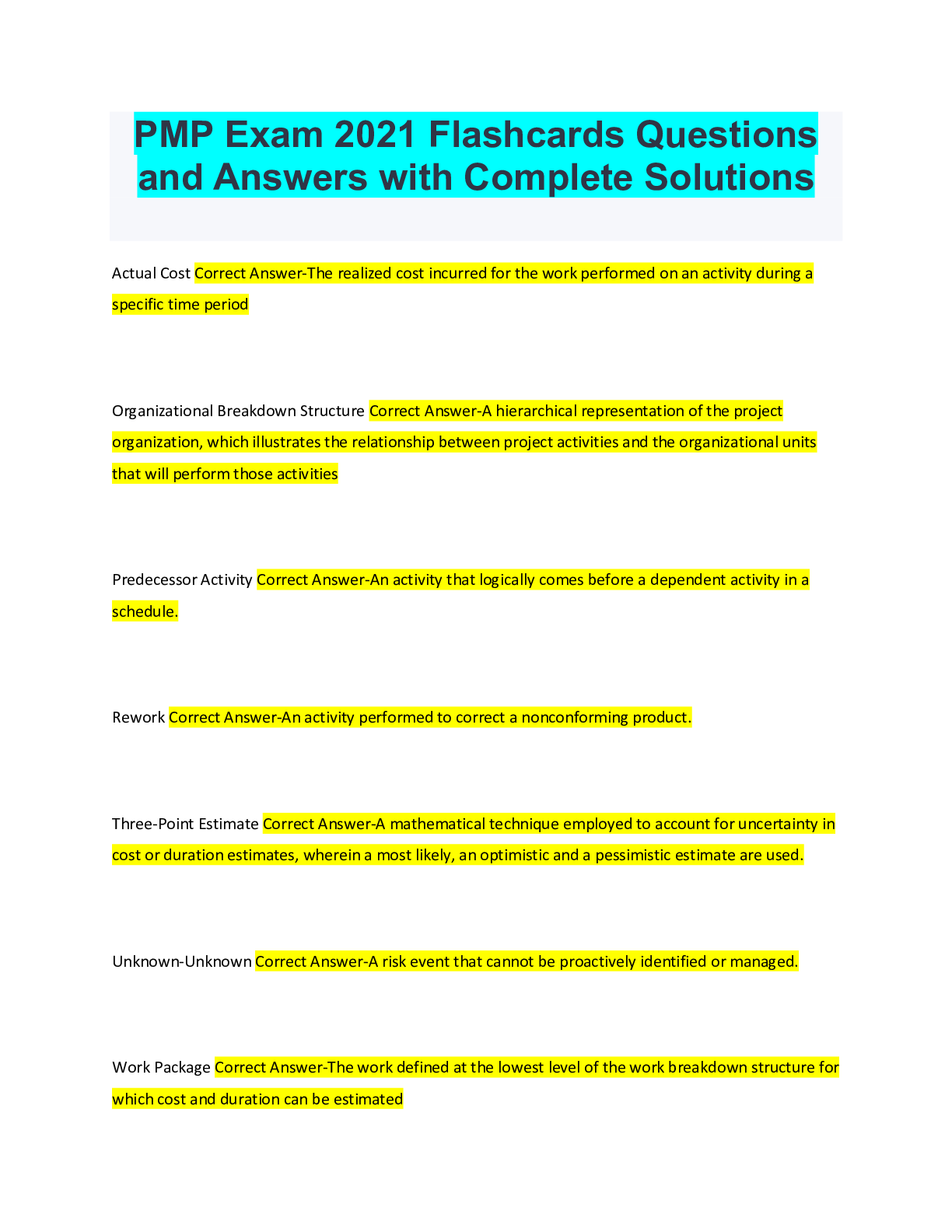
PMP Exam 2021 Flashcards Questions
and Answers with Complete Solutions
Actual Cost Correct Answer-The realized cost incurred for the work performed on an activity during a
specific time period
Organizational Breakdown Structure Correct Answer-A hierarchical representation of the project
organization, which illustrates the relationship between project activities and the organizational units
that will perform those activities
Predecessor Activity Correct Answer-An activity that logically comes before a dependent activity in a
schedule.
Rework Correct Answer-An activity performed to correct a nonconforming product.
Three-Point Estimate Correct Answer-A mathematical technique employed to account for uncertainty in
cost or duration estimates, wherein a most likely, an optimistic and a pessimistic estimate are used.
Unknown-Unknown Correct Answer-A risk event that cannot be proactively identified or managed.
Work Package Correct Answer-The work defined at the lowest level of the work breakdown structure for
which cost and duration can be estimatedAttribute Sampling Correct Answer-A technique where a deliverable is tested against a standard and is
usually pass or fail.
Meetings Correct Answer-A gathering of a group of stakeholders to discuss, and/or decide the outcome,
of issues, or to share, transmit or receive information.
Control Schedule Correct Answer-The process of monitoring the current status of the project schedule,
determining the degree and cause of any variances, and recommending any necessary changes.
Project Management Correct Answer-The application of knowledge, skills, tools, and techniques to
project activities to meet the project requirements
Estimate Costs Correct Answer-The process to estimate the approximate amount of money needed to
complete each activity.
Plan Cost Management Correct Answer-The process to develop the cost management plan, which
contains all of the tools, methodologies, processes and procedures to plan, estimate, and monitor
spending on the project.
Reserve Analysis Correct Answer-The technique employed to compare the amount of reserve on hand,
to the amount of risk that remains.Schedule Model Correct Answer-A representation of the plan for executing the project's activities,
including durations, dependencies, and other planning information, used to produce a project schedule
along with other scheduling artifacts
Conflict Correct Answer-A condition of disagreement that exists between two or more stakeholders.
Epic Correct Answer-This is an oversized backlog item that would need to be decomposed into smaller
component user stories to be completed within a single sprint?
Apportioned Effort Correct Answer-An activity where effort is allotted proportionately across certain
discrete efforts and not divisible into discrete efforts. (Note: Apportioned effort is one of three earned
value management [EVM] types of activities used to measure work performance)
What are story points? Correct Answer-An arbitrary unit of measure for the relative size of a user story
Residual Risk Correct Answer-The amount of the original impact of a risk that remains after
implementation of a response plan.
Discrete Effort Correct Answer-An activity that can be planned and measured and that yields a specific
output. (Note: Discrete effort is on of three earned value management [EVM] types of activities used to
measure work performance)Manage Stakeholder Engagement Correct Answer-The process of ensuring stakeholders are properly
involved throughout the lifecycle of the project, and managed according to the stakeholder
management plan.
What are the two parts of the Sprint Planning meeting? Correct Answer-Part 1: The "what" - led by the
Product Owner
Part 2: The "how" - led by the Development Team
Expectancy Theory Correct Answer-This theory that hypothesizes an individual presumes to be
rewarded for their work. They will remain motivated as long as the rewards meet their expectations and
desires.
Schedule Buffers Correct Answer-A concept used in critical chain method scheduling, wherein time is
added to the various paths of the network diagram based upon the amount of risk in the preceding
path.
Document authorizing a project? Correct Answer-Project Charter
Plan Quality Management Correct Answer-The process to write a quality management plan, which
demonstrates how the project will comply to the quality standards.Risk Breakdown Structure Correct Answer-A hierarchical representation of risks that is organized
according to risk categories
Procurement Audits Correct Answer-A technique applied to gather lessons learned specifically for the
procurement process.
Project Expeditor Correct Answer-A staff assistant to a mid-level manager, has very little, if any,
decision-making ability, and is primarily responsible for ensuring resources are available when needed.
Project Manager Correct Answer-The person who is solely responsible for meeting the project
objectives.
Milestone Correct Answer-A significant point in a project, program, or portfolio.
Project Management Information System (PMIS) Correct Answer-A collection of various systems used to
manage the inputs and outputs of the project management processes.
Delphi Technique Correct Answer-A technique used to gain consensus of a group of stakeholders when
multiple levels of experience, politics, or conflict is present. Sometimes called blind requirements
gathering.Herzberg's Motivation-Hygiene Theory Correct Answer-The theory that hypothesizes the notion that the
amount of pay an employee receives does not satisfy, but it will prevent dissatisfaction.
Control Costs Correct Answer-The process of monitoring cost performance on the project, determining
the cause and degree of any variances and recommending any necessary changes.
Black Swan Correct Answer-A term used in risk to identify an extremely low probability, yet extremely
high impact threat.
Schedule Performance Index Correct Answer-A measure of schedule efficiency expressed as the ratio of
earned value to planned value. Formula: EV / PV
Estimate at Completion Correct Answer-The expected total cost of completing all work expressed as the
sum of the actual cost to date and the estimate to complete
Schedule Variance Correct Answer-A measure of schedule performance expressed as the difference
between the earned value and planned value. Formula: EV - PV
Successor Activity Correct Answer-A dependent activity that logically comes after another activity in a
scheduleWhat is the difference between coaching and mentoring? Correct Answer-Mentoring is for transfer of
knowledge and coaching is done to improve performance
Baseline Correct Answer-The approved version of work product, or the schedule, budget, or scope,
which can be changed only through formal change control procedures and is used as a basis for
comparison.
Determine Budget Correct Answer-The process to determine how much money will be needed for the
project, when it will be needed, and to develop the cost baseline.
Portfolio Correct Answer-Projects, programs, subportfolios, and operations managed as a group to
achieve strategic objectives
Early Finish Date Correct Answer-In the critical path method, the earliest point in time when the
uncompleted portions of a schedule activity can finish based on the schedule network logic, the data
date, and any schedule constraints
Workaround Correct Answer-A response to a threat that has occurred, for which a prior response had
not been planned or was not effective
Rolling Wave Planning Correct Answer-An iterative planning technique in which the work to be
accomplished in the near term is planned in detail, while the work in the future is planned at a higher
levelAcquire Project Team Correct Answer-The process used to obtain the team necessary to complete the
project objectives.
What are the characteristics of a well structured product backlog? Correct Answer-DEEP - Detailed
Appropriately, Estimated, Emergent, and Prioritized
Communication Management Plan Correct Answer-A component of the project, program, or portfolio
management plan that describes how, when, and by whom information will be administered and
disseminated
Identify Risks Correct Answer-The process of determining which opportunities and threats may affect
the project.
Gantt Chart Correct Answer-A bar chart of schedule information where activities are listed on the
vertical axis, dates are shown on the horizontal axis, and activity durations are shown as horizontal bars
placed according to start and finish dates
Customer Correct Answer-The recipient of the goods and services, or products of the project.
Resource Breakdown Structure Correct Answer-A hierarchical representation of resources by category
and typeResource Management Plan Correct Answer-A component of the project or program management plan
that describes how the roles and responsibilities, reporting relationships, and staff management will be
addressed and structured
Earned Value Correct Answer-The estimated and approved amount, for specific work that has been
completed. Usually expressed in terms of currency (dollars).
Physical Percent Complete Correct Answer-An estimate expressed as a percent of the amount of work
that has been physically completed on an activity or a work breakdown structure component
Autocratic Correct Answer-A group decision-making technique where one individual makes the choice
for the entire group.
Quality vs. Grade Correct Answer-The difference between a product that fulfills requirements versus a
category assigned to a products that have the same functional use but different technical
characteristics.
Risk Register Correct Answer-A project document used to record a list of risks and other risk-related
information as it becomes available.
Salience Model Correct Answer-A tool that assists with the classification of stakeholders based on the
their power, legitimacy and urgency.What does IRR stand for? Correct Answer-Internal Rate of Return
Level of Effort Correct Answer-An activity that does not produce definitive end product and is measured
by the passage of time. (Note: Level of effort is one of three earned value management [EVM] types of
activities used to measure work performance)
Procurement Statement of Work Correct Answer-The explicit sections of the project's statement of
work, WBS and WBS dictionary that pertain to a particular procurement
Who holds the formal authority to abnormally terminate a sprint? Correct Answer-Product Owner
Late Finish Date Correct Answer-In the critical path method, the latest possible point in time when the
uncompleted portions of a schedule activity can finish based on the schedule network logic, the project
completion date, and any schedule constraints
Phase Gate Correct Answer-A review at the end of a phase in which a decision is made to continue to
the next phase, to continue with modification, or to end a project or program
Program Management Correct Answer-The application of knowledge, skills, tools, and techniques to a
program to meet the program requirements and to obtain benefits and control not available by
managing projects individuallyWhat is a "Scrum-butt?" Correct Answer-A haphazard or partial approach to implementing agile
practices. We use Scrum, but we don't do daily stand-ups because we can't corral everyone at the same
time.
A good user story has characteristics encapsulated by the acronym INVEST. What are these
characteristics? Correct Answer-Independent, Negotiable, Valuable, Estimable, Small, and Testable
Communication Channels Correct Answer-A formula used to determine the maximum number of
communications pathways within a given set of team members. Formula: [N(N-1)]/2
Probability & Impact Matrix Correct Answer-A tool that can be used to quickly identify the overall rating
of a risk, based upon its probability of occurrence and its expected impact.
Requirements Management Plan Correct Answer-A component of the project or program management
plan that describes how requirements will be analyzed, documented, and managed
Closed Procurements Correct Answer-An output of the process to formally close each procurement,
usually presented in formal written form.
Tornado Diagram Correct Answer-A horizontal type of bar chart where data categories are listed
vertically, so that the largest bar appears at the top of the chart, and the smallest bar appears at the
bottom. Normally used with and is an outcome of a sensitivity analysis.WBS Dictionary Correct Answer-A document that provides detailed deliverable, activity, and scheduling
information about each component in the work breakdown structure
Mutual Exclusivity Correct Answer-A term used to logically identify two events that cannot occur at the
same time.
Stakeholder Correct Answer-An individual, group, or organization who may affect, be affected by, or
perceive itself to be affected by a decision, activity, or outcome of a project, program, or portfolio
Effort Correct Answer-The number of labor units required to complete a schedule activity or work
breakdown structure component, often expressed in hours, days, or weeks
Project Schedule Correct Answer-An output of a schedule model that presents linked activities with
planned dates, durations, milestones, and resources
Cost Management Plan Correct Answer-A component of a project or program management plan that
describes how costs will be planned, structured, and controlled
Fait Accompli Correct Answer-A French word for is complete, and in negotiations it is used as a tactic
when attempting to deflect the conversation away from an negotiable issueControl Quality Correct Answer-The process of verifying that each deliverable meets the quality
standards.
Organizational Charts & Position Descriptions Correct Answer-A tool used to identify the organization of
the project, lines of reporting, and descriptions of the various functions.
Control account Correct Answer-A management control point, usually used in earned value, to bring
actual cost, actual scope and actual duration, and compared it to the baseline, usually at a level above
the work packages of the WBS.
Finish-to-Start Correct Answer-A logical relationship in which a successor activity cannot start until a
predecessor activity has finished
Resource Smoothing Correct Answer-A technique applied to reduce or eliminate over-allocations of
resources assigned to project activities, using only the available amount of float, which preserves the
project completion date.
Risk Category Correct Answer-A group of potential causes of risk
Statistical Independence Correct Answer-A term used when calculating probabilities, in that the
occurrence of one event has no effect on the occurrence of another event. To calculate the probability
of these types of events, you multiply the probability of t
[Show More]