ANCC Practice Questions and Answers
with Complete Solutions
In the early stages of iron deficient anemias, blood studies show:
(a) macrocytic normochromic
(b) microcytic hypochromic
(c) normochromic normocytic
(d)
...
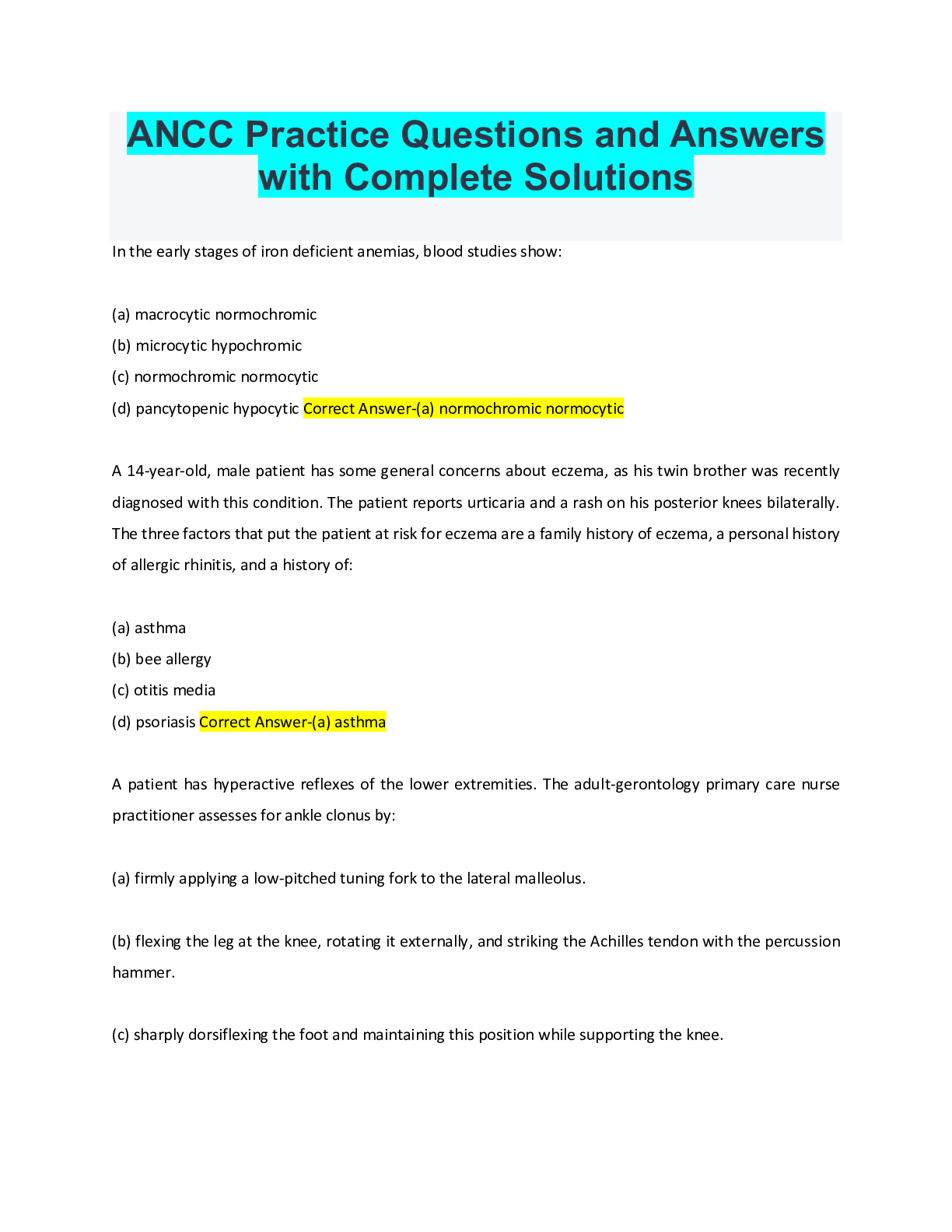
ANCC Practice Questions and Answers
with Complete Solutions
In the early stages of iron deficient anemias, blood studies show:
(a) macrocytic normochromic
(b) microcytic hypochromic
(c) normochromic normocytic
(d) pancytopenic hypocytic Correct Answer-(a) normochromic normocytic
A 14-year-old, male patient has some general concerns about eczema, as his twin brother was recently
diagnosed with this condition. The patient reports urticaria and a rash on his posterior knees bilaterally.
The three factors that put the patient at risk for eczema are a family history of eczema, a personal history
of allergic rhinitis, and a history of:
(a) asthma
(b) bee allergy
(c) otitis media
(d) psoriasis Correct Answer-(a) asthma
A patient has hyperactive reflexes of the lower extremities. The adult-gerontology primary care nurse
practitioner assesses for ankle clonus by:
(a) firmly applying a low-pitched tuning fork to the lateral malleolus.
(b) flexing the leg at the knee, rotating it externally, and striking the Achilles tendon with the percussion
hammer.
(c) sharply dorsiflexing the foot and maintaining this position while supporting the knee.(d) stroking the lateral aspect of the sole from the heel to the ball of the foot with the sharp end of the
percussion hammer. Correct Answer-(c) sharply dorsiflexing the foot and maintaining this position while
supporting the knee.
A 70-year-old, female patient is having her yearly evaluation. The adult-gerontology primary care nurse
practitioner gives which physical examination finding the highest priority for immediate treatment?
(a) Atrophy of vaginal rugae.
(b) Cystocele present.
(c) Palpable ovary.
(d) Pessary in place. Correct Answer-(c) Palpable ovary.
The adult-gerontology primary care nurse practitioner reminds a 16-year-old, male patient who just
received his driver's license to wear a seat belt at all times when in a car. The patient replies that he does
not need to wear a seat belt, because nothing will happen to him if he is involved in an automobile
collision. According to the health belief model, what chief component does the patient lack?
(a) Enabling factors.
(b) Motivation.
(c) Perceived role conflict.
(d) Perceived severity. Correct Answer-(d) Perceived severity.
The adult-gerontology primary care nurse practitioner treats several patients for biological exposure. In
the patients' records, the nurse practitioner documents which epidemiological factors for each exposure?
(a) Comorbidities and length of exposure.
(b) Location and event intensity.
(c) Mode of transmission and incubation.
(d) Premorbid conditions and surveillance rates. Correct Answer-(c) Mode of transmission and incubation.When disseminating research findings in a peer-reviewed journal, the adult-gerontology primary care
nurse practitioner:
(a) concludes that the study proves the hypothesis.
(b) excludes the discussion section, because the conclusion contains this information.
(c) recommends incorporating the results directly into clinical practice.
(d) uses the methodology section to support the validity of the study. Correct Answer-(d) uses the
methodology section to support the validity of the study.
A patient's adult child telephones the adult-gerontology primary care nurse practitioner to inquire about
the patient's illness. The patient's child reports that the parent relies upon the child to explain everything
to him or her. The nurse practitioner:
(a) asks the child to provide a copy of the patient's advance directive document.
(b) assures the child that the nurse practitioner can disclose requested information.
(c) informs the child that he or she must come to the clinic to discuss the parent's case.
(d) tells the child that the nurse practitioner can discuss the information only with the patient. Correct
Answer-(d) tells the child that the nurse practitioner can discuss the information only with the patient.
The adult-gerontology primary care nurse practitioner is appointed to a hospital's multidisciplinary
medical ethics review committee. The nurse practitioner's role is to:
(a) evaluate standards, risks, benefits, and outcomes.
(b) identify how to anticipate and resolve similar future situations.(c) investigate the need for disciplinary action.
(d) obtain agreement of all parties with a chosen solution. Correct Answer-(a) evaluate standards, risks,
benefits, and outcomes.
To improve the quality of clinical practice, the adult-gerontology primary care nurse practitioner:
(a) charges a fee for patients who arrive late to clinic appointments.
(b) disseminates research study results to colleagues.
(c) expresses opinions about alternative therapies with patients who consider such treatments.
(d) schedules time during clinic hours to meet with pharmaceutical representatives. Correct Answer-(b)
disseminates research study results to colleagues.
One effect of using electronic health record applications, such as telemedicine and portable monitoring
systems, has been to:
(a) create stand-alone clinics.
(b) decrease billable visits.
(c) increase risks to patients.
(d) open access to care. Correct Answer-(d) open access to care.
The adult-gerontology primary care nurse practitioner evaluates an 80-year-old patient with cognitive
deficits, who is unaccompanied by the adult child who typically is present. The patient has urinary
symptoms, for which the nurse practitioner considers ordering sulfamethoxazole-trimethoprim (Bactrim).
The patient's previous medical record is unavailable. Before prescribing the medication, the nurse
practitioner:
(a) contacts the patient's adult child.(b) queries the other staff members.
(c) relies on the patient's self-report.
(d) waits until the patient's chart is available. Correct Answer-(a) contacts the patient's adult child.
The adult-gerontology primary care nurse practitioner conducts a small group class on weight
management. The nurse practitioner anticipates that the patient who may have the greatest difficulty
implementing the counseling is the:
(a) extroverted patient raising his or her grandchildren.
(b) introverted patient who does not speak in the group.
(c) personable patient who lives with his or her children.
(d) worried patient whose son is serving in military conflict. Correct Answer-(d) worried patient whose son
is serving in military conflict.
The adult-gerontology primary care nurse practitioner evaluates a patient with cold symptoms who
reports smoking half a pack of cigarettes a day and shows no interest in quitting. The nurse practitioner's
most appropriate approach is to treat the cold symptoms and:
(a) advise the patient to stop smoking.
(b) prescribe bupropion (Zyban).
(c) raise the issue of smoking cessation at the next visit.
(d) recommend that the patient select a low nicotine cigarette. Correct Answer-(a) advise the patient to
stop smoking.The adult-gerontology primary care nurse practitioner plans to provide smoking cessation education at a
community center to older adults and their families. The nurse practitioner designs the program based on
knowledge that older adult smokers:
(a) are likely to be optimistic about their ability to quit.
(b) are more likely to be successful at quitting than younger smokers.
(c) have a decreased risk of morbidity and mortality than do younger smokers.
(d) receive more instruction to quit from health care providers than younger smokers. Correct Answer-(b)
are more likely to be successful at quitting than younger smokers.
An 84-year-old patient arrives at the office for an initial visit. The patient questions the need for colorectal
screening, since 10 years have passed since the last colonoscopy. The adult-gerontology primary care
nurse practitioner recommends:
(a) a colonoscopy.
(b) a fecal DNA test.
(c) flexible sigmoidoscopy.
(d) watchful waiting. Correct Answer-(d) watchful waiting.
To evaluate for heart failure, which diagnostic test does the adult-gerontology primary care nurse
practitioner order for a patient with swelling in the lower extremities?
(a) Ankle-brachial index.
(b) Brain natriuretic peptide test.
(c) D-dimer assay.
(d) Spirometry study. Correct Answer-(b) Brain natriuretic peptide test.Before placing a patient with onychomycosis on a pulsed dose of itraconazole (Sporanox), which
laboratory values does the adult-gerontology primary care nurse practitioner obtain?
(a) Liver function studies.
(b) Platelet count.
(c) Renal function studies.
(d) White blood cell count. Correct Answer-(a) Liver function studies.
A 30-year-old, female patient has a two-week history of nausea, vomiting, decreased weight, abdominal
pain, and a long-term history of multiple sexual partners. The patient's physical examination reveals
abdominal tenderness with icteric sclerae and skin. Which laboratory test confirms active hepatitis B?
(a) Antibody.
(b) Enzyme-linked immunosorbent assay.
(c) Immune globulin G.
(d) Surface antigen. Correct Answer-(d) Surface antigen.
For two to three months, a 78-year-old patient has not been taking levothyroxine (Synthroid) as
prescribed. The patient now has symptoms of increasing constipation, lethargy, and weakness. The adultgerontology primary care nurse practitioner anticipates that laboratory tests will show that the patient's:
(a) T4 level decreased, and TSH level increased.
(b) T4 level increased, and TSH level decreased.
(c) T4 level increased, and TSH level is unchanged.
(d) T4 level is unchanged, and TSH level decreased. Correct Answer-(a) T4 level decreased, and TSH level
increased.A 68-year-old patient has sustained an unintended weight loss of 15 lb (6.8 kg) over the last two months
but reports feeling well. The patient's problems include depression, tobacco abuse, obesity, and
dyslipidemia. His or her medications are sertralizine (Zoloft), simvastatin (Zocor), and famotidine (Pepcid).
The adult-gerontology primary care nurse practitioner performs which THREE actions?
(a) Adds a probiotic.
(b) Conducts a depression screening.
(c) Decreases the dosage of the statin medication.
(d) Obtains a chest x-ray.
(e) Orders a thyroid-stimulating hormone. Correct Answer-(b) Conducts a depression screening.
(d) Obtains a chest x-ray.
(e) Orders a thyroid-stimulating hormone.
Preparing to implement an incontinence reduction program at a nursing home, the adult-gerontology
primary care nurse practitioner reviews several studies. Place the studies in sequential order of the
strength of evidence for this population from strongest to weakest.
(a) A case report of an experimental incontinence reduction program in older adults.
(b) A consensus statement from the urologic association regarding the use of scheduled toileting.
(c) A systematic review of nonrandomized trials concerning the use of vaginal estrogen. Correct AnswerStrongest evidence: (c) a systematic review
...then: (b) a consensus statementWeakest evidence: (a) a case report
What factors does the adult-gerontology primary care nurse practitioner need to consider when
discussing advanced care planning with a patient?
(a) Autonomy and patient safety are rarely competitive considerations.
(b) Decisions regarding a health care representative are a family group decision.
(c) Family members are not integral components in care planning.
(d) Trust and rapport with patients are key to patient satisfaction in decisions for care. Correct Answer-
(d) Trust and rapport with patients are key to patient satisfaction in decisions for care.
The adult-gerontology primary care nurse practitioner working in an urban community health center
recognizes that asthma-related health issues commonly result in higher morbidity and mortality for
persons with:
(a) alcohol dependency.
(b) lower socioeconomic status.
(c) persistent social isolation.
(d) recent immigrant status. Correct Answer-(b) lower socioeconomic status.
During an annual health visit, a 15-year-old female patient is found to have grown 5 in (12.7 cm) over the
past year. She has not reached menarche. Her mother is concerned because the patient's sister reached
menarche at age 11 and the mother reached menarche at age 12. Examination reveals that the patient's
breasts are enlarged, with the areolae forming a mound above the general contour of each breast, andthat the left breast is larger than the right. Axillary hair is absent and the pubic hair is dark, coarse, curly,
dense, and similar in pattern to that of an adult female. These findings are consistent with a diagnosis of:
(a) hypothyroidism.
(b) normal development.
(c) polycystic ovary syndrome.
(d) Turner syndrome. Correct Answer-(b) normal development.
A pale, thin 54-year-old male patient reports a two-month history of numbness in his feet. Past medical
history includes hypertension and a subtotal gastrectomy. An examination reveals a decreased vibratory
sensation and position sense. Blood tests indicate a hematocrit of 27%, mean corpuscular volume of 105
fL, mean corpuscular hemoglobin of 45 pg, and reticulocytes of 1.5%. The diagnosis is:
(a) chronic simple anemia.
(b) folate deficiency anemia.
(c) iron deficiency anemia.
(d) vitamin B12 deficiency anemia. Correct Answer-(d) vitamin B12 deficiency anemia.
Upon referral from a gynecologist, an adult nurse practitioner evaluates an 89-year-old female nursing
home resident for vaginal bleeding. The patient has a history of occasional periods of confusion and
memory loss. The gynecologist recommended dilation and curettage and the patient consented to the
procedure after the gynecologist answered her questions, but the patient's daughter protests. The nurse
practitioner's ethical duty is to support the:
(a) daughter, because she might file a lawsuit over unsatisfactory care.
(b) daughter, because the patient is occasionally confused and incapable of granting informed consent.
(c) nursing home administration, which may choose to support either the patient or the daughter.
(d) patient, who has given informed consent. Correct Answer-(d) patient, who has given informed consent.A 16-year-old patient has been diagnosed with mononucleosis and has a positive throat culture for group
Alpha-hemolytic streptococcal infection. The medication of choice for this patient is:
(a) amoxicillin (Amoxil).
(b) doxycycline (Vibramycin).
(c) erythromycin (E-Mycin).
(d) trimethoprim-sulfamethoxazole (Bactrim). Correct Answer-(c) erythromycin (E-Mycin).
A 70-year-old patient reports fatigue and a nonproductive cough with pain on inspiration and expiration.
The patient denies a sore throat, fever, nasal congestion, or postnasal drip. Examination reveals a welldeveloped patient in no acute distress who is afebrile and has respirations of 32 breaths/min. The patient's
lungs have diminished breath sounds. The heart rate is 70 beats/min, regular with no murmur. There is
no edema of the extremities. An adult nurse practitioner orders:
(a) a chest x-ray.
(b) a lung perfusion scan.
(c) over-the-counter treatments for symptomatic relief.
(d) pulmonary function tests. Correct Answer-(a) a chest x-ray.
An adult nurse practitioner is educating a female patient about her newly diagnosed phobia. The nurse
practitioner explains that phobias differ from other anxiety disorders in that phobias:
(a) are innate and can be prevented.
(b) are related to specific trigger experiences.(c) occur at a later age.
(d) often involve depressive symptoms. Correct Answer-(b) are related to specific trigger experiences.
A 78-year-old male patient comes to the ambulatory care clinic and reports an inability to void. The adult
nurse practitioner has difficulty inserting a urinary catheter due to an obstruction. The nurse practitioner's
action is to:
(a) obtain consent from the patient to perform prostatic massage.
(b) perform a suprapubic aspiration to relieve bladder distention.
(c) prescribe an oral loop diuretic.
(d) refer the patient to a urologist for further treatment. Correct Answer-(d) refer the patient to a urologist
for further treatment.
A patient comes to the clinic with reports of acute pain and loss of vision in the right eye. The adult nurse
practitioner informs the patient that these symptoms require:
(a) assessment with a split lamp.
(b) examination with an otoscope.
(c) immediate referral to an ophthalmologist.
(d) treatment with several ophthalmologic agents. Correct Answer-(c) immediate referral to an
ophthalmologist.
A 45-year-old patient with diabetes comes to the clinic for an annual appointment. The patient declines a
parenteral influenza vaccination because a friend "came down with the flu after receiving the
vaccination." The adult nurse practitioner explains that the vaccination is:(a) a polysaccharide, so it may cause a mild case of influenza.
(b) activated, so it may cause a mild case of influenza.
(c) inactivated, and this is unable to cause influenza.
(d) live attenuated, so it may cause a mild case of influenza. Correct Answer-(c) inactivated, and this is
unable to cause influenza.
An institutional review board rejects an adult nurse practitioner's research proposal on the grounds that
the:
(a) chosen statistics were not optimal to meet research objectives.
(b) literature review was insufficient to develop the research question.
(c) proposed budget did not cover the cost of the study.
(d) subject's rights were not clearly protected. Correct Answer-(d) subject's rights were not clearly
protected.
A patient informs an adult nurse practitioner, "I want to stop smoking." The nurse practitioner responds:
(a) "Do you have any ideas about how you would like to quit smoking?"
(b) "Does your health insurance cover smoking cessation?"
(c) "I will develop a plan for you to stop smoking."
(d) "Quitting smoking is the most important thing you can do for your health." Correct Answer-(a) "Do you
have any ideas about how you would like to quit smoking
[Show More]