WGU D027 Study Guide Latest Update
Already Graded A
21st Trisomy Correct Answer- Down Syndrome
Ace Inhibiters (ACEI) *pril Correct Answer- reduce angiotensin II, increase bradykinin,
hyperkalemia, dry cough, angioede
...
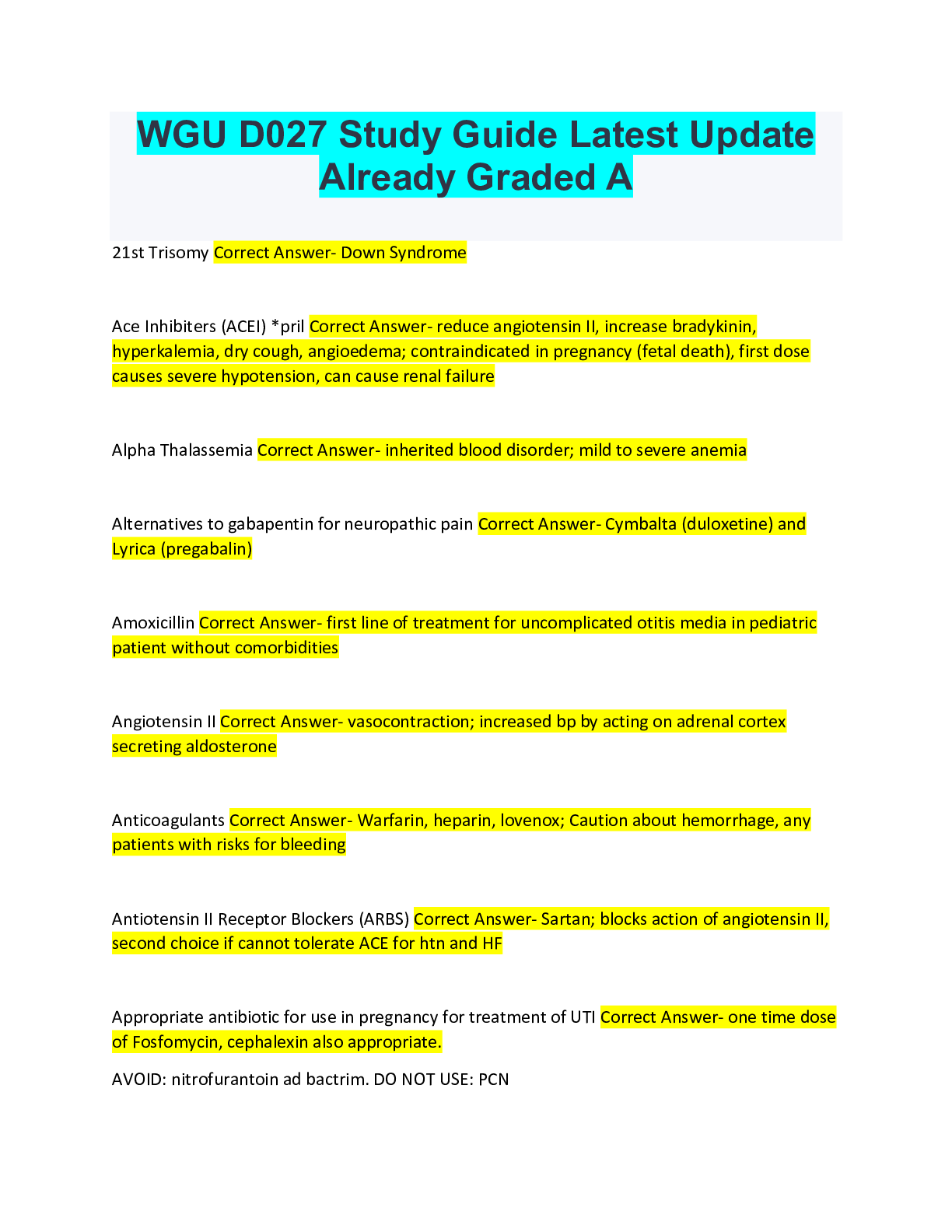
WGU D027 Study Guide Latest Update
Already Graded A
21st Trisomy Correct Answer- Down Syndrome
Ace Inhibiters (ACEI) *pril Correct Answer- reduce angiotensin II, increase bradykinin,
hyperkalemia, dry cough, angioedema; contraindicated in pregnancy (fetal death), first dose
causes severe hypotension, can cause renal failure
Alpha Thalassemia Correct Answer- inherited blood disorder; mild to severe anemia
Alternatives to gabapentin for neuropathic pain Correct Answer- Cymbalta (duloxetine) and
Lyrica (pregabalin)
Amoxicillin Correct Answer- first line of treatment for uncomplicated otitis media in pediatric
patient without comorbidities
Angiotensin II Correct Answer- vasocontraction; increased bp by acting on adrenal cortex
secreting aldosterone
Anticoagulants Correct Answer- Warfarin, heparin, lovenox; Caution about hemorrhage, any
patients with risks for bleeding
Antiotensin II Receptor Blockers (ARBS) Correct Answer- Sartan; blocks action of angiotensin II,
second choice if cannot tolerate ACE for htn and HF
Appropriate antibiotic for use in pregnancy for treatment of UTI Correct Answer- one time dose
of Fosfomycin, cephalexin also appropriate.
AVOID: nitrofurantoin ad bactrim. DO NOT USE: PCNasthma Correct Answer- chronic inflammatory obstruction of bronchi; trigger causing mucus
clogging bronchial tubes; is reversable, give beta antagonists and steroids
At Risk for HF - Stage A Correct Answer- no structural heart disease or symptoms of heart
failure
At Risk for HF - Stage B Correct Answer- structural heart disease but no symptoms of heart
failure
Ataxia in pediatric patient Correct Answer- genetic predisposition, Fragile X syndrome, PraderWillie Syndrome
Autosomal Dominant Correct Answer- 1 parent has, 50% change of child having
Autosomal Recessive Correct Answer- Both parents are carriers, 25% change of child having,
50% chance child is a carrier.
B&T lymphocytes Correct Answer- immune response
Back pain treatment Correct Answer- first 4-6 weeks no imaging needed unless neurologic
involved; give NSAIDS and rest, is the #1/2 reason for visits to PCP
Beta Blockers Correct Answer- prevent chemical messengers; slow HR, relax vessels, lower BP,
Class II antidysrhythmic drug
Beta Thallasemia Correct Answer- low hemoglobin; contraindicated medication ferrous sulfate
BNP Correct Answer- gold standard lab test to diagnose CHFbroken heart syndrome Correct Answer- mimics MI, no coronary obstruction
Bronchitis Correct Answer- excess mucus production, smooth muscle hypertrophy
Bronchodilators (Beta 2-Adrenergic Agonists) Correct Answer- provide symptomatic relief, do
not effect inflammation of disease process; taken PRN during attack (Albuterol), long actinb
Beta2 can be used in combo with glucocorticoids
Buspirone Correct Answer- treats anxiety, not a benzo
Calcium Channel Blockers Correct Answer- vasodilation of arterioles and heart, class IV
antidysrhythmic drug
Cardiac glycosides (Digoxin) Correct Answer- Increased myocardial contractile force (increases
output), used in ED, exerts positive inotropic action, can cause severe dysrhythmias
Cardio selective beta blockers Correct Answer- metoprolol - only beta-1 receptors affected
Cervical cancer screening Correct Answer- 21 - 64 cytology every 3 years, 30-64 cytology and
HPV every 5 years
CHF Correct Answer- heart cannot keep up with metabolic needs; volume overload in
pulmonary area
Chlorpromazine Correct Answer- treats schizophrenia
Color blindness genetic component Correct Answer- x-linked, only comes from mother, 50%
chance; gene: OPN1MW on chromosome 23Crohn's Disease Correct Answer- a chronic, inflammatory autoimmune disorder that can occur
anywhere in the digestive tract; however, it is most often found in the ileum and in the colon;
has skip lesions
Cystic Fibrosis Correct Answer- affects pancreas causing secretions in lungs
Diabetes diagnosis Correct Answer- Hgb A1C is most reliable assessment of blood glucose over
3 month period. Poor control is >9%, goal is <6.5% in healthy people
Diagnosing lung cancer Correct Answer- chest x-ray, mutation in EFGR (gene mutation in people
who have never smoked)
Diagnosing pneumonia Correct Answer- Chest X-ray: viral - diffuse widespread whitening;
bacterial - patchy, consolidated, lobar
Diagnosis of Crohn's Disease Correct Answer- test blood and stool, X-ray of upper and lower GI
with possible contrast, colonoscopy and upper endoscopy, small bowel tissue demonstrates
cobble stoning under microscope
Diagnostic labs for ulcerative colitis Correct Answer- CBC, CRP, ESR, LFT, electrolyte panel, and
ANA (antinuclear antibody)
Diastolic CHF Correct Answer- preserved ejection fraction, problem is with filling
Diazepam (Valium) Correct Answer- 1st choice treatment for anxiety, is a benzodiazepam
Digoxin Dosing Correct Answer- therapeutic - 0.5-0.8 ng/ml. ASSESS apical pulse before
administering, If lethargic and not acting right, see patient FIRSTdihydropyridines CCB Correct Answer- *ine, vasodilators used to treat htn and angina
Diuretics Correct Answer- 2 hours after oral intake, peaks at 4-6 hours, lasts 12 hours
Drug of choice for pediatric UTI with no comorbidities Correct Answertrimethoprim/sulfamethoxazole (Bactrim, Septra);
alternatives: augmentin, cephalosporins
Echocardiogram Correct Answer- Diagnostic tool, evaluates heart structure and function
Ejection fraction of 50% - reduced or preserved? Correct Answer- preserved
Emphysema Correct Answer- destruction of alveolar walls; air goes into lungs, can't get out;
leads to hyperinflation
End of Life care Correct Answer- optimize patient's comfort and function while avoiding
unnecessary side effects
First line of depression treatment Correct Answer- SSRIs - low side effects with good
effectiveness
first line treatment for uncomplicated HTN Correct Answer- hydrochlorothiazide, oral with
lifestyle changes
Florinef Correct Answer- Used to treat conditions which glucocorticoids are low. These
conditions include Addison's disease, adrenocortical insufficiency. *Also treats orthostatic
hypotension; Side effects: nausea, headache, sleep problems, mood chang
[Show More]