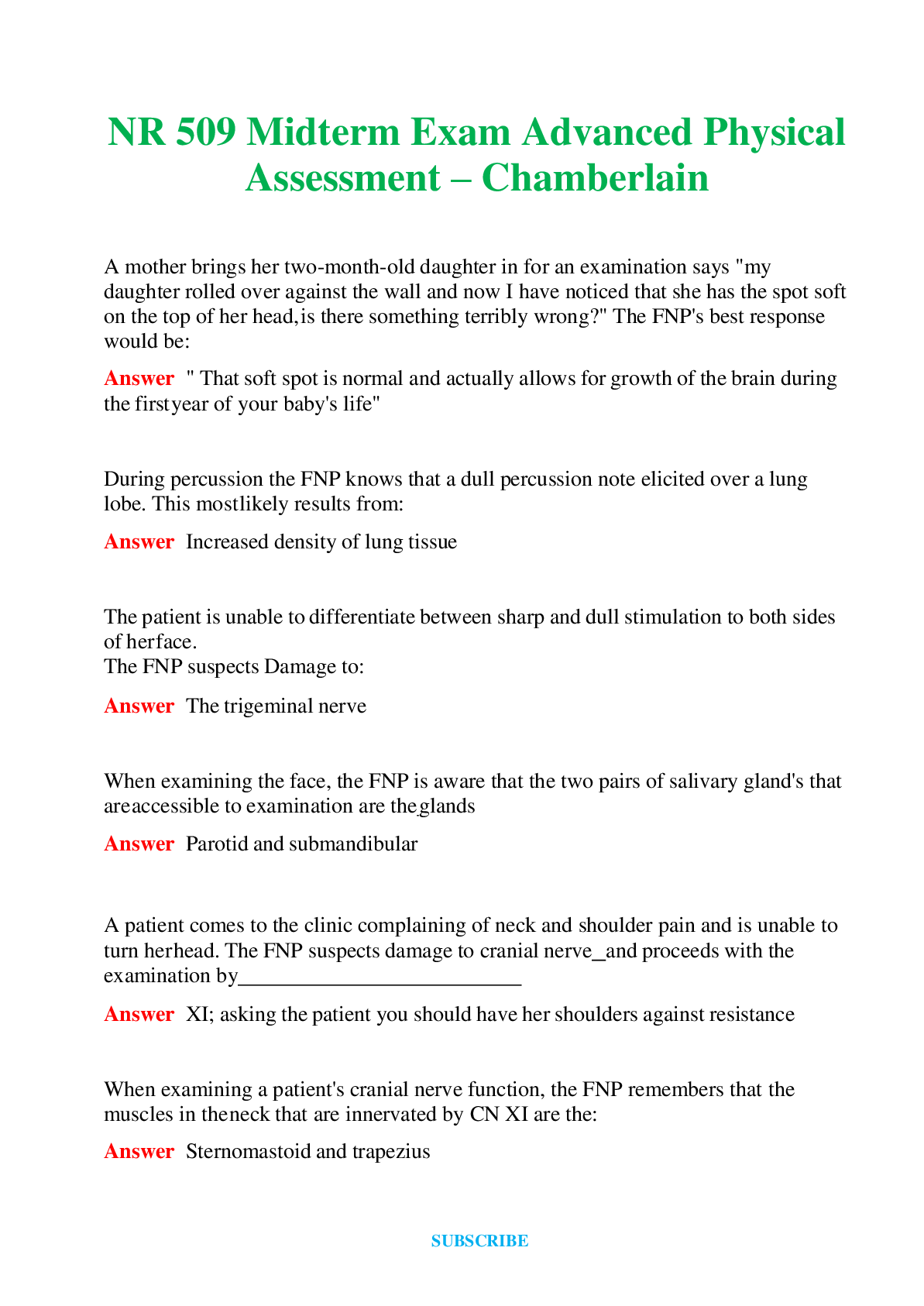
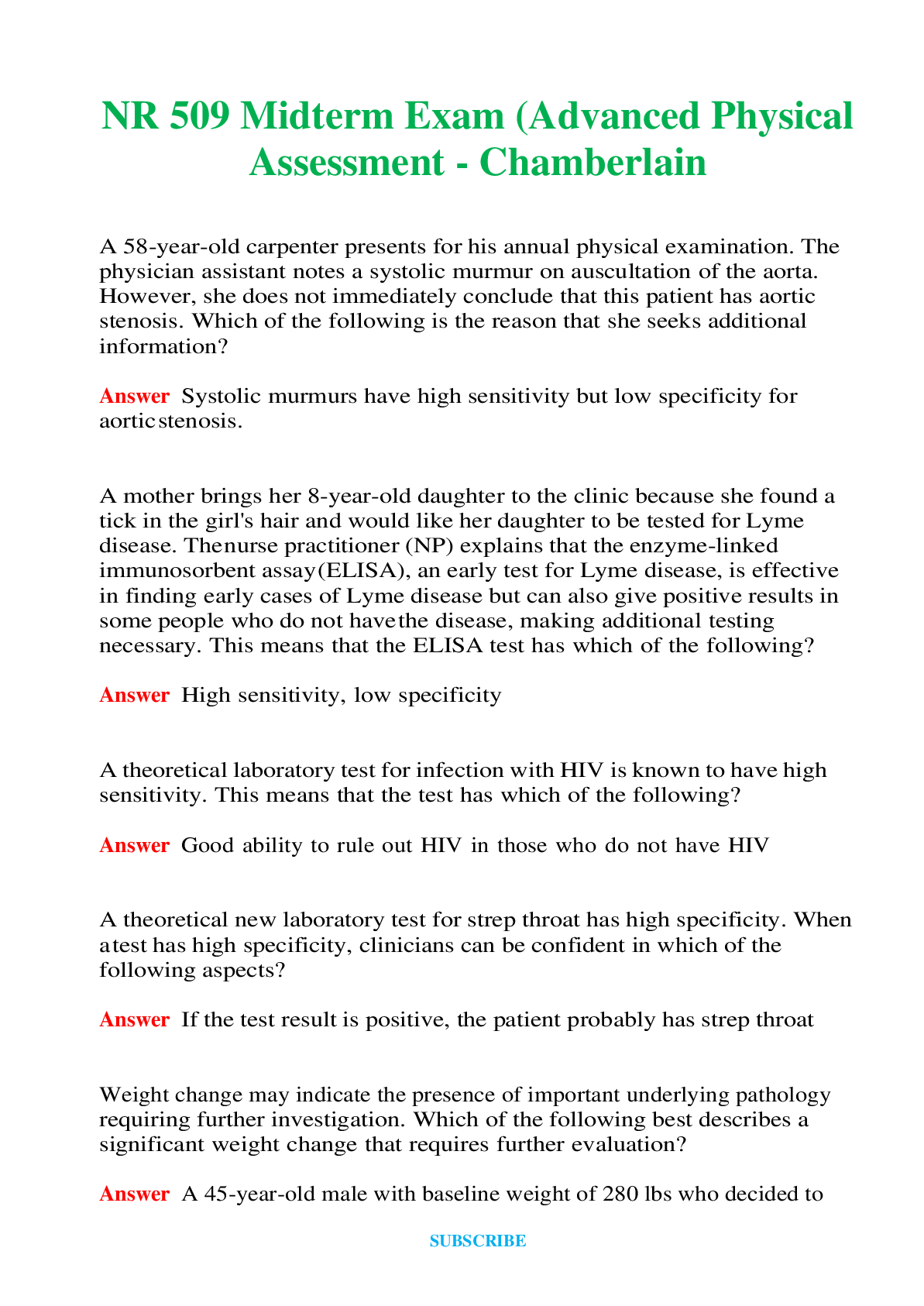
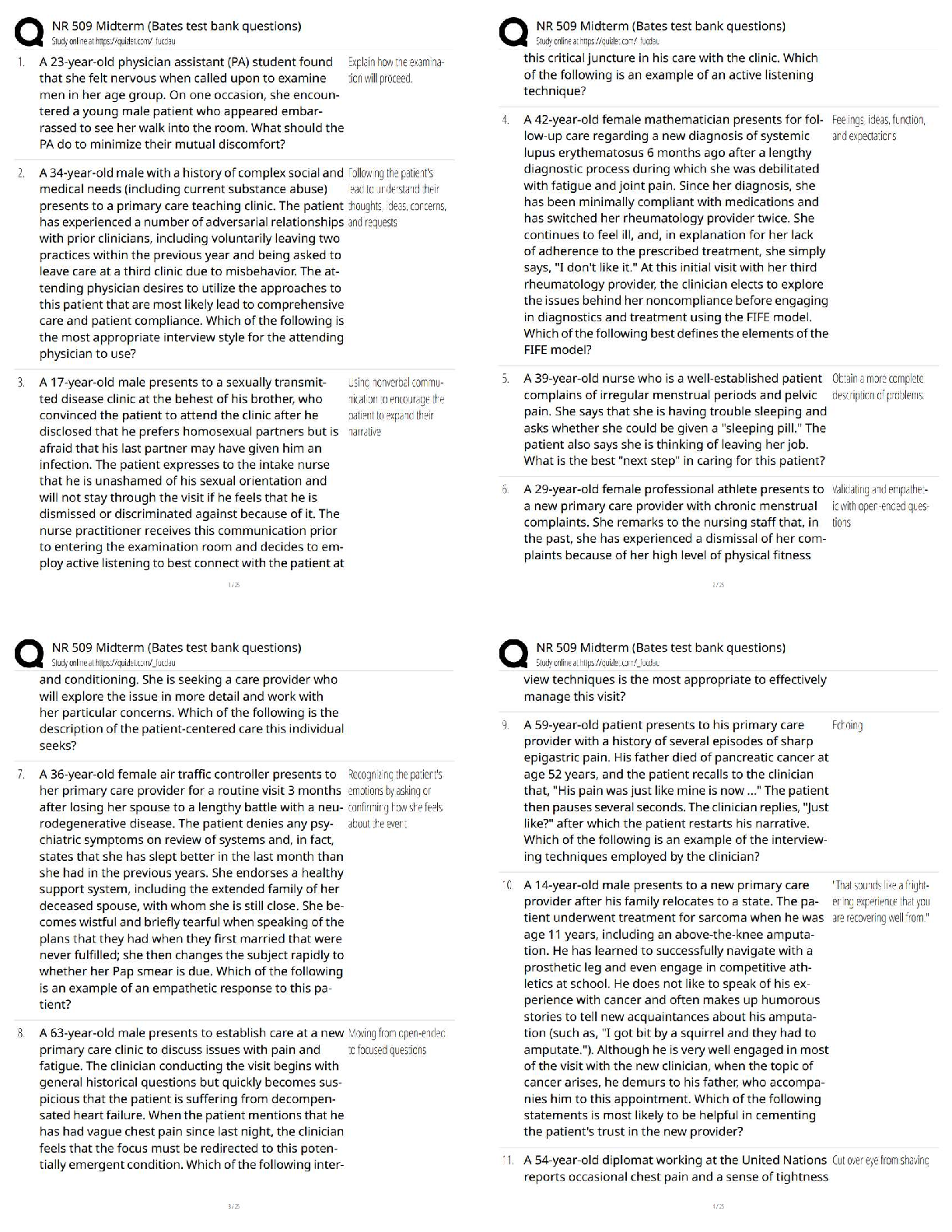
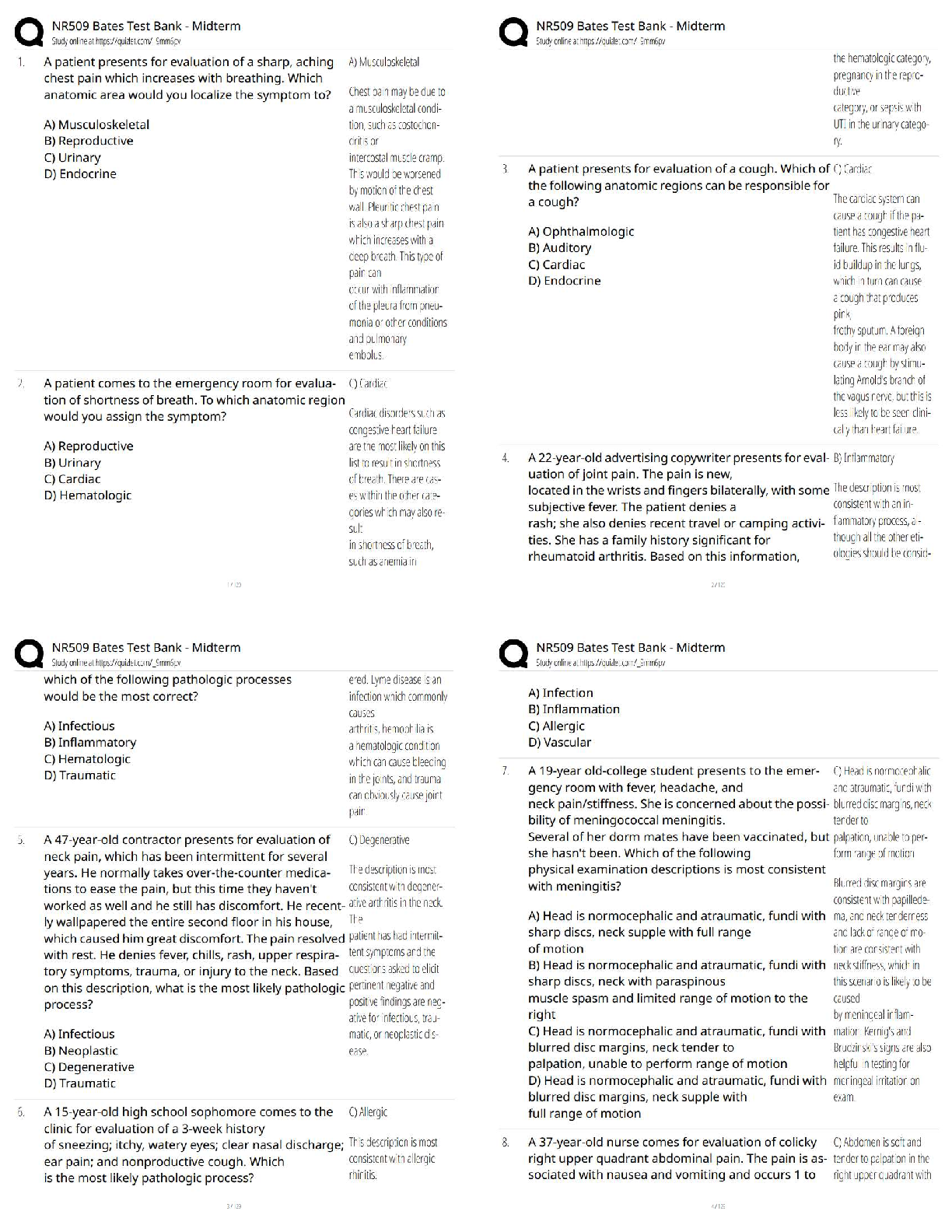
NR 509 Midterm Quiz with Correct
Answers Graded A
32. Which of the following is true of a grade 4-intensity murmur?
A) It is moderately loud.
B) It can be heard with the stethoscope off the chest.
C) It can be heard
...
NR 509 Midterm Quiz with Correct
Answers Graded A
32. Which of the following is true of a grade 4-intensity murmur?
A) It is moderately loud.
B) It can be heard with the stethoscope off the chest.
C) It can be heard with the stethoscope partially off the chest.
D) It is associated with a "thrill." Correct Answer- D) It is associated with a "thrill."
The grade 4 murmur is differentiated from those below it by the presence of a
palpable thrill. A murmur cannot be graded as a 4 unless this is present.
A 7-year-old boy is performing poorly in school. His teacher is frustrated because he is
frequently seen "staring off into space" and not paying attention. If this is a seizure, it most
likely represents which type?
A) Pseudoseizure
B) Tonic-clonic seizure
C) Absence
D) Myoclonus Correct Answer- C) Absence
A 7-year-old child is brought to your clinic by her mother. The mother states that her daughter
is doing poorly in school because she has some kind of "ADD". You ask the mother what makes
her think the child has ADD. The mother tells you that both at home and at school her daughter
will just zone out for several seconds and lick her lips. She states it happens at least four to six
times an hour. She says this has been happening for about a year. After several seconds of liplicking her daughter seems normal again. She states her daughter has been generally healthy
with just normal childhood colds and ear infections. Thepatient's parents are both healthy and no other family members have had these symptoms.
What type of seizure disorder is she most likely to have?
A) Generalized tonic-clonic seizure
B) Generalized absence seizure
C) Simple partial seizure (Jacksonian)
D) Complex partial seizure Correct Answer- B) Generalized absence seizure
In an absence seizure there is no tonic-clonic activity. There is a sudden, brief lapse of
consciousness with blinking, staring, lip-smacking, or hand movements that resolve quickly to
full consciousness. It is easily mistaken for daydreaming or ADD.
A 12-year-old presents to the clinic with his father for evaluation of a painful lump in the left
eye. It started this morning. He denies any trauma or injury. There is no visual disturbance.
Upon
physical examination, there is a red raised area at the margin of the eyelid that is tender to
palpation; no tearing occurs with palpation of the lesion. Based on this description, what is the
most likely diagnosis?
A) Dacryocystitis
B) Chalazion
C) Hordeolum
D) Xanthelasma Correct Answer- C) Hordeolum
A hordeolum, or sty, is a painful, tender, erythematous infection in a gland at the margin of the
eyelid.
A 15-year-old high school sophomore and her mother come to your clinic because themother is concerned about her daughter's weight. You measure her daughter's height and
weight
and obtain a BMI of 19.5 kg/m2. Based on this information, which of the following is
appropriate?
A) Refer the patient to a nutritionist and a psychologist because the patient is anorexic.
B) Reassure the mother that this is a normal body weight.
C) Give the patient information about exercise because the patient is obese.
D) Give the patient information concerning reduction of fat and cholesterol in her diet because
she is obese. Correct Answer- B) Reassure the mother that this is a normal body weight.
The patient has a normal BMI; the range for a normal BMI is 18.5 to 24.9 kg/m2. You may be
able to give the patient and her mother the lower limit of normal in pounds for her
daughter's height, or instruct her in how to use a BMI table.
A 15-year-old high school sophomore comes to the clinic for evaluation of a 3-week history
of sneezing; itchy, watery eyes; clear nasal discharge; ear pain; and nonproductive cough.
Which
is the most likely pathologic process?
A) Infection
B) Inflammation
C) Allergic
D) Vascular Correct Answer- C) Allergic
This description is most consistent with allergic rhinitis.
A 15-year-old high school sophomore presents to the emergency room with his mother for
evaluation of an area of blood in the left eye. He denies trauma or injury but has been coughingforcefully with a recent cold. He denies visual disturbances, eye pain, or discharge from the eye.
On physical examination, the pupils are equal, round, and reactive to light, with a visual acuity
of 20/20 in each eye and 20/20 bilaterally. There is a homogeneous, sharply demarcated area at
the
lateral aspect of the base of the left eye. The cornea is clear. Based on this description, what is
the most likely diagnosis?
A) Conjunctivitis
B) Acute iritis
C) Corneal abrasion
D) Subconjunctival hemorrhage Correct Answer- D) Subconjunctival hemorrhage
A subconjunctival hemorrhage is a leakage of blood outside of the vessels, which
produces a homogenous, sharply demarcated bright red area; it fades over several days,
turning yellow, then disappears. There is no associated eye pain, ocular discharge, or changes in
visual
acuity; the cornea is clear. Many times it is associated with severe cough, choking, or vomiting,
which increase venous pressure.
A 17-year-old high school senior presents to your clinic in acute respiratory distress. Between
shallow breaths he states he was at home finishing his homework when he suddenly began
having right-sided chest pain and severe shortness of breath. He denies any recent traumas or
illnesses. His past medical history is unremarkable. He doesn't smoke but drinks several beers
on the weekend. He has tried marijuana several times but denies any other illegal drugs. He is
an honors student and is on the basketball team. His parents are both in good health. He denies
any recent weight gain, weight loss, fever, or night sweats. On examination you see a tall, thin
young man in obvious distress. He is diaphoretic and is breathing at a rate of 35 breaths per
minute. On
auscultation you hear no breath sounds on the right side of his superior chest wall. On
percussion
he is hyperresonant over the right upper lobe. With palpation he has absent fremitus over theright upper lobe.
What disorder of the thorax or lung best describes his symptoms?
A) Spontaneous pneumothorax
B) Chronic obstructive pulmonary disease (COPD)
C) Asthma
D) Pneumonia Correct Answer- A) Spontaneous pneumothorax
Spontaneous pneumothorax occurs suddenly, causing severe dyspnea and chest pain on the
affected side. It is more common in thin young males. On auscultation of the affected side there
will be no breath sounds and on percussion there is hyperresonance or tympany. There will
be an absence of fremitus to palpation.
A 17-year-old high school student is brought in to your emergency room in a comatose state.
His friends have accompanied him and tell you that they have been shooting up heroin tonight
and they think their friend may have had too much. The patient is unconscious and cannot
protect his airway, so he is intubated. His heart rate is 60 and he is breathing through the
ventilator. He is not posturing and he does not respond to a sternal rub. Preparing to finish the
neurologic examination, you get a penlight.
What size pupils do you expect to see in this comatose patient?
A) Pinpoint pupils
B) Large pupils
C) Asymmetric pupils
D) Irregularly shaped pupils Correct Answer- A) Pinpoint pupils
Narcotics and cholinergics cause very small (1 mm) pupils. Reactions to light can be
appreciated with a magnifying glass.A 19-year old-college student presents to the emergency room with fever, headache, and
neck pain/stiffness. She is concerned about the possibility of meningococcal meningitis.
Several of her dorm mates have been vaccinated, but she hasn't been. Which of the following
physical examination descriptions is most consistent with meningitis?
A) Head is normocephalic and atraumatic, fundi with sharp discs, neck supple with full range
of motion
B) Head is normocephalic and atraumatic, fundi with sharp discs, neck with paraspinous
muscle spasm and limited range of motion to the right
C) Head is normocephalic and atraumatic, fundi with blurred disc margins, neck tender to
palpation, unable to perform range of motion
D) Head is normocephalic and atraumatic, fundi with blurred disc margins, neck supple with
full range of motion Correct Answer- C) Head is normocephalic and atraumatic, fundi with
blurred disc margins, neck tender to
palpation, unable to perform range of motion
Blurred disc margins are consistent with papilledema, and neck tenderness and lack of range of
motion are consistent with neck stiffness, which in this scenario is likely to be caused
by meningeal inflammation. Kernig's and Brudzinski's signs are also helpful in testing for
meningeal irritation on exam.
A 19-year-old college sophomore comes to the clinic for evaluation of joint pains. The student
has been back from spring break for 2 weeks; during her holiday, she went camping. She notes
that she had a red spot, shaped like a target, but then it started spreading, and then the joint
pains started. She used insect repellant but was in an area known to have ticks. She has never
been sick and takes no medications routinely; she has never been sexually active. What is the
most likely cause of her joint pain?
A) Trauma
B) Gonococcal arthritisC) Psoriatic arthritis
D) Lyme disease Correct Answer- D) Lyme disease
Lyme disease is characterized by a target-shaped red spot at the site of the bite, which
disappears, then reappears and starts spreading (erythema migrans). Lyme disease can also
result in joint pain as well as cardiac and neurologic manifestations.
A 19-year-old college student, Todd, is brought to your clinic by his mother. She is concerned
that there is something seriously wrong with him. She states for the past 6 months his behavior
has become peculiar and he has flunked out of college. Todd denies any recent illness or
injuries. His past medical history is remarkable only for a broken foot. His parents are both
healthy. He has a paternal uncle who had similar symptoms in college. The patient admits to
smoking cigarettes and drinking alcohol. He also admits to marijuana use but none in the last
week. He denies using any other substances. He denies any feelings of depression or anxiety.
While speaking with Todd and his mother you do a complete physical examination, which is
essentially normal. When you question him on how he is feeling, he says that he is very worried
that Microsoft has stolen his software for creating a better browser. He tells you he has seen a
black van in his neighborhood at night and he is sure that it is full of computer tech workers
stealing his work through special gamma waves. You ask him why he believes they are trying to
steal his programs. He replies that the technicians have been telepathing their intents directly
into his head. He says he hears these conversations at night so he knows this is happening.
Todd's
mother then tells you, "See, I told you . . . he's crazy. What do I do about it?"
While arranging for a psychiatry consult, what psychotic disorder do you think Todd has?
A) Schizoaffective disorder
B) Psychotic disorder due to a medical illness
C) Substance-induced psychotic disorder
D) Schizophrenia Correct Answer- D) Schizophrenia
Schizophrenia generally occurs in the late teens to early 20s. It often is seen in otherfamily members, as in this case. Symptoms must be present for at least 6 months and must
have at least two features of (1) delusions (e.g., Microsoft is after his programs), (2)
hallucinations
(e.g., technicians sending telepathic signals), (3) disorganized speech, (4) disorganized behavior,
and (5) negative symptoms such as a flat affect.
A 19-year-old construction worker presents for evaluation of a rash. He notes that it started
on his back with a multitude of spots and is also on his arms, chest, and neck. It itches a lot. He
does sweat more than before because being outdoors is part of his job. On physical
examination,
you note dark tan patches with a reddish cast that has sharp borders and fine scales, scattered
more prominently around the upper back, chest, neck, and upper arms as well as under the
arms. Based on this description, what is your most likely diagnosis?
A) Pityriasis rosea
B) Tinea versicolor
C) Psoriasis
D) Atopic eczema Correct Answer- B) Tinea versicolor
This is a typical description of tinea versicolor. The information that the patient is sweating
more also helps support this diagnosis, because tinea is a fungal infection and is
promoted by moisture.
A 21-year-old college senior presents to your clinic, complaining of shortness of breath and a
nonproductive nocturnal cough. She states she used to feel this way only with extreme
exercise, but lately she has felt this way continuously. She denies any other upper respiratory
symptoms, chest pain, gastrointestinal symptoms, or urinary tract symptoms. Her past medical
history is significant only for seasonal allergies, for which she takes a nasal steroid spray but is
otherwise on no other medications. She has had no surgeries. Her mother has allergies and
eczema and her father has high blood pressure. She is an only child. She denies smoking and
illegal drug use but drinks three to four alcoholic beverages per weekend. She is a junior infinance at a local university and she has recently started a job as a bartender in town. On
examination she is in no acute distress and her temperature is 98.6. Her blood pressure is
120/80,
her pulse is 80, and her respirations are 20. Her head, eyes, ears, nose, and throat examinations
are essentially normal. Inspection of her anterior and posterior chest shows no abnormalities.
On auscultation of her chest, there is decreased air movement and a high-pitched whistling on
expiration in all lobes. Percussion reveals resonant lungs.
Which disorder of the thorax or lung does this best describe?
A) Spontaneous pneumothorax
B) Chronic obstructive pulmonary disease (COPD)
C) Asthma
D) Pneumonia Correct Answer- C) Asthma
Asthma causes shortness of breath and a nocturnal cough. It is often associated with
a history of allergies and can be made worse by exercise or irritants such as smoke in a bar. On
auscultation there can be normal to decreased air movement. Wheezing is heard on expiration
and sometimes inspiration. The duration of wheezing in expiration usually correlates with
severity of illness, so it is important to document this length (e.g., wheezes heard halfway
through exhalation). Realize that in severe asthma, wheezes may not be heard because of the
lack of air movement.
A 21-year-old engineering student comes to your office, complaining of leg and back paincand
of tripping when he walks. He states this started 3 months ago with back and buttock paincbut
has since progressed to feeling weak in his left leg. He denies any bowel or bladdercsymptoms.
He can think of no specific traumatic incidences but he was a defensive lineman in high school
and junior college. His past medical history is unremarkable. He denies tobacco use or alcohol
or drug abuse. His parents are both healthy. On examination he is tender over the
lumbar spine and he has a positive straight-leg raise on the left. His Achilles tendon deep reflex
is decreased on the left. While watching his gait you notice he has to pick his left foot up high inorder not to trip.
What abnormality of gait does he most likely have?
A) Sensory ataxia
B) Parkinsonian gait
C) Steppage gait
D) Spastic hemiparesis Correct Answer- C) Steppage gait
This gait is associated with foot drop, usually secondary to a lower motor neuron
disease. This is often seen with a herniated disc, such as in this patient.
A 22-year-old advertising copywriter presents for evaluation of joint pain. The pain is new,
located in the wrists and fingers bilaterally, with some subjective fever. The patient denies a
rash; she also denies recent travel or camping activities. She has a family history significant for
rheumatoid arthritis. Based on this information, which of the following pathologic processes
would be the most correct?
A) Infectious
B) Inflammatory
C) Hematologic
D) Traumatic Correct Answer- B) Inflammatory
The description is most consistent with an inflammatory process, although all the other
etiologies should be considered. Lyme disease is an infection which commonly causes
arthritis, hemophilia is a hematologic condition which can cause bleeding in the joints, and
trauma can obviously cause joint pain.A 23-year-old graduate student comes to your clinic for evaluation of a urethral discharge. As
the provider, you need to get a sexual history. Which one of the following questions is
inappropriate for eliciting the information?
A) Are you sexually active?
B) When was the last time you had intimate physical contact with someone, and did that
contact include sexual intercourse?
C) Do you have sex with men, women, or both?
D) How many sexual partners have you had in the last 6 months? Correct Answer- A) Are you
sexually active?
This is inappropriate because it is too vague. Given the complaint, you should probably assume
that he is sexually active. A specific sexual history will help you to assess this patient's risk for
other sexually transmitted infections.
A 24-year-old secretary comes to your clinic, complaining of difficulty sleeping, severe
nightmares, and irritability. She states it all began 6 months ago when she went to a fast food
restaurant at midnight. While she was waiting in her car a man entered through the passenger
door and put a gun to her head. He had her drive to a remote area, where he took her money
and
threatened to kill her. When the gun jammed he panicked and ran off. Ever since this occurred
the patient has been having these symptoms. She states she jumps at every noise and refuses
to
drive at night. She states her anxiety has had such a marked influence on her job performance
she is afraid she will be fired. She denies any recent illnesses or injuries. Her past medical
history is
unremarkable. On examination you find a nervous woman appearing her stated age. Her
physical
examination is unremarkable. You recommend medication and counseling. What anxiety
disorder to you think this young woman has?A) Specific phobia
B) Acute stress disorder
C) Post-traumatic stress disorder
D) Generalized anxiety disorder Correct Answer- C) Post-traumatic stress disorder
Post-traumatic stress disorder is the fearful response (nightmares, avoidance of
areas, irritability) to an event that occurred at least 1 month prior to presentation. The patient's
fears and reactions cause marked distress and impair social and occupational functions.
A 25-year-old accountant presents to your clinic, complaining of intermittent lower right-sided
chest pain for several days. He describes it as knifelike and states it only lasts for 3 to 5 seconds,
taking his breath away. He states he feels like he has to breathe shallowly to keep it from
recurring. The only thing that makes it better is lying quietly on his right side. It is much worse
when he takes a deep breath. He has taken some Tylenol and put a heating pad on his side but
neither has helped. He remembers that 2 weeks ago he had an upper respiratory infection
with a severe hacking cough. He denies any recent trauma. His past medical history is
unremarkable. His parents and siblings are in good health. He has recently married, and his wife
has a baby due in 2 months. He denies any smoking or illegal drug use. He drinks two to three
beers once a month. He states that he eats a healthy diet and runs regularly, but not since his
recent illness. He denies any cardiac, gastrointestinal, or musculoskeletal symptoms. On
examination he is lying on his right side but appears quite comfortable. His temperature, blood
pressure, pulse, and respirations are unremarkable. His chest has normal breath sounds on
auscultation. Percussion of the chest is unremarkable. During palpation the ribs are nontender.
What disorder of the chest best describes his symptoms?
A) Pericarditis
B) Chest wall pain
C) Pleural pain
D) Angina pectoralis Correct Answer- C) Pleural pain
This pain is sharp and knifelike and occurs over the affected area of pleura.Breathing deeply usually makes the pain worse, whereas lying quietly on the affected side
makes
the pain better. Pleurisy often occurs from inflammation due to an infection, neoplasm, or
autoimmune disease.
A 25-year-old optical technician comes to your clinic for evaluation of fatigue. As part of your
physical examination, you listen to her heart and hear a murmur only at the cardiac apex.
Which valve is most likely to be involved, based on the location of the murmur?
A) Mitral
B) Tricuspid
C) Aortic
D) Pulmonic Correct Answer- A) Mitral
Mitral valve sounds are usually heard best at and around the cardiac apex.
A 25-year-old radio announcer comes to the clinic for an annual examination. His BMI is
26.0 kg/m2. He is concerned about his weight. Based on this information, what is appropriate
counsel for the patient during the visit?
A) Refer the patient to a nutritionist because he is anorexic.
B) Reassure the patient that he has a normal body weight.
C) Give the patient information about reduction of fat, cholesterol, and calories because he is
overweight.
D) Give the patient information about reduction of fat and cholesterol because he is obese.
Correct Answer- C) Give the patient information about reduction of fat, cholesterol, and
calories because he is overweight.
The patient has a BMI in the overweight range, which is 25.0 to 29.9 kg/m2. It isprudent to give him information about reducing calories, fat, and cholesterol in his diet to help
prevent further weight gain.
A 25-year-old type 1 diabetic clerk presents to the emergency room with shortness of breath
and states that his blood sugar was 605 at home. You diagnose the patient with diabetic
ketoacidosis. What is the expected pattern of breathing?
A) Normal
B) Rapid and shallow
C) Rapid and deep
D) Slow Correct Answer- C) Rapid and deep
The body is trying to
rid itself of carbon dioxide to compensate for the acidosis. This is known as Kussmaul's
breathing and is seen in other causes of acidosis as well.
A 28-year-old book editor comes to your clinic, complaining of strange episodes. He states
that about once a week for the last 3 months his left hand and arm will stiffen and then start
jerking. He says that after a few seconds his whole left arm and then his left leg will also start to
jerk. He denies any loss of consciousness or loss of bowel or bladder control. When the
symptoms resolve, his arm and leg feel tired but otherwise he feels fine. His past medical
history
is significant for a cyst in his brain that was removed 6 months ago. He is married and has two
children. His parents are both healthy. On examination you see a scar over the right side of his
head but otherwise his neurologic examination is unremarkable.
What type of seizure disorder is he most likely to have?
A) Generalized tonic-clonic seizure
B) Generalized absence seizureC) Simple partial seizure (Jacksonian)
D) Complex partial seizure Correct Answer- C) Simple partial seizure (Jacksonian)
Simple partial seizures start with a unilateral symptom, involve no loss of
consciousness, and have a normal postictal state. In a Jacksonian seizure the symptoms start
with one body part and "march" along the same side of the body.
A 28-year-old graduate student comes to your clinic for evaluation of pain "all over." With
further questioning, she is able to relate that the pain is worse in the neck, shoulders, hands,
low back, and knees. She denies swelling in her joints; she states that the pain is worse in the
morning; there is no limitation in her range of motion. On physical examination, she has several
points on the muscles of the neck, shoulders, and back that are tender to palpation; muscle
strength and range of motion are normal. Which of the following is likely the cause of her pain?
A) Rheumatoid arthritis
B) Osteoarthritis
C) Fibromyalgia
D) Polymyalgia rheumatica Correct Answer- C) Fibromyalgia
The patient has pain in specific trigger point areas on the muscles, with normal
strength and range of motion. This is an indication for fibromyalgia.
A 28-year-old patient comes to the office for evaluation of a rash. At first there was only one
large patch, but then more lesions erupted suddenly on the back and torso; the lesions itch. On
physical examination, you note that the pattern of eruption is like a Christmas tree and that
there
are a variety of erythematous papules and macules on the cleavage lines of the back. Based on
this description, what is the most likely diagnosis?A) Pityriasis rosea
B) Tinea versicolor
C) Psoriasis
D) Atopic eczema Correct Answer- A) Pityriasis rosea
This is a classic description of pityriasis rosea. The description of a large single or "herald" patch
preceding the eruption is a good way to distinguish this rash from other
conditions.
A 29-year-old computer programmer comes to your office for evaluation of a headache. The
tightening sensation is located all over the head and is of moderate intensity. It used to last
minutes, but this time it has lasted for 5 days. He denies photophobia and nausea. He spends
several hours each day at a computer monitor/keyboard. He has tried over-the-counter
medication; it has dulled the pain but not taken it away. Based on this description, what is your
most likely diagnosis?
A) Tension
B) Migraine
C) Cluster
D) Analgesic rebound Correct Answer- A) Tension
This is a description of a typical tension headache.
A 29-year-old physical therapist presents for evaluation of an eyelid problem. On
observation, the right eyeball appears to be protruding forward. Based on this description,
what
is the most likely diagnosis?A) Ptosis
B) Exophthalmos
C) Ectropion
D) Epicanthus Correct Answer- B) Exophthalmos
Feedback: Exophthalmos is the condition when the eyeball protrudes forward. If it is bilateral, it
suggests the presence of Graves' disease. If it is unilateral, it could still be caused by Graves'
disease. Alternatively, it could be caused by a tumor or inflammation in the orbit.
A 30-year-old sales clerk comes to your office wanting to lose weight; her BMI is 30.0
kg/m2. What is the most appropriate amount for a weekly weight reduction goal?
A) .5 to 1 pound per week
B) 1 to 2.5 pounds per week
C) 2.5 to 3.5 pounds per week
D) 3.5 to 4.5 pounds per week Correct Answer- A) .5 to 1 pound per week
Based on the NIH Obesity Guidelines, this is the weekly weight loss goal to strive for to maintain
long-term control of weight. More rapid weight loss than this does not result in
a better outcome at one year.
A 32-year-old warehouse worker presents for evaluation of low back pain. He notes a
sudden onset of pain after lifting a set of boxes that were heavier than usual. He also states
that
he has numbness and tingling in the left leg. He wants to know if he needs to be off of work.
What test should you perform to assess for a herniated disc?
A) Leg-length testB) Straight-leg raise
C) Tinel's test
D) Phalen's test Correct Answer- B) Straight-leg raise
The straight-leg raise involves having the patient lie supine with the examiner
raising the leg. If the patient experiences a sharp pain radiating from the back down the leg in
an
L5 or S1 distribution, that suggests the presence of a herniated disc.
A 33-year-old construction worker comes for evaluation and treatment of acute onset of low
back pain. He notes that the pain is an aching located in the lumbosacral area. It has been
present intermittently for several years; there is no known trauma or injury. He points to the
left lower
back. The pain does not radiate and there is no numbness or tingling in the legs or
incontinence. He was moving furniture for a friend over the weekend. On physical examination,
you note
muscle spasm, with normal deep tendon reflexes and muscle strength. What is the most likely
cause of this patient's low back pain?
A) Herniated disc
B) Compression fracture
C) Mechanical low back pain
D) Ankylosing spondylitis Correct Answer- ) Mechanical low back pain
The case is an example of mechanical low back pain; in a large percentage of cases
there is no known underlying cause. The pain is often precipitated by moving, lifting, or twisting
motions and relieved by rest.
A 35-year-old archaeologist comes to your office (located in Phoenix, Arizona) for a regularskin check-up. She has just returned from her annual dig site in Greece. She has fair skin and
reddish-blonde hair. She has a family history of melanoma. She has many freckles scattered
across her skin. From this description, which of the following is not a risk factor for melanoma
in
this patient?
A) Age
B) Hair color
C) Actinic lentigines
D) Heavy sun exposure Correct Answer- A) Age
The risk for melanoma is increased in people over the age of 50; our patient is 35
years old. The other answers represent known risk factors for melanoma. Especially with a
family history of melanoma, she should be instructed to keep her skin covered when in the sun
and use strong sunscreen on exposed areas.
A 36-year-old teacher presents to your clinic, complaining of sharp, knifelike pain on the left
side of her chest for the last 2 days. Breathing and lying down make the pain worse, while
sitting
forward helps her pain. Tylenol and ibuprofen have not helped. Her pain does not radiate to
any
other area. She denies any upper respiratory or gastrointestinal symptoms. Her past medical
history consists of systemic lupus. She is divorced and has one child. She denies any tobacco,
alcohol, or drug use. Her mother has hypothyroidism and her father has high blood pressure.
On
examination you find her to be distressed, leaning over and holding her left arm and hand to
her left chest. Her blood pressure is 130/70, her respirations are 12, and her pulse is 90. On
auscultation her lung fields have normal breath sounds with no rhonchi, wheezes, or crackles.
Percussion and palpation are unremarkable. Auscultation of the heart has an S1 and S2 with no
S3or S4. A scratching noise is heard at the lower left sternal border, coincident with systole;
leaning
forward relieves some of her pain. She is nontender with palpation of the chest wall.
What disorder of the chest best describes this disorder?
A) Angina pectoris
B) Pericarditis
C) Dissecting aortic aneurysm
D) Pleural pain Correct Answer- B) Pericarditis
The pain from pericarditis is usually sharp and knifelike and is located over the left side of the
chest. Change of position, breathing, and coughing often make the pain worse,
whereas leaning forward improves the pain. Pericarditis is often seen in rheumatologic diseases
such as systemic lupus and in patients with chronic kidney disease. Patients also experience this
after a myocardial infarction.
A 37-year-old insurance agent comes to your office, complaining of trembling hands. She says
that for the past 3 months when she tries to use her hands to fix her hair or cook they shake
badly. She says she doesn't feel particularly nervous when this occurs but she worries that
other people will think she has an anxiety disorder or that she's a drinker. She admits to having
some recent fatigue, trouble with vision, and difficulty maintaining bladder control. Her past
medical history is remarkable for hypothyroidism. Her mother has lupus and her father is
healthy. She has an older brother with type 1 diabetes. She is married and has three children.
She denies
tobacco, alcohol, or drug use. On examination, when she tries to reach for a pencil to fill out the
health form she has obvious tremors in her dominant hand.
What type of tremor is she most likely to have?
A) Resting tremor
B) Postural tremorC) Intention tremor Correct Answer- C) Intention tremor
Intention tremors are absent at rest or in a postural position and occur only with
intentional movement of the hands. This is seen in cerebellar disease (stroke or alcohol use) or
in
multiple sclerosis. This patient's tremor, fatigue, bladder problems, and visual problems are
suggestive of multiple sclerosis.
A 37-year-old nurse comes for evaluation of colicky right upper quadrant abdominal pain. The
pain is associated with nausea and vomiting and occurs 1 to 2 hours after eating greasy foods.
Which one of the following physical examination descriptions would be most consistent with
the diagnosis of cholecystitis?
A) Abdomen is soft, nontender, and nondistended, without hepatosplenomegaly or masses.
B) Abdomen is soft and tender to palpation in the right lower quadrant, without rebound or
guarding.
C) Abdomen is soft and tender to palpation in the right upper quadrant with inspiration, to the
point of stopping inspiration, and there is no rebound or guarding.
D) Abdomen is soft and tender to palpation in the mid-epigastric area, without rebound or
guarding. Correct Answer- C) Abdomen is soft and tender to palpation in the right upper
quadrant with inspiration, to the
point of stopping inspiration, and there is no rebound or guarding.
In cholecystitis, the pain, which originates from the gallbladder, is located in the
right upper quadrant. Severity of pain with inspiration that is sufficient to stop further
inhalation
is also known as Murphy's sign, which, if present, is further indicative of inflammation of the
gallbladder.A 37-year-old woman is brought into your emergency room comatose. The paramedics say
her husband found her unconscious in her home. Her past medical history consists of type 1
diabetes and she is on insulin. In the ambulance the paramedics obtained a glucose check and
her
sugar was 15. They began a dextrose saline infusion and intubated her to protect her airway.
Despite their efforts, she is posturing in the emergency room with her arms straight at her side
and her jaw clenched. Her legs are also straight and her feet are plantar flexed.
What type of posturing is she showing?
A) Decorticate rigidity
B) Decerebrate rigidity
C) Hemiplegia
D) Chorea Correct Answer- B) Decerebrate rigidity
In this type of rigidity the jaws are clenched and the neck is extended. The arms are adducted
and stiffly extended at the elbows with forearms pronated and wrists and fingers flexed.
The legs are stiffly extended at the knees with the feet plantar flexed. This posture occurs with
lesions in the diencephalon, midbrain, or pons. It can also be seen with severe metabolic
disorder such as hypoxia or hypoglycemia, as in this case.
A 38-year-old accountant comes to your clinic for evaluation of a headache. The throbbing
sensation is located in the right temporal region and is an 8 on a scale of 1 to 10. It started a
few
hours ago, and she has noted nausea with sensitivity to light; she has had headaches like this in
the past, usually less than one per week, but not as severe. She does not know of any inciting
factors. There has been no change in the frequency of her headaches. She usually takes an
over-the-counter analgesic and this results in resolution of the headache. Based on this
description, what is the most likely diagnosis of the type of headache?
A) TensionB) Migraine
C) Cluster
D) Analgesic rebound Correct Answer- B) Migraine
This is a description of a common migraine (no aura). Distinctive features of a migraine include
phonophobia and photophobia, nausea, resolution with sleep, and unilateral
distribution. Only some of these features may be present.
A 38-year-old woman comes to you and has multiple small joints involved with pain, swelling,
and stiffness. Which of the following is the most likely explanation?
A) Rheumatoid arthritis
B) Septic arthritis
C) Gout
D) Trauma Correct Answer- A) Rheumatoid arthritis
Rheumatoid arthritis is a systemic disease and accounts for multiple symmetrically
involved joints. Septic arthritis is usually monoarticular, as are gout and trauma-related joint
pain.
A 41-year-old real estate agent comes to your office, complaining that he feels like his face is
paralyzed on the left. He states that last week he felt his left eyelid was drowsy and as the day
progressed he was unable to close his eyelid all the way. Later he felt like his smile became
affected also. He denies any recent injuries but had an upper respiratory viral infection last
month. His past medical history is unremarkable. He is divorced and has one child. He smokes
one pack of cigarettes a day, occasionally drinks alcohol, and denies any illegal drug use. His
mother has high blood pressure and his father has sarcoidosis. On examination you ask him to
close his eyes. He is unable to close his left eye. You ask him to open his eyes and raise his
eyebrows. His right forehead furrows but his left remains flat. You then ask him to give you a
big smile. The right corner of his mouth raises but the left side of his mouth remains the same.What type of facial paralysis does he have?
A) Peripheral CN VII paralysis
B) Central CN VII paralysis Correct Answer- A) Peripheral CN VII paralysis
In a peripheral lesion the entire side of the face will be involved. This causes the
inability to close the eye, raise the eyebrow, wrinkle the forehead, and smile on the affected
side.
Bell's palsy is an example of this type of paralysis and is probably what is affecting this patient.
A 47-year-old contractor presents for evaluation of neck pain, which has been intermittent for
several years. He normally takes over-the-counter medications to ease the pain, but this time
they haven't worked as well and he still has discomfort. He recently wallpapered the entire
second floor in his house, which caused him great discomfort. The pain resolved with rest. He
denies fever, chills, rash, upper respiratory symptoms, trauma, or injury to the neck. Based on
this description, what is the most likely pathologic process?
A) Infectious
B) Neoplastic
C) Degenerative
D) Traumatic Correct Answer- C) Degenerative
The description is most consistent with degenerative arthritis in the neck. The
patient has had intermittent symptoms and the questions asked to elicit pertinent negative and
positive findings are negative for infectious, traumatic, or neoplastic disease.
A 47-year-old receptionist comes to your office, complaining of fever, shortness of breath,
and a productive cough with golden sputum. She says she had a cold last week and her
symptoms have only gotten worse, despite using over-the-counter cold remedies. She denies
anyweight gain, weight loss, or cardiac or gastrointestinal symptoms. Her past medical history
includes type 2 diabetes for 5 years and high cholesterol. She takes an oral medication for both
diseases. She has had no surgeries. She denies tobacco, alcohol, or drug use. Her mother has
diabetes and high blood pressure. Her father passed away from colon cancer. On examination
you see a middle-aged woman appearing her stated age. She looks ill and her temperature is
elevated, at 101. Her blood pressure and pulse are unremarkable. Her head, eyes, ears, nose,
and throat examinations are unremarkable except for edema of the nasal turbinates. On
auscultation she has decreased air movement, and coarse crackles are heard over the left lower
lobe. There is dullness on percussion, increased fremitus during palpation, and egophony and
whispered pectoriloquy on auscultation.
What disorder of the thorax or lung best describes her symptoms?
A) Spontaneous pneumothorax
B) Chronic obstructive pulmonary disease (COPD)
C) Asthma
D) Pneumonia Correct Answer- D) Pneumonia
Pneumonia is usually associated with dyspnea, cough, and fever. On auscultation
there can be coarse or fine crackles heard over the affected lobe. Percussion over the affected
area is dull and there is often an increase in fremitus. Egophony and pectoriloquy are heard
because of increased transmission of high-pitched components of sounds. These higher
frequencies are usually filtered out by the multiple air-filled chambers of the alveoli.
A 48-year-old grocery store manager comes to your clinic, complaining of her head being
"stuck" to one side. She says that today she was doing her normal routine when it suddenly felt
like her head was being moved to her left and then it just stuck that way. She says it is
somewhat
painful because she cannot get it moved back to normal. She denies any recent neck trauma.
Her
past medical history consists of type 2 diabetes and gastroparesis. She is on oral medication for
each. She is married and has threechildren. She denies tobacco, alcohol, or drug use. Her father has diabetes and her mother
passed away from breast cancer. Her children are healthy. On examination you see a slightly
overweight Hispanic woman appearing her stated age. Her head is twisted grotesquely to her
left but otherwise her examination is normal.
What form of involuntary movement does she have?
A) Chorea
B) Asbestosis
C) Tic
D) Dystonia Correct Answer- D) Dystonia
Dystonia involves large movements of the body, such as with the head or trunk, leading to
grotesque twisted postures. Some medications (such as one commonly used for gastroparesis)
often cause dystonia.
A 49-year-old administrative assistant comes to your office for evaluation of dizziness. You
elicit the information that the dizziness is a spinning sensation of sudden onset, worse with
head
position changes. The episodes last a few seconds and then go away, and they are accompanied
by intense nausea. She has vomited one time. She denies tinnitus. You perform a physical
examination of the head and neck and note that the patient's hearing is intact to Weber and
Rinne and that there is nystagmus. Her gait is normal. Based on this description, what is the
most likely
diagnosis?
A) Benign positional vertigo
B) Vestibular neuronitis
C) Ménière's disease
D) Acoustic neuroma Correct Answer- A) Benign positional vertigoThis is a classic description of benign positional vertigo. The vertigo is episodic,
lasting a few seconds to minutes, instead of continuous as in vestibular neuronitis. Also, there is
no tinnitus or sensorineural hearing loss as occurs in Ménière's disease and acoustic neuroma.
A 49-year-old truck driver comes to the emergency room for shortness of breath and
swelling in his ankles. He is diagnosed with congestive heart failure and admitted to the
hospital. You are the student assigned to do the patient's complete history and physical
examination.
When you palpate the pulse, what do you expect to feel?
A) Large amplitude, forceful
B) Small amplitude, weak
C) Normal
D) Bigeminal Correct Answer- B) Small amplitude, weak
Congestive heart failure is characterized by decreased stroke volume or increased
peripheral vascular resistance, which would result in a small-amplitude, weak pulse. Subtle
differences in amplitude are usually best detected in large arteries close to the heart, like the
carotid pulse. You may not be able to notice these in other locations.
A 50-year-old body builder is upset by a letter of denial from his life insurance company. He is
very lean but has gained 2 pounds over the past 6 months. You personally performed his health
assessment and found no problems whatsoever. He says he is classified as "high risk"
because of obesity. What should you do next?
A) Explain that even small amounts of weight gain can classify you as obese.
B) Place him on a high-protein, low-fat diet.
C) Advise him to increase his aerobic exercise for calorie burning.D) Measure his waist. Correct Answer- D) Measure his waist.
The patient most likely had a high BMI because of increased muscle mass. In this
situation, it is important to measure his waist. It is most likely under 40 inches, which makes
obesity unlikely (even to an insurance company). It is important that you personally contact the
company and explain your reasoning.
A 50-year-old realtor comes to your office for evaluation of neck pain. She was in a motor
vehicle collision 2 days ago and was assessed by the emergency medical technicians on site, but
she didn't think that she needed to go to the emergency room at that time. Now, she has
severe
pain and stiffness in her neck. On physical examination, you note pain and spasm over the
paraspinous muscles on the left side of the neck, and pain when you make the patient do active
range of motion of the cervical spine. What is the most likely cause of this neck pain?
A) Simple stiff neck
B) Aching neck
C) Cervical sprain
D) Cervical herniated disc Correct Answer- C) Cervical sprain
The patient most likely has an acute whiplash injury secondary to the collision. The
features of the physical examination, local tenderness and pain on movement, are consistent
with
cervical sprain.
A 50-year-old woman presents with "left hip pain" of several weeks duration. There is
marked tenderness when you press over her proximal lateral thigh. What do you think she has?A) Osteoarthritis
B) Rheumatoid arthritis
C) Sciatica
D) Trochanteric bursitis Correct Answer- D) Trochanteric bursitis
Bursitis is usually accompanied by tenderness on examination. This location is
consistent with trochanteric bursitis. Osteoarthritis would generally not be tender and would
more likely have decreased range of motion. Rheumatoid arthritis and sciatica would not likely
be tender over this area.
A 55-year-old bank teller comes to your office for persistent episodes of dizziness. The first
episode started suddenly and lasted 3 to 4 hours. He experienced a lot of nausea with vomiting;
the episode resolved spontaneously. He has had five episodes in the past 1.5 weeks. He does
note some tinnitus that comes and goes. Upon physical examination, you note that he has a
normal gait. The Weber localizes to the right side and the air conduction is equal to the bone
conduction in the right ear. Nystagmus is present. Based on this description, what is the most
likely diagnosis?
A) Benign positional vertigo
B) Vestibular neuronitis
C) Ménière's disease
D) Acoustic neuroma Correct Answer- C) Ménière's disease
Ménière's disease is characterized by sudden onset of vertiginous episodes that last several
hours to a day or more, then spontaneously resolve; the episodes then recur. On physical
examination, sensorineural hearing loss is present. The patient does complain of tinnitus.
A 55-year-old bookkeeper comes to your office for a routine visit. You note that on a previous
visit for treatment of contact dermatitis, her blood pressure was elevated. She does not have
prior elevated readings and her family history is negative for hypertension. You measure herblood pressure in your office today. Which of the following factors can result in a false high
reading?
A) Blood pressure cuff is tightly fitted.
B) Patient is seated quietly for 10 minutes prior to measurement.
C) Blood pressure is measured on a bare arm.
D) Patient's arm is resting, supported by your arm at her mid-chest level as you stand to
measure the blood pressure. Correct Answer- A) Blood pressure cuff is tightly fitted.
A blood pressure cuff that is too tightly fitted can result in a false high reading.
The other answers are important to observe to obtain an accurate blood pressure reading.
JNC-7 also mentions the importance of having the back supported when obtaining blood
pressure in the sitting position.
A 55-year-old data entry operator comes to the clinic to establish care. She has the following
symptoms: headache, neck pain, sinus congestion, sore throat, ringing in ears, sharp brief chest
pains at rest, burning abdominal pain with spicy foods, constipation, urinary frequency that is
worse with coughing and sneezing, and swelling in legs. This cluster of symptoms is explained
by:
A) One disease process
B) More than one disease process Correct Answer- B) More than one disease process
The patient appears to have several possible conditions: allergic rhinitis, arthritis,
conductive hearing loss, pleuritic chest pains, heartburn, stress urinary incontinence, and
venous stasis, among other conditions. Although we always try, it is very difficult to assign all of
these
symptoms to one cohesive diagnosis.A 55-year-old secretary with a recent history of breast cancer, for which she underwent surgery
and radiation therapy, and a history of hypertension comes to your office for a routine checkup.
Which of the following aspects of the physical are important to note when assessing the patient
for peripheral vascular disease in the arms?
A) Femoral pulse, popliteal pulse
B) Dorsalis pedis pulse, posterior tibial pulse
C) Carotid pulse
D) Radial pulse, brachial pulse Correct Answer- D) Radial pulse, brachial pulse
A 55-year-old smoker complains of chest pain and gestures with a closed fist over her sternum
to describe it. Which of the following diagnoses should you consider because of her gesture?
A) Bronchitis
B) Costochondritis
C) Pericarditis
D) Angina pectoris Correct Answer- D) Angina pectoris
The clenched fist of Levine's sign, while not completely specific for ischemic pain, should
definitely cause you to consider this etiology.
A 57-year-old maintenance worker comes to your office for evaluation of pain in his legs.
He has smoked two packs per day since the age of 16, but he is otherwise healthy. You are
concerned that he may have peripheral vascular disease. Which of the following is part of
common or concerning symptoms for the peripheral vascular system?
A) Intermittent claudication
B) Chest pressure with exertionC) Shortness of breath
D) Knee pain Correct Answer- A) Intermittent claudication
Intermittent claudication is leg pain that occurs with walking and is relieved by rest.
It is a key symptom of peripheral vascular disease.
A 58-year-old gardener comes to your office for evaluation of a new lesion on her upper chest.
The lesion appears to be "stuck on" and is oval, brown, and slightly elevated with a flat surface.
It has a rough, wartlike texture on palpation. Based on this description, what is your
most likely diagnosis?
A) Actinic keratosis
B) Seborrheic keratosis
C) Basal cell carcinoma
D) Squamous cell carcinoma Correct Answer- B) Seborrheic keratosis
This is a typical description for seborrheic keratosis. The "stuck on" appearance and
the rough, wartlike texture are key features for the diagnosis. They often produce a greasy scale
when scratched with a fingernail, which further helps to distinguish them from other lesions.
Frequently, these benign lesions actually meet several of the ABCDEs of melanoma, so it is
important to distinguish these lesions to prevent unnecessary biopsy.
A 58-year-old man comes to your office complaining of bilateral back pain that now awakens
him at night. This has been steadily increasing for the past 2 months. Which one of the
following is the most reassuring in this patient with back pain?
A) Age over 50
B) Pain at night
C) Pain lasting more than 1 month or not responding to therapyD) Pain that is bilateral Correct Answer- D) Pain that is bilateral
While bilateral pain can be associated with serious illness, it is not one of the "red
flags" of back pain. Red flags should make one suspicious for serious underlying systemic
disease such as cancer, infection, or others. This list includes: age over 50, history of cancer,
unexplained weight loss, pain lasting more than 1 month or not responding to treatment, pain
at
night or increased by rest, history of intravenous drug use, or presence of infection. The
presence of one of these with low back pain indicates a 10% probability of a serious systemic
disease.
A 58-year-old teacher presents to your clinic with a complaint of breathlessness with
activity. The patient has no chronic conditions and does not take any medications, herbs, or
supplements. Which of the following symptoms is appropriate to ask about
[Show More]