Phlebotomy National Exam Study Guide
Questions and Answers Latest 2022
Already Passed
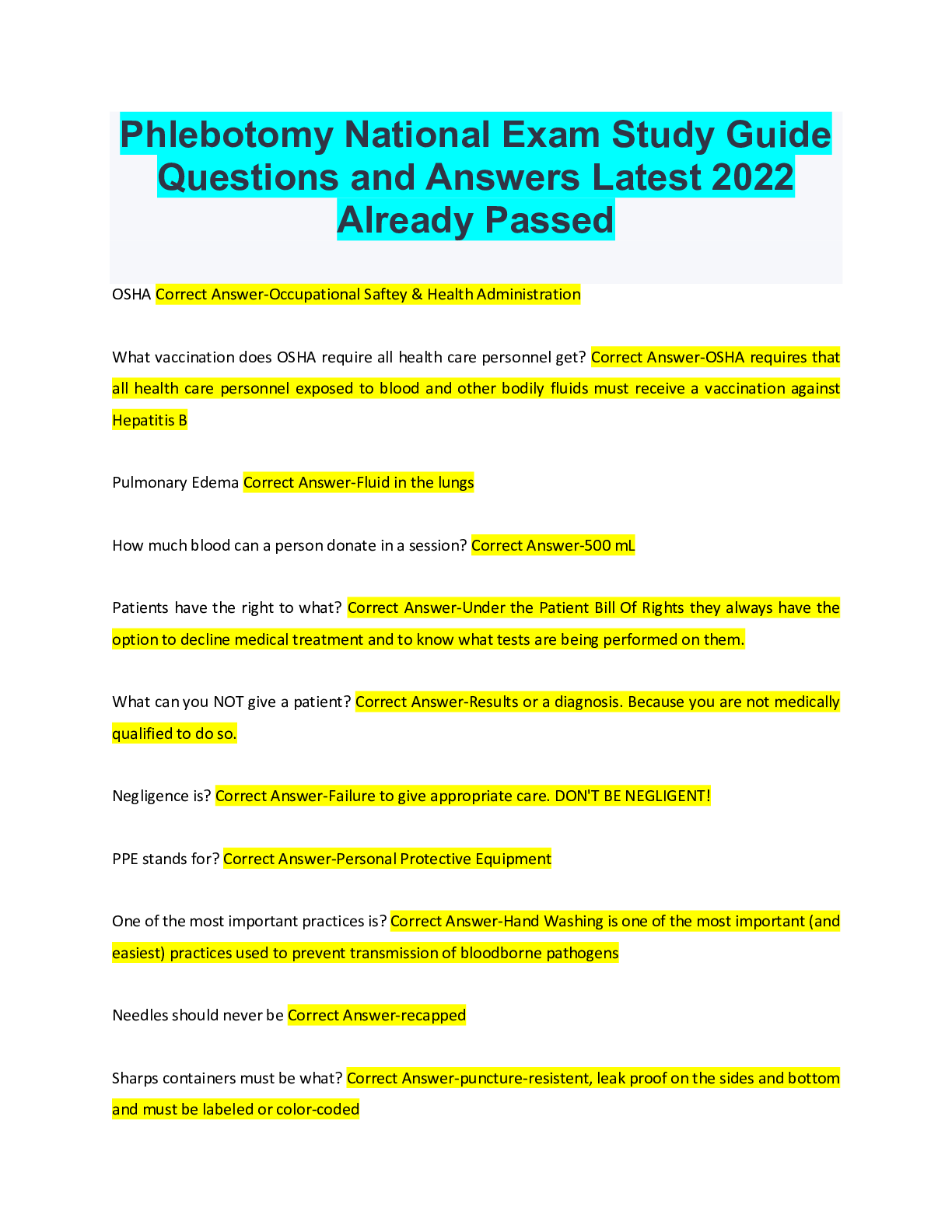
OSHA Correct Answer-Occupational Saftey & Health Administration
What vaccination does OSHA require all health care personnel get?
...
Phlebotomy National Exam Study Guide
Questions and Answers Latest 2022
Already Passed
OSHA Correct Answer-Occupational Saftey & Health Administration
What vaccination does OSHA require all health care personnel get? Correct Answer-OSHA requires that
all health care personnel exposed to blood and other bodily fluids must receive a vaccination against
Hepatitis B
Pulmonary Edema Correct Answer-Fluid in the lungs
How much blood can a person donate in a session? Correct Answer-500 mL
Patients have the right to what? Correct Answer-Under the Patient Bill Of Rights they always have the
option to decline medical treatment and to know what tests are being performed on them.
What can you NOT give a patient? Correct Answer-Results or a diagnosis. Because you are not medically
qualified to do so.
Negligence is? Correct Answer-Failure to give appropriate care. DON'T BE NEGLIGENT!
PPE stands for? Correct Answer-Personal Protective Equipment
One of the most important practices is? Correct Answer-Hand Washing is one of the most important (and
easiest) practices used to prevent transmission of bloodborne pathogens
Needles should never be Correct Answer-recapped
Sharps containers must be what? Correct Answer-puncture-resistent, leak proof on the sides and bottom
and must be labeled or color-codedTypes of Hazards Correct Answer-Biologic - Infectious agents that can cause bacterial, viral, fungal or
parasitic infections
Sharps - Needles, lancets and broken glass can puncture and cut, causing blood-borne pathogen exposure
Chemical - Preservatives and chemicals used in the laboratory. Exposure to Toxin, Carcinogenic or caustic
substances
Fire or explosive - bunsen burners, oxygen and chemicals can cause burns or dismemberment
Physical - wet floors, heavy lifting ance cause falls, sprains and strains
* ALLERGIC reaction ** - Latex sensitivity is a PHYSICAL reaction to care worker allergic reation to the
patient
In infection control WHO is the agent? Correct Answer-Person
In infection control WHAT is portal of exit? Correct Answer-Needle
In infection control WHAT can we control? Correct Answer-Mode Of Transmission OR exit of infection
In infection control WHAT is a portal of entry? Correct Answer-Mucas membrane
In infection control WHO is a susceptible host? Correct Answer-Person
Mode of Transmission Correct Answer-Specific ways in which microorganisms travel from the reservoir to
the suseptible host
Five main types or mode of transmission Correct Answer-contact - direct and indirect (fomite)
Droplet - Cold, Flu and sneezing
Airborne - viral - breath incommon vehicle - person, fomite and not handwashing
vector borne - illness that is transmitted through an invertebrate, such as an insect
Mode of infection Correct Answer-the point in the infection chain where we aim at preventing the spread
of infectious disease
Standard precautions do what? Correct Answer-Infection control method designed to prevent direct
contact with blood and other body fluids and tissues by using a barrier of protection and work control
practices.
What do we assume all patients to be? Correct Answer-Patients are presumed to be infective for bloodborne pathogens
Standard precautions consist of what itmes? Correct Answer-Gloves - when collecting and handling body
fluids, or tissue specimen
Face shield - when danger of splashing on mucous membranes
Disposal - dispose of all needles and sharp objests in punture-proof containers, WITH OUT RECAPPING
Disinfectants - clean fluid spills, thus killing pathogenic organisms
Medical Asepsis Correct Answer-This condition is best defined as "the destruction of pathogenic
microorganisms after they leave the body". It also involves enviromental hygien measures such as
equipment cleaning and disinfection procedures. Methods of medical asepsis are Standard Precautions
and Transmission-based Precautions
What are barrier protections? Correct Answer-Masks
Gloves
Face Shields
Resirator
Gloves
How do you remove PPE equipment? Correct Answer-1st - Gloves
2nd - Gown3rd - Shield
What type of soap should be used? Correct Answer-Non-abrasive, antibacterial soap.
What do you do if blood splashes in the eye or mucous membane? Correct Answer-Flush with warm water
(hotter the better) for 15 minutes
Report incident exposure to your supervisor ASAP!
Who cannot be identified in an incident report? Correct Answer-a minor
Bedside manner includes? Correct Answer-introduce yourself, ask patient name and b-day. Explain what
you will be doing. Chat with patient to keep mind off poke. ADVISE them WHEN you are poking! Speak to
them on a first name basis
What phase is best practice Correct Answer-"pleasant with the patient and professional with the poke".
If patient has an I.V. where do you draw blood? Correct Answer-Downstream from the I.V.
Double Mastectomy patients should ONLY have blood drawn from what? Correct Answer-Hands
Left Mastectomy patients should have blood drawn from what side? Correct Answer-Right side
What is a Fistula? Correct Answer-artificial connections of veins
What is a Graft? Correct Answer-artificial artery connection to vein
Sclerosis is? Correct Answer-Hard and cord like veins
For obese patients what vein is used? Correct Answer-Cephalic Vein is most likely to be the one you can
palpate and draw blood from in an obese patient
Cephalic means what? Correct Answer-HeadMost common complication in Phlebotomy Correct Answer-Hematoma
To prevent a Hematoma Correct Answer-prevented if pressure is placed on the venipuncture site until
bleeding stops
If a patient faints what is the 1st thing to do? Correct Answer-GET the needle out of the arm
Vasovagal Syncope is Correct Answer-fainting, dizziness before, during or after venipuncture
Circulatory System funtion Correct Answer-is todeliver oxyge, nutrients, hormones and enzymes to the
cells. Transport cellular waste such as carbon dioxide and urea to the organs where they can be expelled
from the body.
Circulatory exchange is done where? Correct Answer-capillary level
45% of blood is Correct Answer-formed elements -
Erythrocytes (red blood cells) = 99% of formed elements.
Leukocytes (white blood cells) and Thrombocytes (platelets)
All blood cells originate from Correct Answer-stem cells in the bone marrow
The heart acts as what? Correct Answer-two pumps (right and left sides)
Left and right sides of heart are connected by Correct Answer-two circulations, with each pump equipped
with two valves the function of which is to maintain a one way flow of blood
Pulmonary circulations Correct Answer-carries deoxygentated blood from the right ventricle to the lungs.
(alveoli) and return oxygenated blood from the lungs to the left atrium
Oxygenation takes place Correct Answer-at the alveoli - sacks in the lungsSystemic circulation Correct Answer-carries oxygentated blood from the left ventricle throughout the
body
Tricuspid valve Correct Answer-an atrioventricular valve, being situated between the right atrium and the
right ventricle
Pulmonic valve Correct Answer-semi lunar valve situated between the right ventricle and the pulmonary
artery
Mitral valve Correct Answer-(bicuspid valve) is another atrioventricular valve, being situated between the
left atrium and the left ventricle
Aortic valve Correct Answer-semi lunar valve situated between the left ventricle and the aorta
How long does it take for a full circulation? Correct Answer-one minute
The average person weighting 155 pounds has Correct Answer-approximately 5-6 liters of blood in their
system.
Blood composes of Correct Answer-7-9 percent of total body weight of a person
Blood has how much plasma? Correct Answer-55% is plasma
Plasma is what? Correct Answer-a clear, pale yellow fluid
what does plasma do? Correct Answer-it carries nutrients, lipids, glucose, sodium, magnesium, calcium,
potassium, oxygen, carbon dioxide, nitrogen, antibodies, as wells as vitamins and hormones ect.
What is 45% of blood? Correct Answer-Red blood cells, White blood cells and Platelets. Known as the
formed cellular elementsHow long does your body take to regenerate RBC you lose during donation Correct Answer-6 to 8 weeks
if you donate the maximum of 500 mL
Three layers of the heart are? Correct Answer-Endocardium
Myocardium
Epicardium
Endocardium Correct Answer-the endothelial inner layer lining of the heart
Myocardium Correct Answer-the muscular middle layer. This is the contractile element of the heart
Epicardium Correct Answer-the fibrous outer layer of the heart. The coronary arteries, which supply blood
to the heart are found in this layer
Blood vessels are Correct Answer-Aorts, arteries, arterioles, capillaries, venules and veins, superior and
inferior vena cava
Erythrocytes Correct Answer-Red blood cells or RBC's
Erthrocytes contain Correct Answer-hemoglobin, the oxygen-carrying protein.
Hemoglobin Correct Answer-enters the blood as an immature reticulocyte where in one to two days, it
matures into erythrocyte.
How many RBS's per microliter Correct Answer-4.2 to 6.2 million RBC's per microliter of blood.
What is the normal life span of RBC's Correct Answer-is 120 days
What is leukocytes function Correct Answer-provide the body protection against infection.
How many WBC's for adults per microliter Correct Answer-5,000 to 10,000Leukocytosis is? Correct Answer-an increase in WBC's, is seen in the case of infection and leukemia.
Leukopenia is what? Correct Answer-a decrease in WBC's, is seen with viral infection or chemotherapy
How many types of WBC's are in the blood Correct Answer-Five
A differential count does what? Correct Answer-determines the percentage of each type
Neutrophils are what? Correct Answer-phagocytic cells, meaning, they engulf and digest bacteria. Their
number increase in bacterial infection.
Neutrophils comprise how much of the WBC's population? Correct Answer-40 to 60% of the WBC
population
Lymphocytes do what? Correct Answer-their numbers increase in viral infection, they also play a role in
immunity.
Lymphocytes comprise how much of the WBC population? Correct Answer-20 to 40% of the WBC
population
Monocytes do what? Correct Answer-Increase in intracellular infections and tuberculosis
Moncytes comprise how much of the WBC population? Correct Answer-3 to 8%, they are also the largest
WBC's
Eosinophils do what Correct Answer-they are active against antibody-labeled foreign molecules.
Eosinophils increase Correct Answer-in allergies, skin infections and parasitic infections
Eosiniphils come Correct Answer-first in allergic reactions. During an allergic reaction it would show an
increase in Eosinophil countBasophils do what Correct Answer-release histamine
Basophils count for what of the WBC population? Correct Answer-0 to 1% in the blood
Thrombocytes are essential for what? Correct Answer-blood coagulation
Thrombocytes are also know as Correct Answer-platelets are small irregularly shaped packets of
cytoplasm formed in bone marrow
Three major veins are located Correct Answer-in the antecubital fossa
The three major veins are? Correct Answer-Median cubital vein
Cephalic vein
Basilic vein
1st order of draw Correct Answer-Red topper tube
Red top tube also known as Correct Answer-plain vacume tube and contains no additive or anticoagulant.
collected blood clots, by normal coagulation process is Correct Answer-30 minutes
Do you need to invert a Red Tube Correct Answer-No
Common test for red tubes are Correct Answer-Serum chemistry, Serology, Blood bank
Arteria Blood Gas (ABG) sample must be run within Correct Answer-15 minutes of collection
Arterial blood is used to determine Correct Answer-blood gas levels and blood PH. Usually collected by a
nurse or respiratory therapist
Basal state is Correct Answer-When the patient has fasted and not excersiced in 12 hoursDo you note if a patient has not fasted? Correct Answer-YES!
2nd order of draw tube color is Correct Answer-Light blue
Light blue tube has what additive Correct Answer-Sodium Citrate
Different ratios
Light blue tubes MUST be inverted how many times Correct Answer-5 to 10
Light blue tubes are used to test Correct Answer-coagulation determinations on plasma specimens.
* Certain test require chilled specimens*
Always fill to MAX fill line
3rd order of draw tube color is Correct Answer-Tiger top or gold top (gold in Utah)
Tiger top / Gold top tubes have what additives Correct Answer-Clot activator - (silica in Utah) or glass
particles
Fixotropic gel
Blood cagulates with additive in Correct Answer-15 to 30 minutes
4th order of draw tube color(s) are Correct Answer-Green top
Mint top
Hash marks on label
Green top tube has what additives Correct Answer-Heparin combined with sodium, lithium or ammonium
ion
Mint green top tube has what additive Correct Answer-PST - Plasma Seperator tube
Hash marked tube has what additive Correct Answer-Sodium HeparinCommon tests for Green tubes are Correct Answer-Ammonia
Carboxyhemoglobin ( HCg preg test)
STAT Lytes
LYTES are Correct Answer-electoliytes - potassium, sodium
BMP Panel is Correct Answer-Basic
Metobolic
Panel
A Panel is Correct Answer-A group of tests ordered together
[Show More]







.png)