NASM Questions and Answers with
Complete Solutions
Subjective Information Correct Answer-Information that is gathered from a prospective client to give the
health and fitness professional feedback regarding personal h
...
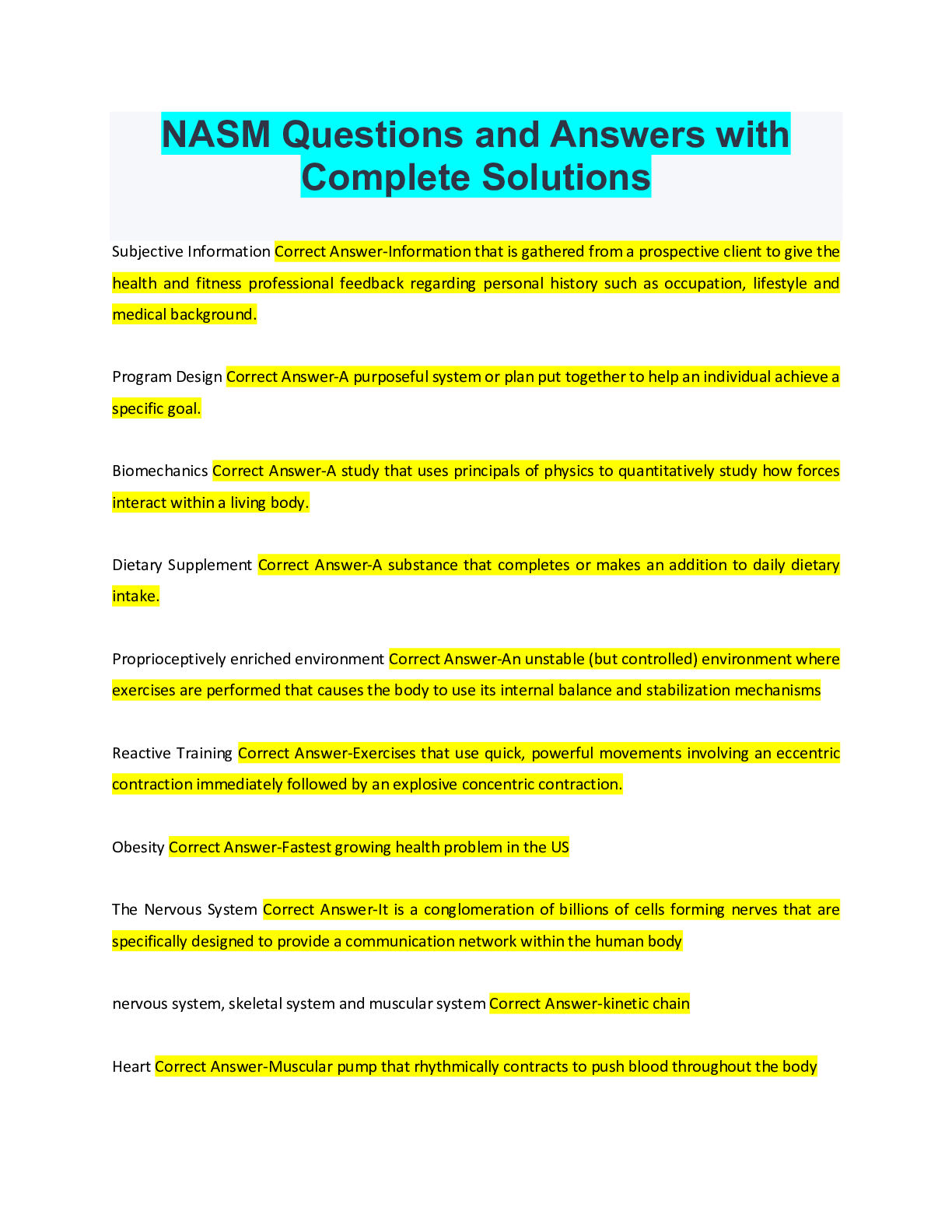
NASM Questions and Answers with
Complete Solutions
Subjective Information Correct Answer-Information that is gathered from a prospective client to give the
health and fitness professional feedback regarding personal history such as occupation, lifestyle and
medical background.
Program Design Correct Answer-A purposeful system or plan put together to help an individual achieve a
specific goal.
Biomechanics Correct Answer-A study that uses principals of physics to quantitatively study how forces
interact within a living body.
Dietary Supplement Correct Answer-A substance that completes or makes an addition to daily dietary
intake.
Proprioceptively enriched environment Correct Answer-An unstable (but controlled) environment where
exercises are performed that causes the body to use its internal balance and stabilization mechanisms
Reactive Training Correct Answer-Exercises that use quick, powerful movements involving an eccentric
contraction immediately followed by an explosive concentric contraction.
Obesity Correct Answer-Fastest growing health problem in the US
The Nervous System Correct Answer-It is a conglomeration of billions of cells forming nerves that are
specifically designed to provide a communication network within the human body
nervous system, skeletal system and muscular system Correct Answer-kinetic chain
Heart Correct Answer-Muscular pump that rhythmically contracts to push blood throughout the bodyDynamic Joint Stabilization Correct Answer-The ability of the kinetic chain to stabilize a joint during
movement.
Speed Correct Answer-The ability to move the body in one intended direction as fast as possible.
The Core Correct Answer-The lumbo-pelvic -hip complex and the thoracic and cervical spine, where the
body's center of gravity is located
Flexibility Correct Answer-The normal extensibility of all soft tissues that allow the full range of motion of
a joint.
Nutrition Correct Answer-The sum of the processes by which an animal or plant takes in and uses food
substances.
Blood Correct Answer-Acts as a medium to deliver and collect essential products to and from the tissues
of the body.
Protein Correct Answer-Amino acids linked by peptide bonds.
Diabetes Correct Answer-Chronic metabolic disorder, in which the body's ability to produce insulin or to
utilize glucose is altered
Rate of force production Correct Answer-How quickly a muscle can generate force
Superior Correct Answer-Positioned above a point of reference.
Dynamic Range of Motion Correct Answer-The combination of flexibility and the nervous system's ability
to control this range efficiently.
General Adaptation Syndrome Correct Answer-The kinetic chain's ability to adapt to stresses placed on it.Multisensory Condition Correct Answer-Training environment that provides heightened stimulation to
proprioceptors and mechanoreceptors.
Cardiorespiratory system Correct Answer-A system comprised of the cardiovascular and respiratory
systems
Rate of Force Production Correct Answer-Ability of muscles to exert maximal force output in a minimal
amount of time.
Acute Variables Correct Answer-Important components that specify how each exercise is to be performed.
Inferior Correct Answer-Positioned below a point of reference.
sensory function Correct Answer-The ability to sense changes in either external or internal environments
Neromuscular efficiency Correct Answer-The ability of the neuromuscular system to allow agonists,
antagonists, and stabilizers to work synergistically and control the entire kinetic chain in all three planes
of motion
Estimated Average Requirement (EAR) Correct Answer-The average daily nutrient intake level that is
estimated to meet the requirement of half the healthy individuals who are in a particular life stage and
gender group.
Controlled Instability Correct Answer-Training environment that is unstable as can safely be controlled by
an individual.
Blood Vessel Correct Answer-A hollow tube that allows blood to be transported to and from the heart
General Warm-Up Correct Answer-A low intensity exercise consisting of movements that do not
necessarily relate to the more intense exercise that is to follow.
Hypertension Correct Answer-blood pressure of 140/90 or higherintegrative function Correct Answer-The ability to analyze and interpret sensory information to allow for
proper decision making, which produces appropriate response
Repetition (Rep) Correct Answer-One complete movement of a single exercise.
Distal Correct Answer-Positioned farthest from the center of the body.
Recommended Dietary Allowance (RDA) Correct Answer-The average daily nutrient intake level that is
sufficient to meet the nutrient requirement of nearly all healthy individuals who are in a particular life
stage and gender group.
Extensibility Correct Answer-The capability to be elongated or stretched.
Adequate Intake (AI) Correct Answer-A recommended average daily nutrient intake level, based on
observed approximations or estimates of nutrient intake that are assumed to be adequate for a group of
healthy people. This measure is used when an RDA cannot be determined.
Deconditioned Correct Answer-A state of lost physical fitness, which may include muscle imbalances,
decreased flexibility, and/or a lack of core and joint stability
Specific Warm-Up Correct Answer-Low intensity exercise consisting of movements that mimic those that
will be included in the more intense exercise that is to follow
Mediastinum Correct Answer-The space in the chest between the lungs that contains all the internal
organs of the chest, except the lungs.
Motor function Correct Answer-Neuromuscular response to sensory information
Dynamic Functional Flexibility Correct Answer-Multiplanar soft tissue extensibility with optimal
neuromuscular efficiency throughout the full range of motion.Anterior (or Ventral) Correct Answer-On the front of the body.
Alarm Reaction Correct Answer-The initial reaction to a stressor.
Osteopenia Correct Answer-The precursor to osteoporosis. indicated by reduced bone mass.
Capillaries Correct Answer-The smallest blood vessel that is the location where substances such as oxygen,
nutrients, hormones, and waste products are exchanged between tissues
Set Correct Answer-A group of consecutive repetitions.
Muscle Imbalance Correct Answer-Alteration of muscle length surrounding a joint
Osteoporosis Correct Answer-Condition in which there is a decrease in bone mass and density as well as
an increase in the space between bones, resulting in porosity and fragility.
Posterior (or dorsal) Correct Answer-On the back of the body.
Postural distortion patterns Correct Answer-Predictable pattern of muscle imbalances
The Central Nervous System Correct Answer-Sensory/Afferent neurons transmit nerve impulses from
effector sites to
Superset Correct Answer-Set of two exercises that are performed back to back without any rest time
between them
Resistance Development Correct Answer-The body increases its functional capacity to adapt to the
stressor.
The Neuron Correct Answer-The functional unit of the nervous systemTolerable Upper Intake Level (UL) Correct Answer-The highest average daily nutrient intake level likely to
pose no risk of adverse health effects to almost all individuals in a particular life stage and gender group.
As intake increases above the UL, the potential risk of adverse health effects increases.
Cardiovascular system Correct Answer-Comprised of the heart, the blood it pumps, and the blood vessels
that transport the blood from the heart to the tissues of the body
Osteoarthritis Correct Answer-Degeneration of cartilage in joint
[Show More]