HAZMAT, MCI, and Incident Management
Exam Study Questions - LATEST
Which of the following agencies have developed regulations for dealing with hazardous materials
emergencies?
a. OSHA and EPA
b. DOT and FCC
c. NAEM
...
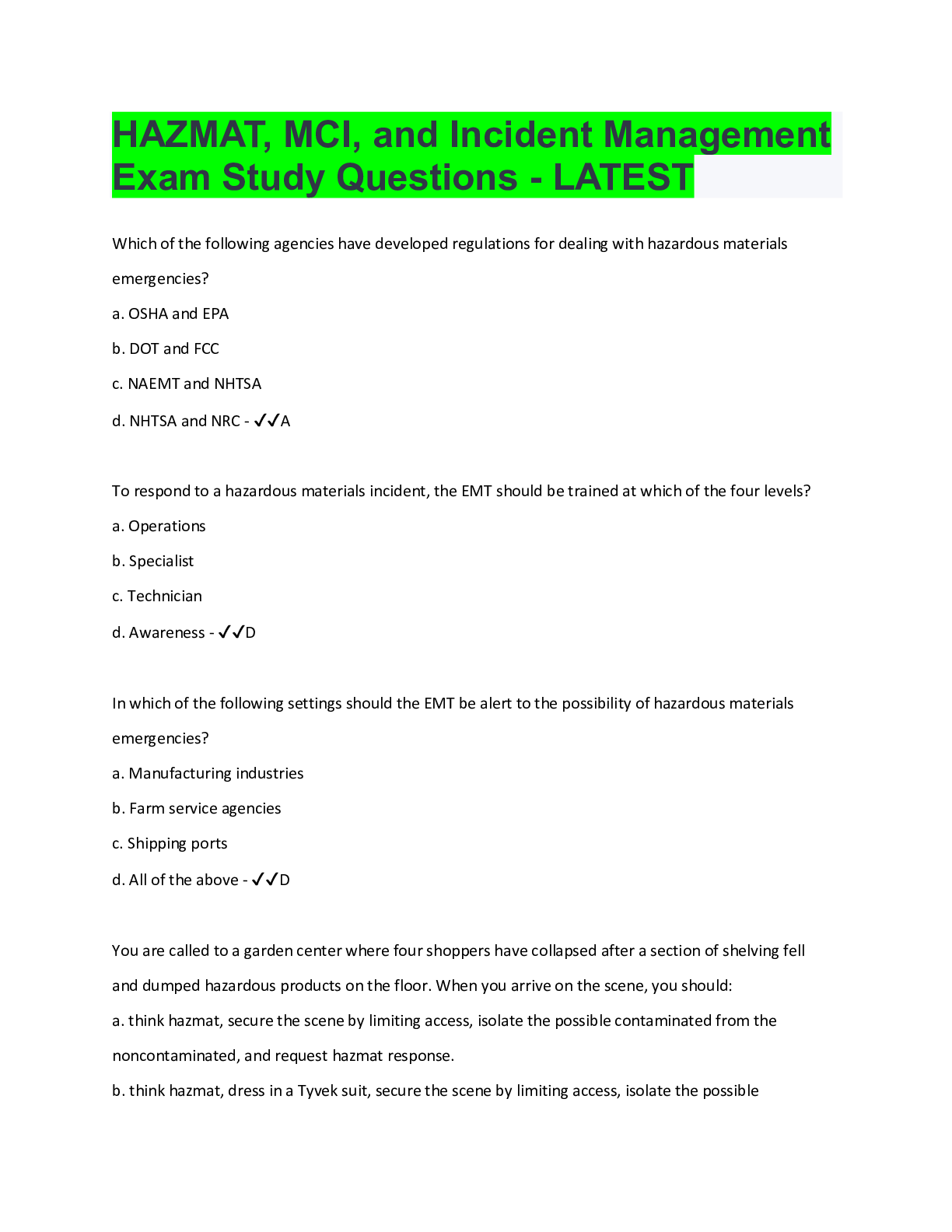
HAZMAT, MCI, and Incident Management
Exam Study Questions - LATEST
Which of the following agencies have developed regulations for dealing with hazardous materials
emergencies?
a. OSHA and EPA
b. DOT and FCC
c. NAEMT and NHTSA
d. NHTSA and NRC - ✔✔A
To respond to a hazardous materials incident, the EMT should be trained at which of the four levels?
a. Operations
b. Specialist
c. Technician
d. Awareness - ✔✔D
In which of the following settings should the EMT be alert to the possibility of hazardous materials
emergencies?
a. Manufacturing industries
b. Farm service agencies
c. Shipping ports
d. All of the above - ✔✔D
You are called to a garden center where four shoppers have collapsed after a section of shelving fell
and dumped hazardous products on the floor. When you arrive on the scene, you should:
a. think hazmat, secure the scene by limiting access, isolate the possible contaminated from the
noncontaminated, and request hazmat response.
b. think hazmat, dress in a Tyvek suit, secure the scene by limiting access, isolate the possiblecontaminated from the noncontaminated, and request hazmat response.
c. secure the scene quickly, triage each patient, and move to fresh air.
d. think hazmat, dress in a Tyvek suit, access the scene to identify the spilled product, secure the MSDS
sheets, and remove victims to fresh air. - ✔✔A
Which of the following are desirable characteristics of the "safe or cold zone" in a hazardous
materials incident?
a. Upwind, uphill from the spill
b. Upwind, on the same level as the spill
c. Downwind, uphill from the spill
d. Downwind, downhill from the spill - ✔✔B
Which of the following is NOT the role of the first arriving EMT at the scene of a possible hazardous
materials emergency?
a. Requesting special resources to respond
b. Recognizing a hazardous materials emergency
c. Establishing a safe zone
d. Rescuing any victims still in the area of the spill - ✔✔D
In which of the following zones is the EMT expected to be staged at the scene of a hazardous
materials incident?
a. Warm zone
b. Hot zone
c. Cold zone
d. Ground zero - ✔✔C
Which of the following should be considered during the scene size-up of a hazardous materials
emergency?a. Potential for spread of the substance
b. The properties and potential dangers of the substance
c. Identification of the substance
d. All of the above - ✔✔D
Which of the following is NOT an acceptable way of attempting to identify a hazardous material?
a. Checking the material safety data sheet
b. Collecting a sample of the material for laboratory analysis
c. Asking the driver of the tractor-trailer truck involved in the incident
d. Using binoculars to obtain information from the placard on a container - ✔✔B
Which of the following is a resource for specific actions to be taken by personnel dealing with a
hazardous materials incident?
a. Medical protocols
b. Emergency response guidebook
c. Medical dictionary
d. Food and Drug Administration toll-free hotline - ✔✔B
When seeking expert advice on how to proceed at a hazardous materials incident, which of the
following information is important to provide?
a. The amount of the substance involved
b. Your level of EMS certification
c. Your background in chemistry
d. Both A and B - ✔✔A
Which of the following is NOT a responsibility of an EMT at the scene of a hazardous materials
emergency?
a. Rehabilitating the hazmat teamb. Decontaminating injured victims
c. Treating injured patients
d. Staying in the cold zone - ✔✔B
Which of the following is NOT a desirable characteristic of the rehabilitation sector of a hazardous
materials incident?
a. It is large enough to accommodate multiple rescue crews.
b. It allows for rapid re-entry to the emergency operation.
c. It is protected from weather elements.
d. It is located in the warm zone. - ✔✔D
Which of the following is a function of the rehabilitation sector in a hazardous materials incident?
a. Providing for hydration of rescue crews
b. Taking baseline vital signs before rescuers enter the operations area
c. Performing medical assessment of rescue crews
d. All of the above - ✔✔D
Which of the following actions may need to be taken by the EMT when treating and transporting a
patient who was exposed to, and contaminated by, a hazardous material?
a. Wearing heavy cloth gloves
b. Disposing of patient care equipment such as blood-pressure cuffs and backboards
c. Wearing a gown, mask, and goggles to prevent secondary contamination
d. Placing towels on the floor of the ambulance to soak up contaminated runoff water - ✔✔B
Which of the following personal protective items must be used by EMS personnel caring for patients
in a hazardous materials emergency?
a. Structural firefighting gear
b. HEPA maskc. Chemical permeable gloves
d. Tyvek or other chemical impermeable coveralls - ✔✔D
Which of the following is NOT a mechanism of decontamination from hazardous materials?
a. Disinfecting
b. Disposing
c. Deodorizing
d. Emulsifying - ✔✔C
When grossly decontaminating a patient who is not wearing personal protective equipment in a
hazardous materials incident, which of the following techniques should be used?
a. Taking a low-pressure decontamination shower
b. Scrubbing with a long-handled brush
c. Sponging with a dilute solution of water and white vinegar
d. Using a high pressure water jet system - ✔✔A
Which of the following is the most common type of multiple-casualty incident that EMS providers will
respond to?
a. Outbreaks of influenza
b. Motor vehicle collisions
c. Structure fires
d. Hazardous materials incidents - ✔✔B
You are on the scene of a church bus roll-over collision. There are 30 passengers involved. As
triage officer, which one of the following patients should you assign the highest priority?
a. A 30-year-old man with multiple lower extremity fractures who is awake, has a strong radial pulse,
and is complaining of severe pain
b. A 35-year-old pregnant woman with a cut on her head, neck pain, and numbness and tingling in her
armsc. A 70-year-old woman who is awake but having difficulty breathing and has absent lung sounds on the
right side
d. An unresponsive 9-year-old male with an open skull fracture who is in cardiac arrest - ✔✔C
Which of the following is a feature of a good disaster plan?
a. It is specific to the geographical location.
b. It has been practiced in mock disasters.
c. It is based on the availability of resources in a particular area.
d. All of the above - ✔✔D
[Show More]