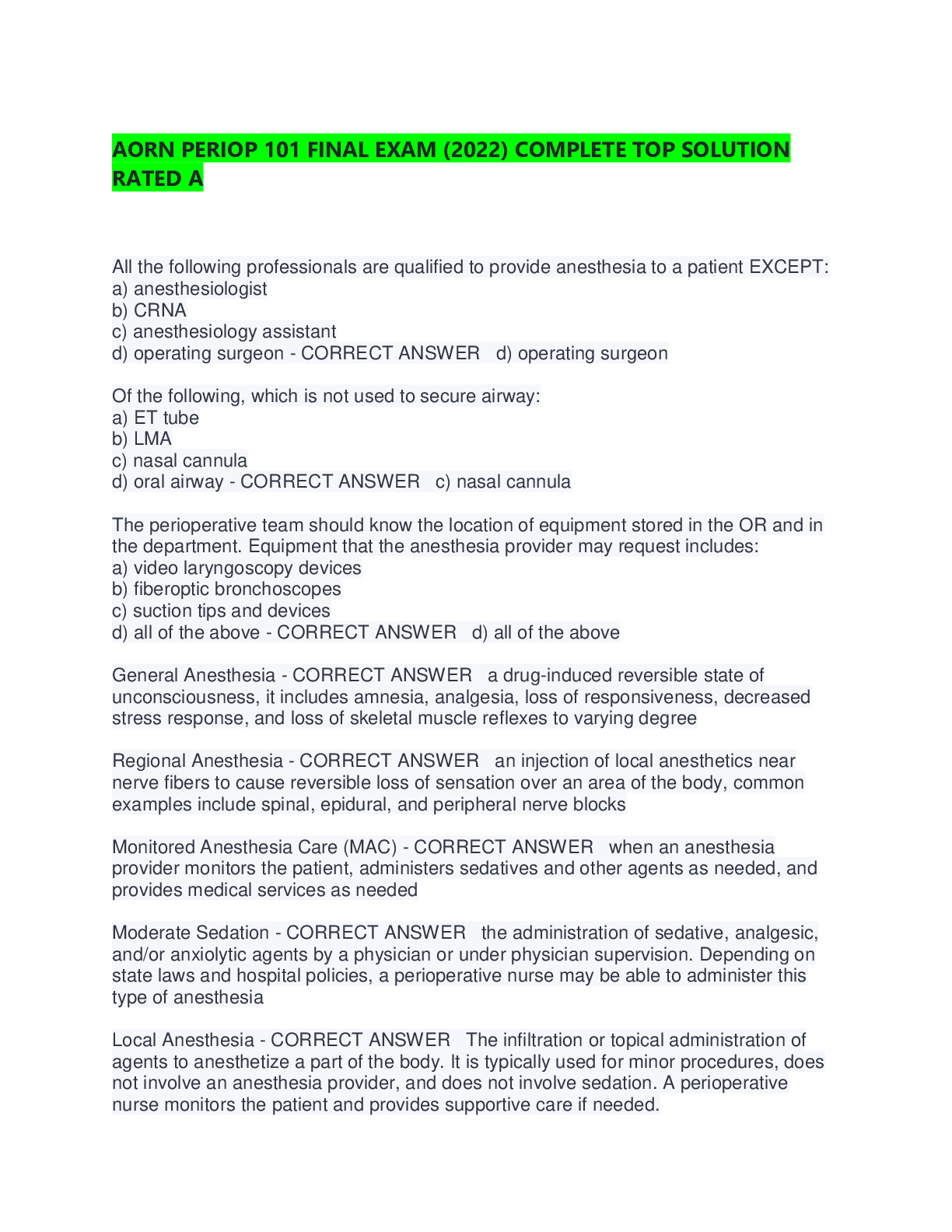
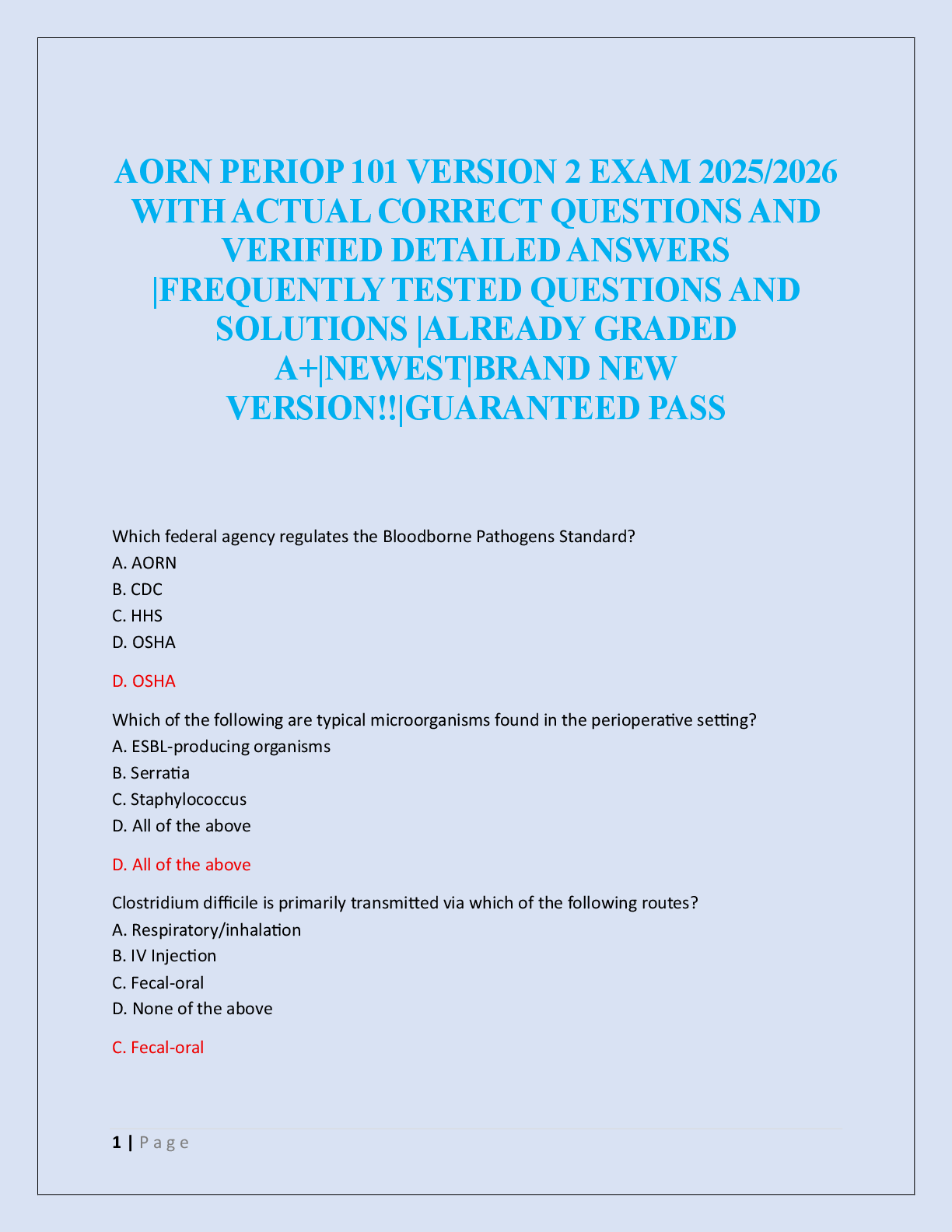
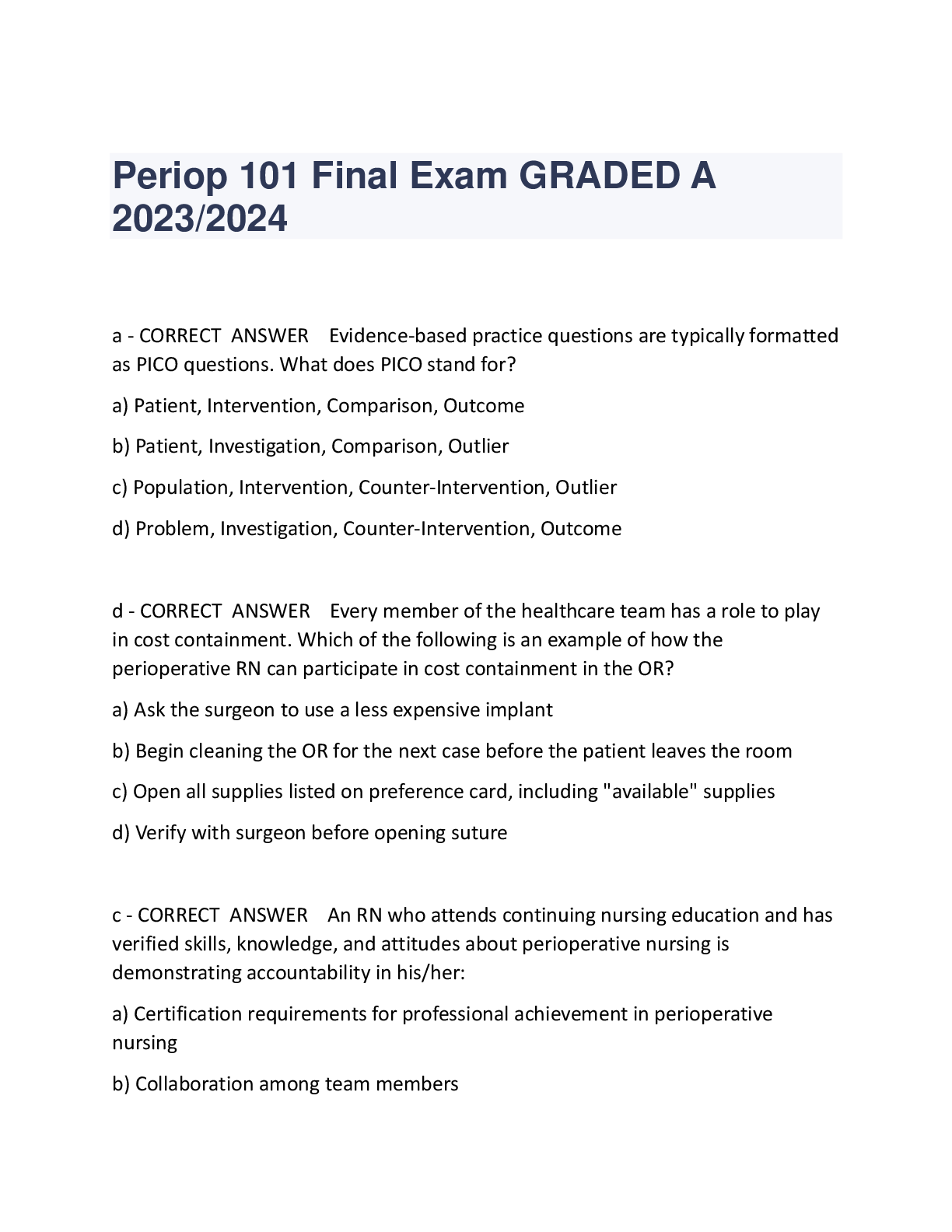
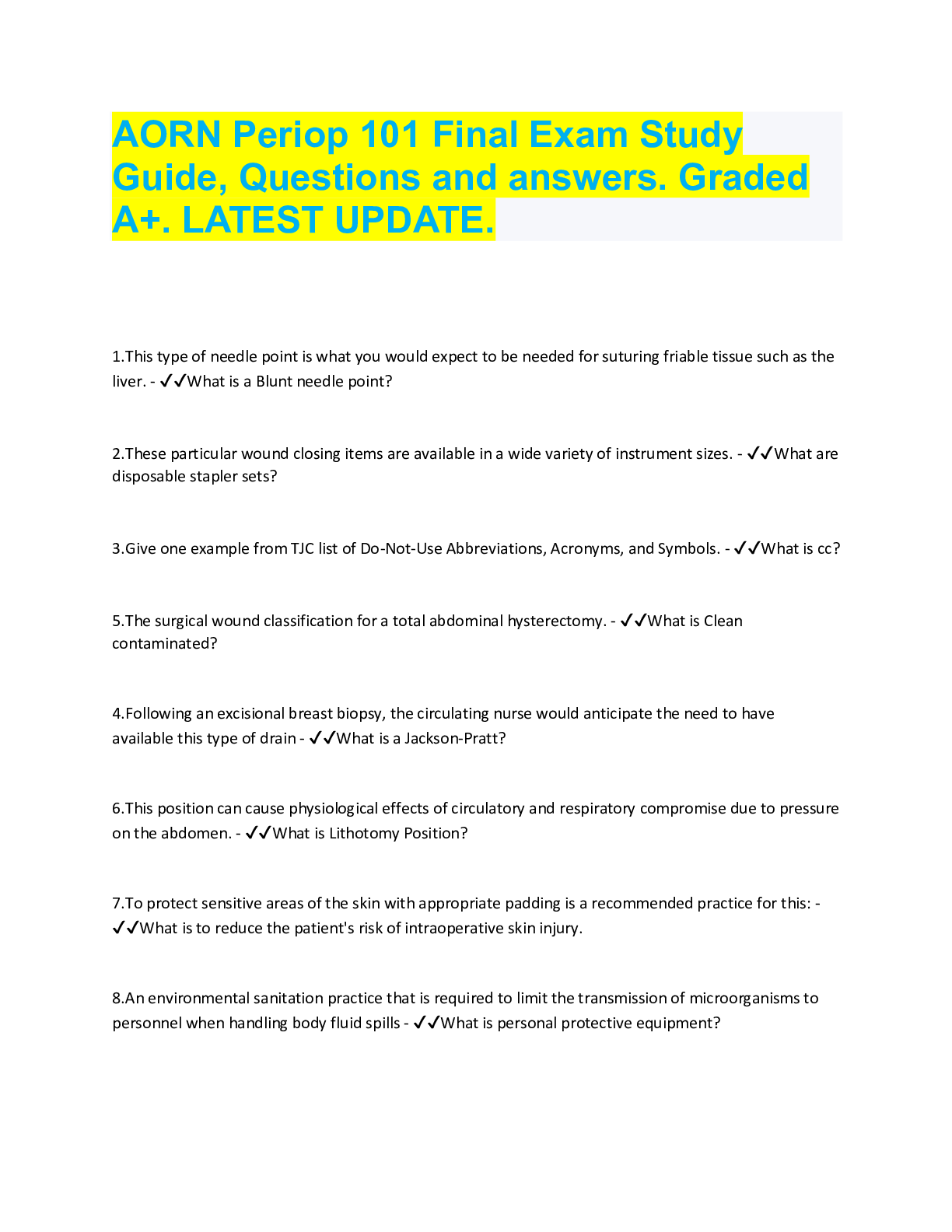
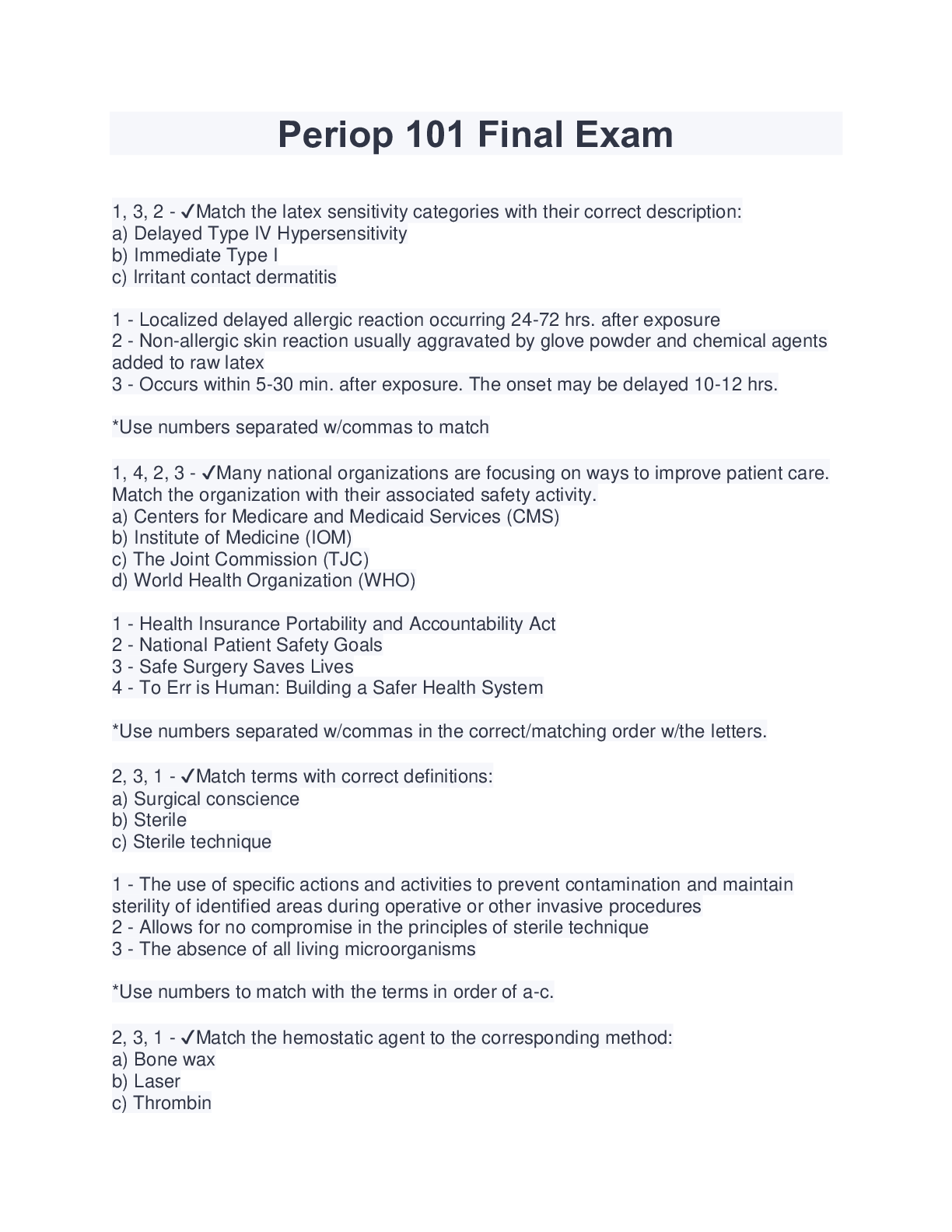
AORN PERIOP 101 FINAL EXAM (2022) COMPLETE TOP SOLUTION RATED A All the following professionals are qualified to provide anesthesia to a patient EXCEPT: a) anesthesiologist b) CRNA c) anesthe ... siology assistant d) operating surgeon - CORRECT ANSWER d) operating surgeon Of the following, which is not used to secure airway: a) ET tube b) LMA c) nasal cannula d) oral airway - CORRECT ANSWER c) nasal cannula The perioperative team should know the location of equipment stored in the OR and in the department. Equipment that the anesthesia provider may request includes: a) video laryngoscopy devices b) fiberoptic bronchoscopes c) suction tips and devices d) all of the above - CORRECT ANSWER d) all of the above General Anesthesia - CORRECT ANSWER a drug-induced reversible state of unconsciousness, it includes amnesia, analgesia, loss of responsiveness, decreased stress response, and loss of skeletal muscle reflexes to varying degree Regional Anesthesia - CORRECT ANSWER an injection of local anesthetics near nerve fibers to cause reversible loss of sensation over an area of the body, common examples include spinal, epidural, and peripheral nerve blocks Monitored Anesthesia Care (MAC) - CORRECT ANSWER when an anesthesia provider monitors the patient, administers sedatives and other agents as needed, and provides medical services as needed Moderate Sedation - CORRECT ANSWER the administration of sedative, analgesic, and/or anxiolytic agents by a physician or under physician supervision. Depending on state laws and hospital policies, a perioperative nurse may be able to administer this type of anesthesia Local Anesthesia - CORRECT ANSWER The infiltration or topical administration of agents to anesthetize a part of the body. It is typically used for minor procedures, does not involve an anesthesia provider, and does not involve sedation. A perioperative nurse monitors the patient and provides supportive care if needed. The phases of general anesthesia, in order, are: a) induction, maintenance, emergence b) emergence, maintenance, induction c) maintenance, emergence, induction d) induction, emergence, maintenance - CORRECT ANSWER a) induction, maintenance, emergence Propofol - CORRECT ANSWER IV induction agent etomidate - CORRECT ANSWER IV induction agent methohexitol - CORRECT ANSWER IV induction agent IV induction agent - CORRECT ANSWER ketamine sevoflurane with or without nitric oxide - CORRECT ANSWER inhaled induction agent Succinylcholine - CORRECT ANSWER short-acting muscle relaxant cisatracurium - CORRECT ANSWER intermediate-acting muscle relaxant atracurium - CORRECT ANSWER intermediate-acting muscle relaxant rocuronium - CORRECT ANSWER intermediate-acting muscle relaxant vecuronium - CORRECT ANSWER intermediate-acting muscle relaxant pancuronium - CORRECT ANSWER long-acting muscle relaxant isoflurane - CORRECT ANSWER used for inhalation maintenance desflurane - CORRECT ANSWER used for inhalation maintenance total iv anesthesia (TIVA) - CORRECT ANSWER a technique for maintaining anesthesia using infusions of short-acting IV agents without inhalation anesthetics. Propofol and remifentanil are often used for TIVA. Reversal agent for succinylcholine - CORRECT ANSWER none! [Show More]
Last updated: 3 years ago
Preview 1 out of 30 pages
Buy this document to get the full access instantly
Instant Download Access after purchase
Buy NowInstant download
We Accept:
Can't find what you want? Try our AI powered Search
Connected school, study & course
About the document
Uploaded On
Sep 12, 2022
Number of pages
30
Written in
All
This document has been written for:
Uploaded
Sep 12, 2022
Downloads
0
Views
38
Scholarfriends.com Online Platform by Browsegrades Inc. 651N South Broad St, Middletown DE. United States.
We're available through e-mail, Twitter, and live chat.
FAQ
Questions? Leave a message!
Copyright © Scholarfriends · High quality services·