50 Question PMA Test
Which of the following processes determines which requirements will be included in the project?
A. Define Scope
B. Determine Requirements
C. Collect Requirements
D. Plan Scope Management
...
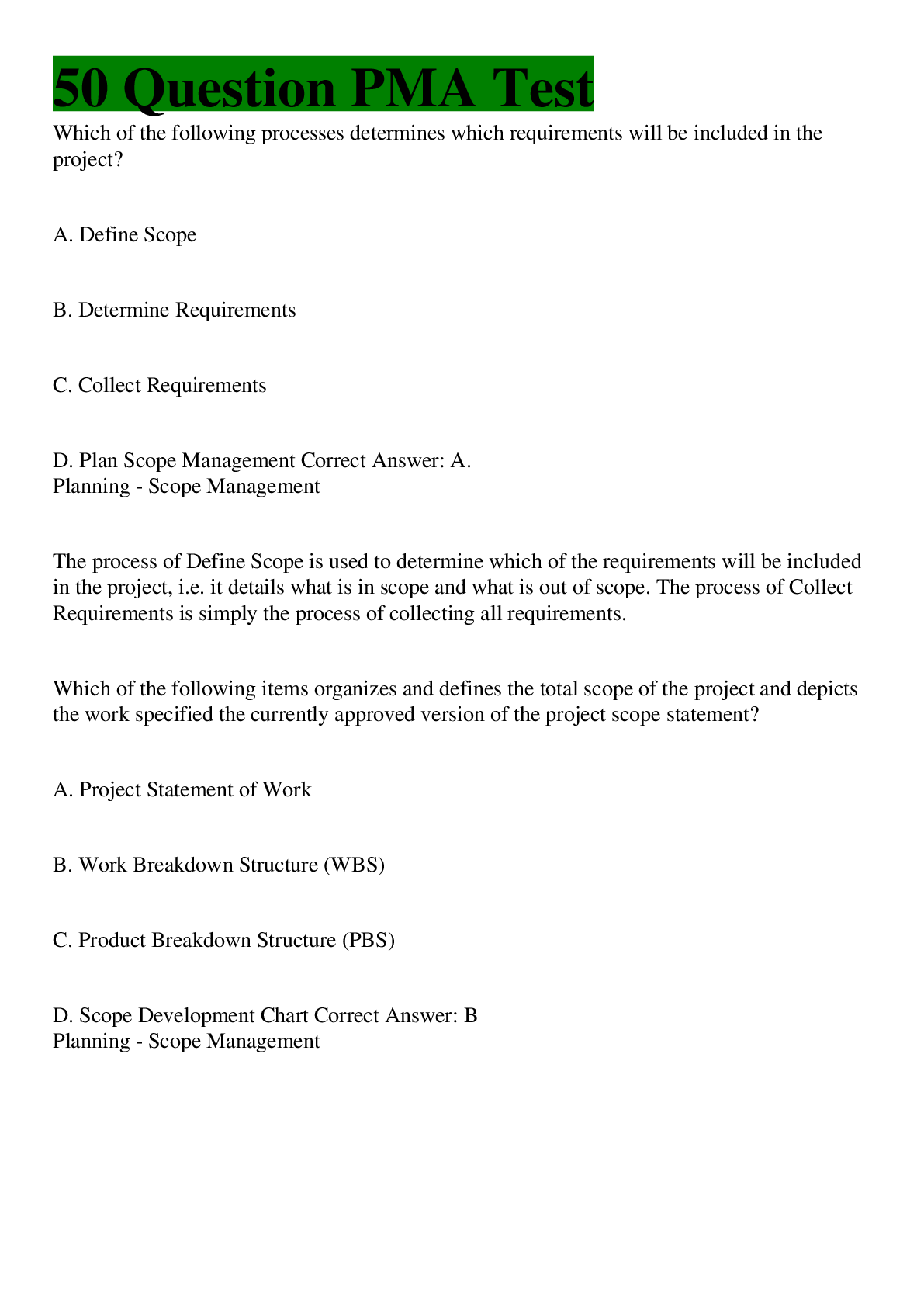
50 Question PMA Test
Which of the following processes determines which requirements will be included in the project?
A. Define Scope
B. Determine Requirements
C. Collect Requirements
D. Plan Scope Management Correct Answer: A.
Planning - Scope Management
The process of Define Scope is used to determine which of the requirements will be included in the project, i.e. it details what is in scope and what is out of scope. The process of Collect Requirements is simply the process of collecting all requirements.
Which of the following items organizes and defines the total scope of the project and depicts the work specified the currently approved version of the project scope statement?
A. Project Statement of Work
B. Work Breakdown Structure (WBS)
C. Product Breakdown Structure (PBS)
D. Scope Development Chart Correct Answer: B
Planning - Scope Management
The Work Breakdown Structure (WBS) is the document that shows the deliverables and work as defined in the currently approved version of the Project Scope Statement. The Project Statement of Work is a document that describes the business need, contains a high-level scope description, and the organization's overall strategic plan. A PBS is only used on projects that produce a tangible product and only includes a breakdown of the components of the product - in other words it does not include the work required to deliver the product.
Which of the following is a true statement regarding the schedule management plan?
A. It may or may not be written depending on the project management approach of the organization's executives
B. It can be formal or informal, highly detailed or broad in nature depending on the project and it is a key input to the Define Activities process
C. It must be formal and highly detailed prior to project management plan approval
D. It requires the input of all stakeholders who will eventually approve the plan Correct Answer: B.
Planning - Time Management
In the approach from PMI, a schedule management plan will be included in every project, i.e. it must exist. However, it can be formal or informal, broadly framed or highly detailed in nature, depending on the needs of the project.
Planning work that will occur sooner at a detailed level, and planning work that will occur later in the project at a higher level, is best described as which of the following?
A. Progressive Elaboration
B. Urgency Assessment
C. Rolling Wave Planning
D. Just-In-Time (JIT) Planning Correct Answer: C.
Planning - Time Management
Rolling wave planning is an iterative technique used to plan the nearer term activities at a more detailed level than those happening later in the project.
Once the network diagram is complete, how many activities or milestones will not have both a predecessor and a successor?
A. 1
B. 1 in each phase
C. As many as necessary
D. 2 in the entire network Correct Answer: D.
Planning - Time Management
Once the network diagram is finished, the only two activities that will not have both a predecessor and a successor will be the starting and ending activities in a project.
Which of the following is a true statement of the critical path?
A. It is the longest path through the network diagram, that denotes the shortest amount of time to complete the project and will have the least amount of total float
B. It is the longest path through the network diagram and will always have zero total float
C. It is the longest path through the network diagram and will have the least free float
D. It is the path that contains the most important activities Correct Answer: A.
Planning - Time Management
The critical path will always be the longest path through the network diagram and can have positive, negative or zero total float. It will also be the path that has the least amount of total float (not the least free float). The perceived "importance" of the activities themselves do not come into play.
Which of the following estimating approaches would you use early in a project?
A. Analogous
B. Parametric
C. Bottom-up
D. Three-point Correct Answer: A.
Planning - Cost Management
Of the estimating approaches listed, only analogous is used early in a project, when little information is known about the project. It is the quickest way of coming up with a total project estimate but it is also the least accurate.
The process of Identify Risk will result in which of the following?
A. Risk Management Plan
B. Risk Register
C. Risk Breakdown Structure
D. Risk versus Reward Correct Answer: B.
Planning - Risk Management
The process of Identify Risk will result in the creation of the Risk Register, which is the document that will list all possible threats and opportunities that could occur during the project. The risk management plan is an outcome of plan risk management and it will possibly include the risk breakdown structure.
As the project manager you have decided to separate the sources of risk by phase and by the WBS. Using this technique you will find the riskiest areas of the project. Which of the following best describes the technique employed?
A. Proper risk planning
B. Risk urgency assessment
C. Risk data quality assessment
D. Risk categorization Correct Answer: D.
Planning - Risk Management
While answer A may be correct it is too general. Answer B is a technique used to identify those risks that could occur sooner in the project. Answer C is a technique used to ensure the quality of the data used to identify and analyze risk. Risk categorization is a technique used to classify risk and can be done through various methods, such as a sample list of risk categories, or it could be done by phase, by the WBS, or by a formal risk breakdown structure.
Your project team has just completed a quantitative analysis of project risk. They have identified a 45% chance of a flood that would cost the project $50,000 in damages and cleanup. They have also identified a 30% chance that the new piece of equipment recently purchased by your organization will save the project $10,000. What is the expected monetary value of these two risks? (Probability)x(impact)
A. $40,000
B. ($40,000)
C. $19,500
D. ($19,500) Correct Answer: D.
Planning - Risk Management
When calculating the contingency budget for a project, one popular method is called EMV or expected monetary value. To calculate EMV for each of these risks you would multiply the probability of occurrence and the impact of that occurrence. So, .45*$50,000= -$22,500. Then you will notice that the second risk is an opportunity. To calculate the EMV for this opportunity it would be, .30*$10,000= $3,000. These two figures would then be added together. So, a negative $22,500 plus $3000 would equal -$19,500. A common way of showing negative numbers is in parentheses.
Two team members are having trouble getting along. They have attempted to resolve their differences between themselves with no lasting outcome. As project manager you have a discussion with them to identify the root cause. After much discussion, you decide that the best way to take care of the situation is to have both team members go play a round of golf, which they both enjoy. What conflict resolution technique have you employed?
A. Compromise/Reconcile
B. Force/Direct
C. Smooth/Accommodate
D. Collaborate/Problem Solve Correct Answer: C.
Executing - Human Resources Management
In this situation the project manager is using smoothing or accommodating, which means they are deemphasizing the areas of disagreement and emphasizing the areas of agreement or commonality. Compromising is when both parties give something up to reach an agreement. Forcing or directing is when one party forces their desire or wish upon someone else. Collaborating or problem-solving is when the conflict is treated as a problem, and possible solutions are discussed. A single solution is chosen and implemented. Then a review will occur to see if that solution corrected the problem.
Which of the following is considered a broad class of communications methods?
A. SharePoint
B. E-mail
C. Interactive
D. Phone calls Correct Answer: C.
Executing - Communications Management
Answers A, B and D are all classified under the area of communications technology. When broadly classified, answer C is considered a communications method. Answer D is a specific technology that could be used in interactive communications. Other forms of interactive communications can include teleconferencing, video teleconferencing, instant messaging and face-to-face.
The project manager decides to call a meeting with all of the prospective contractors who are expected to submit proposals on the new project. The purpose of this meeting is so that the contractors can gain a clearer understanding of the requirements of the procurement. The project manager decides to make this meeting mandatory. In other words, if a contractor does not attend this meeting they will not be qualified to submit a proposal. What is the best description of this requirement?
A. Proposal Evaluation Techniques
B. Bidders Conference
C. Screening System
D. Procurement Negotiations Correct Answer: C.
Executing - Procurement Management
When procurement documentation states that something is mandatory, it generally means that this factor will be used as a screening system to quickly reduce the number of potential bidders. Usually, screening system information is placed in bold letters in advertisement for the procurement. The question discusses a meeting between the project manager and prospective contractors which is also called a bidders conference. Procurement negotiations happen after each of the proposals are evaluated and a selected seller is chosen.
The project manager may call on which of the following individuals to assist in managing stakeholders as needed?
A. Project sponsor
B. Senior executive
C. Assistant project manager
D. Project team member Correct Answer: A.
Executing - Stakeholder Management
Typically when a project manager requires assistance in managing various stakeholders, the project sponsor may be asked to assist. Project managers generally have little authority, so a project sponsor can help because they usually have more authority than the project manager. While answer B may actually be the project sponsor, not all senior executives are a project sponsor. An assistant project manager and team members have less authority than the project manager.
With regards to monitoring and controlling project work, when does this process begin and end?
A. It begins when the project charter is signed and ends when the last deliverable is accepted
B. It begins when the project charter is signed and ends when the project is formally closed
C. It begins when the project is selected and ends when the last deliverable is accepted
D. It begins when the project is conceived and ends when the last deliverable is accepted Correct Answer: B.
Monitoring - Integration Management
Monitoring and controlling project work begins when the project is formally authorized, which is done through the project charter. It ends when the project is formally closed. Work is still required by the team to formally close out the project, even after the last deliverable is accepted.
The chief financial officer, who happens to be your project sponsor, has just called you into their office to discuss a requested change in your project. After asking you several questions, the project sponsor tells you to implement the change. What is the next thing you should do?
A. Implement the change
B. Send the change request to the change control board for approval
C. Fill out a change request form and request the project sponsor's signature
[Show More]



.png)