WGU - C168 Critical Thinking and Logic -
Practice MCQ
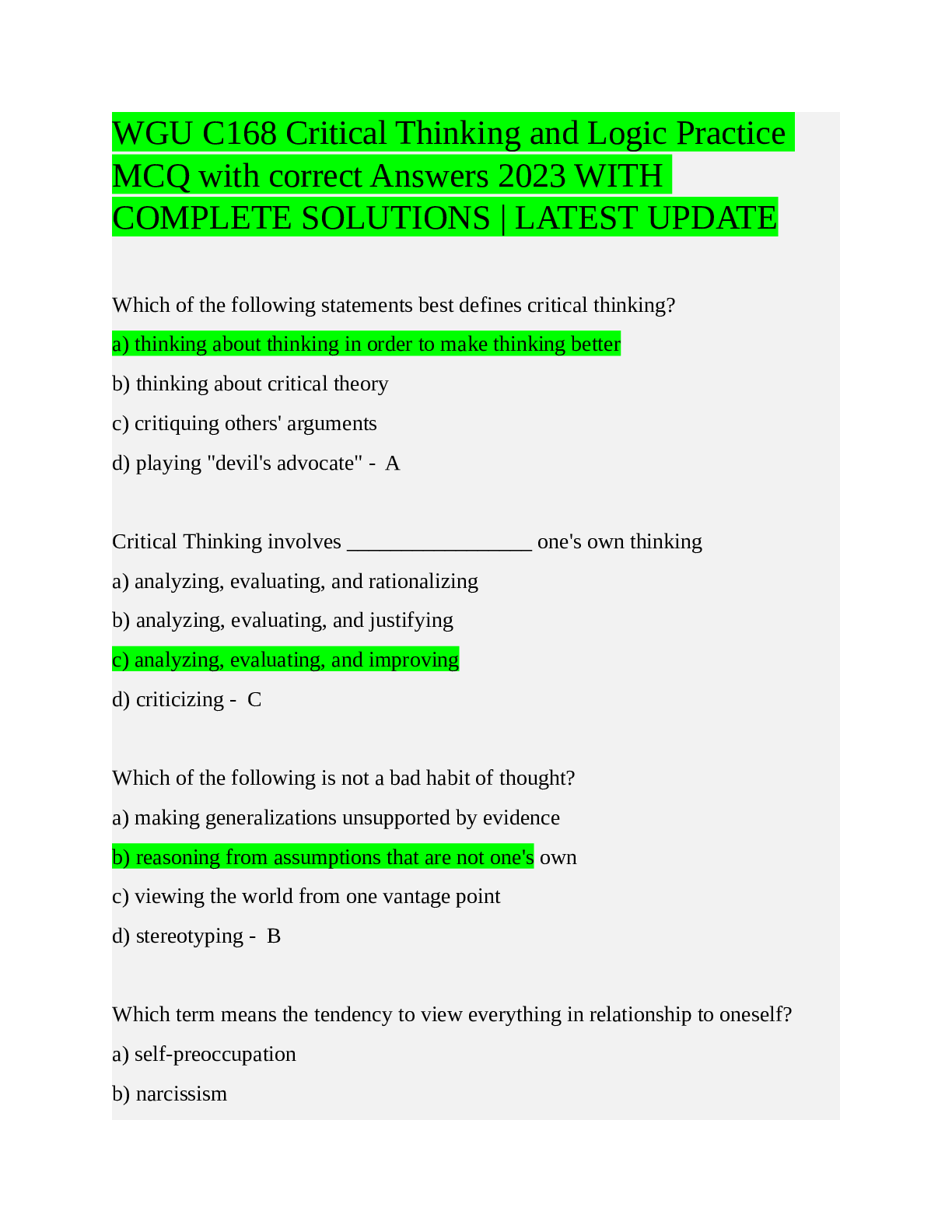
____________________ involves developing the tools of critical thinking and applying them to
current and future challenges.
a) Shallow learning
b) Deep learning
...
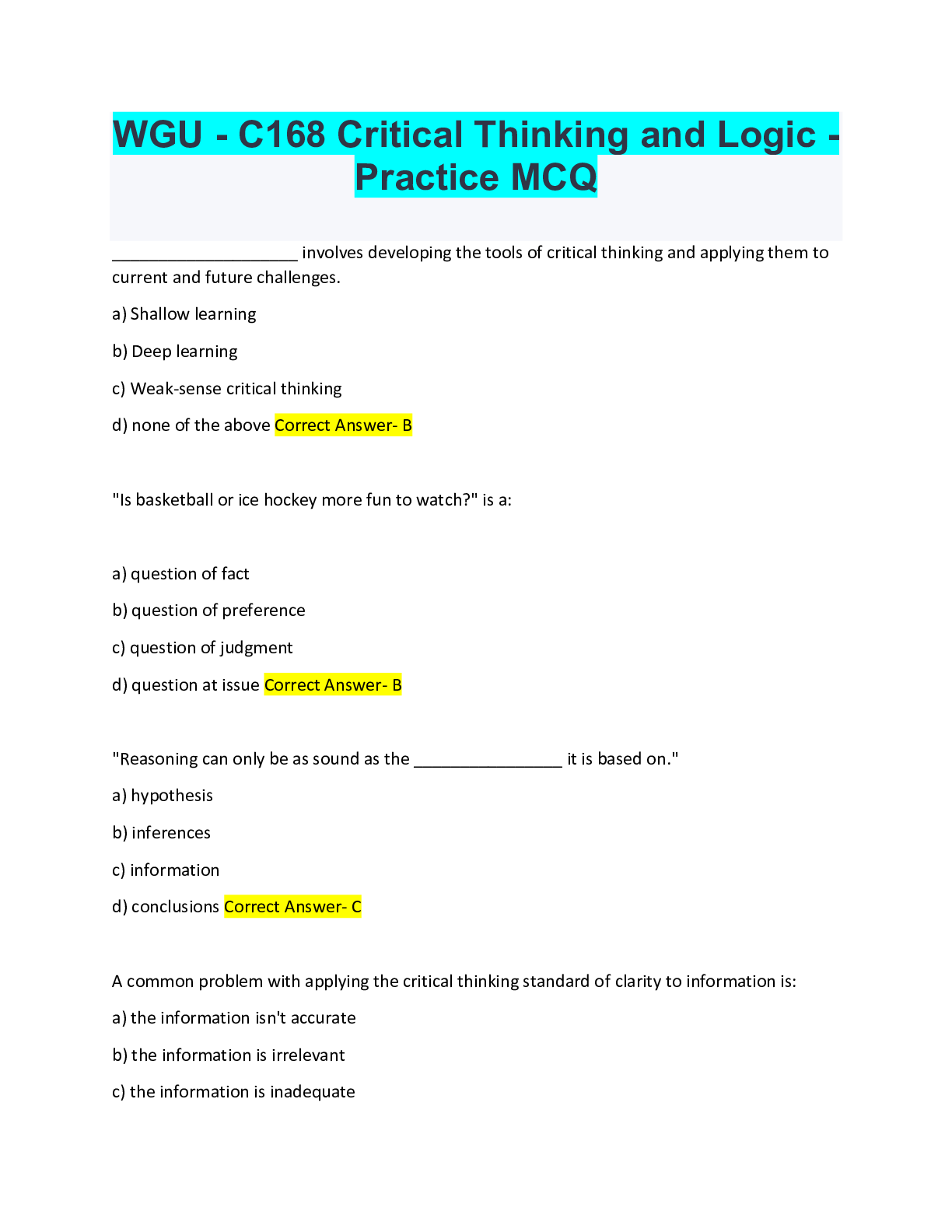
WGU - C168 Critical Thinking and Logic -
Practice MCQ
____________________ involves developing the tools of critical thinking and applying them to
current and future challenges.
a) Shallow learning
b) Deep learning
c) Weak-sense critical thinking
d) none of the above Correct Answer- B
"Is basketball or ice hockey more fun to watch?" is a:
a) question of fact
b) question of preference
c) question of judgment
d) question at issue Correct Answer- B
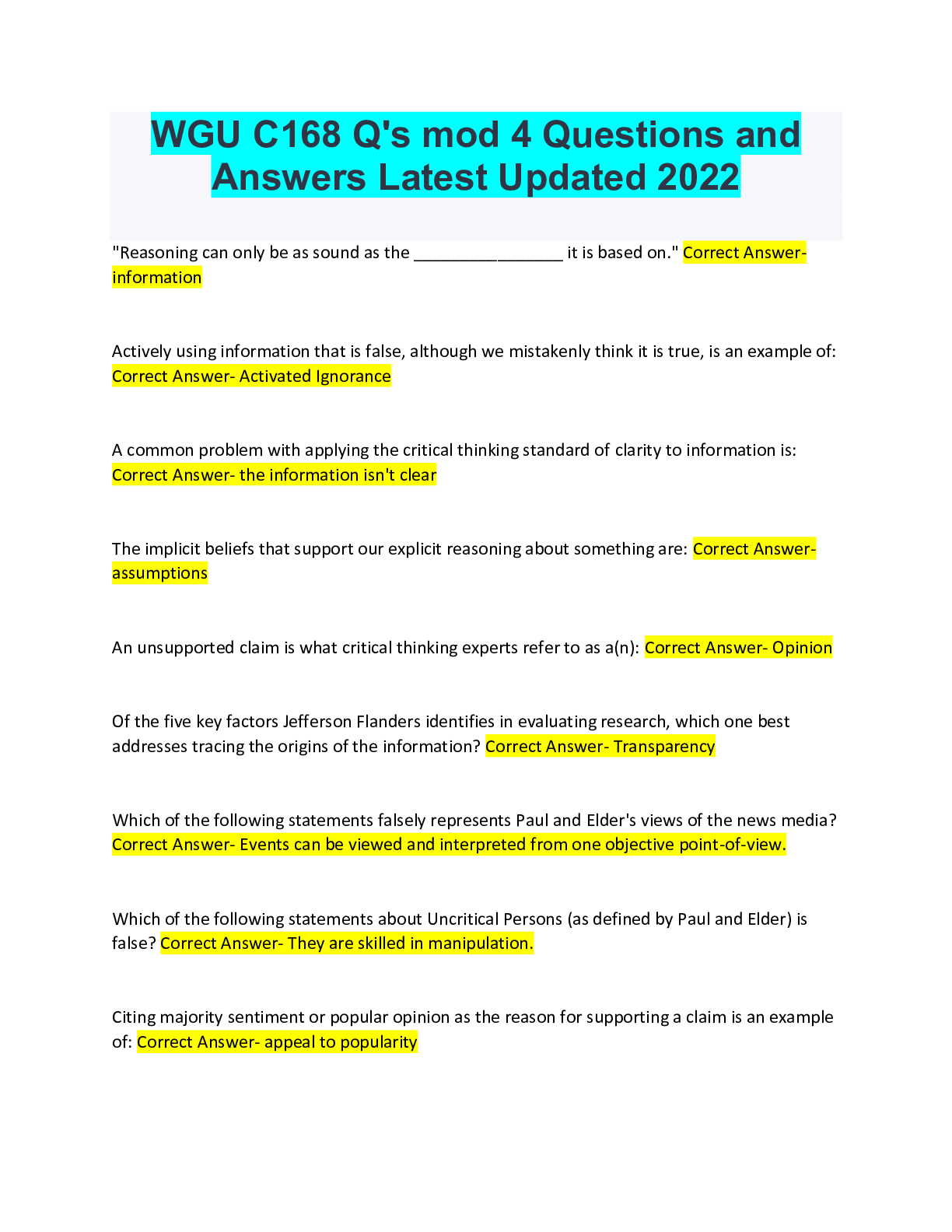
"Reasoning can only be as sound as the ________________ it is based on."
a) hypothesis
b) inferences
c) information
d) conclusions Correct Answer- C
A common problem with applying the critical thinking standard of clarity to information is:
a) the information isn't accurate
b) the information is irrelevant
c) the information is inadequated) the information isn't clear Correct Answer- D
A mechanic ruled out failures in 10 different engine parts before finding the problem in the
carburetor. This is an example of:
a) common factor method
b) single difference method
c) concomitant variation
d) process of elimination Correct Answer- D
A research study is an example of which kind of evidence?
a) Qualitative
b) Admissible
c) Quantitative
d) Credible Correct Answer- C
A scientist discovered that all laboratory hamsters that had been eating lettuce developed
Salmonella poisoning. This is an example of causation by:
a) common factor
b) single difference
c) concomitant variation
d) process of elimination Correct Answer- C
Actively using information that is false, although we mistakenly think it is true, is an example of:
a) Inert Information
b) Activated Ignorance
c) Activated Knowledge
d) Critical thinking Correct Answer- BAn effective approach to correcting egocentric myopia would be to:
a) focus on complexities and restating them
b) review our thinking for realism
c) consider points of views that conflict with ours
d) none of the above Correct Answer- C
An unsupported claim is what critical thinking experts refer to as a(n):
a) Preliminary conclusion
b) Opinion
c) Deductive assertion
d) Inference Correct Answer- B
Another term for critical thinking is:
a) first-order thinking
b) second-order thinking
c) primary
d) secondary Correct Answer- B
Another term used to describe egocentric thinking is:
a) domination
b) submission
c) strategic subservience
d) rigidity of thought Correct Answer- D
Bringing an unbiased perspective to all relevant viewpoints exemplifies which of the following?
a) intellectual humility
b) relativismc) fair-mindedness
d) intellectual integrity Correct Answer- C
Citing majority sentiment or popular opinion as the reason for supporting a claim is an example
of:
a) appeal to authority
b) appeal to popularity
c) hasty generalization
d) slippery slope Correct Answer- B
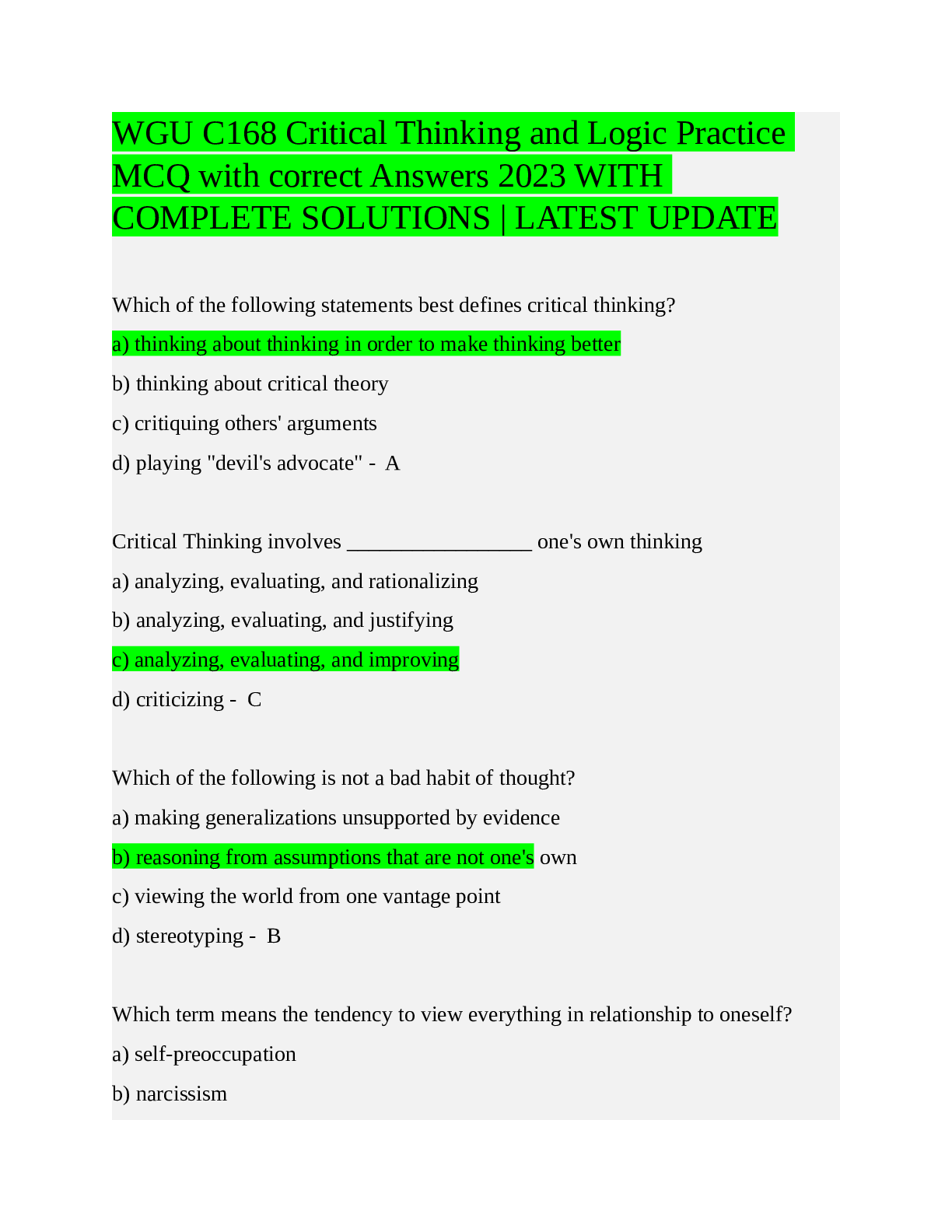
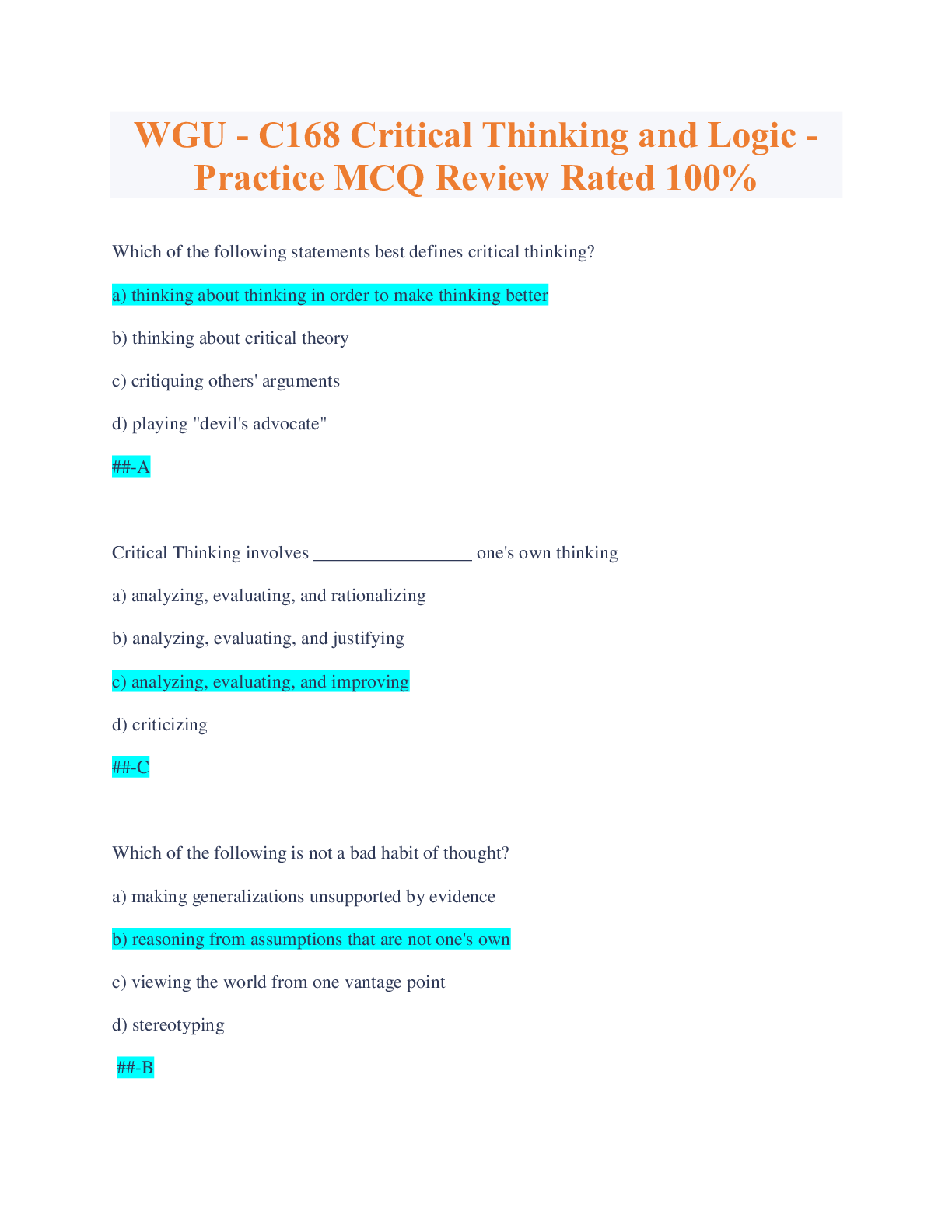
Critical Thinking involves _________________ one's own thinking
a) analyzing, evaluating, and rationalizing
b) analyzing, evaluating, and justifying
c) analyzing, evaluating, and improving
d) criticizing Correct Answer- C
Critical thinking values ________ of thought over ______ of thought.
a) depth/speed
b) speed/depth
c) speed/conformity
d) conformity/speed Correct Answer- A
Dismissing an argument by attacking the person who offers it rather than by refuting its
reasoning is an example of:
a) ad hominem fallacy
b) appeal to authority
c) appeal to popularity
d) red herring Correct Answer- ADistinctions between the elements of reasoning are_______ not ________.
a) Absolute/Relative
b) Relative/Absolute
c) Subjective/Objective
d) Objective/Subjective Correct Answer- B
Hiding or distorting evidence illustrates which of the following?
a) strong-sense thinking
b) weak-sense thinking
c) intellectual cunning
d) first-order thinking Correct Answer- B
Ignoring complexity and embracing a version of reality that conforms to our existing views,
values, and beliefs is an example of:
a) egocentric oversimplification
b) egocentric immediacy
c) egocentric absurdity
d) egocentric blindness Correct Answer- A
In analyzing causation, looking for a causal factor that is present in one situation but absent in
another, similar, situation is called the:
a) common factor method
b) single difference method
c) concomitant variation method
d) process of elimination method Correct Answer- B
In constructing questions of judgment, which of the following is NOT part of the process?a) Developing questions that could be answered differently by people with different view points
b) Developing questions that require reasoned judgment to answer
c) Developing questions that have only one answer
d) Developing questions that have competing answers Correct Answer- C
In reasoning, we make __________ based on ___________.
a) Assumptions/inferences
b) Assumptions/information
c) Inferences/assumptions
d) Inferences/implications Correct Answer- C
In some cases, the conclusions we draw are based on assumptions that operate at a(n)
________ level.
a) Subconscious
b) Conscious
c) Subliminal
d) Irrational Correct Answer- A
In strategic thinking, engaging and challenging your own thinking is which component?
a) Identification
b) Intellectual action
c) Weak-sense thinking
d) Strong-sense thinking Correct Answer- B
In strategic thinking, recognizing when your thinking is irrational or flawed is which component?
a) Identification
b) Intellectual actionc) Weak-sense thinking
d) Strong-sense thinking Correct Answer- A
In thinking through a problem, the critical thinker does all of the following except:
a) raises vital questions
b) gathers information that supports his/her presuppositions
c) thinks open-mindedly
d) reaches well-reasoned conclusions Correct Answer- B
It is impossible to interpret the significance of a percentage without knowing the _________ on
which it is based.
a) Relative numbers
b) Absolute numbers
c) Statistical sample
d) Median Correct Answer- B
Of the five key factors Jefferson Flanders identifies in evaluating research, which one best
addresses tracing the origins of the information?
a) Authority
b) Transparency
c) Point-of-view
d) Accuracy Correct Answer- B
Paul and Elder believe that ethical principles common to all humans can be found in:
a) the Golden Rule
b) the Golden Mean
c) the U.S. Declaration of Independence
d) the Universal Declaration of Human Rights Correct Answer- DPaul and Elder's "Dimensions of Decision-Making" suggest all of the following steps, except:
a) Figure out the information you need and seek it.
b) Consider pros and cons of options.
c) Be strategic in your decision-making.
d) Merge problems and decisions into a comprehensive decision whenever possible. Correct
Answer- D
Reasoning that is specific, exact and sufficiently detailed is said to be:
[Show More]

.png)
.png)
.png)