Chapter 61--Assessment of Reproductive Function
MULTIPLE CHOICE
1. A male client asks the nurse about the purpose of the prostate gland. The nurse should respond that it is
a structure that:
1. secretes an alkaline s
...
Chapter 61--Assessment of Reproductive Function
MULTIPLE CHOICE
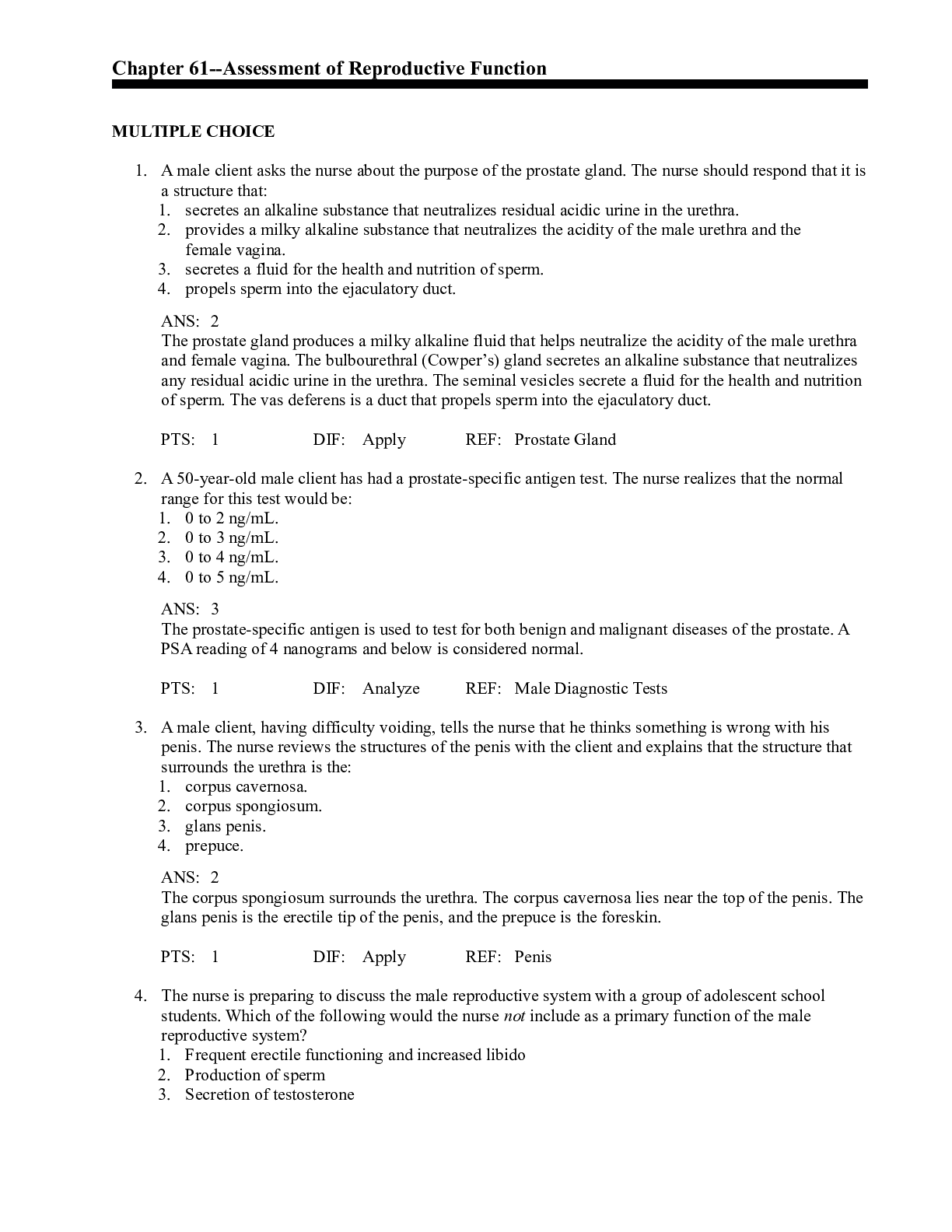
1. A male client asks the nurse about the purpose of the prostate gland. The nurse should respond that it is
a structure that:
1. secretes an alkaline substance that neutralizes residual acidic urine in the urethra.
2. provides a milky alkaline substance that neutralizes the acidity of the male urethra and the
female vagina.
3. secretes a fluid for the health and nutrition of sperm.
4. propels sperm into the ejaculatory duct.
PTS: 1 DIF: Apply REF: Prostate Gland
2. A 50-year-old male client has had a prostate-specific antigen test. The nurse realizes that the normal
range for this test would be:
1. 0 to 2 ng/mL.
2. 0 to 3 ng/mL.
3. 0 to 4 ng/mL.
4. 0 to 5 ng/mL.
PTS: 1 DIF: Analyze REF: Male Diagnostic Tests
3. A male client, having difficulty voiding, tells the nurse that he thinks something is wrong with his
penis. The nurse reviews the structures of the penis with the client and explains that the structure that
surrounds the urethra is the:
1. corpus cavernosa.
2. corpus spongiosum.
3. glans penis.
4. prepuce.
PTS: 1 DIF: Apply REF: Penis
4. The nurse is preparing to discuss the male reproductive system with a group of adolescent school
students. Which of the following would the nurse not include as a primary function of the male
reproductive system?
1. Frequent erectile functioning and increased libido
2. Production of sperm
3. Secretion of testosterone
4. Transportation and depositing of sperm
.
PTS: 1 DIF: Apply REF: Male Reproductive System
5. A male client is diagnosed as being infertile. The nurse realizes which of the following structures of
the client’s reproductive system is affected?
1. Epididymis
2. Rete testes
3. Seminal vesicles
4. Seminiferous tubules
PTS: 1 DIF: Analyze REF: Spermatogenesis
6. The nurse, preparing to discuss the female reproductive system with a group of adolescent females,
would include that which of the following is not a primary function of the female reproductive system?
1. Breastfeeding
2. Hormone secretion
3. Pregnancy
4. Sensory innervation
PTS: 1 DIF: Apply REF: Female Reproductive System
7. A young adult female client is concerned that she does not have enough “eggs” since she has not yet
become pregnant. The nurse should assure her that the number of ova available to produce a pregnancy
would be around:
1. 500.
2. 10,000.
3. 300,000.
4. 2,000,000.
PTS: 1 DIF: Apply REF: Ovaries
8. During a gynecological exam, it is noted that a client’s os is in the shape of a slit. The nurse realizes
that this shape means that the client has:
1. borne children.
2. not started menses.
3. not borne any children.
4. gone through menopause.
PTS: 1 DIF: Analyze REF: Cervix
9. The nurse, reviewing the reproductive hormones needed to produce sperm and ova, realizes that which
of the following hormones is not involved in the formation of sperm and ova?
1. Follicle-stimulating hormone
2. Gonadotropin-releasing hormone
3. Luteinizing hormone
4. Prolactin
PTS: 1 DIF: Analyze REF: Spermatogenesis; Menarche
10. During the examination of the male testes, the nurse should instruct the client on:
1. the importance of having an annual prostate examination.
2. monthly testicular self-examinations.
3. why a colonoscopy is important every 10 years after the age of 50.
4. how a condom prevents the spread of sexually transmitted infections.
PTS: 1 DIF: Apply REF: Physical Examination of the Male Genitalia
11. A male client has a prostate specific antigen level of 22 nanograms. The nurse realizes that this client
will most likely be scheduled for a(n):
1. bone scan
2. CT scan
3. testicular biopsy
4. duplex ultrasonography
PTS: 1 DIF: Apply REF: Male Diagnostic Tests
12. A female client’s Pap test revealed atypical results. The nurse realizes that this client will most likely
be scheduled for a(n):
1. culdoscopy.
2. colposcopy.
3. loop electrosurgical excision.
4. cold-knife conization.
PTS: 1 DIF: Analyze REF: Female Diagnostic Tests
MULTIPLE RESPONSE
1. A female client has an infection of the paraurethral glands. When asked by the client what these glands
do, the nurse should respond: (Select all that apply.)
1. “These glands function like the prostate gland in the male.”
2. “These glands secrete mucus near the vaginal opening.”
3. “These glands secrete mucus.”
4. “These glands are similar to the Cowper’s glands in the male.”
5. “These glands are located inside the urethra.”
6. “These glands serve no real function.”
PTS: 1 DIF: Apply
REF: Paraurethral (Skene's) Glands; Bulbourethral (Bartholin's) Glands
2. The nurse is instructing a postmenopausal client in the importance of having serum lipid levels
analyzed because after menopause, which of the following changes can occur? (Select all that apply.)
1. Total cholesterol increases
2. Low-density lipoprotein increases
3. Triglycerides increase
4. High-density lipoprotein decreases
5. Low-density lipoprotein decreases
6. High-density lipoprotein increases
PTS: 1 DIF: Apply REF: Menopause
3. The nurse is reviewing the physiological sexual response pattern within males and females and realizes
that which of the following occur in both genders? (Select all that apply.)
1. Resolution
2. Orgasm
3. Erection
4. Lubrication
5. Plateau
6. Excitement
PTS: 1 DIF: Analyze REF: Sexual Response Cycle
4. A female client is concerned that she has not had sexual intercourse with her husband for over 2
months. Which of the following can the nurse respond as causes for an alteration in sexual
functioning? (Select all that apply.)
1. Chronic illnesses
2. Physical disabilities
3. Negative body image
4. Medications
5. Surgical procedures
6. Employment status
PTS: 1 DIF: Apply REF: Sexual Dysfunction
5. The nurse is concerned that a female client might be experiencing intimate partner violence. Which of
the following assessment questions can be used to gain more information from the client? (Select all
that apply.)
1. “In the last year have you been hit, slapped, or physically hurt by someone?”
2. “Are you currently sexually active?”
3. “Within the last year has someone made you do something sexual that you did not want to
do?”
4. “Is sex satisfying to you?”
5. “Are you afraid of your partner or anyone else?”
6. “Do you have discomfort with intercourse?”
PTS: 1 DIF: Apply REF: Box 61-2 A Short Abuse Assessment Screen
[Show More]

 Med Surg test Latest Verified Questions and all Correct Answers with Explanations Chapter 61 Managements of Patients with Dermatologic Pro.png)
 Med Surg test Latest Verified Questions and all Correct Answers with Explanations Chapter 61 Managements of Patients with Dermatologic Problems.png)
.png)



.png)